
About This Artwork
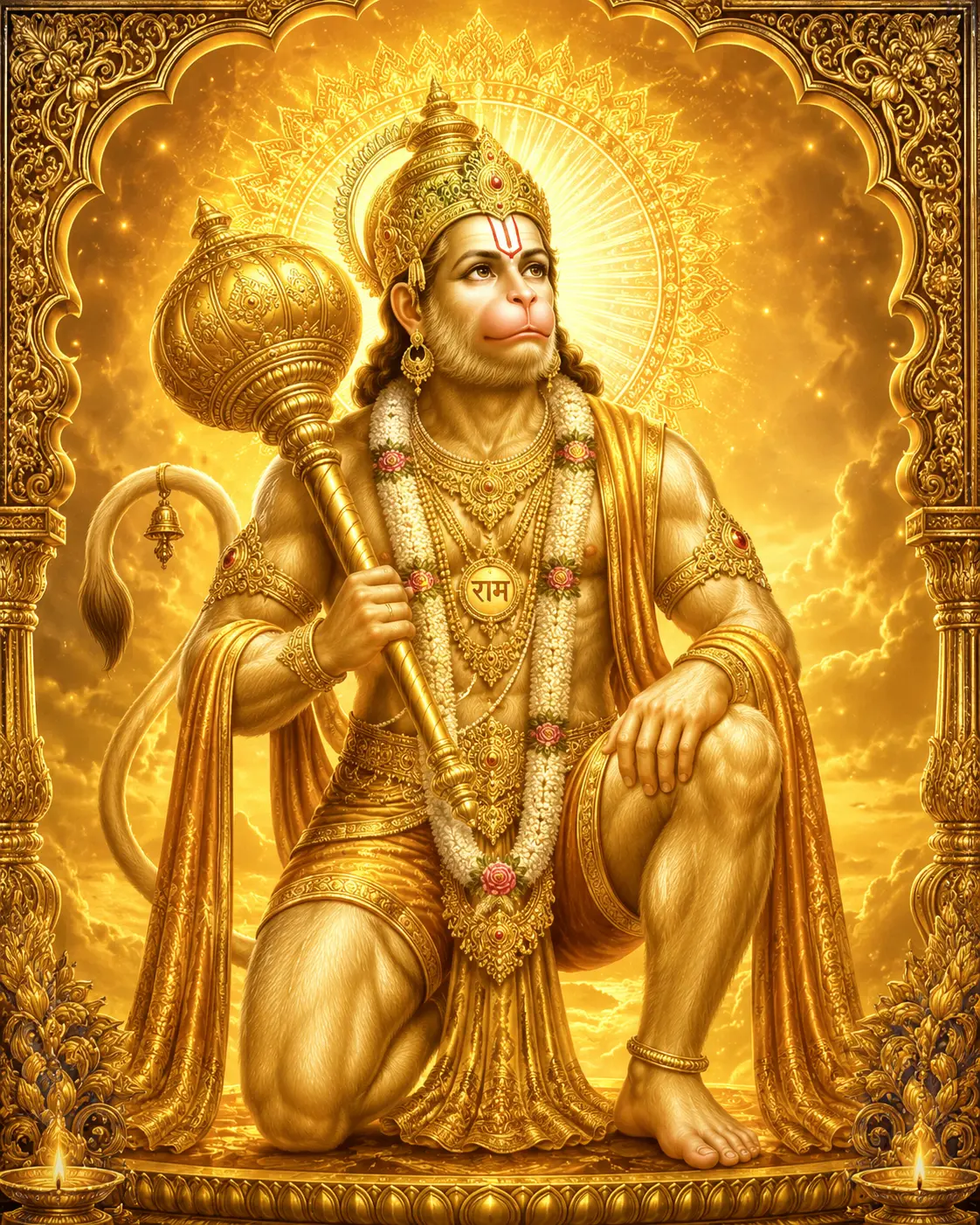
This piece depicts Lord Hanuman in the devotional posture most closely associated with his relationship to Rama — kneeling, composed, the mace (gada) held upright beside him, his expression carrying the quality of complete attention that characterises one whose entire being is oriented toward a single point of devotion. He is adorned with a crown, ornate jewellery, and a floral garland bearing a Ram pendant at its centre — a detail that signals, even in the image itself, that Hanuman's identity is inseparable from his devotion to Rama.
The overall palette is warm and golden — deep amber, antique gold, and the rich ochre of sacred lamp light — distinct from the indigo-and-gold register of the Ganesha and Shiva compositions. The intricate archway that frames the figure places this image in the visual language of temple art and manuscript illumination, where the deity is presented as the centrepiece of an act of worship rather than simply as a figure in isolation.
The kneeling posture is particularly significant. Hanuman is, in terms of physical power, among the most formidable figures in all of Hindu mythology — capable of lifting mountains, leaping across oceans, setting Lanka on fire with his burning tail. His willingness to kneel is not weakness but its opposite: the absolute voluntary surrender of the most powerful to the most beloved. This is the central paradox and the central teaching of Hanuman's iconography, and it is legible in this image without any text required.
About Lord Hanuman
Lord Hanuman occupies a position in Hindu devotional life that is difficult to parallel in any other tradition. He is simultaneously the most powerful figure in the Ramayana — the one who could lift mountains, who leapt across an ocean in a single bound, who single-handedly devastated the demon army of Lanka — and the most completely surrendered. Every ounce of that extraordinary power is voluntarily placed in service of Rama, with no trace of pride or self-interest. This combination — supreme capability and complete self-surrender — is what makes Hanuman unique among all the major deities of the Hindu tradition and what gives his image a particular quality of emotional resonance for devotees across every background and tradition.
He is a Chiranjeevi — one of the immortal beings who persist across cosmic ages — and is understood in the Vaishnava tradition as still present in the world, still available to those who call upon him with genuine devotion. The Hanuman Chalisa, recited daily by hundreds of millions of people across India and the diaspora, is addressed to him as a living presence rather than a historical figure.
Who Is Lord Hanuman? — The Devotee Who Became a Deity
Hanuman's origins are described in the Valmiki Ramayana and elaborated in the Ramacharitmanas of Tulsidas, in the Mahabharata, and in numerous Puranic texts. He is the son of Anjana (a celestial being) and Kesari (a vanara king), and is understood as a manifestation of Shiva's eleventh Rudra — born to serve Vishnu's avatar Rama.
His childhood is marked by extraordinary power and a characteristic irrepressibility. As an infant he leapt toward the sun, mistaking it for a ripe fruit. Indra struck him with a thunderbolt, breaking his jaw — hence the name Hanuman, derived from the Sanskrit for broken jaw. As compensation, the gods bestowed on him a series of gifts: immortality, the strength of ten thousand elephants, freedom from illness, the ability to take any form at will, and the power to traverse the sky.
His most significant attribute — the quality that defines his place in the Hindu tradition more than any of these powers — is introduced when he meets Rama in the forest. From that moment, Hanuman's life has a single orientation: the service of Rama. Every act, every exercise of his extraordinary capabilities, every feat of strength and intelligence and courage in the Ramayana is performed not for Hanuman's own glory but in service of that devotion. This is understood in the bhakti tradition as the highest form of yoga — the complete channelling of all energy toward a single divine focus.
Hanuman and the Ramayana — His Central Role
Hanuman's role in the Ramayana is not that of a supporting character. Without him, the central action of the epic does not succeed. When Sita is abducted by Ravana to Lanka, it is Hanuman who first locates her — crossing the ocean alone, entering Lanka in miniature form, and finding her imprisoned in the Ashoka grove. It is Hanuman who gives Sita Rama's ring as a token of hope. It is Hanuman who, before returning, sets Lanka on fire with his burning tail — an act of intimidation and warning. And it is Hanuman who, when Lakshmana lies mortally wounded in the battle that follows, carries an entire mountain across the sky rather than waste time searching for a single herb.
Each of these episodes is not simply adventure narrative. In the bhakti reading of the Ramayana, each event is an expression of what devotion looks like in action — resourceful, tireless, fearless, present in every situation with exactly the right capability deployed at exactly the right moment.
The Hanuman Chalisa — A Living Practice
The Hanuman Chalisa is a forty-verse devotional hymn composed by the poet-saint Tulsidas in the sixteenth century CE, written in the Awadhi dialect of Hindi. It is addressed directly to Hanuman and describes his nature, his powers, his devotion to Rama, and the protection and blessings available to those who call upon him.
The Chalisa is among the most widely recited religious texts in the world. Daily recitation by hundreds of millions of people — in homes, temples, on morning commutes, before sleep — makes it not merely a historical text but a living practice. In North India, the Hanuman Chalisa is as universally known as any text in any tradition: children learn it in early childhood, adults recite it in moments of difficulty or transition, and it is sung collectively in temples throughout the subcontinent on Tuesday and Saturday — the days particularly associated with Hanuman.
The text begins by establishing Tulsidas's own unworthiness and his complete reliance on Hanuman's grace. It then describes Hanuman's attributes — his golden body, his power, his knowledge of scriptures, his role in the Ramayana — before ending with a direct appeal for protection, blessing, and the deepening of devotion to Rama. Reciting the Chalisa is understood in the tradition as an act of devotion to Hanuman that automatically invites Rama's grace, because Hanuman and Rama are inseparable.
What Does Hanuman Symbolize? — The Iconography of This Artwork
- The kneeling posture: Hanuman is depicted in many forms — standing in battle, tearing open his chest to reveal Rama and Sita within his heart, flying through the sky with a mountain in his palm. The kneeling form shown in this artwork is the posture of complete, conscious submission: the most powerful kneeling before the most beloved. This is the central image of bhakti yoga — not the weakness of the powerless but the chosen surrender of the fully capable.
- The gada (mace): Held upright beside the kneeling figure, the mace is Hanuman's weapon and symbol of physical power. In this artwork it is held steady and still — power at rest, in service, not deployed. This stillness within power is one of the most important qualities associated with Hanuman: he is never reckless, never wasteful of the extraordinary force he carries.
- The Ram pendant: The garland's central ornament bearing the name Ram (राम) in Devanagari script is a detail that appears across many Hanuman devotional images. It signals that Hanuman's adornment — what he carries closest to his heart — is the name of Rama. In the bhakti tradition, the name of the divine is understood to be equivalent to the divine itself, and wearing that name is an act of complete identification with the beloved.
- Crown and jewellery: Unlike many images of saints or ascetics, Hanuman is often depicted with royal ornaments — a crown, armlets, earrings, elaborate garlands. This reflects his status as a king (of the vanaras), but more significantly, it reflects the tradition's understanding that the greatest devotee is also the most honoured — that Hanuman's surrender to Rama does not diminish him but elevates him to the highest possible position in the cosmic order.
- The golden-warm palette: The amber and gold tones of this artwork place it in the register of lamp-lit temple devotion — the quality of light associated with the diya (oil lamp) that burns before the image during puja. This is quite different from the deep indigo-and-gold of the Shiva meditation image or the Vrindavan sunset of the Krishna composition. Hanuman's visual register is warm, immediate, and intimate — the light of devotion rather than the light of cosmic distance.
Hanuman in Yoga Practice — Why Practitioners Relate to Him
Beyond his place in the Vaishnava devotional tradition, Hanuman holds a particular significance for yoga practitioners of every background.
His name gives the Sanskrit word Hanumanasana — the full splits, the posture that recalls Hanuman's legendary leap across the ocean from India to Lanka. This is the most physically demanding expression of his leap, and practising the posture is understood in some traditions as a devotional act in addition to a physical one.
More broadly, Hanuman is associated with prana — the life force, the breath, the animating energy that yoga practice works with directly. He is the son of Vayu, the wind god, which makes him in a sense the embodiment of the perfected breath. The mastery of prana that advanced yoga practice points toward — the capacity to direct energy with precision, to sustain extraordinary effort without depletion, to be fully present in the body as a vehicle of consciousness — is modelled by Hanuman in every episode of the Ramayana.
In bhakti yoga, Hanuman is the archetype of what the path looks like at its fullest expression: every capacity in complete service, no ego taking credit, the fruit of every action surrendered to the beloved. For those who find devotional practice the most natural approach to the spiritual path, Hanuman is the most immediate and the most complete example.
Displaying Hanuman in the Home
Hanuman imagery is among the most widely displayed sacred art in Hindu homes, yoga studios, and gyms in India and across the Indian diaspora. His association with strength, fearlessness, and protection makes him a natural presence in spaces dedicated to physical practice — but his association with devotion, loyalty, and the completeness of surrender makes him equally at home on a puja altar or in a meditation room.
Tuesday and Saturday are traditionally Hanuman's days, and many households light a lamp before his image on these days as a regular practice of acknowledgement and devotion.
In a yoga studio or gym, Hanuman's image carries a specific invitation: not simply to physical strength, but to the kind of strength that serves something larger than itself. In a home altar or puja room, the kneeling Hanuman with the Ram pendant is a constant reminder of what the bhakti path points toward — the heart that holds only the beloved.
This artwork is available as an instant digital download in five sizes, and as a finished rolled poster, framed print in four frame colour options, or gallery-wrapped canvas.