About This Artwork
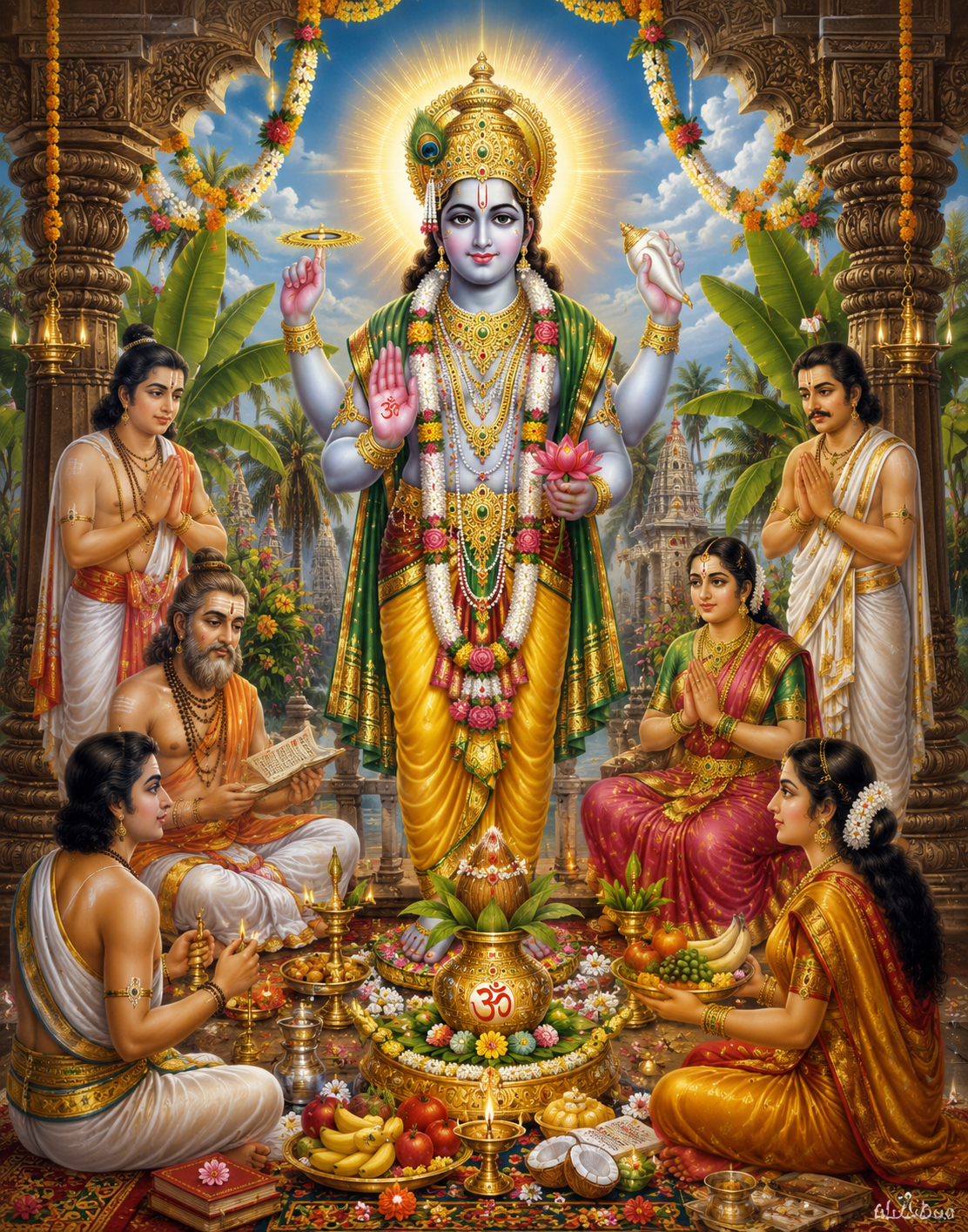
This piece depicts Lord Satyanarayana — the form of Vishnu worshipped in the Satyanarayan Puja — in a complete South Indian temple setting. He stands four-armed at the centre of the composition in luminous blue, his classical attributes clearly visible: the Sudarshana chakra in his upper right hand, the shankha (conch shell) in his upper left, a pink lotus in his lower left, and his lower right hand raised in abhaya mudra with the Om symbol glowing on his open palm.
The composition extends into a full puja scene. A priest reads from the Satyanarayana Katha at the left. Devotees — men in white dhotis, women in crimson and gold silk sarees — sit in puja posture around the central kalasha bearing the Om symbol, surrounded by the traditional offerings: fruits, flowers, diyas, coconut, and sacred food. Ornate carved South Indian temple pillars frame the scene on either side, hung with marigold garlands. In the background, banana trees, palm trees, and the distant silhouette of a temple gopuram complete a composition rooted firmly in the visual language of South Indian devotional life.
The overall palette is warm and celebratory — vivid gold, deep blue, crimson, and the greens of a tropical sacred landscape — quite different from the quieter, more austere Himalayan register of the Shiva image or the Vrindavan gold of the Krishna composition. This is devotion in community, ceremony in the home, the sacred made immediate and domestic.
About Lord Satyanarayana
Lord Satyanarayana is a form of Vishnu — one of the three principal deities of Hinduism — whose name combines two Sanskrit words: Satya (truth, reality, that which is) and Narayana (the sustainer, the one in whom all beings reside, an ancient name for Vishnu). He is, in this sense, Vishnu understood as the embodiment and sustainer of truth itself.
What makes Satyanarayana distinctive from other Vishnu forms is not his iconography — he is depicted in the classical Vishnu manner with four arms and characteristic attributes — but rather his primary context: he is the deity of the Satyanarayan Puja, a domestic ritual performed in Indian homes for every significant occasion of life. While Vishnu is worshipped in grand temple traditions across India, Satyanarayana is particularly the deity of the household, of the family gathering, of the ceremony that marks transitions and expresses gratitude.
He is among the most widely worshipped forms in the Indian diaspora worldwide — in homes across the United States, the United Kingdom, Canada, Australia, and Southeast Asia, the Satyanarayan Puja is performed for housewarmings, marriages, births, new businesses, anniversaries, and auspicious occasions of every kind.
What Is the Satyanarayan Puja?
The Satyanarayan Puja is a Hindu ritual worship (puja) dedicated to Lord Satyanarayana. It is one of the most commonly performed pujas in Hindu households — accessible, relatively simple in its requirements, and not restricted to any particular caste, region, or lineage. The primary textual source for the puja is the Skanda Purana, specifically the Reva Khanda section, which contains the Satyanarayan Katha — the collection of stories that give the ritual its narrative framework and that are recited or read aloud during the ceremony.
The puja itself involves the installation of the Satyanarayana image (or the Skanda Purana text) at a central altar, the preparation of traditional offerings (fruits, flowers, tulsi leaves, and panchamrita — the five sacred substances), the reading of the Satyanarayana Katha, and the distribution of the prasad (sacred food, typically a semolina-based preparation called sheera or shira) at the conclusion.
What is distinctive about the Satyanarayan Puja within Hindu ritual practice is its domestic character and its universal accessibility. Unlike many Vedic rituals that require specialist priests and elaborate preparations, the Satyanarayan Puja can be performed by the family themselves, with or without a priest, on a day that is convenient and meaningful to them. It is this accessibility that has made it the ritual of choice for the Indian diaspora across the world — a complete and meaningful ceremony that can be performed in a home, in any country, for any occasion.
When Is the Satyanarayan Puja Performed?
The Satyanarayan Puja has no fixed calendar date — it is performed as an expression of gratitude or as an invocation of blessings for specific occasions. The most common occasions include:
- Housewarmings (griha pravesh): Performing the puja before or upon entering a new home is among the most widely observed customs in Hindu households, both in India and in the diaspora. The ceremony marks the home as a sacred space and establishes a relationship of protection and blessing for the family that will live there.
- Marriages: The Satyanarayan Puja is frequently performed either as part of the marriage ceremony itself or in the days surrounding it — as an expression of gratitude for the union and as a beginning for the new household.
- Births and naming ceremonies: The arrival of a new child is marked in many families with a Satyanarayan Puja as an act of thanksgiving and as an invocation of blessing for the child's life.
- New business or professional beginnings: Starting a new enterprise, taking a new position, or marking a significant professional transition are common occasions for the puja in the Indian business community.
- Anniversaries and auspicious milestones: The puja is performed to mark any moment of significance — a recovery from illness, completion of an important goal, any occasion where gratitude and acknowledgement of divine support feel appropriate.
- Full moon days (Purnima): Many families perform the puja monthly on Purnima as a standing practice of gratitude and devotion, particularly during the months of Kartika and Vaishakha.
The common thread across all these occasions is gratitude — the Satyanarayan Puja is at its core an act of acknowledgement, a ceremony that says: something good has happened, something important is beginning, and we mark this with reverence.
The Satyanarayana Katha — the Stories of the Ritual
The Satyanarayana Katha consists of five chapters from the Skanda Purana that are read or recited during the puja. Each chapter is a story — a narrative that illustrates the nature and the consequences of devotion to Satyanarayana, and of the failure to honour a vow made to him.
The stories span social positions and circumstances: a poor Brahmin who is blessed with wealth after performing the puja, a woodcutter, a merchant, a king. What connects them is not social status but sincerity and integrity — those who approach Satyanarayana with genuine devotion and honour their commitments receive his support, while those who neglect or dishonour a vow encounter difficulty until they restore their integrity.
The Katha is not primarily a collection of miracle stories. It is a narrative framework for understanding the relationship between truth, commitment, gratitude, and consequence — which is exactly what the name Satyanarayana (truth + sustainer) points toward. Performing the Katha is not simply reading texts; it is participating in a living narrative tradition that has been transmitted in Indian households for centuries.
The Iconography of This Artwork — What to Look For
- The four arms: Vishnu is consistently depicted with four arms, each holding a specific attribute. In this artwork: upper right holds the Sudarshana chakra (the discus, a spinning wheel of light associated with the mind, with time, and with the cutting away of ego and ignorance), upper left holds the shankha (the conch shell, whose sound represents the primordial vibration of creation, Om), lower left holds a pink lotus (associated with purity, enlightenment, and the unfolding of consciousness), and lower right is raised in abhaya mudra — the gesture of protection and fearlessness — with the Om symbol visible on the palm.
- Abhaya mudra with Om: The open right hand raised in blessing with the Om symbol is particularly associated with Satyanarayana and is the most immediately recognisable element of his iconography. It is the gesture of the deity who says: you are safe, you are protected, there is nothing to fear.
- The puja scene: The worshippers, priest, kalasha, and offerings in this composition are not simply decorative background — they are part of the iconography of Satyanarayana specifically. Unlike portraits of deities in isolation, the Satyanarayana image often includes the puja context, because the deity is inseparable from the ritual through which he is most commonly approached. The image depicts not just who Satyanarayana is but how he is encountered: in the middle of a family ceremony, surrounded by those who have gathered to offer their attention and gratitude.
- The South Indian temple setting: The carved pillars, marigold garlands, and tropical landscape place this composition in the South Indian devotional visual tradition, which is characterised by elaborate architectural ornament, vivid colour, and a quality of ceremonial richness distinct from the spare Himalayan iconography of the Shiva compositions or the pastoral warmth of the Vrindavan Krishna images.
Displaying Satyanarayana in the Home
The Satyanarayana image is most naturally placed in a home puja room or altar space, where it serves as the focal point for regular or occasional worship. Because of the deity's specific connection with the Satyanarayan Puja, the image in a puja room is not simply decorative — it is a permanent presence that marks the space as one where that relationship of gratitude and acknowledgement is maintained.
For families who perform the Satyanarayan Puja regularly, having a high-quality, iconographically complete image is significant. The standard calendar-print or inexpensive poster that many diaspora families use is often replaced, as the family settles and establishes itself, with a more considered and enduring piece — which is exactly the context for which this artwork was designed.
The image also works in a living room as a statement piece that communicates the family's values and traditions — particularly for Indian diaspora households where the puja room and the living room are adjacent or combined. In this context the warm, celebratory palette — vivid gold, crimson, tropical green — reads as generosity and abundance rather than austerity.
As a digital download it gives you full control over size and framing. The rolled, framed, and canvas print options arrive ready to display with no further preparation needed.