
About This Artwork
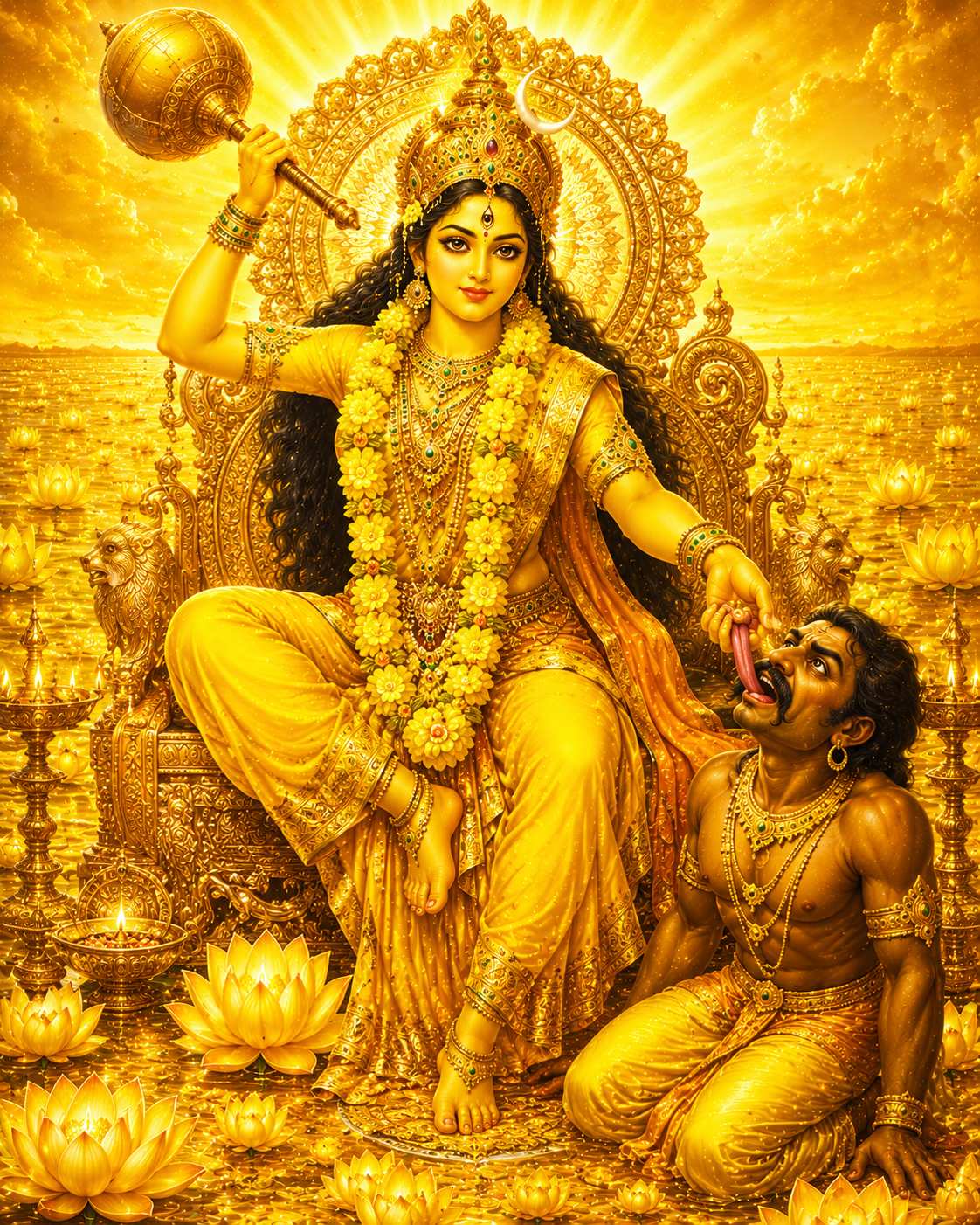
This piece depicts Maa Bagalamukhi — the eighth of the Dasha Mahavidyas, the great wisdom goddess whose specific domain is the power of stambhana: the capacity to bring to complete stillness every force that opposes the alignment of the practitioner's path with truth. She is radiant in brilliant yellow and turmeric gold — the colour that identifies her above all others in the Mahavidya tradition, the colour of clarity, of sacred fire, of the light that cuts through every confusion.
She is seated in regal authority on her golden throne at the centre of a vast shimmering ocean of golden nectar, surrounded in every direction by blooming yellow lotuses. Her right hand is raised high, holding the golden mace (gada) poised in the gesture of decisive power. Her left hand extends forward, firmly gripping the tongue of the demon (Madan) who kneels helplessly before her — the demon of destructive speech, harmful words, and the uncontrolled tongue that causes suffering. Her three eyes — the third eye of supreme knowledge blazing at the centre of her forehead — are calm, focused, and completely clear. On her forehead rests the yellow crescent moon. Her garlands are of yellow champaka flowers, her ornaments of brilliant gold.
The entire composition blazes with the brilliant yellow and turmeric gold that are Bagalamukhi's signature colours — the most uniformly yellow palette in the entire collection, instantly distinct from the deep indigo of the Shiva images, the cosmic blue of the Vishnu compositions, the warm crimson of the Durga pieces, or the rose-and-gold of the Kamalatmika. This yellow is specific and deliberate: it is the colour of sacred turmeric (haridra), which is itself associated with purity, auspiciousness, and the clearing of what obstructs.
About Maa Bagalamukhi — The Paralyser of All Opposing Forces
Maa Bagalamukhi is the eighth of the Dasha Mahavidyas — the ten great wisdom goddesses of the Shakta Tantric tradition — and she is among the most immediately distinctive of the ten, both in her iconography and in the specific quality of her power. Where Kali dissolves through radical confrontation and Tara carries the seeker across the ocean of suffering with fierce compassion, Bagalamukhi acts through a different and equally complete quality: the capacity to bring every opposing force to absolute stillness.
Her name is composed of two Sanskrit elements interpreted differently across traditions. The most common reading is Bagala (from Valga, meaning bridle or rein) + Mukhi (face or aspect) — making her the one whose face controls, whose power applies the bridle that reins in every runaway force. In another reading, Bagala derives from Valgana (sudden, staggering) + mukha (mouth/face) — the one whose power stuns and staggers. Both readings point toward the same quality: a force that meets the momentum of what opposes and brings it to a complete stop.
Her other names are equally revealing: Pitambari — the yellow-robed one, from Pita (yellow) + Ambara (garment/sky) — the goddess dressed in the yellow of sacred turmeric and divine clarity. Brahmastra Roopini — she who is herself the Brahmastra, the supreme divine weapon, the weapon that is irresistible and that operates at the level of consciousness rather than matter. These names collectively identify a power that is decisive, specific in its application, and oriented toward the removal of what opposes the alignment of the practitioner's path with the real.
The Stambhana Power — What It Actually Means
The power most associated with Bagalamukhi in the Shakta tradition is stambhana — the power to paralyse, to freeze, to bring to complete stillness. This concept operates at several levels simultaneously in the tradition, and understanding it at each level gives a more complete picture of what Bagalamukhi actually represents:
At the most immediate level, stambhana refers to the capacity to halt the forward movement of any force that is causing harm — whether that force is external (harmful speech, aggressive action, an opposing will) or internal (the runaway momentum of the ego-mind's habitual patterns, fear, doubt, self-sabotage). The image of the goddess gripping the demon's tongue and raising the mace is an image of this capacity expressed in the most direct possible visual language.
At a deeper level, stambhana in the Tantric understanding is a quality of consciousness itself — the capacity of awakened awareness to remain completely still in the face of whatever arises, without being moved, without reacting, without being carried away by the force of events or emotions or thoughts. This stillness is not passivity but the most active possible quality of awareness — the stillness from which decisive, clear, and perfectly timed action can arise.
At the deepest level, Bagalamukhi's stambhana power is understood as the power to still the practitioner's own internal enemy — the uncontrolled movement of the mind that generates the stream of thought, reaction, judgment, and self-narration that in the yogic understanding is the primary obstacle to recognising one's own nature. She paralyses not an external adversary but the internal noise that prevents the deeper silence from being heard.
This reading makes Bagalamukhi one of the most internally significant of the Mahavidyas for practitioners of meditation and yoga — she is the power that enables genuine stillness, the force that makes the practice of inner silence possible by stilling what resists it.
The Origin of Bagalamukhi — The Cosmic Storm
The mythological account of Bagalamukhi's origin is found in the Shakta Tantric texts and describes a moment of cosmic emergency. During a period when the universe was threatened by a great storm that was destroying all of existence, the gods approached the supreme goddess (Adi Parashakti) for help. She manifested from the Haridra Sarovara — the ocean of turmeric, the sacred golden lake — in her Bagalamukhi form, and with a single act of divine will brought the storm to complete stillness. The winds ceased. The waters calmed. The universe was preserved.
This origin story encodes several of Bagalamukhi's most characteristic qualities simultaneously: she arises from the golden-yellow ocean of turmeric (establishing her colour and her element), her action is singular and decisive (not prolonged battle but immediate stillness), and what she preserves is the cosmos itself (the scope of her power is not limited to individual conflicts but operates at the level of the whole).
The Haridra Sarovara from which she emerges is also understood as the ocean of divine nectar (amrita) and of sacred speech — turmeric being associated in Indian ritual tradition with purity, the clearing of what is impure, and the quality of golden clarity that makes sacred action possible.
The Tongue-Pulling Iconography — Reading the Central Image
The most immediately striking element of Bagalamukhi's iconography — present in this artwork and consistent across the tradition — is the image of the goddess gripping the tongue of a kneeling demon with her left hand while raising a golden mace in her right. This is Bagalamukhi's signature gesture, as distinctive as Ganesha's broken tusk or Krishna's peacock feather, and it encodes her nature in a single visual statement.
The demon whose tongue she holds is named Madan in the texts — a demon whose particular power was the destructive use of speech. Words used without wisdom, without care for their effects, without the orientation toward truth — the power of language weaponised and turned toward harm — this is what Madan represents. Bagalamukhi's grip on his tongue is the stillness of that power: she has not destroyed the tongue (which would be the destruction of speech itself) but has taken it firmly in hand, bringing it under the governance of the wisdom it was violating.
The golden mace raised in the right hand is the instrument of decisive power — not yet deployed, held in readiness. The mace raised and the tongue gripped simultaneously is an image of the moment just before the resolution — the moment of maximum power, when what was opposing has been stilled but the victory has not yet been formally completed. This frozen moment is itself a teaching about the nature of Bagalamukhi's power: it does not need to strike to be effective. The raising of the mace is already sufficient.
The three eyes — including the third eye of supreme knowledge at the centre of the forehead — signal that Bagalamukhi's action arises from complete awareness, not from anger or reaction. The three eyes see all three planes of existence simultaneously; there is nothing hidden from this awareness, no strategy or concealment that the demon's tongue could deploy that the third eye does not already see through. Her stillness is the stillness of one who has nothing left to be surprised by.
The Yellow of Bagalamukhi — Turmeric, Gold, and Sacred Clarity
The brilliant yellow that saturates this artwork is not an aesthetic choice but an iconographic prescription: Bagalamukhi's yellow is among the most precisely specified colour associations in the entire Mahavidya tradition. She is Pitambari — the yellow-robed one — and her colour is haridra, sacred turmeric.
Turmeric (Curcuma longa) is among the most ubiquitous sacred substances in Hindu ritual practice. It is used to purify spaces, objects, and practitioners before worship. It is applied to the body as a purifying and auspicious treatment in pre-wedding rituals (haldi ceremony). It is offered to deities. It colours the sacred powder thrown in festival celebrations. Its brilliant golden-yellow hue is associated in the tradition with purity, with the removal of impurity, with sacred fire, and with the quality of divine clarity that sees through what obscures.
That Bagalamukhi's defining colour is turmeric — the purifying, obstacle-clearing, clarity-producing substance — is a precise statement about the nature of her power. She does not operate through force alone but through the quality of sacred clarity that, when it arises, naturally stills what was causing turbulence. The yellow light of her presence in this artwork is the light of that clarity — sattvic, penetrating, decisive, and completely calm.
The Datia Temple — Bagalamukhi's Principal Shrine
The most important temple dedicated to Maa Bagalamukhi is the Bagalamukhi Devi Temple at Datia, Madhya Pradesh — one of the 64 Shakti Peethas and among the most powerful Shakta pilgrimage sites in North India. The temple is situated on a hill above the town of Datia and is associated with extraordinary accounts of the goddess's responsiveness to sincere worship.
The Datia Bagalamukhi temple is particularly associated with practitioners of Bagalamukhi sadhana — formal practice sequences involving her specific mantras, yantras, and ritual procedures. The primary mantra associated with Maa Bagalamukhi — Om Hleem Bagalamukhi Sarvadustanaaam Vaacham Mukham Padam Stambhaya Jihvaam Keelaya Buddhim Vinaashaya Hleem Om Swaha — is among the most powerful and most precisely specified mantras in the Shakta Tantric tradition and is the centrepiece of Bagalamukhi sadhana.
The second significant Bagalamukhi temple is at Nalkheda, Madhya Pradesh, also an important pilgrimage site. The tradition of the Peethambara Peetha at Datia has been maintained with particular rigour and has attracted practitioners from across India and from the Indian diaspora worldwide.
Bagalamukhi's Place in the Dasha Mahavidya Sequence
As the eighth Mahavidya, Bagalamukhi occupies a specific position in the sequence that reflects her specific function: she comes after the fierce dissolution of Kali, the compassionate crossing of Tara, the sovereign power of Tripura Sundari, the cosmic vastness of Bhuvaneshvari, the fierce austerity of Bhairavi, the self-transcendence of Chhinnamasta, and the radical stripping of Dhumavati — and before the royal eloquence of Matangi and the lotus abundance of Kamalatmika.
In this sequence, Bagalamukhi's placement makes sense: after the more radical and dissolving forms of the earlier Mahavidyas have cleared what needs to be cleared, Bagalamukhi brings the decisive stillness that consolidates the clearing. She paralyses what remains of the ego's resistance after the earlier goddesses have worked through their own specific modes of transformation. Her action is the moment of crystallisation — when the work of the previous seven goddesses has created the conditions for a final, definitive stilling of what was opposing the path.
The practitioners who work with the Dasha Mahavidya tradition often note that Bagalamukhi's energy is among the most immediately tangible of the ten — her yellow colour, her specific mantra, and the precision of her iconography make her one of the most immediately accessible and most clearly experienced of the Mahavidyas in practice.
Displaying Bagalamukhi in the Home
Maa Bagalamukhi's image is displayed in the puja rooms and practice spaces of Shakta practitioners and in dedicated Mahavidya altars where all ten goddesses are honoured together or in sequence. Her brilliant yellow palette makes her one of the most visually distinct and immediately recognisable images in any multi-Mahavidya display.
In a dedicated practice space, her image carries the quality most associated with her — the stillness she represents becoming available as a quality of the space itself. In a Mahavidya altar or collection display, she represents the eighth position in the sequence, with Matangi and Kamalatmika completing the set.
The brilliant yellow and turmeric gold palette of this artwork is among the most vibrant in the collection. It suits a natural wood or gold frame rather than white or black, and works particularly well against a white or cream wall where the yellow can read in its full saturation.
The digital download allows immediate printing at your preferred size. Print on matte or semi-gloss photo paper at FedEx Office, Staples, or any professional print shop.