About This Artwork
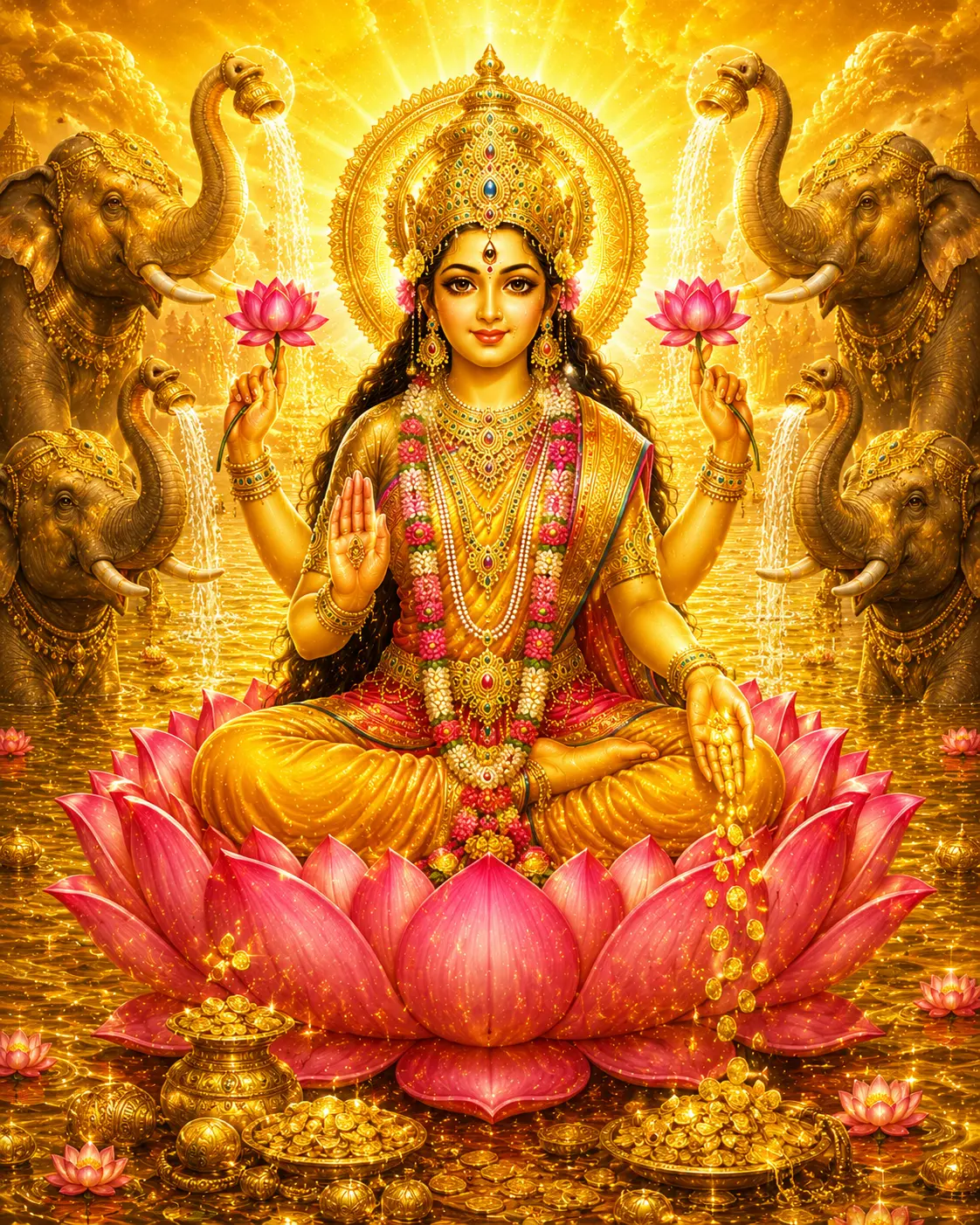
This piece depicts Maa Kamalatmika — the tenth of the Dasha Mahavidyas — in the form most closely associated with her classical identity as the lotus goddess and as the Tantric Lakshmi. She sits in padmasana on a magnificent blooming pink lotus throne that rises from a shimmering golden ocean of nectar. Her form glows in warm gold, radiant and serene. Four arms extend: the two upper hands each hold a pink lotus in full bloom, while the lower hands rest in abhaya mudra (the palm raised in the gesture of fearlessness and protection) and varada mudra (the palm facing downward in the gesture of granting blessings).
On either side, four elephants raise their trunks high and pour streams of golden nectar from ornate golden vessels over the goddess — the ceremonial abhishekam performed by the four directions of the cosmos in recognition of the completeness of what she embodies. The ocean below her throne blooms with pink and white lotus flowers. The palette throughout — warm molten gold, deep pink and rose, luminous ivory — is among the richest and most opulent in the entire collection, appropriate to a goddess whose domain is abundance in its most complete expression.
This is a different visual register from the Lakshmi Wall Art elsewhere in this collection. That image depicts Lakshmi in her classical Vaishnava form as the consort of Vishnu. Kamalatmika is Lakshmi encountered through the Tantric Mahavidya framework — the same essential nature, but approached through the lens of the ten great wisdom goddesses, where she represents the culmination and completion of the entire sequence.
About Mahalakshmi — Goddess of Abundance, Beauty, and Grace
Mahalakshmi is one of the most widely worshipped goddesses in all of Hinduism and the most universally present deity in Indian domestic life. She is the goddess of abundance, prosperity, beauty, grace, and auspiciousness — the divine feminine principle that sustains the material and spiritual flourishing of the world. She is the consort of Vishnu, the preserver of the universe, and together they represent the complementary poles of existence: Vishnu as the sustaining consciousness, Lakshmi as the sustaining abundance that makes continued existence possible.
The worship of Lakshmi is not limited to any single tradition, region, or community within Hinduism. She is present in Vaishnava households as the primary goddess of the home, in Shakta traditions as one of the three forms of the supreme goddess (alongside Saraswati and Durga), and in Tantric traditions as the culminating Mahavidya — the goddess who represents the final flowering of the entire path of inner transformation. The Diwali festival celebrated across the Indian subcontinent and diaspora is centrally a celebration of Lakshmi — the return of light and the arrival of abundance, marked by the lighting of lamps to welcome the goddess into every home.
Who Is Mahalakshmi? — Her Names, Forms, and Traditions
Lakshmi's names across the tradition point to different dimensions of what she embodies:
Mahalakshmi: The great Lakshmi, the goddess in her most complete and sovereign form — not Lakshmi as the consort of Vishnu alone but Lakshmi as the independent supreme goddess who encompasses all forms of abundance, all dimensions of the divine feminine power.
Kamala: Lotus — the name most directly associated with the iconographic form in this artwork. Kamala is the goddess who dwells in and emerges from the lotus, the flower that represents purity (rooted in mud, blooming above the water, untouched by what sustains it), consciousness (the heart chakra is visualised as a lotus), and the spiritual path itself (the movement from the root to the flower, from the gross to the refined).
Shri: Auspiciousness, beauty, radiance, the quality of divine grace that makes things good, prosperous, and complete. The exclamation Shri placed before a name in Sanskrit is an invocation of Lakshmi — an acknowledgement that the named thing or person is held in her grace.
Kamalatmika: The lotus-natured one, the one whose nature is that of the lotus — pure, radiant, rooted in the real, blooming in the open. This is the Mahavidya name, and it points specifically to the quality of spiritual abundance that underlies and surpasses all material abundance.
The Ashtalakshmi — the eight forms of Lakshmi — enumerate the different dimensions of her abundance: Adi Lakshmi (primordial abundance), Dhana Lakshmi (material wealth), Dhanya Lakshmi (harvest and food), Gaja Lakshmi (the elephant form associated with royalty and imperial abundance), Santana Lakshmi (the abundance of children and lineage), Veera Lakshmi (courage and strength), Vijaya Lakshmi (victory), and Vidya Lakshmi (knowledge and learning). The depiction in this artwork — with four elephants (gaja) performing the abhishekam — draws on the Gaja Lakshmi tradition specifically.
Kamalatmika — The Tenth Mahavidya
The Dasha Mahavidyas are the ten great wisdom goddesses of the Shakta Tantric tradition — ten forms of the supreme goddess (Devi, Shakti, Adi Parashakti) each representing a different facet of the divine feminine power and a different stage or dimension of the path of inner transformation.
The ten Mahavidyas, in their most commonly given sequence, are: Kali, Tara, Tripura Sundari (also known as Shodashi), Bhuvaneshvari, Bhairavi, Chhinnamasta, Dhumavati, Bagalamukhi, Matangi, and Kamalatmika. Kamalatmika is the tenth — the final, the culminating, the completion.
The ordering is significant. The sequence begins with Kali — the most fierce, the most radical, the most confronting of the Mahavidyas, who strips away every illusion, every attachment, every false identity in a single devastating gesture of dissolution. It proceeds through progressively complex and nuanced forms of the divine feminine: the fierce, the compassionate, the terrible, the mysterious, the nurturing, the illuminating. And it concludes with Kamalatmika — who is, in essence, the goddess after the dissolution is complete. After Kali has cleared everything that was false, after Tara has helped the practitioner cross the ocean of samsara, after each of the other Mahavidyas has done her specific work of transformation, what remains? The lotus goddess — radiant, abundant, complete, seated in the fullness of what was always there beneath the accumulations that needed to be cleared.
This is why the Tantric tradition places Kamalatmika at the end: not because abundance is the highest value, but because the abundance she embodies is specifically the abundance that is revealed when all the layers of false identity and grasping have been dissolved. It is not a material reward for spiritual practice. It is the recognition of what was always already present — the inexhaustible, self-replenishing grace that is the nature of consciousness itself.
The Gaja Lakshmi — The Elephant Abhishekam
The scene depicted in this artwork — the goddess flanked by elephants performing the ceremonial pouring of nectar — has a specific name in the iconographic tradition: Gaja Lakshmi (Lakshmi of the elephants). It is among the oldest and most consistently reproduced of all Lakshmi images, appearing in ancient temple sculpture, in manuscript illumination, in folk art, and in contemporary devotional painting.
In Indian iconographic tradition the elephant is associated with royalty, with the clouds that bring rain (and therefore harvest and abundance), with steadiness and reliability, with the power of memory (elephants do not forget), and with the four directions of space (four elephants representing the cosmic reach of what is being blessed). The ceremonial pouring of nectar — the abhishekam — performed by these four elephants is not simply a scene of worship. It is a cosmological statement: the four directions of the universe recognise and pay homage to the completeness of what Kamalatmika embodies.
The nectar (amrita) being poured is itself significant. Amrita in Indian tradition is the nectar of immortality — the fluid of consciousness that, when it touches what is below, transforms it from the mortal to the timeless. The elephants pouring amrita over the lotus goddess is an image of the universe saturating itself with the grace of its own deepest nature.
The Lotus — Kamalatmika's Central Symbol
The lotus appears in this artwork in multiple forms: as the throne on which Kamalatmika is seated, as the flowers held in her upper two hands, and as the blooms that fill the golden ocean around her. It is the defining symbol of her iconographic identity.
The lotus in Indian tradition carries a specific philosophical meaning that goes beyond simple beauty. It grows rooted in mud, rises through water, and blooms above the surface — untouched by what nurtured and supported it. This is the image of the practitioner: rooted in the material world, nourished by practice and experience, blooming in the open air of awareness without being stained by what was passed through.
The fact that Kamalatmika holds lotuses in her hands, sits on a lotus, and is surrounded by lotuses is not decorative repetition. It is iconographic emphasis: this goddess is lotus-nature itself. The abundance she represents is the abundance of the fully bloomed, fully present, fully open consciousness — the awareness that has emerged from the water of samsara and opened its petals completely.
Displaying Mahalakshmi Kamalatmika in the Home
Lakshmi is the most universally present goddess in Indian domestic spaces — more images of Lakshmi are displayed in Indian homes, in India and across the diaspora, than of any other deity. Her image is placed at the entrance of homes, in the puja room, in the kitchen (associated with the household's abundance), in businesses, in places of work and commerce, and at every threshold that is being consecrated as a space of welcome and prosperity.
Kamalatmika specifically is the Tantric form of this goddess, and her image is appropriate for the same spaces where Lakshmi is traditionally displayed while carrying a depth of iconographic resonance beyond the popular forms. For practitioners of the Dasha Mahavidya system, Kamalatmika's image is often placed after the other nine — completing the visual set as she completes the spiritual sequence.
The warm, opulent palette of this artwork — gold, pink, rose, ivory — is among the most visually celebratory in the entire collection. It suits a living room or entrance hall as naturally as a puja room. The framed print works particularly well with a white or natural wood frame that allows the warm palette to breathe rather than contrasting with it.
This artwork is available as an instant digital download in five sizes, and as a finished rolled poster, framed print in four frame colour options, or gallery-wrapped canvas.