About This Artwork
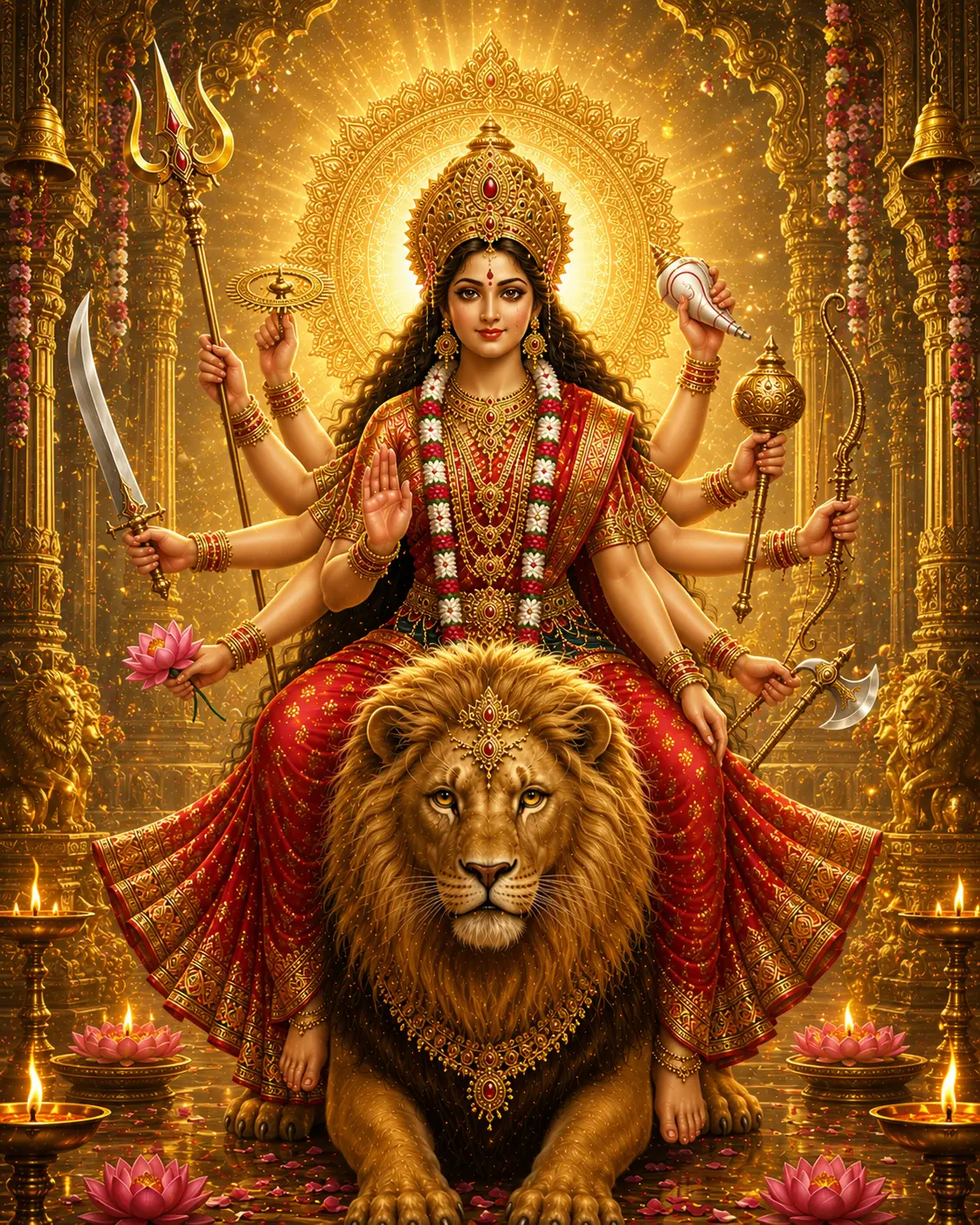
This piece depicts Maa Durga in her serene temple form — not the battlefield warrior of the Mahishasuramardini tradition, but the divine mother who sits enthroned in sacred stillness and receives her devotees. She is seated in regal majesty upon her lion vahana, the lion himself adorned and composed, his golden eyes carrying the quiet power of one who serves the goddess of the universe. She faces outward with the complete serenity of one who has never lost a battle and for whom battle is no longer even the primary concern — what remains, beyond all conflict, is the mother.
Eight arms extend with the precise arrangement of her classical iconography: the trishul, the Sudarshana chakra, the shankha, the sword, the lotus, the gada (mace), the bow, and the lower right hand raised in abhaya mudra — the gesture of fearlessness extended to all who stand before her. She wears a magnificent crimson and gold silk garment with intricate gold embroidery, an elaborate jeweled crown, and cascading garlands. Behind her, a mandala halo of brilliant gold light radiates outward from her crown, filling the temple space with her presence. Golden pillars framed with flower garlands rise on either side. At her feet, pink lotus flowers bloom and golden diyas cast warm sacred light across the entire scene.
The palette — warm crimson, molten gold, soft pink — is among the most celebratory in the collection, suited to the Navaratri devotional tradition in which Durga is worshipped with colour, flame, flowers, and music for nine nights. This is the Durga of the living temple rather than the cosmic battlefield: the mother who is always present, always available, always completely protective.
About Maa Durga — The Invincible Divine Mother
Maa Durga is one of the most widely worshipped deities in all of Hinduism and the most powerful expression of the divine feminine in the Shakta tradition. Her name derives from the Sanskrit dur (difficult, fort) and ga (to go through, to approach) — she is the one who is difficult to approach or defeat, the impenetrable fortress, the power that no force of ignorance or darkness can overcome.
She is one of the three forms of the great goddess (Tridevi) alongside Saraswati (knowledge) and Lakshmi (abundance), and she is understood in the Shakta tradition as the supreme goddess — Adi Parashakti, the original power — of whom all other goddesses are aspects or expressions. She is simultaneously the fierce warrior who defeats demons and the compassionate mother who protects her devotees with the same absolute force she uses in battle.
The distinguishing quality of Durga — what separates her from the other forms of the divine feminine in this collection — is the combination of absolute fierceness and absolute grace. She is not fierce without love, nor loving without power. She is the goddess who picks up every weapon precisely because her love is as fierce as her strength.
The Mahishasuramardini — Durga's Origin and the Myth of Her Power
The most important mythological account of Durga's origin and nature is found in the Devi Mahatmyam (also called the Durga Saptashati or Chandi Path), a text of 700 verses from the Markandeya Purana that is among the most widely recited sacred texts in the Hindu tradition.
The account describes a period when the demon Mahishasura — a buffalo demon of extraordinary power — had defeated the gods and driven them from the heavens. The gods, exhausted and defeated, assembled and from their combined energies a radiant form of the goddess arose — Durga, Shakti in her warrior form, the concentrated divine power of all the gods made manifest as a single invincible feminine force.
Each god contributed a weapon from their own arsenal: Shiva gave his trishul, Vishnu his Sudarshana chakra, Indra his vajra, Varuna his shankha (conch), Agni his spear. Together these weapons became the eight arms of Durga, and with them she entered battle against Mahishasura. The demon took many forms during the battle — demon, buffalo, lion, man — and in each form Durga's weapons were perfectly adapted to defeat him. Finally, in the form of the buffalo demon, Mahishasura was slain. This form of Durga — standing triumphant with the demon crushed beneath her foot — is called Mahishasuramardini: the destroyer of Mahishasura.
The image in this artwork is not the Mahishasuramardini form. It is the temple Durga — the mother who sits in sacred peace after the battle is won, who receives her devotees, who extends the same power that defeated every demon in the cosmos in the gentler form of abhaya mudra: do not fear, I am here.
Navaratri — Nine Nights of Durga
Navaratri (literally "nine nights") is the most important festival associated with Maa Durga and one of the most widely celebrated festivals in the Hindu calendar. It occurs twice annually — the more widely observed Sharad Navaratri in autumn (September/October) and the Chaitra Navaratri in spring — and lasts for nine nights and ten days.
During Navaratri, Durga is worshipped in nine different forms — the Navadurga — each representing a different aspect of the divine feminine power. The nine forms, in their traditional sequence, are: Shailaputri (daughter of the mountain), Brahmacharini (the ascetic), Chandraghanta (the moon-bell), Kushmanda (the cosmic egg creator), Skandamata (mother of Skanda/Kartikeya), Katyayani (the warrior form), Kalaratri (the dark night), Mahagauri (the pure white), and Siddhidatri (the bestower of powers).
The climax of Navaratri is Vijayadashami (Dussehra) — the tenth day, celebrated as the day of Durga's final victory over Mahishasura and, in the North Indian Ram Lila tradition, the day of Rama's victory over Ravana. It is one of the most widely celebrated days in the Indian calendar, marking the victory of the sacred over the demonic in every form.
Durga Puja, celebrated most elaborately in West Bengal, Odisha, and the Northeast, is the five-day festival within Navaratri that has become one of the world's great cultural celebrations — comparable in scale and community participation to major carnival traditions worldwide. In Kolkata alone, thousands of temporary shrines (pandals) are constructed throughout the city, each with an elaborately crafted Durga image. The pandal-hopping tradition draws millions of visitors over the festival days. The final day, Vijayadashami, sees the immersion (visarjan) of the Durga images in the river — a moment of profound beauty and emotion that marks the goddess's return to her cosmic home.
The Eight Arms — Iconography of This Artwork
Durga's multiple arms are not a stylistic convention. Each arm, each weapon, and each gesture carries specific meaning within the iconographic tradition:
Trishul (trident): Shiva's weapon, given to Durga at her creation. The three prongs represent the three gunas (tamas, rajas, sattva), the three planes of existence, and the three aspects of time. The trishul pierces through all three simultaneously.
Sudarshana chakra (spinning disc): Vishnu's weapon, a spinning wheel of razor-sharp light. It represents the mind in its purified, clarified state — the discernment that cuts through illusion. In Durga's hands, it is the force that severs what is false.
Shankha (conch shell): The primordial sound of creation — Om — made audible. Vishnu's conch is also Durga's, signaling that the protective power of the divine pervades all sound and vibration.
Sword: The sword of knowledge — the capacity to cut through ignorance with a single decisive stroke. In the iconographic tradition, the sword is always the sword of discriminative wisdom, not simply a weapon of war.
Lotus: The presence of the lotus in the hands of a warrior goddess is among the most characteristic paradoxes of Durga's iconography. She holds a weapon in one hand and a symbol of purity and beauty in another — the complete integration of fierceness and grace.
Gada (mace): The weapon of absolute authority, of the force that cannot be resisted. In Vishnu's hands the gada represents the power of time; in Durga's hands it is the unconquerable force of the divine mother's protection.
Bow: The bow represents focus and concentrated intention. An arrow is only as accurate as the stillness of the archer behind it. Durga with a bow signals the complete steadiness of the protective power that she extends.
Abhaya mudra: The lower right hand raised in the gesture of fearlessness — palm facing outward toward the devotee. This is not a weapon. It is the most important gesture in the entire composition: among all the implements of protection, the most powerful is the direct assurance of the mother: you need not fear.
The Lion — Durga's Vahana
The lion (or tiger, in some regional traditions) that serves as Durga's vahana is not incidental to her iconography. The lion represents power, courage, strength, and the sovereign force of the natural world. That Durga rides the lion — that she is carried by the most powerful of wild animals — signals that she is above and beyond the nature of physical power, not simply equivalent to it.
In the Shaiva Siddhanta reading, the lion also represents the ego — the force that prowls and dominates and believes itself to be the greatest power in the field. The goddess who rides the lion has tamed the ego without destroying it — she uses it as her vehicle, not as her master.
The lion in this artwork sits in composed dignity, decorated with a jeweled maang tikka — a detail that humanizes the animal and places him within the sacred space of the temple rather than the wild. He is not a captured beast but a willing servant, a companion to the mother.
Displaying Durga in the Home
Maa Durga's image is among the most universally displayed sacred art in Hindu homes, particularly in Bengali and North Indian households, in Shakta households of all regional traditions, and increasingly in any home where a strong, protective feminine presence is valued.
The puja room is her most natural home, particularly during Navaratri when many families establish a dedicated Durga altar for the nine days. The entrance of the home — particularly the main door or the threshold — is also a traditional placement for Durga's image, reflecting her role as protector of the household and guardian of boundaries.
The warm crimson and gold palette of this artwork suits any space that welcomes warmth and strength. The acrylic format is particularly striking for this image — the glass-like surface enhances the depth of the crimson and the brilliance of the gold mandala halo, giving the image a luminosity that matte paper cannot match. For a statement wall in a living room or dedicated altar space, the acrylic print makes Durga's presence immediately felt.
The framed poster with a dark wood or black frame complements the richness of the red and gold. The rolled poster gives you maximum size flexibility and freedom to choose your own framing.