About This Artwork
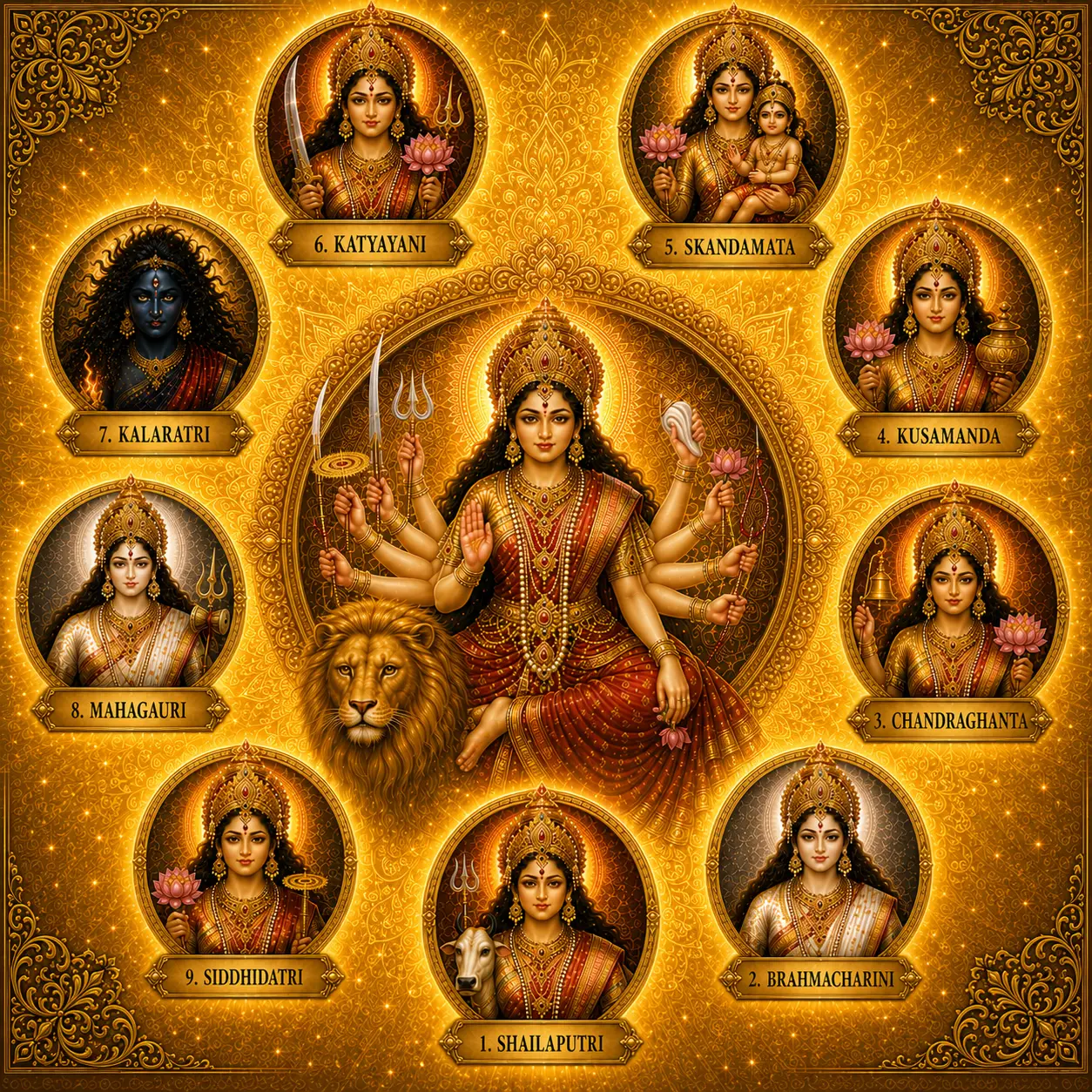
This piece brings together all nine sacred forms of Maa Durga in a single complete composition — the Navadurga, the nine divine manifestations worshipped on the nine nights of Navaratri. Maa Durga in her primary form sits at the centre of the composition, enthroned on her magnificent lion, radiating the supreme authority of the divine mother who encompasses all her forms within herself. Surrounding her, arranged in a ring of nine individual medallions, each Navadurga is depicted with her specific attributes, vehicle, and iconographic details: Shailaputri, Brahmacharini, Chandraghanta, Kushmanda, Skandamata, Katyayani, Kalaratri, Mahagauri, and Siddhidatri — from the first night to the ninth, from the daughter of the mountain to the bestower of all perfections.
The overall composition is mandala-like in its organisation — a central figure surrounded by a ring of nine, enclosed within an ornate golden border. The palette throughout is warm gold and deep crimson, the colours of Navaratri itself — the lamp-lit, flower-strewn, celebratory energy of nine sacred nights. This is a commission-complete image: everything that Navaratri honours, gathered into a single frame.
This artwork is formatted as a square print — the symmetrical medallion arrangement requires a square canvas. Digital files come in square sizes from 5×5 to 16×16 inches; the rolled poster maintains the square proportions. Frame accordingly with a square frame.
About the Navadurga — The Nine Forms of Maa Durga
The Navadurga are the nine sacred manifestations of Maa Durga worshipped on the nine consecutive nights of Navaratri — the most auspicious festival in the Hindu Shakta tradition. Each night is dedicated to one form, each form represents a distinct facet of the divine feminine power, and together the nine forms constitute a complete cycle that moves from origin and discipline through fierce transformation toward the ultimate bestowal of liberation and spiritual perfection.
The Navadurga tradition is rooted in the Devi Mahatmyam (Durga Saptashati) and the Devi Bhagavata Purana, and it is observed across North and South India, in the Indian diaspora worldwide, and in the Shakta and Shaiva traditions without regional distinction. Each family and lineage may observe the nine days with slightly different emphases, but the nine forms and their sequence are consistent across traditions.
This artwork brings all nine together in a single image — the complete Navadurga as a visual reference and altar piece, suitable for devotees who wish to honour the full sequence in one display rather than nine separate images.
The Nine Forms — Who They Are
1. Shailaputri — Daughter of the Mountain. The first Navadurga, Shailaputri is the daughter of Himavan, the king of the Himalayas, and the first form of Durga. She rides a bull (Nandi) and carries a trishul and lotus. She represents the primal, grounded power of the divine feminine — the mountain as the source, the earth as the foundation from which all the other forms arise. Worshipped on the first night of Navaratri.
2. Brahmacharini — The Ascetic. The second form, Brahmacharini is depicted in white, walking barefoot, carrying a japa mala and a kamandalu (water vessel). She represents the fierce austerity and discipline of the spiritual path — the tapas through which Parvati won Shiva. Her form honours the practitioner who walks the difficult path with unwavering resolve. Worshipped on the second night.
3. Chandraghanta — The Bell-Bearer. The third form, Chandraghanta bears a half-moon (crescent) on her forehead in the shape of a bell (ghanta) — the sound of which destroys evil and invokes the divine. She rides a tiger, has ten arms, and is depicted in golden radiance. She represents the warrior quality of the goddess — fearless, resonant, her presence announced by the sound that clears all obstruction. Worshipped on the third night.
4. Kushmanda — Creator of the Cosmic Egg. The fourth form, Kushmanda is understood as the creator of the universe — the goddess who, with a small smile, created the cosmic egg (anda) from which all of existence emerged. She rides a lion, has eight arms, and carries a pot of amrita (nectar of immortality) among her attributes. She represents the creative power of the divine feminine at the cosmic scale. Worshipped on the fourth night.
5. Skandamata — Mother of Skanda. The fifth form, Skandamata is Durga as the mother of Kartikeya (Skanda/Murugan). She is depicted in white, seated on a lotus, holding the infant Kartikeya in one arm. She represents the protective, nurturing power of the divine mother — fierce enough to carry the commander of the celestial armies in her arms, tender enough to be simply his mother. Worshipped on the fifth night.
6. Katyayani — The Fierce Warrior. The sixth form, Katyayani is the goddess in her most directly warrior aspect — born from the wrath of the assembled gods to defeat the demon Mahishasura. She is depicted in golden light, riding a lion, with multiple arms bearing weapons. She represents the decisive, active power of the divine feminine — the force that acts without hesitation when protection is needed. Worshipped on the sixth night.
7. Kalaratri — The Dark Night. The seventh form, Kalaratri is the most fearsome of the nine — dark-complexioned, matted hair, riding a donkey, flames emerging from her nostrils, a garland of skulls. She is the destroyer of ignorance, the one who burns away what is false with terrifying completeness. Despite her fierce appearance, she is considered the most auspicious form — Shubhankari, the giver of good — because what she destroys is precisely what prevents the devotee from reaching liberation. Worshipped on the seventh night.
8. Mahagauri — The Supremely Pure. The eighth form, Mahagauri is pure white — the goddess after the fierce dissolution of Kalaratri is complete. She rides a white bull or elephant, carries a trishul and damaru, and radiates the complete peace and purity of the divine feminine restored to its essential nature. She represents the serenity that follows transformation — the goddess who has passed through every fire and emerged luminous. Worshipped on the eighth night (Ashtami).
9. Siddhidatri — Bestower of All Perfections. The ninth and final form, Siddhidatri is the goddess who bestows all eight classical siddhis (spiritual powers) and all nine nidhis (divine treasures). She is seated on a lotus, radiating supreme grace, surrounded by siddhas (perfected beings), gandharvas, asuras, and devas who all receive her blessings. She represents the complete fruition of the path — what is available at the end of the nine sacred nights of practice and devotion. Worshipped on the ninth night (Navami).
Navaratri — Nine Nights of Sacred Practice
Navaratri (nine nights) is observed twice annually — the more widely celebrated Sharad Navaratri in autumn (September/October, aligned with the harvest) and the Chaitra Navaratri in spring (March/April). The autumn Navaratri culminates in Vijayadashami (Dussehra) — the tenth day of victory — celebrated across the subcontinent as the day of Durga's triumph over Mahishasura and, in the North Indian Ram Lila tradition, of Rama's victory over Ravana.
During Navaratri, practitioners wake early, bathe, fast or observe special diets, light lamps, offer flowers and incense, recite the Durga Saptashati (Devi Mahatmyam), and perform the specific worship associated with the day's Navadurga form. In many families the Navaratri altar is established on the first day and maintained throughout the nine nights — a dedicated space in the home where the goddess is welcomed as a living guest.
The Navadurga image is specifically suited to this altar: a single piece that holds all nine forms allows the complete Navaratri sequence to be honoured without needing nine separate images. The central Durga on her lion anchors the devotional space, while the nine medallions around her serve as both iconographic reference and devotional focus for each of the nine nights.
The Garba and Dandiya Raas dances of Gujarat — now celebrated in Indian diaspora communities worldwide — are performed during Navaratri in honour of the goddess. The nine nights of dance, music, and collective worship make Navaratri one of the most joyful and community-oriented festivals in the Hindu calendar.
How to Use This Artwork During Navaratri
This image functions as both a devotional altar piece and a complete reference guide to the Navadurga sequence. Here are ways it is used during the festival:
As a central altar image: Place the Navadurga print at the centre of your Navaratri altar. The central Durga figure presides over the nine nights, while the surrounding medallions remind you which form is being honoured each day.
As a daily reference: On each night, direct your attention to the specific medallion of that day's Navadurga form as the focus of your puja, meditation, or recitation — while the full image holds the complete context.
As a permanent puja room piece: Outside Navaratri, the Navadurga image serves as the most complete expression of Durga's multifaceted nature available in a single frame — suitable for year-round display in a dedicated sacred space.
As a Navaratri gift: For families who observe Navaratri and do not yet have a Navadurga image, this is among the most meaningful and practical gifts — complete, immediately useful, and iconographically accurate.
The square format suits a dedicated altar space particularly well — the symmetrical composition reads as a mandala, centred and contained, creating a visual focus that draws the eye inward toward the central Durga figure.
Displaying the Navadurga
The square format of this artwork is its defining display characteristic. Standard square frame sizes that accommodate the digital prints: 5×5, 7×7, 11×11, 14×14, and 16×16 inches — all available at IKEA, Target, Amazon, and most home stores in standard sizes.
In a dedicated puja room or Navaratri altar space, the 11×11 or 14×14 print is a natural choice — large enough to read the individual forms clearly while fitting on a standard altar surface. For a wall display, 16×16 is a strong statement piece.
The rolled poster gives you maximum size flexibility while maintaining the square proportions — choose a square frame from your preferred frame shop after printing.