
About This Artwork
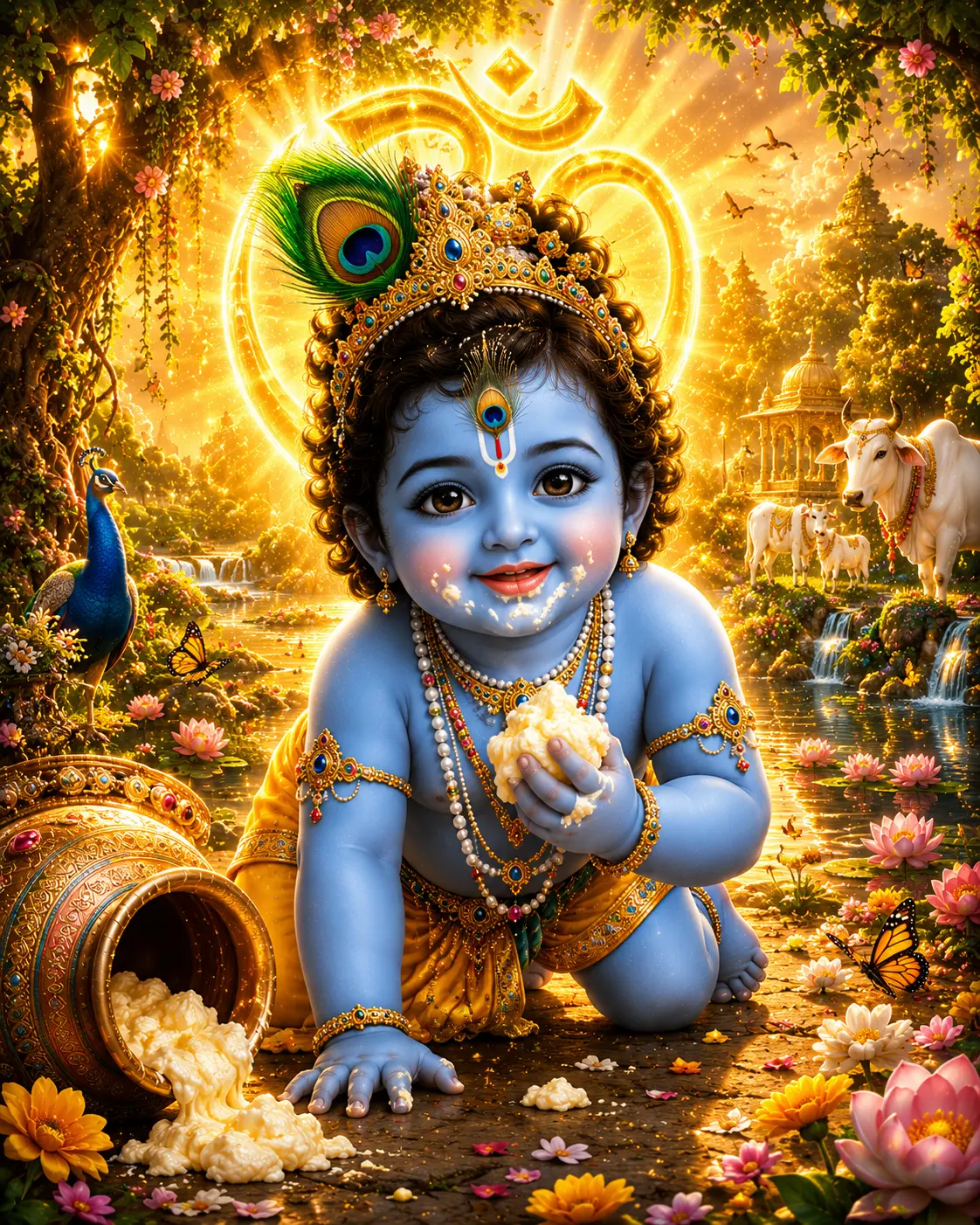
This piece depicts Krishna as Bal Gopal — the divine child, the baby form of the supreme, caught in the eternal act that has made him the most universally beloved figure in the Vaishnava tradition. He sits in the luminous Vrindavan forest, luminous blue, peacock feather crown on his head, pearl necklaces at his throat, and on his face the most irresistible smile in all of sacred art: caught, delighted, completely unapologetic. Butter from the overturned clay matka is smeared on his face and held in his small fist. He does not look away. He looks directly at us.
The golden Om symbol blazes in sacred light above him — a reminder that this laughing, butter-stealing, irresistibly charming child is simultaneously the source of all existence, the Purushottama, the supreme consciousness that plays in Vrindavan as a game of divine delight. White sacred cows graze peacefully in the warm golden landscape behind him. A magnificent peacock stands to his left. Pink lotus flowers bloom throughout the composition. The palette — warm gold, luminous blue, the deep green of the sacred forest — is specifically Vrindavan: intimate, warm, domestic, the quality of light that belongs to the garden where the divine plays before the world knows what it is witnessing.
This is the form of Krishna that is most immediately, most universally lovable — the form that transcends doctrine and background and simply asks to be held.
About Baby Krishna — Bal Gopal, the Divine Child
Bal Gopal — Baby Krishna, the divine child of Vrindavan — is one of the most beloved and most extensively depicted forms of Krishna in all of Hindu devotional art and literature. The name combines Bala (child, young) and Gopala (cowherd, protector of cows) — the child who tends the cows, who plays in the fields and forests of Vrindavan, who steals butter from his mother's pantry and from the homes of the gopis with a smile that makes punishment impossible.
In the Vaishnava tradition, the Bala Krishna form is not simply a biographical phase preceding the cosmic teacher of the Gita. It is a theologically complete expression of the divine — the supreme consciousness at play, the absolute in its most accessible, most intimate, most human-scaled form. The Bhagavata Purana's tenth book dedicates extraordinary attention to Krishna's childhood precisely because in the tradition's understanding, the divine at play is as fully the divine as the divine at war or the divine in meditation.
For the devotee on the bhakti path, the child Krishna — Bal Gopal — offers a form of relationship with the divine that is available to everyone: the love of a parent or grandparent for a child, the instinct to protect and cherish, the delight of watching a beloved small being be completely themselves. This is Vatsalya bhava — the devotional mood of parental love — one of the five classical rasas (flavours) of bhakti in the Vaishnava taxonomy.
The Butter Thief — Why Krishna Steals
The maakhan chor — the butter thief — is the most characteristic of all the Bala Lila stories and the one most directly depicted in this artwork. Krishna steals butter. He steals it from his mother Yashoda's pantry. He steals it from the neighbours' homes, enlisting his cowherd friends to stand on each other's shoulders to reach the pots hung from the ceiling. When caught, he smiles. When scolded, he smiles. When threatened with punishment, he looks up with eyes that make the punishment disappear before it is even spoken.
The theological reading of the butter-stealing stories is extensive in the commentarial tradition. At the most immediate level, the stories simply delight — they are among the most charming narratives in any religious tradition, and their charm is part of their point. At a deeper level, the butter (maakhan) is understood as the essence — the cream of human experience, the distilled sweetness of consciousness. Krishna steals the butter of consciousness from the ordinary mind and takes it for himself — because the supreme consciousness is the rightful owner of all that the mind considers its own.
The overturned pot in this artwork — the matka, the clay vessel — is the ego, the container of ordinary self-concept, now emptied and overturned. What was contained has been taken by the divine. And the face that looks back at us from the scene is smiling because what looks like theft is actually liberation.
This is an interpretation, not an instruction — the stories are approached differently by different traditions and lineages. But the depth of the Bala Lila is part of why these stories have sustained centuries of poetry, music, dance, painting, sculpture, and the daily devotional practice of millions of households.
Yashoda and the Devotional Mood of Parental Love
The relationship at the centre of the Bala Lila is not Krishna's relationship with Radha (which belongs to his youth in Vrindavan as a young man) but his relationship with Yashoda — his foster mother, the cowherd woman who raises him, scolds him, chases him around the kitchen, and loves him with the most complete and unconditional maternal love in the tradition.
In the taxonomy of bhakti rasas developed by Rupa Goswami in the Vaishnava tradition, Vatsalya bhava — the parental love of the devotee for the divine child — is considered among the most tender and most complete of the devotional moods. Yashoda represents this mood at its purest: she does not know she is raising the supreme being. She knows only that she loves this child, that he is her own, that he is the most wonderful, most impossible, most adorable thing in the universe.
The tradition holds that this not-knowing is part of the grace of the lila — the divine play. If Yashoda knew she was holding the universe in her lap, she could not simply hold him. The love that can scold, that can tie him to a mortar with a rope, that can wipe the butter off his face with a mixture of exasperation and complete tenderness — this love is available only to one who does not know what she is loving. And in that not-knowing, she loves more completely than any cosmic awareness could.
For devotees who approach Bal Gopal in the Vatsalya bhava, this is the invitation: to love the divine with the uncomplicated, possessive, completely personal love of a parent for a small and irresistible child.
Janmashtami — The Celebration of Krishna's Birth
Janmashtami is the festival celebrating Krishna's birth — observed on the eighth day (Ashtami) of the dark fortnight of the month of Bhadrapada (typically August or September). It is one of the most widely celebrated festivals in the Hindu calendar, observed with particular intensity in Mathura and Vrindavan (the cities of Krishna's birth and childhood), in Gujarat and Maharashtra (where the dahi handi tradition of human pyramids breaking a pot of curd echoes the Bala Lila directly), and in Vaishnava communities worldwide.
At midnight — the hour of Krishna's birth — temples and homes erupt with celebration: the conch is blown, bells are rung, sacred songs are sung, and in many households a small Bal Gopal image or statue is given a ritual bath (abhishek), dressed in new clothes, placed in a decorated cradle, and welcomed as the newly arrived divine child.
The dahi handi tradition of Maharashtra and Gujarat — where young men form human pyramids to reach and break a pot of curd hung high in the street, exactly as Krishna and his cowherd friends did in Vrindavan — is among the most joyful and physically spectacular expressions of devotional celebration in the Indian calendar. Teams of young people train for months; the pots are hung at extraordinary heights; the streets fill with thousands of spectators. The divine child's butter-stealing becomes a community festival of teamwork, courage, and collective joy.
For the Indian diaspora, Janmashtami is celebrated in temples, in community halls, and in homes worldwide — a festival that is as much cultural as it is devotional, carrying the specific warmth of the childhood stories across every distance and generation.
The Iconography of This Artwork — What to Look For
The butter and the matka: The overturned clay pot and the butter in Krishna's hand are the defining narrative elements — the moment of the story frozen in gold and blue. Look at the expression: he is not hiding, not looking away. He meets the viewer's gaze directly, with the smile of one who knows that what he has done is delightful and that the viewer knows it too.
The peacock feather crown: Even as a baby, Krishna wears the peacock feather — his signature ornament, associated with the rains, with beauty, with the full expression of his nature even in its youngest and most playful form. The peacock feather on the infant's crown signals that this baby is always and entirely Krishna.
The golden Om: The Om symbol blazing in golden light above the child is the most explicit theological statement in the composition — the reminder that this baby, this butter thief, this irresistible small being, is the source of the primordial sound, the ground of all existence. The juxtaposition of the Om and the butter-smeared face is intentional and exact.
The white cows: Sacred cows grazing peacefully in the golden Vrindavan background identify the setting as Gokul/Vrindavan — the pastoral world of Krishna's childhood. The cow is sacred in Hindu tradition and is particularly associated with Krishna as Gopala, the protector of cows. Their presence in the background is not merely decorative; it grounds the scene in the specific sacred geography of the Bala Lila.
The peacock: The peacock standing to Krishna's left in the artwork is an additional identification of the setting as Vrindavan, where peacocks are specifically associated with Krishna's presence. In the Bhagavata Purana, peacocks dance when Krishna plays his flute — the birds of Vrindavan recognise the divine before the humans do.
The warm golden palette: Unlike the cosmic blue-and-indigo of the Nataraja or the sapphire-and-gold of the adult Krishna playing the flute, the Bala Gopal palette is warmer, more intimate — the golden afternoon light of Vrindavan, the light in which childhood happens. This warmth is one of the most important emotional qualities of the image.
Displaying Bal Gopal in the Home
Bal Gopal images are among the most universally present in Vaishnava households — it is common for families to maintain a small Bal Gopal statue or image that is dressed, bathed, and cared for as a living presence rather than simply displayed as an object. This tradition of seva (service) to the divine child is particularly associated with the Pushtimarga tradition founded by Vallabhacharya, but the impulse to care for the Bal Gopal image as if for an actual child is found across many Vaishnava lineages.
In a home altar or puja room, a Bal Gopal image brings a specific quality: lightness, joy, and the warmth of the domestic divine — the deity who is at home in the kitchen, who is familiar with the pantry, who fills the household with the laughter of his own irresistible presence.
In a child's nursery or bedroom, the Bal Gopal image carries an obvious and immediate resonance — the divine child watching over the sleeping child, the supreme at play keeping company with the small human also at play. This is among the most meaningful and culturally resonant choices for a sacred image in a child's space within the Indian and Indian diaspora tradition.
The digital download format is ideal for printing a nursery-sized image immediately; the rolled poster allows for large-format display in a puja room or children's space. Both are available now.