
About This Artwork
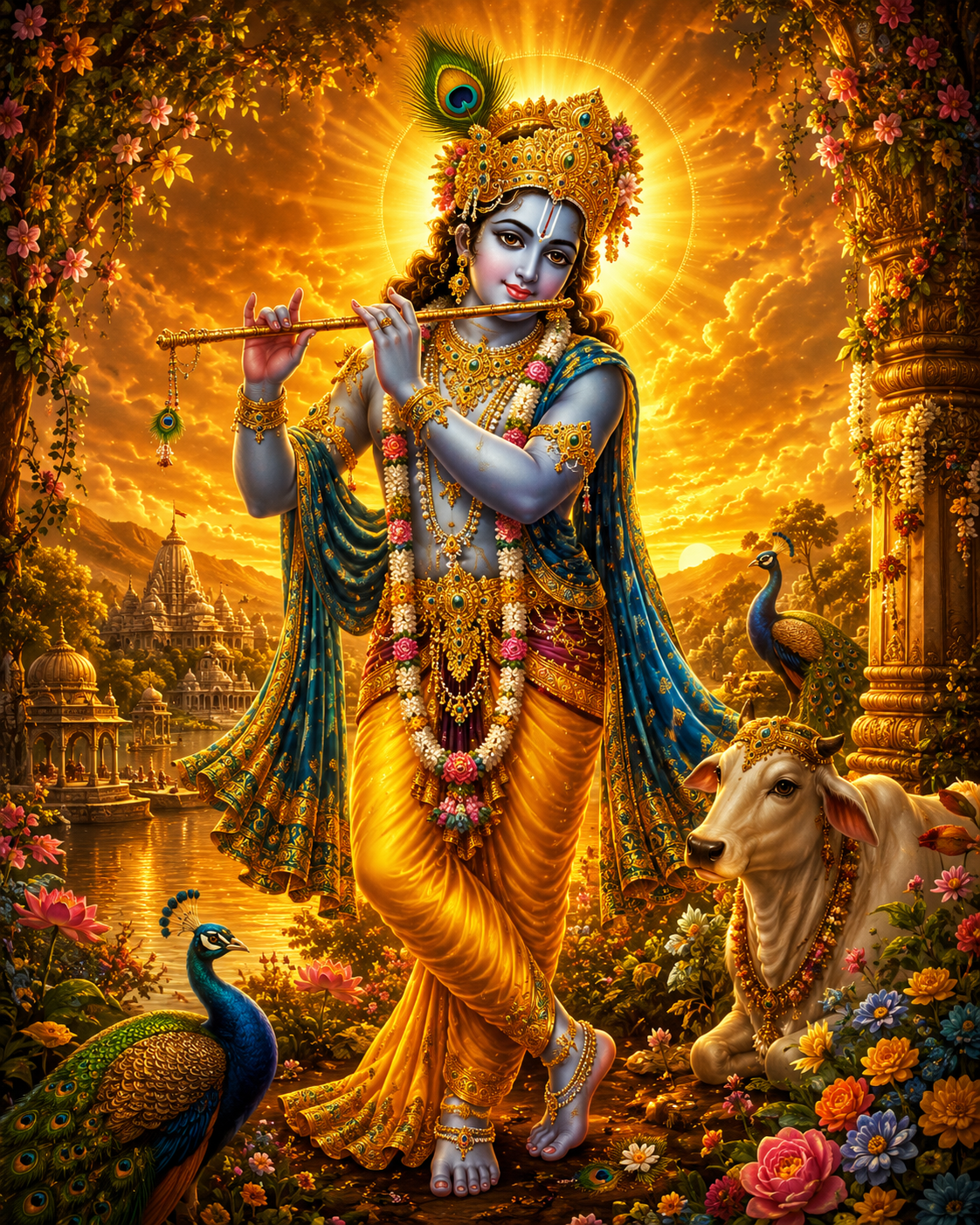
This piece depicts Lord Krishna in his most celebrated form — the divine flute player of Vrindavan. His skin is the luminous blue of a sapphire or a monsoon sky, a blue that in Indian artistic tradition signals the infinite, the sky-like nature of pure consciousness. Against the warm gold of a Vrindavan evening, the contrast is both visually striking and iconographically deliberate.
Krishna stands in the tribhanga posture — the characteristic triple-bend stance where the head, torso, and legs each lean in a slightly different direction, creating a figure of effortless grace rather than rigid formality. The flute is raised to his lips. His peacock feather crown, golden ornaments, and garlands mark him as the sovereign of Vrindavan, while the peacocks and white cow in the composition identify this as the pastoral world of his early life — the Vrindavan where he spent his childhood and youth among cowherds and devotees.
The gold palette and warm celestial light place this image in a long tradition of devotional Krishna art where the divine is not depicted as distant or austere but as radiant, joyful, and intimately present. The piece works in a dedicated meditation space, a yoga studio, a home altar, or any room where a sense of beauty and presence is welcome.
About Lord Krishna
Lord Krishna is one of the most widely worshipped, written about, and artistically depicted deities in all of Hinduism — and one of the most complex. He appears in the Mahabharata as a prince, a charioteer, a king, and a cosmic teacher. He appears in the Bhagavata Purana as a cowherd child in Vrindavan, a lover, a dancer, a butter thief, and the source of all divine play. He is identified in Vaishnava theology as the eighth avatar of Vishnu — or, in many traditions, as the supreme being himself, the source from which even Vishnu emerges.
What makes Krishna distinctive among Hindu deities is this range. He is simultaneously the child who steals butter and the teacher who delivers the Bhagavad Gita on a battlefield. He is the lover of Radha in the groves of Vrindavan and the supreme politician of Dwarka. He is accessible and playful and also, in the Gita's eleventh chapter, the terrifying cosmic form that encompasses all of time. Few figures in any religious tradition hold that breadth of roles within a single identity.
Who Is Lord Krishna?
Krishna is the son of Vasudeva and Devaki, born in the city of Mathura under circumstances that immediately marked him as extraordinary — his birth was foretold, his life was threatened from birth by his uncle Kamsa, and he was secretly transported across the Yamuna river to be raised by the cowherd Nanda and his wife Yashoda in the village of Gokul and later in Vrindavan.
His early life in Vrindavan is the subject of a vast body of devotional literature and art — the Bhagavata Purana's tenth book being the most celebrated account. It is during this period that he plays the flute, dances with the gopis (cowherd women) in the rasa lila, steals butter from his mother's pantry, and performs a series of feats that gradually reveal his divine nature. The Vrindavan period culminates in his departure — a departure that in the bhakti tradition is understood as a wound that never fully heals and that drives the devotional longing at the heart of the Vaishnava path.
His adult life involves the killing of Kamsa, his role in the Mahabharata war, his friendship with the Pandavas, and his eventual end in Dwarka. The Bhagavad Gita is set at the moment just before the battle of Kurukshetra begins, when the warrior Arjuna loses his nerve and Krishna, his charioteer, delivers a teaching on duty, action, devotion, and the nature of reality that has shaped Indian philosophy for over two thousand years.
The Flute — What It Represents
The flute is Krishna's most distinctive attribute and the one most consistently present in traditional imagery. In the visual tradition, it identifies him immediately — even when other details are absent, the flute marks the figure as Krishna.
In devotional and philosophical commentary, the flute carries multiple layers of meaning. At the most immediate level it represents music as a vehicle of the divine — sound as a form of the sacred, the way a melody can move through a listener and create an experience that ordinary language cannot.
In a deeper reading, the flute is hollow — it produces sound precisely because it is empty. This is understood in the Vaishnava tradition as an image of the devotee who, having emptied themselves of ego and self-will, becomes an instrument through which the divine can sound. The music is Krishna's; the hollow reed is the surrendered self.
In Vrindavan, the sound of the flute is what draws the gopis away from their homes and families and into the forest at night — an image that bhakti poets have returned to repeatedly as an expression of the soul's irresistible attraction toward the divine.
What Does Krishna Symbolize? — Key Iconographic Elements in This Artwork
- Blue skin: Krishna's blue or dark complexion is one of his most recognisable attributes. The name Krishna itself means dark or black in Sanskrit. In artistic tradition this blue is rendered as luminous and jewel-like — the blue of a sapphire, or of the sky at that particular depth where it becomes genuinely dark. It is associated with the infinite, the all-pervading, the sky-like quality of pure awareness.
- Peacock feather crown: The peacock feather in Krishna's crown is his signature ornament, present across virtually every iconographic tradition. The peacock is associated in Indian tradition with beauty, with the rains (peacocks dance at the arrival of the monsoon), and with the relationship between the visible and the hidden. Krishna wearing a peacock feather signals his intimacy with the natural world of Vrindavan and his lordship over it.
- Tribhanga posture: The triple-bend standing posture — weight shifted, body creating an S-curve — is specific to Krishna in Hindu iconography. It communicates ease, grace, and a relaxed sovereignty very different from the formal, symmetrical postures associated with Vishnu or the fierce standing postures of Shiva forms. The tribhanga says: this deity is at play.
- Peacocks and white cow: These two elements identify the setting as Vrindavan and Krishna's role as Govinda — the lord of cows, the protector and celebrant of the pastoral world. The white cow in particular is associated with Kamadhenu, the mythological wish-fulfilling cow, and with the abundance and sacredness of the Vrindavan environment.
- The Vrindavan landscape in gold: The warm gold and amber of the background — a landscape at golden hour — places this image in the devotional visual tradition where Vrindavan is not merely a historical location but a state of grace, a quality of light and presence.
The Bhagavad Gita — Krishna as Teacher
Whatever relationship a viewer brings to Hindu tradition, the Bhagavad Gita is almost certainly the reason they know Krishna's name. Set on the battlefield of Kurukshetra just before the great Mahabharata war begins, the Gita is a conversation between Krishna and the warrior Arjuna that covers the nature of action and its consequences, the structure of the self, the relationship between the individual and the absolute, and the paths of knowledge, devotion, and action as routes toward liberation.
The teaching is given in eighteen chapters. It moves from Arjuna's crisis of conscience — his unwillingness to fight a war that will kill his teachers and kinsmen — through Krishna's argument for why action performed without attachment to its fruits is both necessary and spiritually coherent, into increasingly expansive territory about the nature of the divine, the structure of reality, and the relationship between the devotee and God.
The Gita has been read by Gandhi, by Thoreau, by Oppenheimer (who quoted it at the first nuclear test), and by hundreds of millions of ordinary practitioners for whom it functions as a daily guide. Placing a Krishna image in a study, a meditation space, or a creative workspace is, among other things, an acknowledgement of that teaching tradition.
Displaying Krishna in the Home
Krishna imagery is among the most common sacred art in Hindu households — particularly in Vaishnava homes and among those on a bhakti path. The altar or puja space is the most traditional placement, where Krishna is often depicted alongside Radha as the divine couple. A meditation or yoga space is equally natural given Krishna's role as the teacher of the Gita.
In a study or creative workspace, the flute-playing Krishna carries a specific resonance — music, learning, and creative work are all within his domain as Govinda and as the teacher of the Gita.
This artwork is available in four formats to suit different needs and spaces. The digital download gives you full control over print size and framing — from a small 5×7 on a desk to a 16×20 statement piece. The rolled poster suits those who want to choose their own frame. The framed poster arrives fully ready to hang in your choice of white, natural wood, dark wood, or black frame. The canvas is gallery-wrapped and needs no frame at all — the image wraps around the edges for a finished, contemporary look.