About This Artwork
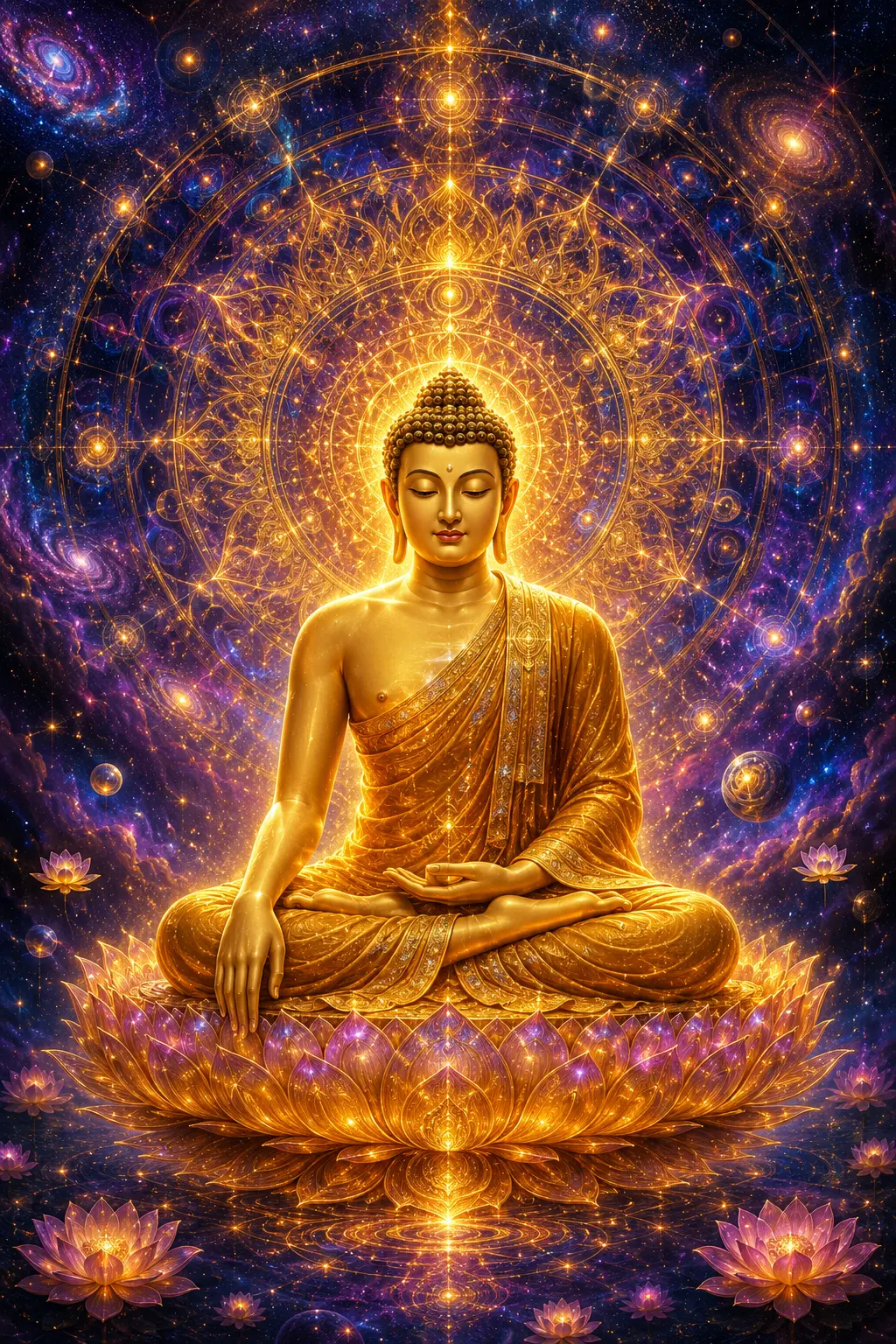
This piece depicts Gautama Buddha at the central moment of his awakening — the night of the full moon in Vaishakha, seated beneath the Bodhi tree at Bodh Gaya, the moment of complete and irreversible enlightenment. He is shown in padmasana, the lotus posture of complete stillness. His right hand is in bhumisparsha mudra — the earth-touching gesture, fingers extended downward to rest on the ground — the gesture that corresponds to the exact moment when, according to the tradition, he called the earth as his witness against the demon Mara's claim that his enlightenment was not real. His left hand rests in dhyana mudra in his lap, the bowl of the hands open and at rest.
His form is luminous gold — not the historical figure but the Buddha of the devotional and meditational tradition, the presence of awakening rendered in the visual language of the sacred. Behind him, a vast mandala of sacred geometry radiates outward in concentric rings of gold, indigo, and violet light — circles, petals, and geometric patterns that in the Indian and Tibetan traditions represent the structure of awakened consciousness made visible. Around and beyond the mandala, the deep cosmic background opens: galaxies, nebulae, the indigo-violet immensity of deep space, the universe as the ground in which a single human being, seated absolutely still, discovered the nature of mind.
The palette — brilliant gold, deep cosmic indigo, violet, and the warm rose of the lotus throne — is the richest and most cosmic in the collection, rivalled only by the Nataraja and the Anantha Padmanabha in its sense of scale. This is the Buddha not as a historical teacher in a grove but as the awakened mind depicted in its own nature — spacious, luminous, and completely at rest.
About Gautama Buddha — The Awakened One
Gautama Buddha — Siddhartha Gautama, the historical figure who became the Shakyamuni (the sage of the Shakya clan), the Tathagata (the one who has thus gone and thus come), the Awakened One — was born in what is now Lumbini, southern Nepal, approximately 563–480 BCE by commonly used scholarly dating, though these dates remain subject to ongoing scholarly discussion. He was born into a family of the ruling Kshatriya clan of the Shakya republic, given the name Siddhartha (he who achieves his aim), and raised in conditions of considerable privilege and protection.
At approximately 29 years of age, despite his family's efforts to shield him from the realities of suffering, he encountered the four sights that the tradition describes as transformative: an old man, a sick person, a corpse, and a wandering renunciant. The first three revealed the fact of suffering — dukkha, the inevitable unsatisfactoriness and impermanence of conditioned existence. The fourth pointed toward a possibility: that there might be a way through.
He renounced his royal life, left his family, and spent approximately six years as a wandering ascetic, studying under two of the foremost meditation teachers of his time (Alara Kalama and Uddaka Ramaputta) and practising extreme austerities with a group of five other seekers. He found neither the teachers' approaches nor the extreme asceticism adequate — neither led where he understood it was necessary to go. He abandoned the extreme ascetic path, ate a meal offered by a village woman named Sujata, and seated himself beneath a fig tree at Bodh Gaya (in present-day Bihar, India) with the resolve that he would not rise until he had understood what needed to be understood.
The night of that sitting — the full moon night of the month of Vaishakha — is the night depicted in this artwork. By dawn, the tradition holds, Siddhartha Gautama had become the Buddha — the Awakened One.
The Moment of Enlightenment — Bhumisparsha Mudra
The gesture depicted in this artwork — the right hand extending downward to touch the earth with the fingertips while the left rests in the lap — is the bhumisparsha mudra: the earth-touching gesture, the gesture of calling the earth as witness.
The story behind this mudra is among the most dramatic in the Buddhist tradition. During the night of his awakening, Mara — the lord of the realm of death and desire, the force that keeps living beings caught in the cycle of rebirth — came to challenge Siddhartha's right to the enlightenment he was approaching. Mara attacked with armies of demons, then with his daughters sent to seduce the meditating sage, then with his final argument: by what authority does this person claim enlightenment? Who can witness that this attainment is real?
Siddhartha's response was this gesture. He reached down and touched the earth — silently, without words. The earth itself, the tradition says, responded: it trembled, affirming that across countless previous lifetimes of practice and merit-making, this being had prepared for this moment and had the right to what he was claiming. Mara fled. By dawn, the awakening was complete and irreversible.
The bhumisparsha mudra — the earth-witness gesture — subsequently became the most widely used iconographic identification of the moment of the Buddha's enlightenment. It appears in Buddhist art across every school and tradition, in every country where Buddhism has been practiced, across nearly 2,500 years of artistic production. In this artwork, the golden Buddha holding this gesture is placed against a cosmic scale backdrop — the earth as witness expanded to include the entire universe.
The Four Noble Truths — The Teaching That Followed
After his enlightenment, the Buddha is said to have spent some time in the awareness of what he had discovered, then to have decided — at the urging, in the tradition, of the deity Brahma — to teach. He walked to the Deer Park at Isipatana (present-day Sarnath, near Varanasi) and found the five ascetics with whom he had previously practised. There he gave his first teaching — the Dhammacakkappavattana Sutta, the Setting in Motion of the Wheel of the Dhamma — presenting the Four Noble Truths:
The First Noble Truth (Dukkha): Suffering exists. More precisely: conditioned existence has an inherent quality of unsatisfactoriness, impermanence, and the inability to provide permanent satisfaction. This is not pessimism but diagnosis — an accurate description of what is the case, prior to any prescription for what to do about it.
The Second Noble Truth (Samudaya): The arising of suffering has a cause. That cause is tanha — craving, thirst, the compulsive grasping and aversion that characterises the untrained mind. Suffering arises because the mind reaches for what it wants and pushes away what it doesn't want, and because neither the reaching nor the pushing can ever be satisfied by what it finds.
The Third Noble Truth (Nirodha): The cessation of suffering is possible. This is the teaching's central hope: that the cause of suffering, having been identified, can be addressed. Nibbana (Pali) or Nirvana (Sanskrit) — the cooling, the extinguishing — is the state in which craving has ceased and the cycle of conditioned suffering is no longer generating itself.
The Fourth Noble Truth (Magga): There is a path to the cessation of suffering. The Eightfold Path — right understanding, right intention, right speech, right action, right livelihood, right effort, right mindfulness, right concentration — is the Buddha's prescription for how to move from the diagnosis of the first two truths toward the possibility of the third.
These four truths are the structural foundation of all subsequent Buddhist teaching across every school and tradition, from the earliest Theravada texts to the Mahayana philosophical elaborations to the Tibetan Vajrayana synthesis. Everything that followed in 2,500 years of Buddhist development is an expansion on, or a deepening into, what these four truths point toward.
Buddha in the Hindu Tradition — The Dashavatara Connection
Within the Hindu tradition, Gautama Buddha is identified as the ninth avatar of Vishnu in the Dashavatara — the ten principal descents of the divine into human form. This identification appears in the Bhagavata Purana and other Puranic texts and places the Buddha within the Vaishnava theological framework as a divine manifestation whose specific teaching of compassion, non-violence (ahimsa), and the cessation of suffering was precisely what was needed at a particular moment in the cosmic cycle.
Different Hindu texts interpret the Buddha avatar with different emphases. Some understand the teaching of the Buddha as genuine and complete on its own terms, consistent with the Vedanta and Yoga traditions' insights into the nature of mind and suffering. Others present a more polemical reading in which the Buddha's non-Vedic teaching was specifically designed to mislead those who were not ready for the deeper Vedic revelation — though this interpretation is not widely emphasised in contemporary Hindu contexts.
The practical significance of the Dashavatara identification for this collection is that it provides a Hindu theological framework within which the Buddha's image is appropriately included in a collection of Hindu sacred art — without requiring any claim that Buddhism and Hinduism are the same tradition, or that the Buddha's teaching is reducible to Hindu philosophy. They are different traditions that share a common soil — the ancient Indian investigation of the nature of mind, suffering, and liberation — and that diverge in significant ways on key questions of metaphysics, practice, and the nature of the divine.
The Iconography of This Artwork — Reading the Sacred Image
Padmasana (lotus posture): The full lotus posture in which the Buddha is seated is both practically and symbolically significant. Practically, it is the most stable and energetically complete seated posture for extended meditation — the body becomes a pyramid, the spine naturally erect, the energy contained and directed upward. Symbolically, it echoes the lotus iconography across the entire Hindu and Buddhist tradition: rooted in the mud, rising through water, blooming above — the meditator grounded in the body and in the world, rising through practice, opening into awareness.
Bhumisparsha mudra (earth-touching gesture): The right hand reaching down to touch the earth with the fingertips — the gesture of calling the earth as witness at the moment of enlightenment. This is the single most iconographically specific element in the image: it identifies this as the moment of awakening, not meditation in general.
Dhyana mudra (meditation gesture): The left hand resting in the lap, palm upward, fingers relaxed — the classic meditation gesture across both Hindu and Buddhist traditions. In combination with bhumisparsha, these two mudras simultaneously encode the peak of outward assertion (calling the earth as witness) and the deepest inward stillness (the meditative ground from which that assertion arose).
The golden form: The Buddha's luminous gold complexion in this artwork is the devotional register rather than the historical one — it represents the quality of awakened consciousness, the luminosity of mind that has cleared itself of obscuration and shines with its own natural light. In the Tibetan tradition this quality of luminosity (Tibetan: ösel) is understood as the fundamental nature of mind, temporarily obscured by confusion and liberated through practice.
The mandala: The vast sacred geometry mandala radiating behind the Buddha represents the structure of awakened consciousness — the ordered, patterned, self-luminous quality of a mind that has recognised its own nature. In the Tibetan Buddhist tradition, mandalas are the primary visual vehicle for depicting the quality of enlightened awareness and the relationship between the practitioner and the enlightened state being sought.
The cosmic background: Galaxies, nebulae, and the deep cosmic void behind the mandala and the Buddha extend the image to cosmic scale — the awakened mind as co-extensive with the universe, the small human figure whose inner discovery encompasses everything that exists.
The Buddha Image for Yoga and Meditation Practitioners
The image of the Buddha at the moment of enlightenment resonates across multiple contemporary practice contexts in ways that go beyond any single religious tradition:
For yoga practitioners, the bhumisparsha mudra and the padmasana posture are immediately recognisable — the gesture and the seat are part of the embodied vocabulary of yoga practice, and seeing them in the context of the most famous moment of human awakening gives them a depth that goes beyond their use as asana names or posture shapes.
For meditators of any tradition — vipassana, samatha, mindfulness-based practices, Zen, Tibetan, or secular — the image of the seated figure at the moment of complete realisation is the archetype of what meditation practice points toward. It is the image of the goal of the path expressed in the posture and gesture of the practice itself.
For those drawn to sacred art as environmental support — the understanding that the quality of images in a practice space affects the quality of practice in that space — the Buddha image in this artwork carries a specific quality of stillness and luminosity that is distinct from more active or devotional images elsewhere in the collection.
The cosmic scale of this artwork — the vastness of the mandala and the nebulae behind a single human figure in meditation — is a visual statement about the relationship between the individual practitioner and the cosmos they sit within. Small, still, completely present, the seated figure is the measure against which the infinite backdrop makes itself known.
Displaying the Buddha in the Home
The Buddha image is among the most widely displayed sacred images in contemporary Western and diaspora homes — in yoga studios, meditation spaces, therapy rooms, wellness centres, and living spaces where a quality of peace and depth is valued.
For those within the Hindu tradition, the Buddha is appropriately placed in a puja room as the ninth avatar of Vishnu. For those from Buddhist traditions, the image works on any wall as a focal point for practice or as a reminder of the tradition's central figure and teaching. For those in neither tradition who are drawn to the image's quality of stillness and the aesthetic register of the cosmic mandala and golden form, it works as a statement piece in any space.
The specific combination of the cosmic mandala and the nebulae background makes this one of the most visually expansive pieces in the collection — it suits a large wall, particularly in a meditation room or yoga studio, where size allows the full mandala to read. The digital download lets you choose from small (5×7) to large (16×20) depending on your space.