About This Artwork
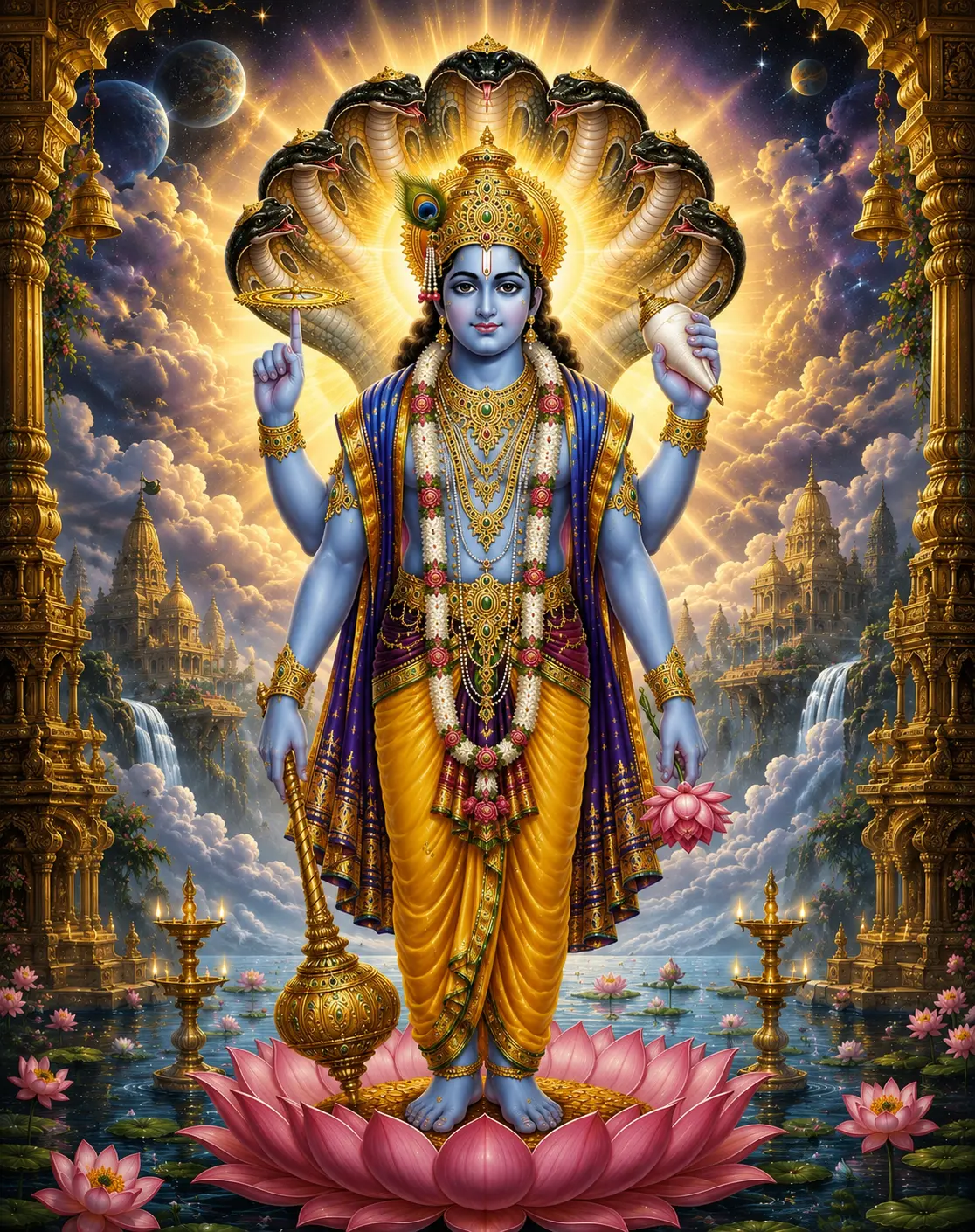
This piece depicts Lord Vishnu in his sovereign, standing cosmic form — the Param Purusha, the supreme being who sustains all of existence through the continuous exercise of his four attributes and the unbroken presence of his attention. He stands on a magnificent blooming pink lotus throne that rises from a sacred cosmic lake, the water's surface scattered with pink lotuses and lit by golden diyas that cast their warm light across the still water. His form is luminous blue — the deep, inexhaustible blue of the infinite sky, the colour that Indian iconographic tradition consistently associates with the boundless and the all-pervading.
Four arms extend with the precise arrangement established by centuries of Vaishnava iconographic tradition. The upper right hand holds the Sudarshana chakra — the spinning disc of divine discrimination and cosmic justice, blazing with light. The upper left hand holds the shankha — the conch shell whose sound is the primordial vibration, the Om that sustains creation in existence. The lower right hand holds the kaumodaki gada — the golden mace, the power of knowledge that dissolves ignorance. The lower left hand holds a pink lotus — the symbol of the complete flowering of consciousness, uncontaminated by what nurtured it.
Behind the deity, the seven-headed Shesha Naga — Ananta, the infinite, the cosmic serpent of eternity — spreads his hoods in a canopy of protection above Vishnu's crown, each hood radiating the energy of the eternal ground on which the universe rests between the cycles of creation. Vishnu wears an elaborate jewelled crown with a peacock feather, cascading garlands of white and pink flowers, and magnificent gold and purple silk garments. Golden temple architecture rises on either side with waterfalls descending into the sacred lake. Above, the cosmic sky opens completely — planets, the Earth as seen from space, a crescent moon, star fields, and nebulae visible in their entirety, the whole cosmos present as witness to this vision of its own sustaining principle.
The palette — warm gold, luminous blue, deep cosmic purple, and the soft rose of the lotus flowers — is among the most cosmically expansive in the collection, appropriate to a deity whose domain is the entirety of manifest existence.
About Lord Vishnu — The Cosmic Sustainer
Lord Vishnu is one of the three principal deities of Hinduism and the central deity of the Vaishnava traditions — the largest single stream of Hindu religious practice, comprising an estimated 600–700 million practitioners worldwide. Within the Trimurti — the divine triad of Brahma (the creator), Vishnu (the sustainer), and Shiva (the transformer) — Vishnu's role is the preservation and maintenance of the created universe: the force that holds everything in existence between the moments of its creation and its dissolution, the presence that keeps the cosmic order (dharma) from collapsing under the weight of entropy, ignorance, and the accumulation of adharma.
His Sanskrit name Vishnu is derived from the root vish — to pervade, to spread through — and his most fundamental quality is all-pervasiveness: Vishnu is the deity who is not in a single place or form but who pervades the entire manifest universe as its sustaining principle. He is simultaneously outside the universe as its witness and inside every particle of it as its ground. This quality of simultaneous transcendence and immanence — of being both the container of everything and the content of everything — is what distinguishes Vishnu's theological role from the more localised presences of many other deities.
Who Is Lord Vishnu? — His Names and Their Meanings
The Vishnu Sahasranama — the Thousand Names of Vishnu — is among the most widely recited sacred texts in the Vaishnava tradition, found in the Mahabharata (the Anushasana Parva) and recited daily in millions of homes and temples. Each name points to a different quality or aspect of Vishnu's nature. Some of the most significant:
Narayana: One of Vishnu's most ancient and most used names. The etymology most commonly given is Nara (the primordial waters, or humanity, or the individual soul) + Ayana (the resting place, the abode) — making Narayana the one who dwells in the waters, who is the abode of all souls, or the one in whom all humanity finds its resting place. In the cosmological understanding, Narayana rests on the cosmic waters between the cycles of creation, with the universe-containing lotus emerging from his navel — Brahma seated on that lotus is the creator, but the ground from which the lotus arises is Narayana.
Hari: One of Vishnu's most devotionally used names — the one who removes (harati) sin, suffering, and the obstacles that prevent the soul from recognising its own nature. In bhakti practice, Hari is the name most associated with the removal of sorrow and the restoration of joy.
Purushottama: The supreme Purusha — the highest person, the ultimate being. In Samkhya philosophy, Purusha is the cosmic witness-consciousness that underlies all of prakriti (nature, matter, manifestation). Vishnu as Purushottama is not merely one form of the divine but the supreme consciousness itself, the witness of the entire cosmic display.
Govinda: The cowherd, the protector of cows — this name connects Vishnu to Krishna and to the pastoral world of Vrindavan, where the divine descends into the most intimate and domestic register.
Janardana: The one who protects humanity, who is petitioned by those in difficulty. This name emphasises Vishnu's protective function and his availability to those who call upon him in genuine need.
The Dashavatara — The Ten Avatars of Vishnu
The most distinctive theological contribution of Vishnu to the Hindu tradition is the concept of the avatar — the divine descent (from Sanskrit ava, down, + tri, to cross over) — the voluntary taking of a physical form by the supreme being in order to restore dharma when it has been overwhelmed by adharma.
The ten principal avatars of Vishnu (Dashavatara) are among the most important figures in the entire Hindu mythological tradition, and their sequence has attracted extraordinary attention from philosophers, scientists, and comparative mythologists for reasons that go beyond religious allegiance:
1. Matsya (the fish): Vishnu descends as a great fish to save Manu (the first man, cognate with the Biblical Noah) and the sacred Vedas from a catastrophic flood. The aquatic life form is the earliest and most primitive — the avatar sequence begins in the ocean, in the most ancient environment of life.
2. Kurma (the tortoise): Vishnu descends as a giant tortoise during the churning of the cosmic ocean (Samudra Manthan) to serve as the pivot-base for the churning stick — Mount Mandara — providing the stable ground on which creation's churning takes place.
3. Varaha (the boar): Vishnu descends as a great boar to rescue the Earth (Bhudevi, personified as a goddess) from the demon Hiranyaksha who has dragged her to the bottom of the cosmic ocean.
4. Narasimha (the man-lion): Vishnu descends as a half-man, half-lion form to defeat the demon Hiranyakashipu — who has obtained a boon that he cannot be killed by man or beast, by day or night, inside or outside, on earth or in the sky, by any weapon. Narasimha manifests at twilight (neither day nor night), at the threshold of a doorway (neither inside nor outside), with Hiranyakashipu on his lap (neither earth nor sky), and destroys him with his claws (neither a made weapon nor bare hands). The Narasimha avatar is among the most philosophically sophisticated — the divine finds the gap in every condition and passes through it.
5. Vamana (the dwarf): Vishnu descends as a dwarf Brahmin to reclaim the three worlds from the demon king Bali, who has conquered all of creation through the power of his own righteousness. In three steps, the dwarf expands to encompass the entire universe.
6. Parashurama (the axe-wielding warrior): Vishnu descends as a Brahmin warrior to restore the balance between the warrior (Kshatriya) class and the priestly (Brahmin) class, which has been disrupted by the arrogance of the Kshatriyas.
7. Rama: Vishnu descends as the ideal king and ideal man — the protagonist of the Ramayana, the model of dharmic conduct in every role (son, husband, king, warrior). The Rama avatar is the subject of the Ramayana and of the devotion of hundreds of millions of practitioners.
8. Krishna: Vishnu descends as the divine cowherd of Vrindavan and the cosmic teacher of the Bhagavad Gita — the most philosophically complete and most widely studied of the avatars, explored in depth on the Krishna pages of this collection.
9. Buddha (or Balarama): The ninth avatar is identified in many Puranic lists as the Buddha — Siddhartha Gautama — understood in the Hindu tradition as an avatar of Vishnu who came to teach compassion and non-violence (ahimsa) at a moment when those qualities were critically needed. Some lists identify the ninth avatar as Balarama (Krishna's elder brother) instead.
10. Kalki: The future avatar — not yet descended, according to tradition. Kalki will appear at the end of the current Kali Yuga riding a white horse, bringing the current cosmic age to its conclusion and inaugurating the next Satya Yuga.
The Dashavatara sequence has attracted particular attention from evolutionary biologists and philosophers of science who have noted the progression: aquatic life (Matsya), amphibious life (Kurma, Varaha), primitive mammal/hybrid (Narasimha), dwarf/early hominid (Vamana), fully human warrior (Parashurama), civilised ideal human (Rama), divine human (Krishna), the reforming teacher (Buddha), and the future form (Kalki). The sequence parallels the evolutionary timeline with a precision that continues to generate discussion. This is noted here as an interesting observation about the depth of the Puranic vision, not as a claim that the rishis were conducting biological research.
The Four Attributes — Reading Vishnu's Four Arms
The four attributes Vishnu holds in this artwork constitute a complete cosmological statement about the nature of existence:
Sudarshana chakra (upper right): The spinning disc — the wheel of divine time and cosmic discrimination. Sudarshana means "beautiful to behold" — the disc is not simply a weapon but an instrument of divine intelligence that distinguishes what is real from what is apparent, what is eternal from what is temporary. At the subatomic level, it represents the spinning of the primordial particles; at the cosmic level, it is the wheel of time itself.
Shankha / conch (upper left): The conch shell whose sound — Panchajanya, Vishnu's named conch — is the primordial vibration of creation, the cosmic Om. In battle, the conch was blown to signal the beginning — in Vishnu's hands, it signals the continuous vibration that sustains all of existence in being. The sound of Vishnu's conch is the sound the universe makes simply by existing.
Kaumodaki gada / mace (lower right): The golden mace — named Kaumodaki — is the power of knowledge that dissolves ignorance. In the tradition, ignorance (avidya) is not simply the absence of information but the active force that prevents the soul from recognising its own nature. The gada is the instrument of that dissolution — the force that strikes at the root of misperception.
Pink lotus (lower left): The lotus in Vishnu's hand — as on his lotus throne — is the symbol of consciousness fully bloomed, fully open, untouched by what nurtured it. The lotus that Vishnu holds is the offering of consciousness back to itself — the universe recognising its own nature through the deity who sustains it.
Shesha Naga — The Cosmic Serpent
The seven-headed Shesha Naga forming a canopy above Vishnu's crown in this artwork is not a decorative detail but a cosmological statement of the first order.
Shesha (also called Ananta — the infinite) is the cosmic serpent on whose coils Vishnu rests between the cycles of creation in the cosmic ocean of milk. The universe exists on the back of Shesha; when the universe is dissolved at the end of a cosmic cycle, it is absorbed back into Shesha's infinite coils, where it rests until the next creation. Shesha is therefore not a creature within the universe but the ground in which the universe is contained — the infinite context in which even Vishnu's cosmic activity takes place.
The seven heads in this artwork spread above Vishnu like a crown or canopy — a protective umbrella of the infinite above the sustaining presence of the deity. This arrangement places Vishnu simultaneously as the sustainer of the manifest universe and as resting within the larger infinite ground of Shesha — a double structure that encodes the complete cosmological vision of the Vaishnava tradition in a single visual arrangement.
The Cosmic Sky — The Universe as Witness
The cosmic sky in this artwork — planets, the Earth as seen from space, a crescent moon, star fields, and nebulae visible above the deity — is one of the most distinctive elements of this composition and one that places it in dialogue with the contemporary scientific awareness of the scale of the universe.
The Earth is visible from space in the upper portion of the composition — a detail that connects the traditional iconographic language to the specific experience of modernity, where the image of the Earth as a small sphere in infinite space has become one of the defining visual experiences of the 20th and 21st centuries. Vishnu, the sustainer of the cosmos, stands with the cosmos in its contemporary visual form above and behind him — the entire universe, including the Earth that the viewer inhabits, held within the scope of his awareness and his four arms.
Displaying Vishnu in the Home
Vishnu's image is widely displayed in Vaishnava households, in puja rooms across all Hindu traditions (where he is frequently present alongside Lakshmi and other deities), and in meditation spaces where the sustaining, stabilising quality of his presence is specifically invoked.
The cosmic palette of this artwork — the luminous blue, warm gold, deep purple, and rose — is among the most visually expansive in the collection. It suits a statement wall in a living room or study as much as it suits a dedicated puja room or meditation space. The sheer scale of the composition — from the lotus throne and cosmic lake to the planetary and nebular sky — gives it a quality of depth that is difficult to achieve in smaller prints; the 16×20 size will do the most justice to the range of detail in the artwork.
The digital download format allows immediate printing at your preferred size. Print on matte or semi-gloss photo paper at FedEx Office, Staples, or any professional print shop, frame in a style that suits your space, and the image is ready.