About This Artwork
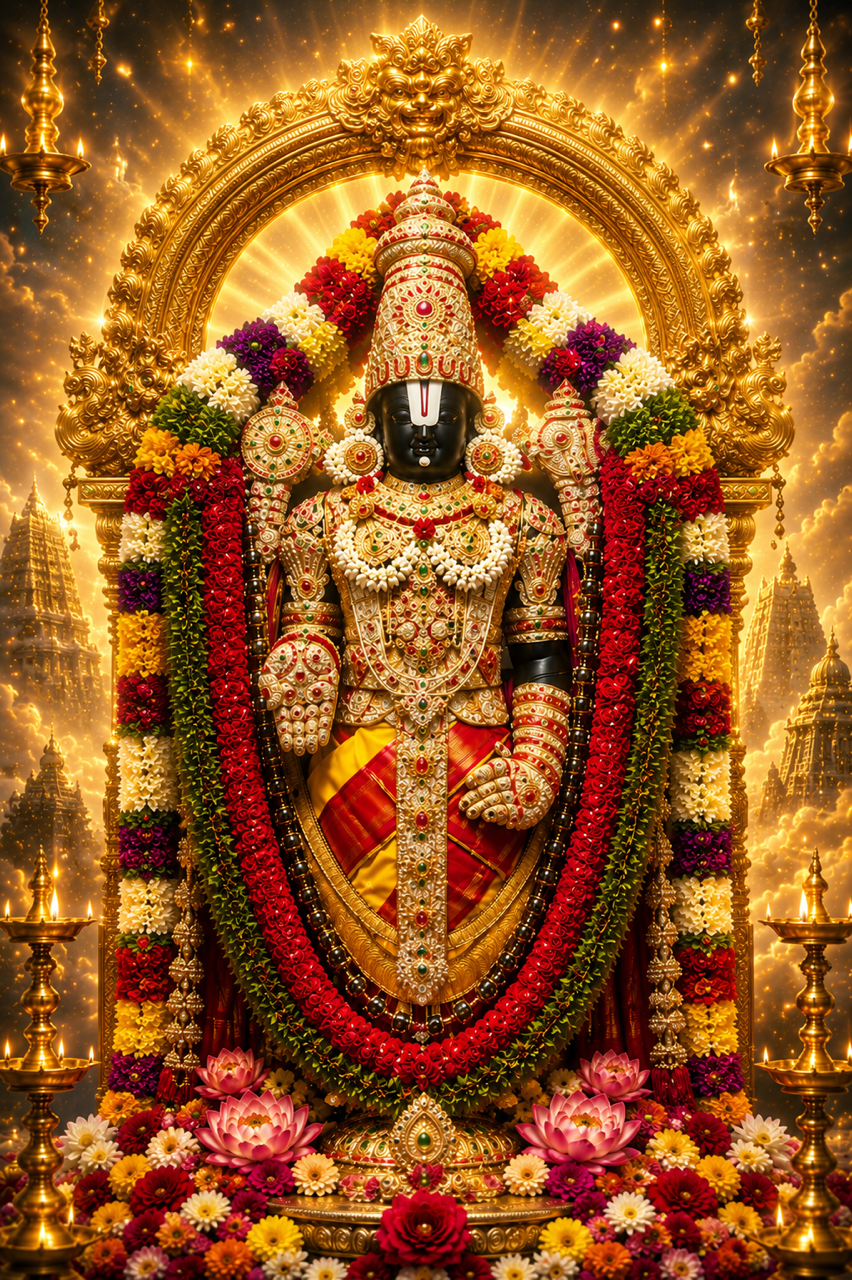
This piece depicts Lord Venkateswara — Tirupati Balaji, Govinda, Srinivasa, the Lord of the Seven Hills — in his authentic Tirumala temple darshan form, rendered with the specific iconographic precision that devotees of the Tirumala tradition will recognise immediately. Every detail corresponds to the actual darshan as it appears at the Tirumala Venkateswara Temple in Andhra Pradesh.
The distinctive tall cylindrical kiritam (crown) rises above the deity's head — this is the most immediately recognisable element of Venkateswara's iconography, present in no other deity's representation in the same form. His complexion is the sacred dark black of the Tirumala moolavar (original deity) — Neela megha shyama, the colour of a dark rain cloud. The white namam tilak marks his forehead in the Vaishnava tradition. The alankaram — the elaborate gold jewelled ornamentation worn by the deity — is rendered with the specific grandeur of the Tirumala temple tradition, where the deity's decoration is among the most opulent in the world.
Multi-coloured flower garlands cascade in layers — red, yellow, and white — from the kiritam crown to the base, as they appear in the fresh garlands offered daily at the temple. On either side of the deity, the Sudarshana chakra and the shankha (conch) are present. The golden prabhavali arch behind the deity culminates in a sacred lion face (Yali) at the apex. Golden diyas and lotus flowers complete the sacred atmosphere. In the background, the distinctive silhouettes of the Tirumala gopurams confirm the setting: this is Govinda in his sacred abode on the seven hills.
About Lord Venkateswara — Tirupati Balaji, the Lord of the Seven Hills
Lord Venkateswara is a form of Vishnu enshrined at the Tirumala Venkateswara Temple in Tirupati, Andhra Pradesh — the most visited pilgrimage site on earth by any metric, receiving between 50,000 and 100,000 devotees per day and well over 25 million visitors annually. No religious site in the world — not the Vatican, not Mecca (which restricts entry to Muslims), not any Buddhist or Hindu site — receives as many visitors. To understand the significance of Lord Venkateswara is to understand something real about the scale of devotion that certain presences in the Hindu tradition continue to generate in the 21st century.
His name Venkateswara combines Venkata (the name of the hill on which he resides, itself derived from Sanskrit roots meaning that which burns away sins) and Ishwara (the lord). He is therefore the Lord of Venkata, the Lord of the Sacred Hill. His other widely used names include Srinivasa (the abode of Shri/Lakshmi), Govinda (the cowherd, a Vishnu name), Balaji (the young lord — the name most commonly used in North India), and Tirupati Balaji (from the town of Tirupati at the foot of the seven hills).
The Tirumala Temple — History and Scale
The Tirumala Venkateswara Temple sits atop the Tirumala Hills — a seven-peaked range in the Eastern Ghats of Andhra Pradesh — at an elevation of approximately 853 metres. The hills themselves are referred to as the Saptagiri (seven hills) and are understood in the tradition as a manifestation of Adishesha, the cosmic serpent on whom Vishnu rests.
The temple's origins are ancient and contested — Vaishnava tradition places the self-manifestation of Venkateswara (svayambhu — one who appeared of his own accord, not installed by human hands) in the Treta Yuga, though the earliest documented temple structures date to approximately the 9th century CE. The temple has been continuously expanded, endowed, and supported by rulers across South Indian history — from the Pallava and Chola kings through the Vijayanagara Empire (whose patronage was transformative and whose records from the 14th–16th centuries describe the temple's extraordinary wealth and pilgrim traffic) to the present administration under the Tirumala Tirupati Devasthanams (TTD), a government-administered trust that manages the temple and its enormous revenues.
The temple's annual income — from the hundi (donation box), from the tirupati laddu prasad, from the famous tonsure offerings (where devotees shave their heads as an act of surrender and gratitude), and from the elaborate tier system of paid darshan queues — makes it the richest religious institution in the world by most measures. The gold, cash, and jewel donations received annually are of extraordinary scale.
The Darshan — What Devotees Seek at Tirumala
The word darshan (from the Sanskrit darsana — to see, to have vision of) is the central purpose of the pilgrimage to Tirumala. In Hindu devotional practice, seeing the deity — and being seen by the deity — is itself the sacred act. The pilgrimage is made, the queues are waited through (sometimes for many hours, sometimes for days in the case of the free darshan), the physical and financial sacrifice is offered, specifically for the moment of standing before the Venkateswara moolavar and receiving the deity's gaze.
The Tirumala darshan is famously brief — the inner sanctum queues move continuously, and most pilgrims have only seconds of direct visual access to the deity before moving on. The brevity of the moment, after sometimes days of waiting, is understood in the tradition as itself a teaching: the darshan is complete in an instant; what is received in that instant cannot be measured by its duration.
The image in this artwork is specifically a darshan image — it is framed as the devotee's view of the deity, presenting the complete Tirumala darshan in its authentic iconographic details for those who cannot make the pilgrimage in person and for those who have made it and wish to maintain that visual connection in their daily sacred space.
Venkateswara's Iconography — Reading the Tirumala Darshan
The Tirumala Venkateswara iconography is among the most precisely defined in the Hindu tradition — every element of the deity's appearance at Tirumala is prescribed by the Agamic texts that govern the temple's rituals and by the specific tradition of the moolavar (original, self-manifested deity). What this artwork depicts:
The kiritam (cylindrical crown): The tall, cylindrical gold crown is the single most distinctive element of the Venkateswara form and exists in no other deity's standard iconographic representation in the same shape. It signals immediately and unambiguously: this is Venkateswara of Tirumala.
The dark complexion: Venkateswara is depicted as dark — neela megha shyama, the colour of a dark rain cloud — which is the traditional complexion of Vishnu forms associated with the deep mystery of the divine. The darkness is not simply colour but quality: the depth of the infinite, the unfathomable nature of the supreme.
The white namam tilak: The white U-shaped Vaishnava tilak on the deity's forehead is the mark of the Shri Vaishnava tradition — the vertical lines representing the divine feet of Vishnu, the lower horizontal mark representing Lakshmi. At Tirumala, the tilak is applied fresh as part of the daily ritual of the moolavar.
The alankaram: The ornate golden decoration — crown, necklaces, armlets, waistband, garments — applied to the deity at Tirumala is among the most elaborate and valuable in any temple in the world. The specific arrangement of ornaments changes with the daily ritual calendar (various alankaram forms are applied at different times of day and on different festival days), but the overall quality of extraordinary opulence is constant. The gold weight of the ornaments currently on the deity runs into hundreds of kilograms.
The flower garlands: Multi-coloured fresh garlands — red roses, yellow marigolds, white tuberoses — are offered and changed multiple times daily at Tirumala. Their presence in this artwork signals the living, freshly worshipped quality of the deity's daily temple ritual.
The Sudarshana chakra and shankha: Vishnu's primary attributes — the spinning disc of divine discernment and the conch of primordial sound — flank the deity on either side, confirming his Vaishnava identity even within the distinctive Tirumala iconographic form.
The prabhavali arch with Yali: The golden arch (prabhavali) behind the deity's head terminates at its apex in a Yali — the composite mythological creature (part lion, part elephant, part horse) that serves as a guardian figure in South Indian temple architecture. The Yali at the apex of the prabhavali is the marker of the sacred space that defines the deity's presence.
The Tirumala gopuram in the background: The distinctive gopurams of the Tirumala temple complex are visible in the golden background of this artwork — confirming the sacred geography and placing the darshan in its specific architectural and geographic context.
Venkateswara as the Kaliyuga Deity
The Hindu tradition recognises four cosmic ages (yugas): Satya (or Krita), Treta, Dvapara, and Kali. Each age is understood to be characterised by a decreasing availability of the conditions for spiritual practice — decreasing lifespan, decreasing capacity for discipline, increasing difficulty of traditional paths of knowledge and renunciation.
Venkateswara is specifically identified in the Puranic tradition as the Kaliyuga Pratyaksha Daivam — the directly visible (pratyaksha) deity of the current age (Kali Yuga). In this understanding, while the conditions of the age make the demanding practices of previous yugas inaccessible to most people, Venkateswara at Tirumala remains directly accessible — he can be visited, seen, offered to, and prayed to without extensive qualification, austerity, or initiation. The pilgrimage to Tirumala is itself the practice.
This framing makes the image of Venkateswara in a home sacred space particularly significant: for devotees who accept this understanding, maintaining Venkateswara's image in a home puja room is maintaining an active connection to the most accessible divine presence available in the current age.
Displaying Venkateswara in the Home
Venkateswara is among the most universally present deity images in South Indian Hindu households — Telugu, Kannada, and Tamil families across the diaspora maintain his image in the puja room as a matter of course, and his presence is extending well beyond South Indian communities as Tirupati's fame and the deity's reputation spread through the broader Hindu world.
The specific iconographic details of this artwork — the authentic kiritam, the darshan framing, the prabhavali and gopuram — make it particularly meaningful for devotees who have made the Tirumala pilgrimage and wish to maintain that darshan in their daily life. For those who have not yet been to Tirumala, it provides an iconographically accurate visual connection to the deity in his sacred home.
In a home puja room, the Venkateswara image is typically placed in a position of honour — facing east if possible, at eye level or above, in a dedicated altar space rather than a general decorative position. The morning lighting of a lamp before the image is the simplest and most direct form of daily practice associated with this deity.
The digital download format allows you to choose any size from 5×7 to 16×20 — or the unique 12×18 poster size available in this listing's ZIP 4 — giving complete control over how the image fits your altar space.