About This Artwork
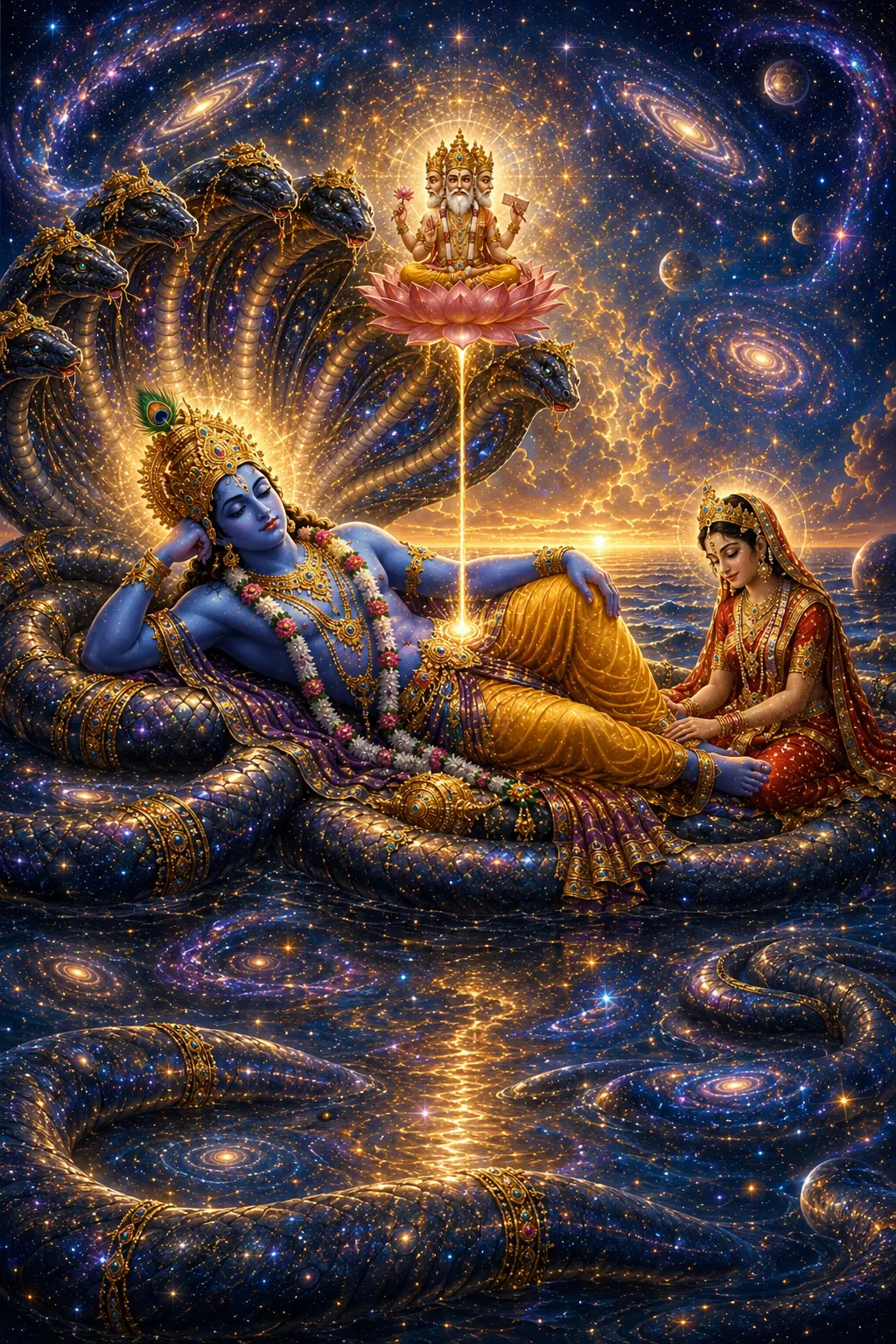
This piece depicts Lord Vishnu in the Anantha Shayana form — the eternal reclining posture that is simultaneously the most cosmologically complete and the most physically composed of all Vishnu's iconographic forms. He reclines on the coiled body of Ananta Shesha — the infinite cosmic serpent — whose many hoods fan protectively above him like a living crown. His form is luminous blue, richly crowned and garlanded, dressed in gold and yellow silk, at ease with the absolute ease of one for whom sustaining the entire universe is no more effortful than breathing.
At his feet, Goddess Lakshmi sits in devotion — the divine feminine as the constant companion of the supreme, present even at the moment of cosmic rest between creations. From Vishnu's navel, a beam of light rises upward, and from that beam blooms a great lotus — and on the lotus, four-headed Brahma sits in the meditative stillness that precedes his work. This is the precise moment between the end of one cosmic cycle and the beginning of the next: Vishnu resting on the primordial waters, the cosmos contained in his dream, Brahma about to open his eyes and begin creation anew.
Below and behind the three figures, a shimmering field of stars and galaxies extends across the cosmic ocean — not the warm Vrindavan gold of the Krishna images or the Himalayan blue of the Shiva meditation, but the cool, vast, silver-blue of deep space, the visual register of the interval between universes. This is among the most compositionally horizontal pieces in the collection — the reclining form requires landscape space, and it uses it fully, drawing the eye from Lakshmi at the feet across Vishnu's resting body upward to Brahma poised above.
About Anantha Padmanabha — Vishnu in the Cosmic Reclining Form
Anantha Padmanabha is the name of Lord Vishnu in the specific form depicted in this artwork — reclining upon the multi-headed serpent Ananta Shesha on the cosmic ocean (Kshirasagara, the ocean of milk) that exists between the cycles of creation. The name is composed of three Sanskrit elements: Anantha (the infinite, endless — the name of the cosmic serpent Shesha as well as a quality of Vishnu himself), Padma (lotus — the lotus that grows from Vishnu's navel), and Nabha (navel). Anantha Padmanabha is therefore the one whose navel holds the lotus of the infinite — the deity whose very centre of being is the source from which creation emerges.
This is one of the most cosmologically specific of all Vishnu's iconographic forms — it depicts not simply a deity in a particular posture but a particular moment in the cosmic cycle: the pralaya, the interval between the dissolution of one universe and the beginning of the next, when all of existence is absorbed back into Vishnu and rests there until the conditions for a new creation arise. The image is therefore not a scene from within the universe but a scene from outside it — a view of the cosmic situation from which the universe is generated.
The Three Figures — A Complete Cosmological Map
The three principal figures in this composition together constitute one of the most complete cosmological statements in Hindu iconographic tradition:
Vishnu reclining: At the centre and the largest figure, Vishnu's reclining posture is the key to the entire image's meaning. He is not asleep — the tradition is careful on this point. He rests in Yoga Nidra, a state of conscious repose that is not unconsciousness but a different quality of consciousness entirely: awareness without agitation, the still ground from which both dreaming and waking arise. In this state, Vishnu holds the dissolved universe within his awareness as a dream holds its contents — not separate from the dreamer, not independently existing, but real within the space of his infinite consciousness. The universe, between creations, is Vishnu's dream.
Lakshmi at his feet: The goddess of abundance, grace, and auspiciousness is the constant companion of Vishnu in all his forms — but her specific placement at his feet in this reclining composition is iconographically deliberate. Lakshmi serves the Lord, tends to him, maintains the relationship of devotion (seva) even at the cosmic moment of rest. In the Sri Vaishnava theological tradition, Lakshmi's presence with Vishnu at this moment is understood as the assurance that when creation recommences, it will do so under the auspices of Shri — that the new universe will be one of grace and abundance rather than mere material existence. She is the quality that ensures creation is worth having.
Brahma on the lotus: Rising from Vishnu's navel on a beam of light, the lotus bears four-headed Brahma in the meditative stillness just before his act of creation. This figure is among the most important in the composition because it encodes the cosmological hierarchy with perfect visual clarity: Brahma is the creator — the one who brings the manifest universe into existence through his contemplation and speech — but he himself arises from Vishnu's navel, which means his creative power is not independent but is generated from and sustained by Vishnu's deeper nature. The lotus connects the creator to the sustainer without collapsing the distinction between them. Brahma creates; but the ground of Brahma's existence is Vishnu; and the ground of Vishnu's existence is Ananta, the infinite.
The three figures therefore map three levels of cosmic reality: the absolute ground (Ananta/Shesha as the infinite background), the sustaining consciousness (Vishnu in Yoga Nidra), the world-creating intelligence (Brahma on the lotus) — and the grace that ensures the quality of what is created (Lakshmi).
Ananta Shesha — The Infinite Ground
The multi-headed serpent on whose coils Vishnu rests is Ananta Shesha — Ananta meaning infinite or endless, Shesha meaning remainder or that which remains. The name Shesha points to what Ananta is: that which remains when everything else has been dissolved. At the end of a cosmic cycle, when Brahma's creative day has ended and the universe is drawn back into Vishnu at the moment of pralaya (dissolution), what remains? Shesha remains. The infinite background that cannot be dissolved because it is not itself a created thing — it is the ground in which created things arise and into which they return.
The many hoods fanning above Vishnu in this artwork are both a protective canopy and a visual representation of the infinite — each hood multiplying the sense of protection and of the vast extension of the cosmic ground that Shesha represents. The number of hoods varies by tradition and by iconographic interpretation — commonly five, seven, or eleven — but in devotional art the many-hooded form is always Shesha in his full, expanded expression.
In the Vaishnava tradition, Ananta Shesha is also understood as a great devotee — the first and most devoted servant of Vishnu, who supports the Lord's rest with his entire being. This reading places Shesha in the same category as Garuda (Vishnu's eagle vehicle) and Hanuman (Rama's devoted servant) as beings whose greatness consists precisely in the completeness of their surrender and service.
The Padmanabhaswamy Temple — Where This Form Is Worshipped
The most famous and most ancient shrine of Anantha Padmanabha is the Padmanabhaswamy Temple in Thiruvananthapuram (Trivandrum), the capital of Kerala — one of the 108 Divya Desams, the sacred Vaishnava pilgrimage sites identified in the Nalayira Divya Prabandham of the Alvars (the Tamil Vaishnava poet-saints).
The temple's architecture is a remarkable combination of Kerala and Dravidian styles, with a distinctive seven-tiered gopuram visible from much of the city. The presiding deity — the moolavar, the original deity of the shrine — is Vishnu in the Anantha Shayana posture, carved from a single piece of a special composition (katusarkara yogam) and measuring approximately five metres in length. The image is so large that it is viewed through three separate doorways (which frame the head and upper body, the central portion, and the feet respectively), so that no single human view encompasses the entire form — a deliberate iconographic statement about the limits of any single perspective on the infinite.
The Padmanabhaswamy Temple became internationally prominent in 2011 when a series of underground vaults beneath the temple were opened by court order. The treasures discovered — gold, jewels, golden idols, ancient artefacts accumulated over centuries of royal patronage — were estimated at values ranging from $22 billion to over $1 trillion by different assessors, making it the most valuable temple treasure in the world by any measure. The legal and spiritual debates surrounding the vaults' contents and their appropriate disposition continue.
The temple was historically the family deity of the Travancore royal family, who traditionally considered themselves Padmanabha Dasa — servants of Padmanabha (Vishnu) — and administered their kingdom as stewards of the Lord's domain rather than as independent rulers. This relationship between devotion and sovereignty — where the king governs as a trustee of the divine — is a recurring pattern in South Indian temple traditions and finds one of its most complete expressions at Thiruvananthapuram.
Access to the inner sanctum of the Padmanabhaswamy Temple is restricted to Hindus. The temple follows the Pancharatra Agama system for its rituals and maintains traditions of extraordinary antiquity.
Yoga Nidra — The Cosmic Sleep That Is Not Sleep
The state in which Vishnu rests in the Anantha Shayana form is described in the Puranic texts as Yoga Nidra — yogic sleep, or more precisely the state of awareness that underlies and precedes the states of waking, dreaming, and deep sleep without being any of them.
In the Yoga tradition, Yoga Nidra is a practice — a technique of bringing awareness into the threshold between waking and sleep, the hypnagogic state in which ordinary mental activity dissolves without consciousness itself dissolving. In this state, deep impressions (samskaras) can be processed and released, and the practitioner can access a quality of awareness that is both deeply restful and deeply alert.
When applied to Vishnu in the Anantha Shayana form, Yoga Nidra points to the nature of the cosmic interval itself: the universe between creations is not simply darkness or absence but an active state of divine consciousness that is aware without having an object to be aware of. Vishnu in Yoga Nidra is the model of what consciousness looks like when it is fully itself without the universe as its content — pure awareness at rest.
For practitioners of yoga and meditation, this image carries a specific resonance beyond its devotional meaning. The reclining form — horizontal, at ease, the body supported from below and the awareness expanded upward — mirrors the orientation of savasana (corpse pose) and the deep relaxation practices that form part of every complete yoga practice. Anantha Padmanabha is the deity whose posture is the posture of the practitioner at rest in the deepest phase of practice.
Displaying Anantha Padmanabha in the Home
The Anantha Padmanabha form is displayed in Vaishnava homes, in puja rooms across the tradition, and in any space where the specific quality of Vishnu's cosmic presence — the sustaining principle at rest, the ground of creation, the assurance that the universe is held — is the quality the practitioner wishes to maintain in their environment.
The horizontal composition of this artwork makes it particularly suited to wide wall spaces where a landscape-format image creates a sense of expansiveness — a bedroom wall viewed from the bed, a meditation room's main wall, the long wall of a living room or study. The cool cosmic palette (silver-blue starfield, golden figure, the warm rose of Lakshmi's garments) is restrained and sophisticated and works in most interior colour schemes.
In a bedroom, Anantha Padmanabha carries a specific logic: the reclining Vishnu in Yoga Nidra at the threshold between waking and sleep is a natural presence in the room dedicated to that threshold. In a meditation space, the image of the divine at rest in Yoga Nidra supports the practitioner's own movement toward that quality of awareness.
The digital download format allows you to choose any print size — the composition works particularly well at 11×14 or 16×20 in landscape orientation for a wall display. Print on matte or semi-gloss photo paper at FedEx Office, Staples, or any professional print shop.