About This Artwork
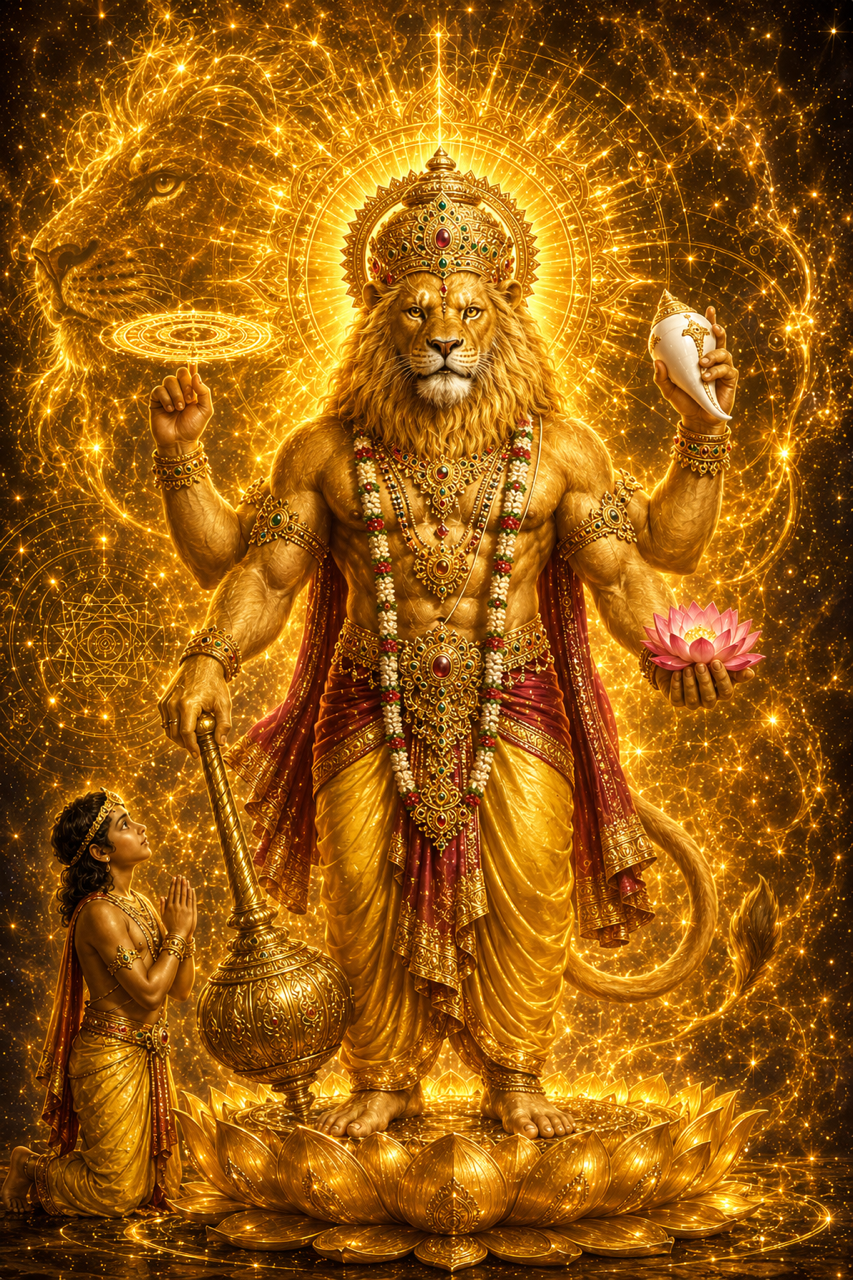
This piece depicts Lord Narasimha — the fourth avatar of Vishnu, the lion-headed protector — in a form that holds the complete paradox of his nature in a single image. He stands on a golden lotus, four-armed and resplendent in gold and precious gems, his lion face both fierce and composed, his bearing that of one for whom the battle is already over before it has been fought. The Sudarshana chakra blazes in his upper right hand. The shankha gleams in his upper left. The kaumodaki gada rests in his lower right. A pink lotus is offered in blessing in his lower left — the same lotus that Vishnu holds in the standing cosmic composition elsewhere in this collection, here present in the hands of his most fierce avatar, signalling that the fierceness and the grace are never separate.
At Narasimha's feet, young Prahlada kneels with his hands folded in the anjali mudra of prayer, his posture one of complete surrender and complete trust. The contrast between these two figures — the terrifying lion-deity above and the small, serene child below — is the iconographic core of the Narasimha tradition. The entire cosmic drama that Narasimha represents resolves into this single relationship: the deity of extreme fierceness kneeling toward, or receiving the prayer of, the one who simply and completely trusts. Behind both figures, a field of stars extends into the deep cosmos — the starfield in which the impossible event of Narasimha's manifestation occurred, the darkness from which the divine can emerge in any form when the one who loves it calls.
The palette is predominantly warm gold, deep amber, and the luminous blue-black of space — distinct from the celestial blue of the standing Vishnu composition and entirely appropriate to a form associated with the column of fire from which Narasimha burst, the cosmic threshold between the possible and the impossible.
About Lord Narasimha — The Fierce Protector
Lord Narasimha — Nara (man) + Simha (lion), the man-lion — is the fourth avatar of Lord Vishnu and one of the most theologically rich forms in the entire Vaishnava tradition. He is simultaneously the most fierce of Vishnu's avatars — the form that bursts from a stone column in a blaze of fire and light to tear a demon king apart with his bare hands — and the most tender, the deity who descended specifically to protect a child's faith and to honour a devotee's complete and unconditional trust.
Narasimha does not exist in ordinary iconographic terms. He is neither fully human nor fully animal, manifesting at a threshold that has no category in the ordinary taxonomy of existence. He appears neither in the daytime nor at night — at twilight. He appears neither inside nor outside — at a doorway threshold. He places the demon neither on the ground nor in the sky — on his own lap. He uses neither a weapon nor bare hands — his claws. He defeats through a form, a time, a place, and a method that exist in the gaps between every condition that was supposed to prevent defeat. The Narasimha story is the definitive Hindu account of what happens when the divine finds the gap in every limitation and moves through it to keep its promise to the faithful.
The Story of Prahlada and Hiranyakashipu
The mythological account of Narasimha's descent is found primarily in the Bhagavata Purana (seventh book) and is one of the most narratively complete and emotionally powerful stories in all of Hindu mythology.
The demon king's boon: Hiranyakashipu was a powerful asura (demon) whose brother Hiranyaksha had been killed by Vishnu in the Varaha avatar. Consumed by rage and grief, Hiranyakashipu undertook extreme austerities (tapas) to obtain a boon from Brahma that would make him effectively immortal. The boon he received was precisely specified: he could not be killed by man or beast, by day or night, inside or outside his palace, on earth or in the sky, by any living being created by Brahma, by any weapon, or by any animate or inanimate object.
Armed with this apparent invincibility, Hiranyakashipu conquered the three worlds, expelled the gods from the heavens, and declared himself the supreme being to be worshipped above all others. He then demanded that his own household acknowledge his supremacy.
Prahlada's refusal: The complication was his son. Prahlada was a child of extraordinary spiritual depth who, even in his mother's womb, had absorbed the teachings of the sage Narada on Vishnu's nature and glory. From infancy, Prahlada was a devoted Vaishnava — he chanted Vishnu's names, contemplated Vishnu's nature, and taught his young classmates to do the same. He had no interest in power, no fear of his father's wrath, and no capacity for pretending that his father was the supreme being when he knew, with complete certainty, that Vishnu was.
Hiranyakashipu's response to his son's refusal was systematic persecution. He had Prahlada thrown from a cliff, trampled by elephants, bitten by serpents, subjected to poison, thrown into fire, cast into the ocean, subjected to extreme cold, attacked by armed men. In each case, Prahlada remained unharmed — not because he was trying to survive, but because he had completely surrendered his survival to Vishnu and was therefore not in the scope of any harm that Hiranyakashipu could direct.
The column of fire: The final confrontation came when Hiranyakashipu, enraged beyond endurance, struck a palace column and demanded: "If your Vishnu is everywhere, is he in this pillar?" The question was a taunt — the demon king's last attempt to prove the emptiness of his son's faith by showing that no divine protector would emerge from a stone column.
The column split. From the crack between what was inside and what was outside, at the twilight hour that was neither day nor night, in the form that was neither man nor beast — Narasimha emerged. What followed is described in the Bhagavata Purana in language of extraordinary power: the demon king was dragged to the threshold of the palace (neither inside nor outside), placed on Narasimha's lap (neither on earth nor in the sky, and not in the grip of a weapon or a bare hand), and destroyed by Narasimha's claws, which are neither weapons nor hands as ordinarily understood.
Every condition of the boon was honoured. And every condition was transcended by the form that existed in the gaps between all conditions.
Prahlada — The Devotee Who Called This Form Forth
Prahlada is, in the Vaishnava tradition, one of the twelve Mahajanas — the great devotees through whose example the path of bhakti is most clearly demonstrated. His specific teaching is arguably the most radical: that genuine devotion, once established, cannot be touched by any external force. No threat, no punishment, no demonstration of the father's power could reach Prahlada, not because Prahlada was armoured or indifferent, but because he was simply not available to be disturbed. His attention was somewhere else entirely.
The child kneeling at Narasimha's feet in this artwork is not simply a narrative detail. He is the reason the form exists. Narasimha did not arise because Vishnu decided to manifest or because the cosmos required this particular event. He arose because Prahlada's complete, unconditional, undefended faith created the conditions — or more precisely, the impossibility — that Vishnu's love for his devotee could not leave unanswered. The Narasimha story is a story about what love does when it encounters the apparently impossible. It finds the gap.
In the Bhagavata Purana's account, after the demon is destroyed, Narasimha's fierce energy does not immediately subside. The gods and sages are afraid to approach him. Lakshmi herself hesitates. It is Prahlada who walks forward, completely unafraid, and places his head at Narasimha's feet — and at that touch, the fury dissolves. The child who called this form forth is also the one whose presence calms it.
The Iconography of This Artwork — Reading Narasimha
The lion face: The lion head on a human body is the defining characteristic of Narasimha — the form that exists between the human and the animal, in the gap between all the categories that Hiranyakashipu's boon covered. The face is simultaneously fierce and composed in this artwork: the lion's features are fully present, but the expression carries the resolution of one whose action is complete and whose nature is fundamentally protective.
Four arms with Vishnu's attributes: Despite the lion head and the fierceness of his form, Narasimha holds Vishnu's standard four attributes — chakra, shankha, gada, lotus — confirming his identity as Vishnu in this fierce avatar form. The lotus in the lower left hand is particularly significant: it signals that grace and fierceness are the same divine energy in different expressions.
The golden lotus throne: Narasimha stands on a lotus throne, the same symbol of purity and spiritual perfection that underlies all Vishnu forms. The lotus grounds the fierce avatar in the same spiritual reality as the serene cosmic sustainer.
Gold and gems: The rich gold ornamentation and jewelled adornment in this artwork place Narasimha in the register of regal, even celebratory, devotional art rather than only the fearsome or martial. This is the form as worshipped in his temples — adorned, honoured, and approached with the same devotional aesthetics as any other deity.
Prahlada at the feet: The small figure of Prahlada in anjali mudra at Narasimha's feet is the key that unlocks the entire composition. Without Prahlada, this is an image of a fierce deity. With him, it is an image of the most intimate possible relationship between the divine and the human: the one who trusts completely, and the form that arose to justify that trust.
The starfield background: The cosmic darkness and starfield behind the two figures places this event in the deep context of the cosmos — not in a palace corridor but in the infinite ground of existence from which Narasimha emerged when the column split. The stars are witness to the impossible that became possible because a child refused to stop trusting.
Narasimha's Temples and Tradition
Narasimha is worshipped across the Hindu world with a particularly strong tradition in South India and in the Sri Vaishnava tradition. The most important Narasimha temples include Ahobilam in Andhra Pradesh (the site traditionally identified as where the events of the Prahlada story occurred, featuring nine Narasimha shrines across the Nallamala Hills), Simhachalam in Andhra Pradesh, and the Narasimha shrines present in virtually every major Vaishnava temple complex.
The mantra most closely associated with Narasimha — the Narasimha Maha Mantra and the Ugra Narasimha Stotram — is understood in the Vaishnava tradition as particularly potent for protection, for the removal of fear, and for situations where ordinary means appear to have run out. The tradition holds that Narasimha's protection is specifically available to those whose trust, like Prahlada's, is complete and unconditional.
The Narasimha Jayanti — celebrated on the fourteenth day (Chaturdashi) of the bright fortnight of the month of Vaishakha (typically April/May) — marks the day of Narasimha's manifestation. It is observed with fasting, recitation of the Narasimha Stotrams, and special worship at Narasimha temples.
Displaying Narasimha in the Home
Narasimha is displayed in Hindu homes primarily in two contexts: in puja rooms where his protective presence is specifically invoked for the household, and in spaces associated with the practitioner's sadhana and inner practice.
The tradition of placing Narasimha's image at the entrance of the home — facing outward toward the threshold — is common in South Indian Vaishnava households, where he is understood to stand guard at the boundary between the protected interior and whatever may approach from outside.
For practitioners on a devotional path who understand faith as the central practice — who resonate with Prahlada's absolute, undefended trust as the model they wish to embody — the Narasimha image serves as a constant reminder of what complete trust looks like and what it calls forth.
The gold-and-starfield palette of this artwork works in a puja room, a meditation space, or a study. The figure is vertical and contained — it works well in a smaller frame (8×10 or 11×14) on an altar as much as in a larger print on a dedicated wall.
The digital download allows immediate printing at your preferred size. Print on matte or semi-gloss photo paper at FedEx Office, Staples, or any professional print shop.