About This Artwork
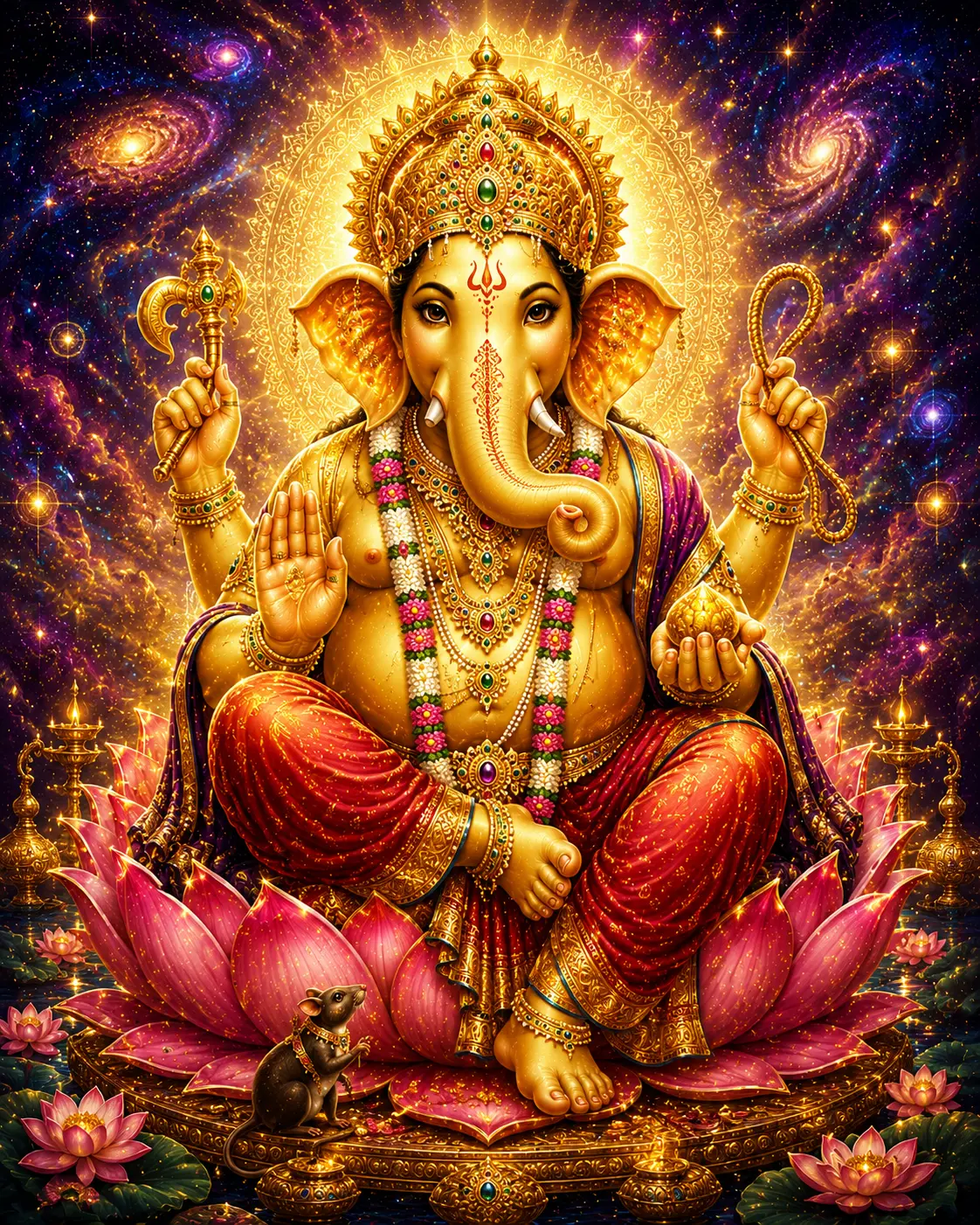
This piece depicts Lord Ganesha with his most recognisable attributes rendered in fine gold linework against a deep indigo ground. The composition centres on his elephant head — broad, calm, and alert — with large listening ears, a curved trunk, and the single broken tusk that appears in his right hand or rests at his side depending on the artistic tradition.
At Ganesha's feet sits Mushika, the small mouse who serves as his mount and vehicle. The choice of a mouse as vahana for the largest of deities is itself a piece of symbolic intelligence — the mouse moves through the smallest gaps, representing the mind's ability to penetrate obstacles that would stop a larger force.
The gold-on-indigo palette places this image in the visual language of temple devotion — the quality of light you find in a sanctuary lit by oil lamps, where every detail is deliberately drawn to draw the eye inward. The piece works in a dedicated meditation space, a home altar, a study, or anywhere a quiet and intentional presence is welcome.
About Lord Ganesha
Lord Ganesha — also known as Ganapati, Vinayaka, and Vighneshvara — is among the most widely worshipped deities in Hinduism and one of the most recognisable sacred images in the world. He is the son of Shiva and Parvati, and he holds a unique position in Hindu tradition as the deity invoked at the beginning of every important undertaking — a journey, a ceremony, a new business, a piece of writing, a ritual of any kind.
His elephant head, generous form, and calm, alert presence make him immediately distinct from every other deity in the Hindu pantheon. He is associated with wisdom, learning, the arts, the removal of obstacles, and the patronage of beginnings — which is why his image appears at the entrance of temples, at the start of sacred texts, and in the homes and workplaces of people across South Asia and across the world.
Who Is Lord Ganesha?
Ganesha is a primary deity — not a subsidiary figure or a regional variation, but one of the five principal deities of mainstream Hinduism (the Panchayatana). He is the elder son of Shiva, the great yogi and ascetic, and Parvati, the goddess of love, devotion, and power. His younger brother is Kartikeya (also known as Murugan), the warrior deity associated with victory and the planet Mars.
The name Ganesha is composed of two Sanskrit words: gana (a group, a category, an assembly) and isha (lord or master). He is therefore the lord of categories, of groups, of the assembly of beings — a role that extends into his association with language, classification, and the structures of knowledge.
He is worshipped across virtually all Hindu traditions and communities, and his presence extends well beyond Hinduism into Buddhist and Jain iconography, where similar elephant-headed figures appear in different theological roles.
Why Does Ganesha Have an Elephant Head?
The most widely told story of Ganesha's origin describes how Parvati created him from the clay or sandalwood paste she used to bathe, breathing life into the figure and setting him to guard her door while she bathed. A confrontation followed in which Ganesha was beheaded.
Parvati's grief was absolute, and Shiva — understanding what had happened — sent his attendants to find and bring back the head of the first living being they encountered sleeping with its head to the north. The first creature they found was an elephant. That head was brought back, placed on Ganesha's body, and Shiva restored him to life — and, in recognition of what had occurred, bestowed on him the status of first among all deities and foremost among all ganas.
The elephant head carries its own symbolism independent of the origin story. The elephant is associated in Indian tradition with wisdom, memory, intelligence, strength, and auspiciousness. An elephant does not forget. It is powerful but measured. It clears paths through dense forest — a natural image for the remover of obstacles.
What Does Ganesha Symbolize?
Ganesha's symbolism is dense and has been elaborated across centuries of commentarial tradition. Some of the most consistently described associations:
- The elephant head: wisdom, memory, discernment, the power of intellect applied to practical ends.
- The large ears: attentive listening — the capacity to hear what is subtle and important rather than simply what is loud.
- The trunk: adaptability and precision. An elephant's trunk can uproot a tree or pick up a coin — this duality represents the ability to handle both grand challenges and fine details.
- The broken tusk: sacrifice in pursuit of knowledge. One of the most cited stories involves Ganesha breaking off his own tusk to use as a pen to transcribe the Mahabharata as it was dictated by the sage Vyasa, without the pen breaking or the transcription stopping.
- Mushika the mouse: the mind. The mouse moves through every gap, reaches into every corner, finds its way through complexity — and yet Ganesha, who represents the higher intelligence that can direct and govern the mind, rides upon it.
Note: these are traditional associations drawn from texts and commentarial sources. They represent how the symbolism has been understood and transmitted within the tradition — not prescriptions for what a viewer should believe or experience.
Ganesha's Iconography — What to Look For in This Artwork
If you are new to Hindu sacred imagery, knowing what to look for transforms the viewing experience. In this artwork, look for:
- The single broken tusk — either held in Ganesha's hand or visible as a shortened tusk on one side of his face. This is one of his most distinctive identifying marks.
- The trunk — curved to the left in this image, which in iconographic tradition is associated with the ida nadi, the cooling energy channel, and with accessibility and approachability in devotional practice.
- The four arms — common in representations of Hindu deities, each arm may hold a different object. Common attributes include a lotus (representing purity and enlightenment), a modaka (a sweet, often associated with the sweetness of spiritual attainment), an axe or goad (representing the cutting away of obstacles or attachments), and a broken tusk.
- Mushika at the feet — look for the small mouse at or near the base of the composition, often depicted in miniature scale to emphasise Ganesha's grandeur by contrast.
- The gold-on-indigo palette — in this particular artwork, the deep indigo ground represents the infinite, the unmanifest, the space before form. The gold linework represents sacred form emerging from that ground — a visual language drawn from the traditions of temple devotion and manuscript illumination.
Displaying Ganesha in the Home
Ganesha imagery is among the most commonly displayed sacred art in Hindu households, workplaces, and public spaces. In traditional practice, the entrance of a home or the threshold of a room is a common placement — reflecting Ganesha's role as guardian and inaugurator. The image is often placed at eye level or higher.
In a meditation or puja space, Ganesha is typically the first image installed or the first invocation made, consistent with his status as the deity of beginnings. In a study or creative workspace, his association with learning, writing, and the arts makes him a natural companion.
This artwork works equally well in a dedicated sacred space and in a living room or hallway as a piece of art that carries meaning. The gold-on-indigo palette is formal enough for a focused meditation space and visually striking enough to hold its own on any wall.
As a practical matter: the digital download version allows you to choose your own print size and framing, which gives you full control over how the image fits your specific space. The finished print options — rolled poster, framed, and canvas — offer a ready-to-hang alternative if you prefer not to manage printing yourself.