About This Artwork
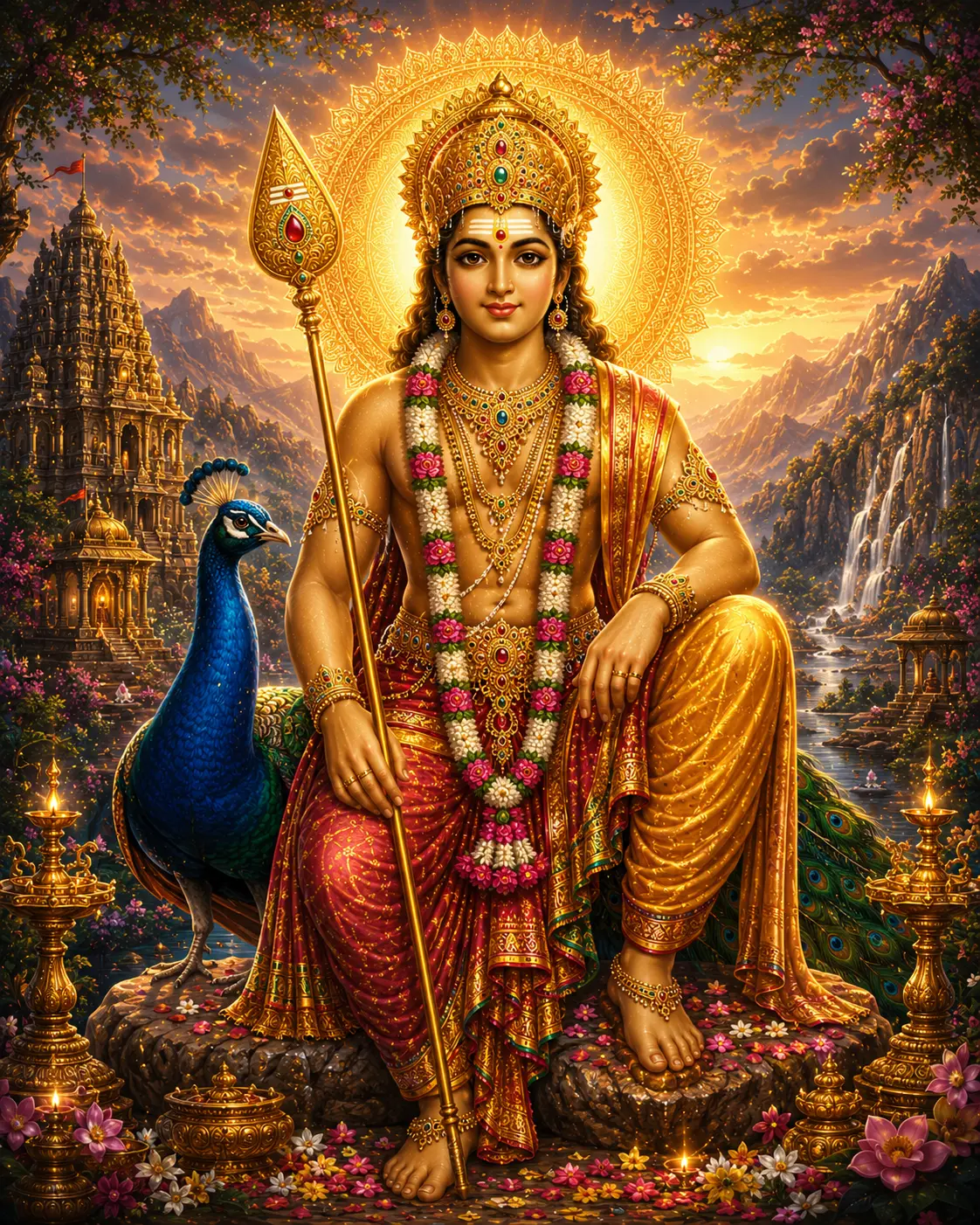
This piece depicts Lord Kartikeya — known across South India as Murugan, and across the broader Hindu tradition as Skanda, Subrahmanya, Shanmukha, and Saravana — in his primary iconographic form as the divine warrior deity. He stands radiant and youthful, his expression carrying the serene certainty of one whose victories are not in question. In his hand he holds the vel — the sacred spear of divine wisdom — with the commanding ease of one for whom this instrument is as natural as breath.
Behind and beside him, the peacock spreads its iridescent feathers in full display. A temple structure and waterfall are visible in the background; golden oil lamps (diyas) frame the foreground, placing the scene in the visual language of active worship rather than mythological distance. The palette is brilliant — deep gold, celestial blue, the vivid iridescence of the peacock's plumage — dynamic and alive in a way that distinguishes Kartikeya's visual register from the quieter, more contained energy of the Shiva meditation image or the pastoral warmth of the Krishna composition. This is a deity of active energy, clarity, and movement.
The piece works in a home altar or puja space, a yoga or meditation room, a study, or a creative workspace — anywhere that the qualities associated with Kartikeya (clarity, decisiveness, the cutting through of confusion) are welcome.
About Lord Kartikeya — Murugan, the Divine Warrior
Lord Kartikeya is the elder son of Shiva and Parvati and the younger brother of Ganesha, and he occupies a position in Hindu tradition that is both universal and regionally concentrated in a way unlike most other major deities. He is worshipped across the entire Hindu world under different names — Skanda and Kumara in Sanskrit literature and North Indian traditions, Subrahmanya in Karnataka and Andhra, Shanmukha (the six-faced one) in philosophical contexts, and Murugan above all in Tamil Nadu and in the global Tamil diaspora, where his presence is so pervasive that Tamil culture and Murugan devotion are effectively inseparable.
In the broader Shaiva tradition he is the commander of the celestial armies (Devasena), the warrior who defeated the demon Surapadman and restored order to the cosmos. In the Tamil Shaiva Siddhanta tradition he is something considerably deeper than a warrior god — he is Guru, the divine teacher who whispered the meaning of the Pranava (Om) into his own father Shiva's ear, demonstrating that wisdom runs in every direction and that the teacher may appear in any form.
Who Is Lord Kartikeya? — His Names and Their Meanings
The multiplicity of Kartikeya's names reflects the multiplicity of traditions that have gathered around him over millennia, each contributing a different angle on his nature:
- Kartikeya: The most widely used name in North Indian and Sanskrit contexts. Derived from the Krittikas — the Pleiades, the six star-mothers who nursed the infant Skanda after his fiery birth from the spark of Shiva's concentrated energy. The name honours those six mothers.
- Murugan: The Tamil name, meaning the beautiful one, the young one, the fragrant one. In Tamil devotional literature Murugan is not simply a deity but a presence — the beauty of the hills (in the Sangam age landscape poetry, the kurinji or mountain landscape is Murugan's domain), the energy of youth, vitality, and the inexhaustible.
- Skanda: From the Sanskrit root meaning to leap or to flow — associated with the spilling of Shiva's seed that gave rise to Kartikeya's birth, and with the rapid, decisive nature of his energy.
- Shanmukha: The six-faced one. Six faces, twelve arms, the deity who looks simultaneously in all six directions — north, south, east, west, up, and down — representing awareness that excludes nothing and comprehends everything simultaneously.
- Subrahmanya: Associated particularly with the Shaiva Siddhanta tradition of South India. The name is understood as pointing to the one who is very close to Brahman — to the absolute — or as the one who nurtures or enlightens seekers on the path toward the absolute.
- Kumara: The eternal youth, the ever-young — Kartikeya does not age in the iconographic tradition, and his perpetual youth is not simply aesthetic but signals the inexhaustible, ever-fresh nature of the divine energy he embodies.
The Vel — Kartikeya's Spear of Divine Wisdom
Of all the attributes associated with Lord Kartikeya, the vel is the most immediately distinctive and the most iconographically consistent across all traditions and regions. It is always present. It is, in many depictions, sufficient by itself to identify the figure as Kartikeya even when other details are absent.
The vel is a spear — but in the Shaiva Siddhanta interpretation of Murugan's mythology, it is specifically the spear of divine wisdom (jnana shakti vel), given to Kartikeya by his mother Parvati. The vel is the concentrated force of discriminative intelligence — the capacity to see through illusion, to distinguish between the real and the apparent, to cut through confusion with a single decisive act of clarity.
The story of the vel's deployment against the demon Surapadman is read in the devotional tradition not merely as a mythological battle but as an inner event: the vel represents the moment of clarity that destroys the demon of ignorance not through force but through the absolute precision of awakened perception. Surapadman, in his final form as a mango tree, was split by the vel into two — one half becoming Kartikeya's peacock vahana, the other his rooster banner. The enemy is not destroyed but transformed: this is the vel's ultimate action.
The Peacock — Symbol of Transformation
The peacock that appears prominently in this artwork is not merely Kartikeya's vehicle — it is one of the most semantically rich elements in his iconography.
The peacock in Indian tradition is associated with rain, with beauty that arrives after darkness, with the transformation of what is difficult or toxic into something radiant. Peacocks eat snakes — the poison of the serpent becomes, through the peacock's metabolism, the iridescent beauty of its feathers. This transformation is central to understanding the peacock as Kartikeya's vahana: the energy that rides on transformation, that takes what is difficult and converts it into something luminous.
In the mythology of Surapadman, the demon himself becomes the peacock after his defeat — the enemy's energy is not annihilated but transmuted, brought into service. The peacock that spreads its feathers behind Kartikeya in this artwork is therefore not a decorative flourish. It is the symbol of the fundamental nature of Kartikeya's path: not the destruction of what opposes, but the transformation of it into beauty and service.
Kartikeya and the Tamil Shaiva Siddhanta Tradition
While Kartikeya/Murugan is worshipped across the Hindu world, his deepest philosophical and devotional elaboration has occurred within the Tamil Shaiva Siddhanta tradition — one of the most sophisticated and complete of all Hindu theological systems, and one of the oldest continuously practised spiritual traditions in the world.
Tamil devotion to Murugan finds its earliest expression in the Sangam literature (roughly 300 BCE to 300 CE), where Murugan is already a fully formed presence associated with the mountain landscape, with love, with vitality, and with the young warrior energy that is also, in the Tamil poetic understanding, the energy of erotic and devotional longing simultaneously.
The Tirumurugaṟṟuppaṭai (Guide to Lord Murugan) is among the earliest explicitly devotional texts in Tamil — a guide to the six sacred abodes (arupadaiveedu) of Murugan in Tamil Nadu, each associated with a different aspect of his nature and each a major pilgrimage site: Palani, Tiruchendur, Swamimalai, Tiruttani, Pazhamudircholai, and Thiruparamkunram. The six abodes are still among the most visited pilgrimage destinations in South India.
The Thirumurugatrupadai and the later devotional literature of the Nayanars (the Shaiva saint-poets, including Appar, Sundarar, and Manikkavacakar) established Murugan within a complete theological and devotional framework that continues to sustain millions of Tamil Hindus worldwide. Murugan temples are found across the Tamil diaspora — in Sri Lanka, Malaysia, Singapore, South Africa, Fiji, the United Kingdom, the United States, Canada, and Australia — and the Thai Pusam festival celebrated at major Murugan temples (notably the Batu Caves in Malaysia, the Murugan Temple in London, and the Palayamkottai temple in Tamil Nadu) is among the most spectacular expressions of Hindu devotion in the contemporary world.
Kartikeya's Iconography — What to Look For in This Artwork
- The vel: Held in the right hand or planted beside the figure, the vel's distinctive leaf-shaped blade and often-ornate shaft make it immediately recognisable. In this artwork it is held with the ease and confidence of one for whom it is the natural extension of consciousness.
- Shanmukha — the six faces: Classical representations of Kartikeya show six faces and twelve arms. In this artwork the single-face representation is used — the more commonly displayed form in devotional painting — but the tradition of six faces remains part of how he is understood.
- The peacock: Spreading its iridescent plumage behind the deity, the peacock in this composition is depicted in full display — the position associated with the onset of rains and with the fullest expression of the bird's beauty.
- Youth and radiance: Unlike the majestic gravitas of Vishnu or the ascetic stillness of Shiva in meditation, Kartikeya's iconography emphasises youth, beauty, and active vitality. He is always depicted as young, always glowing, always in a state of dynamic readiness rather than composed withdrawal. This quality — what the Tamil tradition calls the beauty of kurinji — is integral to how he is understood and how he is approached in devotion.
- Temple and waterfall in background: These elements place the composition in the sacred landscape of South India — the hill temple and the descending water are visual signatures of Murugan's domain, the mountain (malai) being his primordial landscape in Tamil tradition.
Displaying Kartikeya in the Home
Kartikeya/Murugan imagery is a fixture in Tamil Hindu households worldwide and is increasingly found beyond Tamil communities among all who are drawn to the warrior archetype in Hindu iconography. The altar or puja space is the most natural placement — particularly in Tamil homes where Murugan may hold a central or sole position.
For those outside the Tamil tradition, Kartikeya is a meaningful presence in any space dedicated to clarity of mind, decisive action, or creative work. His association with discriminative wisdom (viveka) makes him a natural companion for study, writing, and any work that requires the capacity to cut through confusion to what is essential.
In a yoga or meditation space he represents the active, dynamic pole of the spiritual path — the complement to the inward stillness of the Shiva meditation image. Where Shiva sits in absolute stillness, Kartikeya moves with absolute precision. Both are needed; both belong in a complete practice space.
This artwork is available as an instant digital download in five sizes, and as a finished rolled poster, framed print in four frame colour options, or gallery-wrapped canvas — all ready to display without further preparation.