About This Artwork
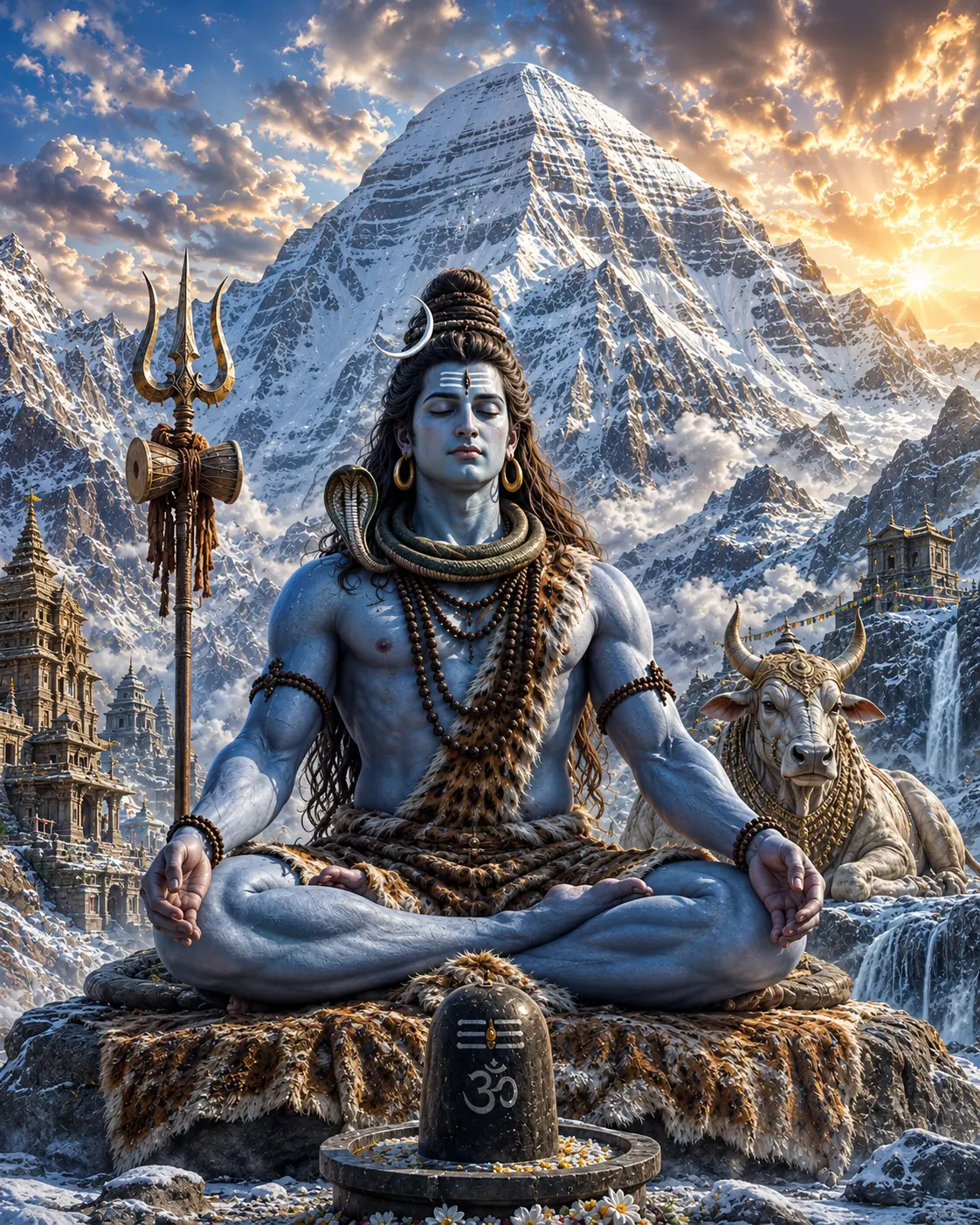
This piece depicts Lord Shiva in the form most immediately associated with meditation and with the origins of yoga — seated in padmasana on a tiger skin, in a state of absolute stillness, on the snow peak of Mount Kailash. His blue form radiates a quality of contained power that is distinct from every other depiction in this collection: this is not the fierce Shiva of the cremation ground, nor the cosmic dancer of the Nataraja, but the Adi Yogi — the first yogi — absorbed in the meditation from which, according to tradition, the entire science of yoga and inner transformation emerged.
The composition is dense with iconographic detail. The trishul is planted beside him. A cobra winds at his neck. Rudraksha beads cross his chest. Nandi, his bull and faithful attendant, rests at the lower right. In the foreground stands a Shivalinga bearing the Om symbol. To the left, the outline of an ancient temple. Behind him, waterfalls cascade down Himalayan slopes, and above it all, the great snow peak of Kailash rises against a golden sunrise sky.
The gold and luminous blue palette — blue skin, golden light, the deep indigo of the background — places this image in the visual tradition of sacred Himalayan iconography, where Shiva's domain is always understood as elevation: the highest peak, the deepest meditation, the stillness beyond all movement. The piece works in a dedicated meditation or yoga space, a home altar, or any room where a quality of quiet and depth is welcome.
About Lord Shiva
Lord Shiva is one of the three principal deities of Hinduism — alongside Brahma and Vishnu, he forms the Trimurti, the divine triad through which creation, preservation, and dissolution are understood. Within that framework, Shiva is associated with dissolution and transformation: he is the force that ends cycles so that new ones can begin, the presence that clears what has accumulated so that what is essential can remain.
But to describe Shiva only as a deity of destruction is to miss what makes him so central to Hindu tradition and so deeply embedded in the practice of yoga. Shiva is also the Adi Yogi — the first yogi, the originator of the science of inner transformation who, according to the tradition of Adiyoga, transmitted the complete knowledge of yoga to the seven sages (saptarishis) on the banks of the Kantisarovar lake in the Himalayas. In this sense, every tradition of yoga, every practice of meditation, every method of using the body and breath to alter inner states traces itself back to Shiva.
He is simultaneously the supreme ascetic — dwelling on Mount Kailash in eternal meditation, wearing the tiger skin of the forest, rubbing ash on his body, matted hair locked in a crown — and the devoted husband of Parvati and father of Ganesha and Kartikeya. He is the destroyer of ego and illusion and the most intimate of deities, accessible to those who approach him with genuine sincerity regardless of social status or ritual propriety. In the Shaiva traditions, he is not a distant cosmic principle but a living presence in the world.
Who Is Lord Shiva? — His Place in the Hindu Tradition
Shiva's names are numerous — more than 1,008 names appear in the Shiva Sahasranama — and each points to a different aspect of his nature. Some of the most commonly encountered:
- Mahadeva — the great god, a title signifying his supreme status within Shaiva theology.
- Shankar — the auspicious one, the giver of blessings; this is the benevolent face of Shiva, the deity worshipped in family homes and village temples across India.
- Nataraja — the lord of the cosmic dance, depicted in his famous dancing form within a ring of fire, one foot raised, one planted on the figure of Apasmara (forgetfulness or ignorance). This form is explored in a separate page in this collection.
- Adi Yogi — the first yogi; the form depicted in this artwork, seated in meditation as the original practitioner and teacher of yoga.
- Rudra — the roarer, the fierce; Shiva's older Vedic form, associated with storms, wild places, and the untameable aspects of nature.
- Bhairava — the terrifying form, associated with the cremation ground, with time, and with the dissolution of illusion. Also explored separately in this collection.
Shiva belongs to no single region of India and to no single caste or community. Shaivism — the broad family of traditions centred on Shiva — encompasses Kashmir Shaivism (with its sophisticated philosophy of consciousness), the Shaiva Siddhanta of Tamil Nadu, the Vira Shaivism (Lingayat) of Karnataka, and the widespread popular devotion (bhakti) traditions of the Deccan and the Gangetic plain. The Shiva Purana, the Linga Purana, and the relevant sections of the Mahabharata are among the primary textual sources.
What Does Shiva Symbolize? — The Iconographic Elements of This Artwork
The Kailash meditation composition is one of the most iconographically complete representations of Shiva. Each element in this artwork carries meaning:
- Blue skin: Shiva's blue complexion in this tradition is associated with the poison Halahala that he swallowed to save the universe during the churning of the cosmic ocean (Samudra Manthan). He held the poison in his throat rather than swallowing it — his throat turned blue, giving him the name Neelakantha (the blue-throated one). The blue also connects Shiva to the infinite sky and to consciousness itself.
- Padmasana on tiger skin: The lotus posture signals meditation — the disciplined, inward-turning stillness through which inner transformation occurs. The tiger skin beneath him is among the most consistent attributes in Shiva iconography: it signals his mastery over the animal forces of the mind, the tiger representing ego, desire, and the untamed aspects of human nature that yoga seeks to bring under awareness.
- The trishul (trident): Shiva's weapon and emblem. The three prongs represent different triads depending on the tradition — creation, preservation, destruction; the three gunas (tamas, rajas, sattva); past, present, future; the three nadis (ida, pingala, sushumna) of the subtle body. At its most fundamental, the trishul is the symbol of Shiva's absolute sovereignty over time and the three planes of existence.
- The cobra (Vasuki): The snake wound at Shiva's neck is Vasuki, the king of nagas. In Shaiva iconography, the cobra represents awakened kundalini energy — the serpent power that, in yoga practice, is understood to rise from the base of the spine through the central channel (sushumna) toward the crown. Shiva wears the awakened serpent as an ornament, signifying his complete mastery of this energy.
- Rudraksha beads: The rudraksha is the seed of the Elaeocarpus ganitrus tree, sacred to Shiva and widely used in the practice of mantra and meditation. Rudrāksha means "the eye of Rudra" — the beads are understood to have originated from Shiva's tears. They are worn by practitioners across Shaiva, Shakta, and Vaishnava traditions as an aid to meditation and as a mark of devotion.
- Nandi: Shiva's bull and vehicle (vahana) rests to the right of the composition. Nandi is Shiva's most devoted attendant — the gatekeeper of Kailash, the guardian of the threshold between the ordinary world and Shiva's domain. In a deeper reading, Nandi represents the dedicated disciple, the one who sits and waits with total patience at the entrance to the master's presence.
- The Shivalinga with Om: In the foreground of this artwork, a black Shivalinga bears the Om symbol. The Shivalinga is one of the most widely worshipped sacred forms in Hinduism — an aniconic representation of Shiva that is not simply a symbol but, in the Shaiva understanding, a direct embodiment of Shiva's presence. The Om symbol on the linga connects it to the primordial sound from which all of creation is understood to have emerged.
- Mount Kailash: The Himalayan peak that rises behind Shiva in this composition is not simply a backdrop. Kailash is understood in Hindu, Buddhist, Bon, and Jain traditions alike as the sacred axis of the world — the Meru of mythology, the point where heaven and earth meet, the abode of Shiva and Parvati. The mountain has never been climbed and remains under a voluntary moratorium — it is circumambulated (pradakshina) by pilgrims rather than ascended. Its presence in this composition is not incidental: it places Shiva literally at the summit of the world, in the highest and most removed location, as far from the noise of ordinary life as it is possible to be.
Shiva and the Origins of Yoga
The Adi Yogi tradition holds that Shiva was the originator of yoga — not in a mythological sense alone, but as a historical transmission. According to this account, Shiva first transmitted the complete science of yoga to Parvati (the first student) and then, at the request of a group of seven sages who gathered to receive his teaching, transmitted it in seven different directions — the seven streams of yoga that became the root traditions of Indian inner science.
This story is the basis for Shiva's title of Adi Yogi, and it is the reason that Shiva in meditation is the most natural image for a yoga practitioner's space. The image of Shiva on Kailash is not simply beautiful — it represents the source from which the practitioner's own path came.
Whether this account is understood literally or metaphorically, it points to something real: Shiva is the deity most closely associated with inner practice, with the technologies of consciousness, and with the radical possibility that a human being can move beyond ordinary states of experience into something qualitatively different. That is the proposition at the heart of yoga, and Shiva is its emblem.
Displaying Shiva in the Home
Shiva imagery is found in virtually every Hindu home and in most yoga studios, meditation centres, and practice spaces in India and increasingly worldwide. The Shivalinga — in the form depicted in this artwork's foreground — is the most widely installed sacred object in Hindu domestic practice. The meditation form of Shiva depicted here is particularly associated with spaces dedicated to inner practice.
In a home altar or puja space, the Kailash Shiva composition carries a quality of depth and stillness that is distinct from more devotional or celebratory forms. It is an image that invites a similar quality in the viewer — not excitement or joy in the way that a Krishna image might, but quiet, depth, and the sense of something vast and still beneath the surface of things.
In a yoga or meditation space, the Adi Yogi is a natural choice: it is an image of what practice points toward. In a study or creative workspace, Shiva as the originator of consciousness science — and as Dakshinamurti, the teacher facing south — is a meaningful presence for any form of sustained enquiry or creative work.
This artwork is available as an instant digital download for home printing in five sizes, and as a finished rolled poster or framed print in your choice of frame colour, ready to hang.