About This Artwork
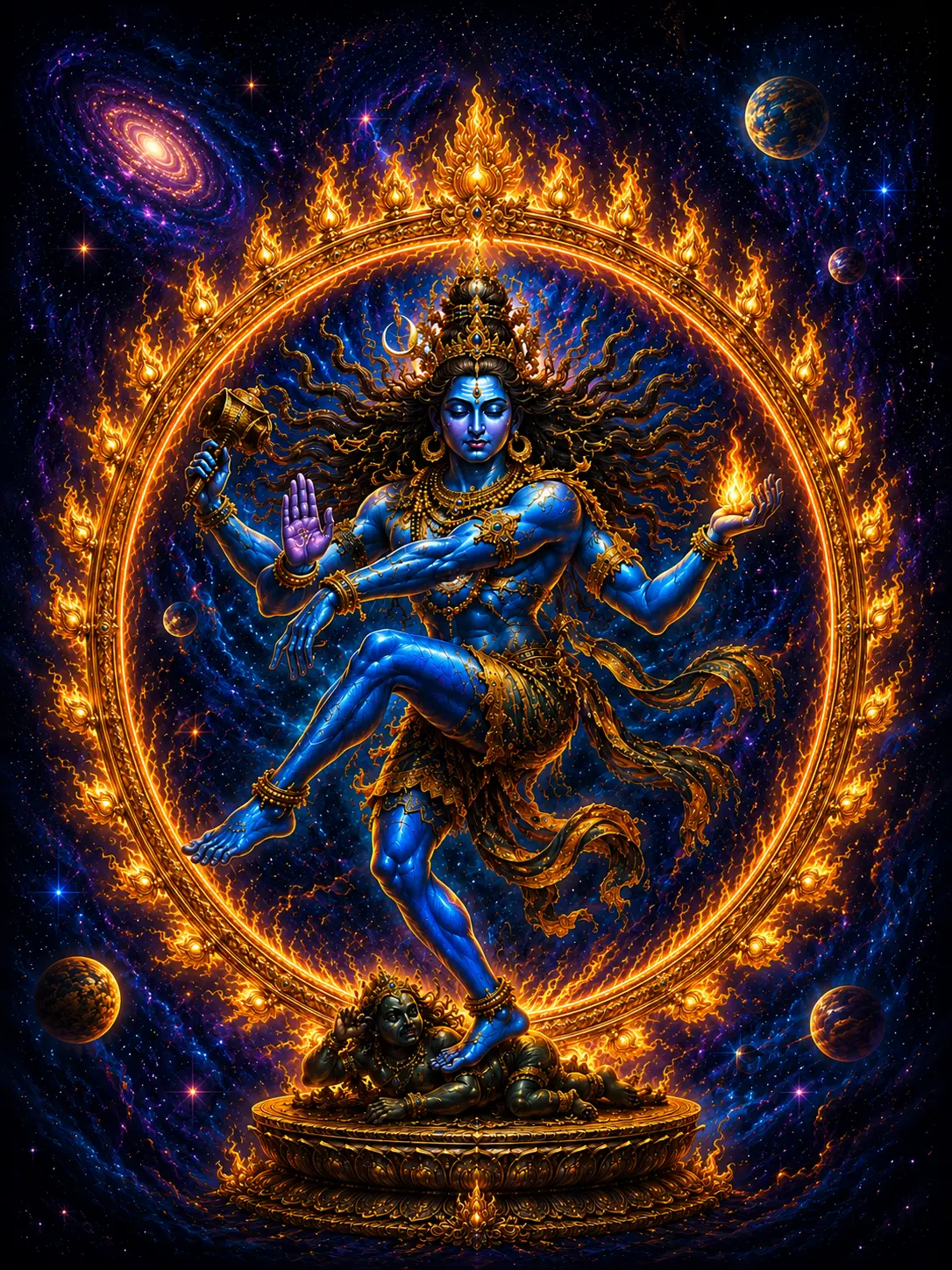
This piece depicts Lord Shiva in the Nataraja form — the Cosmic Dancer — performing the Ananda Tandava, the Dance of Bliss, within the prabhamandala: the blazing golden ring of fire that circumscribes the boundaries of the manifest universe. His blue form moves within this ring against a deep cosmic backdrop of star fields and space, a palette of sapphire, gold, and deep cosmic purple that places the image simultaneously in the register of sacred iconography and of contemporary consciousness of the cosmos at large scale.
Four arms extend in the precise configuration established by centuries of South Indian bronze-casting and temple iconography. The upper right hand holds the damaru, the small hourglass drum whose beat is the primordial sound of creation. The upper left hand holds a tongue of flame — the fire of dissolution that ends each cycle. The lower right hand is raised in abhaya mudra, the gesture of protection and fearlessness. The lower left extends in the gajahasta pose, pointing toward the raised left foot — toward liberation.
Beneath the right foot, pressed into the ground, is the small figure of Apasmara — the dwarf demon of forgetfulness, of inattention, of ego. Shiva dances upon him, not to destroy but to hold him down — to keep the force of ignorance contained while the dance of consciousness continues. The raised left foot is the promise of moksha, of release, available to those who attend to the dance.
The fire ring that encloses everything is both boundary and liberation — it marks the edge of the universe as we know it and, to those who understand the iconography, the threshold of what lies beyond. This is among the most complete cosmological images in any artistic tradition in the world — a map of the entire universe and of the practitioner's inner landscape simultaneously.
About the Nataraja — Shiva as the Cosmic Dancer
The Nataraja — Shiva as the Lord of the Dance — is one of the most widely recognised and most philosophically complete sacred images ever created. It emerged from the South Indian Shaiva tradition, achieved its canonical form in the bronze sculptures of the Chola period (roughly 850–1250 CE), and has since become one of the defining images not only of Hindu devotional art but of world art at large.
The Nataraja appears at the entrance of the CERN particle physics laboratory in Geneva, installed there as a gift from the Government of India — a recognition acknowledged by physicists that the image of Shiva's dance and the modern scientific understanding of the subatomic processes of creation and dissolution share something more than metaphorical resonance. The physicist Fritjof Capra, in his influential work on the parallels between modern physics and Eastern mysticism, used the Nataraja as a central image for precisely this reason.
The fact that a 12th-century bronze sculpture from Tamil Nadu speaks meaningfully to 21st-century particle physics is not a coincidence of aesthetics. It is a consequence of the extraordinary depth of the cosmological vision that the image was designed to express.
What Is the Ananda Tandava?
Tandava is the fierce, vigorous dance associated with Shiva — the dance of power, the dance that shakes the cosmos. There are traditionally seven forms of Shiva's tandava. The Ananda Tandava — the Dance of Bliss — is the most celebrated and the one depicted in the Nataraja iconography.
It is performed, according to tradition, in the Chit Sabha — the Hall of Consciousness — at the Nataraja temple in Chidambaram, Tamil Nadu. Chidambaram is one of the Pancha Bhuta Stalas — the five temples in South India each associated with one of the five classical elements. Chidambaram's element is akasha — space, ether, the void, the dimension of pure consciousness. Shiva dancing in the Chit Sabha is Shiva dancing in the space of pure awareness itself.
The Ananda Tandava is not a dance of destruction — that is a common misreading. It is a dance of bliss: the spontaneous, continuous movement of consciousness that is the very nature of existence at every scale, from the subatomic to the cosmic. In this reading, the universe is not a static arrangement of matter but a continuous performance — a dance in which creation, preservation, and dissolution are not sequential events but simultaneous aspects of a single ongoing movement.
The Five Actions — Panchakriya
The Nataraja iconography encodes the Panchakriya — the five cosmic actions of Shiva — with precise, intentional exactness. Each of the four arms and the two feet corresponds to one of these five actions:
Srishti — Creation: The upper right hand holds the damaru, the hourglass drum. The sound of the damaru is the primordial Nada — the original vibration from which all of existence emerges. In the Vedic understanding, sound (shabda) precedes form; the universe is called into being by vibration before it takes material shape. The damaru's two-beat rhythm represents the binary pulse of consciousness — the alternation of being and non-being, presence and absence, that underlies all manifestation.
Sthiti — Preservation: The lower right hand is raised in abhaya mudra — the palm facing outward in the gesture of protection and assurance: do not fear. This is the action of maintaining the universe in existence, of the continuity that allows experience to occur between the moments of creation and dissolution. Shiva as preserver is not Vishnu's role — it is the stillness within the dance, the continuity within the movement.
Samhara — Dissolution: The upper left hand holds a tongue of flame. Fire is the element of dissolution — the force that ends one cycle so the next can begin. In the Indian cosmological framework, dissolution is not destruction but renewal: the clearing of what has accumulated so that the ground is prepared for new creation. The flame and the drum are in equilibrium — creation and dissolution held simultaneously in the two upper hands.
Tirobhava — Concealment: The right foot presses down on Apasmara, the dwarf demon of forgetfulness, of ego, of the inability to perceive clearly. Apasmara represents the force that conceals the true nature of reality from ordinary perception — the maya that makes the dance look like solid, permanent matter rather than the continuous movement of consciousness that it actually is. Shiva does not destroy Apasmara; he holds him down. Concealment is a necessary part of the cosmic game — without it, there would be no experience, no learning, no path of return.
Anugraha — Liberation and Grace: The raised left foot is the fifth action — the gesture of grace, of liberation, of moksha. The lower left hand points toward it: look here, this is what is available. The raised foot is not the consequence of the dance but its constant offering — liberation is always already available, always present within the dance, for those whose attention turns toward it.
Reading the Nataraja — What to Look For in This Artwork
The prabhamandala (fire ring): The blazing golden ring within which Shiva dances is the boundary of the manifest universe. It is simultaneously the wall that separates samsara (the cycle of experience) from what lies beyond it, and the fire of consciousness that ultimately consumes every limit. In this artwork the ring is rendered in brilliant gold against the deep cosmic backdrop — it reads both as a frame and as a source of light.
The damaru: The small hourglass drum in the upper right hand is held between thumb and forefinger and shaken to produce the primordial beat. Its sound is the Nada Brahma — the creative sound of consciousness. In Shaiva cosmology, the Pranava (Om) emerges from this beat as the first differentiation of the formless absolute into the manifest.
The flame: Held in the upper left hand, the flame is the complement to the drum — dissolution balancing creation, the end-of-cycle fire that corresponds to the beginning-of-cycle sound. Together the two hands hold the complete rhythm of existence.
Apasmara: The small, somewhat comical figure crushed under Shiva's right foot is not simply a defeated enemy. Apasmara means literally "one who has forgotten" — he is the personification of the ordinary human condition of forgetfulness of one's true nature. His presence in the iconography is not incidental; he is structurally necessary, representing what the dance holds in check so that the world can continue to unfold.
The cosmic background: In this artwork, Shiva dances not against a neutral ground but against a field of stars and deep cosmic space. This extension of the image beyond its traditional flat background connects the ancient cosmological vision to the modern scientific awareness of the scale and nature of the universe — the same resonance that led CERN to install a Nataraja at its entrance.
The Nataraja and Science — Why This Image Speaks Beyond Religion
The Nataraja has attracted serious attention from scientists and philosophers of science for a reason that is worth stating directly, because it is part of why this image has achieved such extraordinary cross-cultural reach.
Modern physics describes a universe in which matter is not solid substance but a continuous field of energy — in which particles are patterns of vibration, in which the distinction between creation and destruction at the subatomic level is statistical rather than absolute, in which the vacuum of space is not empty but seething with virtual particles continuously appearing and annihilating. The Nataraja — dancing within the fire of dissolution and creation simultaneously, standing on the compressed ego of ordinary perception, playing the drum of primordial vibration — captures something about this picture that the conceptual language of modern physics describes only with great difficulty.
This is not to say that the rishis who formulated the Shaiva cosmology were conducting particle physics experiments. It is to say that the deepest intuitions about the nature of reality, pursued far enough, arrive at descriptions that rhyme across the distance of millennia and the gulf between methods. The Nataraja is one of the clearest examples of this convergence in any artistic tradition.
Displaying the Nataraja in the Home
The Nataraja is among the most displayed sacred images in Hindu homes worldwide and is arguably the single most recognised Hindu sacred image in Western homes, galleries, and public institutions. Its cross-cultural legibility — the visual power of a figure dancing within a ring of fire — makes it accessible to viewers with no prior knowledge of the iconographic tradition while remaining inexhaustible in depth for those who bring that knowledge to it.
In a yoga studio, the Nataraja is the natural presiding image — Shiva as the original yogi and as the embodiment of the truth that yoga points toward: that beneath the movement of practice, beneath the fluctuations of body and mind, there is a stillness that is itself the source of the dance. In a meditation room or home altar, the image carries both the energy of Shiva's most dynamic form and the deep stillness that makes the dance possible.
In any living space — living room, study, hallway — the Nataraja works as a statement piece of exceptional visual power. The gold-blue-cosmic purple palette of this artwork makes it bold enough to anchor a wall while remaining sophisticated in its colour use.
The canvas format is particularly well-suited to this image — the gallery-wrap allows the cosmic ring and starfield to extend to the edges of the frame, giving the piece the quality of a window opening onto the cosmos. The framed print with a black frame creates a similar effect within a more contained and formal presentation.