About This Artwork
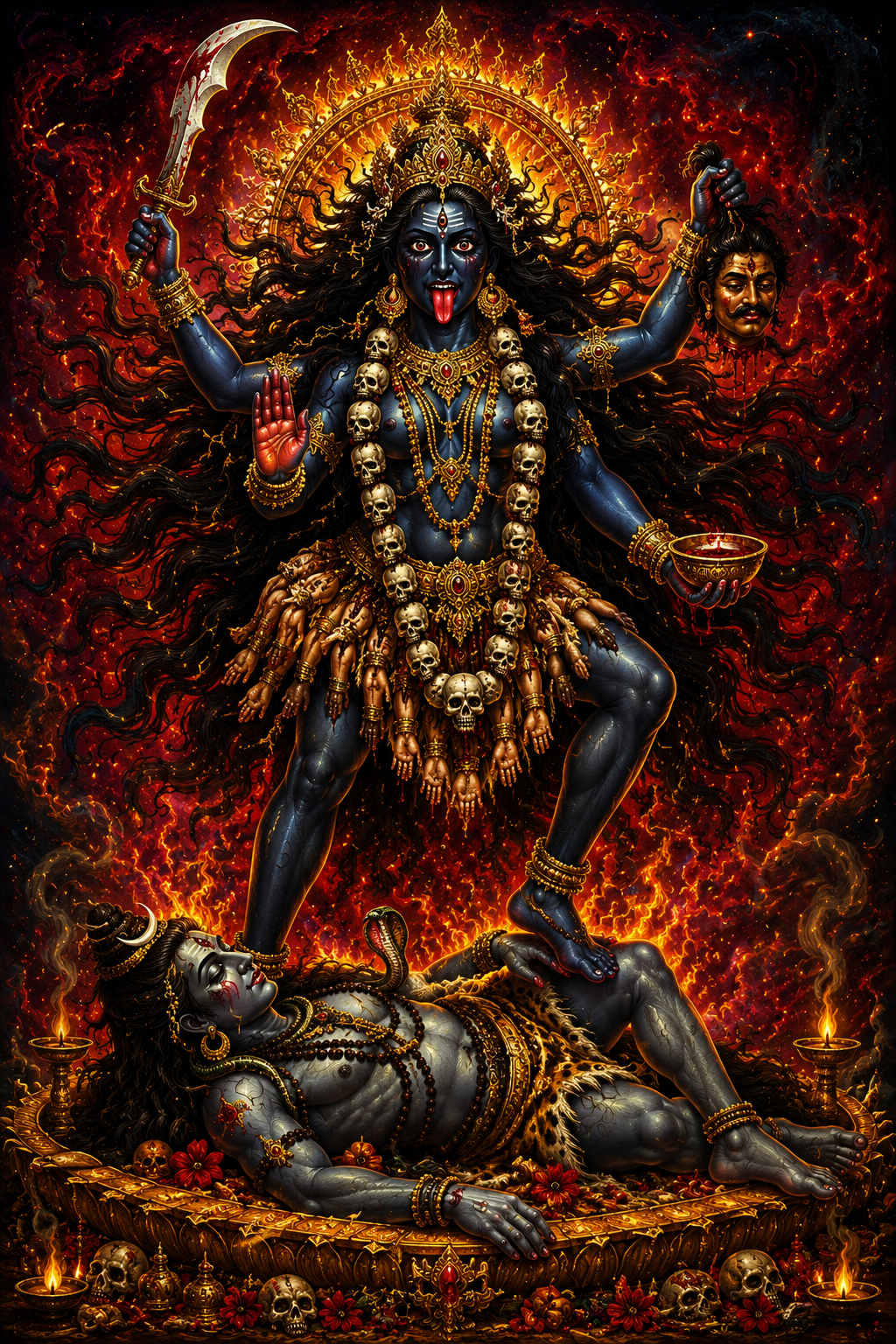
This piece depicts Maa Kali in the Mahakali form — the first and supreme of the Dasha Mahavidyas, the most primary and complete expression of the divine feminine's transformative power, the goddess who stands at the beginning of the Mahavidya sequence because she represents what all the other nine are expressing in different modalities and at different levels of intensity. Her complexion is luminous blue-black — the deep, absorbing darkness that in the tradition is not the absence of light but its source, the primordial ground from which all illumination arises. She stands in the Dakshinamukhi posture — the southern-facing position that in the Shakta tradition is the posture of liberation, the direction of Yama (the lord of death), the direction that transcends the ordinary fear of mortality.
Four arms extend in the precise arrangement of her most widely depicted form: the upper left hand holds the khanda — the cleaver, the instrument of the sharp cut that severs what is not real from what is; the upper right hand holds the munda — the severed head of the demon ego, the result of Kali's action; the lower left hand extends in varada mudra, the gesture of freely flowing grace; the lower right in abhaya mudra, the gesture of fearlessness extended to all who stand before her. Around her neck, the garland of skulls — fifty-two in the most commonly given count, each representing one of the fifty-two Sanskrit letters, the entire field of speech and language and the ego-identities constructed through it. At her waist, a skirt of severed arms — the actions and their consequences, the accumulated karma that Kali, in her grace, relieves the devotee of.
She stands on the reclining form of Shiva — Mahakala, the great lord of time, the supreme Shiva. This is the most theologically dense element of the entire composition. Her extended tongue — the red slash of direct perception that tastes the blood of the demon she has just dissolved — touches the recognition of what she has done: she has gone beyond even Shiva, beyond even time itself. Everything else in the composition is set against a blazing crimson background — the fire of consciousness that Kali's presence ignites wherever she appears.
The palette of this artwork — luminous blue-black, blazing crimson, the gold of the ornaments against the darkness — is the most dramatically contrasted in the entire collection, and intentionally so. Kali does not present herself in gentle or ambiguous colours. She is what she is, completely and without apology.
About Maa Kali — The First and Supreme Mahavidya
Maa Kali is the first of the Dasha Mahavidyas and, in the Shakta tradition, the most primary and most complete expression of the divine feminine's ultimate nature. She is not simply the most fierce of the ten — she is the form from which all the other nine arise, the ground of the entire Mahavidya tradition, the goddess whose nature encompasses everything that each of the other nine expresses in their particular modality.
Her name is one of the most direct and most important in the entire Sanskrit theological vocabulary. Kali derives from Kala — time. She is the feminine of Kala: she who is time, she who transcends time, she who devours time. In the Shakta understanding, time is the fundamental structure within which the entire manifest universe unfolds — the sequence of past, present, and future within which all causation, all karma, all experience takes place. Kali as the one who devours time is the force that operates beyond this structure — the absolute, the timeless, the reality that is prior to and more fundamental than the time within which everything else occurs.
She is simultaneously Kali (time) and Kaali (the dark one, the black one) — the goddess whose complexion is the darkness that is the source of all light, the primordial void from which creation arises and into which it eventually returns. This darkness is not the darkness of ignorance or absence but the darkness of the full, the darkness of the night sky that contains all the stars, the darkness that makes the light visible precisely because it is its ground.
Kali as the First Mahavidya — The Position of Radical Beginning
As the first of the Dasha Mahavidyas, Kali's position in the sequence is not simply chronological but structural. She is first because she is most radical — because her action is the most fundamental, the most complete, and the most unconditional of all the ten goddesses' modes of operation.
The Mahavidya sequence moves, as discussed in the individual pages for each goddess, from the most concentrated and primary energy toward the most complete and flowering expression. Kali begins the sequence because she represents the most direct encounter with what the entire sequence is oriented toward: the stripping away of everything that is not real, the encounter with consciousness in its pure, unconditioned, primordial form.
Every subsequent Mahavidya can be understood as an elaboration of what Kali does — Tara carries the practitioner across what Kali has stripped away; Tripura Sundari reveals the bliss of what remains; Bhuvaneshvari opens the vast space of that bliss into cosmic dimension; Bhairavi sustains the heat of the process; Chhinnamasta enacts the radical self-transcendence; Dhumavati holds the void that remains; Bagalamukhi stills what remains of resistance; Matangi brings the living knowledge of the wild encounter with reality; and Kamalatmika reveals the inexhaustible abundance of what was always there beneath everything that was dissolved.
Kali is first not because she is most important in a hierarchical sense but because she represents the most unmediated beginning — the encounter with reality as it actually is before any of the elaborations and refinements of the other nine are added.
The Iconography of This Artwork — Each Element Decoded
The iconography of the Mahakali form is the most dense and most carefully encoded in the entire Hindu tradition. Every element carries a specific meaning, and together they constitute one of the most complete theological statements in any sacred visual tradition.
The blue-black complexion: Kali's dark complexion is among the most important iconographic elements. The texts describe it as the colour of the night sky at its deepest — the blue-black that contains all colours within it as potentiality before any specific colour has arisen. It is also the colour of the absolute, of the consciousness that underlies and precedes all manifestation, of the ground of being that is prior to all the qualities and forms through which it expresses itself. The darkness of Kali is the darkness of fullness, not of emptiness — the darkness that is the source of all light.
The khanda (sword) and the munda (severed head): The sword in Kali's upper left hand is the instrument of viveka — discriminative wisdom, the capacity to distinguish what is real from what is not. The severed head in her upper right hand is the result of that discrimination: the ego, the sense of separate selfhood that constructs itself out of identification with thoughts, feelings, roles, and stories, has been recognised as not ultimately real and has been severed. The head is the demon's head — the head of Raktabija in the Devi Mahatmyam account, or more broadly the head of ego-identification in the broader Shakta understanding. Kali holds it up not in triumph but as a demonstration: this is what the sword of discrimination does, and this is what it leaves in its wake.
Varada and abhaya mudras: The lower two hands rest in the gestures of giving (varada) and fearlessness (abhaya) — simultaneously with the sword and the severed head. This simultaneous expression of fierce dissolution and unconditional grace is the iconographic paradox at the heart of Kali's form: the one who destroys the ego is the same one who offers fearlessness and grace. The destruction is not the end of grace but its most direct expression — the ego that Kali dissolves was itself the primary obstacle to receiving the grace that abhaya mudra announces is freely available.
The skull garland: The fifty-two skulls that form Kali's garland represent the fifty-two letters of the Sanskrit alphabet — the entire field of language, speech, and the ego-constructs that are built from it. Every thought, every self-concept, every story we tell about ourselves is ultimately constructed from language. The skulls are language's raw material worn as ornament — the recognition that consciousness itself is prior to and more fundamental than the linguistic structures through which it ordinarily expresses itself.
The severed arms at the waist: The skirt of severed arms represents the accumulated actions and their consequences — karma, in its most literal form. Kali wears karma as a skirt because she is beyond its reach, because she operates from a level of consciousness that is prior to the causal structure within which karma operates. The severed arms are not being punished or destroyed — they are being worn, displayed, acknowledged. Nothing is hidden from Kali; everything is included in her awareness.
Standing on Shiva: The most theologically significant element of the entire composition is Kali's posture — standing on the reclining form of Shiva. Shiva as Mahakala (the great lord of time) is the supreme masculine principle of the Shaiva tradition — the highest possible expression of consciousness in its aspect as the witness, the knower, the unchanging ground of all experience. And Kali stands on him. The visual statement is precise: Shakti (energy, the active creative power, the feminine principle) is not subordinate to Shiva (consciousness, the witnessing principle) but is his ground. Consciousness does not precede energy; energy is what makes consciousness possible. Without Shakti, Shiva is a corpse — the Shaiva texts make this explicit. Kali standing on Shiva is the goddess demonstrating that the active, transforming, time-transcending energy of the feminine is the foundation on which even the supreme masculine consciousness rests.
The extended tongue: The protruding red tongue is the image that most immediately confronts the viewer who encounters Kali's form for the first time. In the most common popular account, it represents Kali's startled recognition when she stepped onto Shiva and realised she had inadvertently stepped on her husband — a moment of wifely modesty expressed through the tongue. In the deeper theological reading, the tongue represents Kali tasting the blood of the demon she has just dissolved — the direct, unmediated, experiential encounter with the result of the discrimination the sword performed. The tongue is the organ of direct taste, direct experience — and Kali does not theorise about liberation; she tastes it.
Kali and the Dakshinamukhi Posture
The form of Kali in this artwork stands in the Dakshinamukhi (south-facing) posture — facing south, the direction traditionally associated with Yama (the lord of death and transformation) and with the liberation that comes from facing and transcending the fear of mortality.
The direction south in the Indian cosmological understanding is the direction of the completion of cycles, of the ending of what has run its course, of the transformation that ordinary consciousness calls death. Kali faces south because she is the goddess who has faced and transcended this direction completely — who stands at the meeting point of time and the timeless, of the conditioned and the unconditioned, and who from that position offers the fearlessness that comes from having nothing left to fear.
The Dakshinamukhi form is specifically worshipped in the Bengali and Tamil Shakta traditions and is the form most associated with the Dakshineshwar Kali Temple in Kolkata — the temple at which Sri Ramakrishna Paramahamsa served as priest and at which he had the direct visions of the goddess that are among the most documented cases of mystical experience in the modern era. The Ramakrishna-specific Kali form is explored in detail in the separate Goddess Kali Sri Ramakrishna Wall Art page in this collection.
Kali in the Bengali Shakta Tradition
The deepest and most elaborate development of Kali's theology and devotion has occurred within the Bengali Shakta tradition — the Shakta lineages of Bengal that produced, over several centuries, a body of devotional poetry (Shyama Sangeet), philosophical elaboration, and direct mystical encounter that is unparalleled in any other regional Kali tradition.
The poets of the Bengali Shakta tradition — Ramprasad Sen (1718–1775) being the most celebrated — addressed Kali not as a terrifying goddess to be appeased but as a mother: often a difficult, unpredictable, apparently careless mother, but a mother nonetheless. Ramprasad's poems move between the extremes of devotional frustration ("Why haven't you answered? I've called and called") and the deepest recognition ("The mind that runs from you is the only mind that hasn't understood what you are"). This is the bhakti of the Bengali Kali tradition: intimate, direct, unmediated, and completely comfortable with the full range of the devotional relationship — including anger, confusion, despair, and the love that survives all three.
The Kali Puja celebrated in Bengal — observed on the new moon night of the month of Kartika (close to Diwali but observed separately in Bengal) — is among the most spectacular religious observances in India, with enormous temporary temples (pandals) constructed across Kolkata and West Bengal and millions of devotees gathering to worship the goddess through the night. The aesthetic register of these pandals — elaborate, inventive, often incorporating contemporary themes and materials while remaining anchored in the theological tradition — is a living demonstration of the creative vitality of the Kali tradition in the contemporary world.
The Compassion Within the Fierce Form
The most important theological corrective to any misreading of Kali's iconography is the understanding, expressed consistently across all the major Shakta traditions, that every fierce element of her form is an expression of the most unconditional compassion that exists.
The sword does not destroy what is genuinely real — it only destroys what was never real but what the conditioned mind mistook for real: the ego, the separate self, the collection of identifications and stories that ordinary consciousness takes to be the essential self. In the Shakta understanding, the dissolution of these structures is not a loss but a liberation — the most generous possible gift, offered by a mother whose love is too complete to allow the child to remain comfortable in an illusion that is causing suffering.
The skulls are not trophies but teachings. The blood is not cruelty but the direct taste of what genuine transformation looks like. The dark complexion is not malevolence but the primordial darkness that is the source of all light. The extended tongue is not obscenity but the recognition of what has been done and the direct experiential confirmation of its results.
The tradition consistently insists: the apparent terror of Kali's form is terror only from the perspective of the ego that is being dissolved. From the perspective of the awareness that is being revealed — the awareness that was always there beneath the ego's constructions — Kali's action is the most loving thing that has ever been done.
Displaying Maa Kali in the Home
Kali's image is displayed in Shakta households, particularly in Bengal and Tamil Nadu, in Mahavidya altars by those who work with the ten-goddess tradition, and in dedicated practice spaces by practitioners across the Shakta Tantric traditions worldwide.
Her image is not typically placed in general living spaces in the way that Ganesha or Lakshmi's images are — not because there is anything wrong with doing so, but because her specific quality of fierce, radical, uncompromising presence is most meaningfully placed in a dedicated space where the practitioner is prepared to meet that quality with equal seriousness.
In a Mahavidya collection, she occupies the first position — the opening of the sequence, the most radical beginning, the ground from which everything else follows.
The blue-black and crimson palette is the most dramatically intense in the collection. A black frame is the strongest choice for this artwork; it creates a contained, focused visual field that complements the intensity of the image. Print on matte paper for the deepest rendering of the blue-black complexion.