
About This Artwork
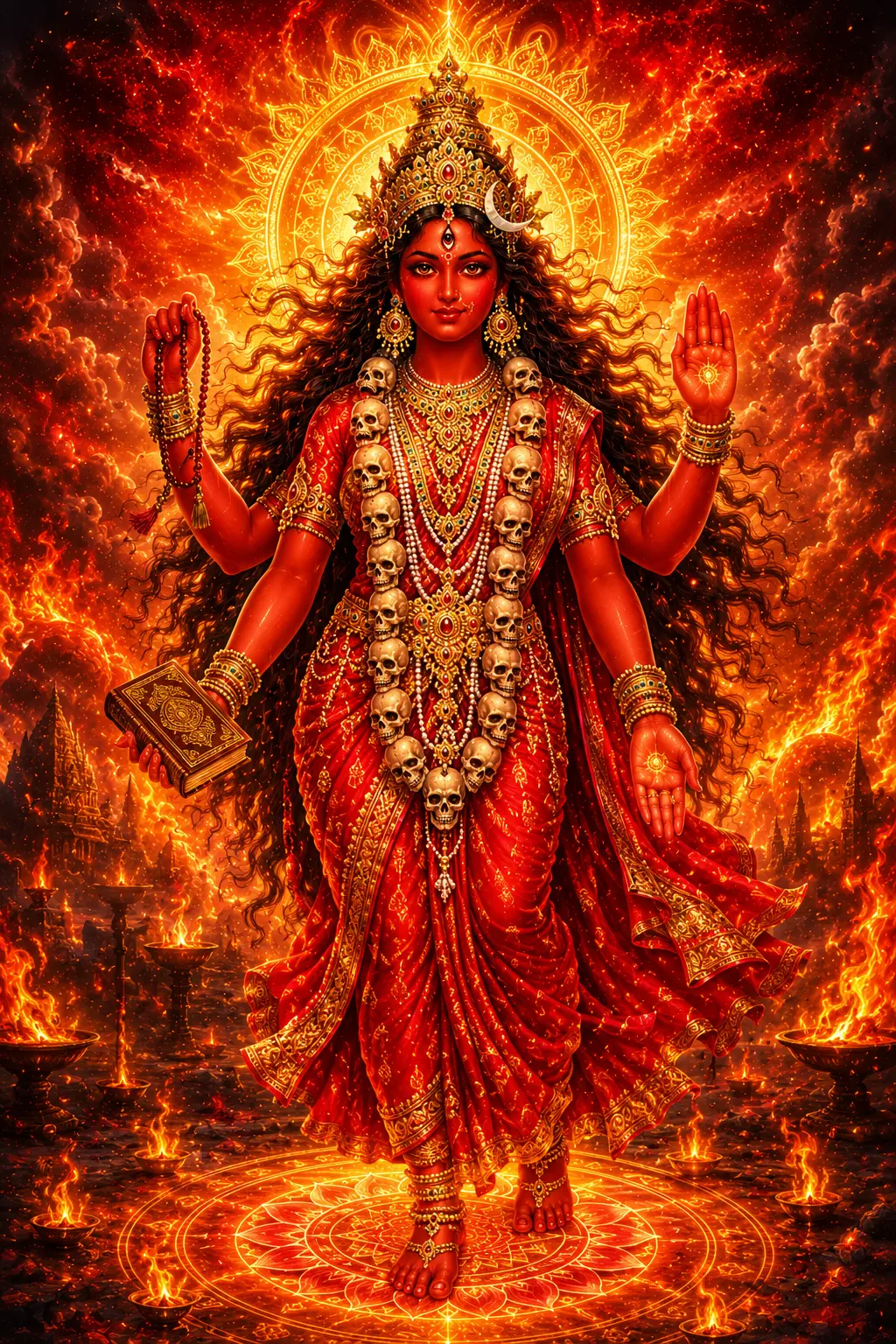
This piece depicts Maa Bhairavi — the fifth of the Dasha Mahavidyas, the fierce solar goddess of sacred fire, tapas, and the purifying dissolution that makes new creation possible — in the full blazing energy of her most characteristic form. Her complexion glows with the red-gold of the midday sun at its most concentrated and intense — not the gentle rose-gold of Bhuvaneshvari's cosmic dawn but the fierce, uncompromising radiance of fire at its most active. She stands surrounded by the sacred flames of transformation that burn behind her like a second sun, the entire composition ablaze in deep fiery red, blazing gold, and luminous orange.
Four arms extend in the precise arrangement that makes her iconography immediately distinctive within the Mahavidya tradition: one hand holds a japa mala — the rosary of mantra practice, the instrument of sustained spiritual discipline — and another holds a sacred book, the vessel of the knowledge that underlies all practice. The other two hands rest in the mudras of blessing (varada) and fearlessness (abhaya), extended toward the devotee simultaneously with the instruments of practice and knowledge. Around her neck, a garland of skulls — the characteristic ornament of the fierce Mahavidyas, representing the dissolution of ego-identities that the path requires. Three eyes blaze with the fierce wisdom and simultaneous compassion of one who sees what is actually happening and responds with the clarity that circumstance requires.
The palette of this artwork — fiery red, blazing gold, luminous orange, the deep warmth of sacred flame — is the most intensely warm in the collection. Where Bhuvaneshvari is the cool vast blue of infinite space, Bhairavi is the concentrated red-gold heat of the fire at its centre. Together they represent the complete picture of what the cosmos is: the vast open container and the intense transformative energy that moves within it.
About Maa Bhairavi — The Fierce Solar Goddess
Maa Bhairavi is the fifth of the Dasha Mahavidyas and one of the most immediately powerful in her visual and energetic presence. Her name derives from the Sanskrit Bhai (fear, awe) + ravi (sun) — she who is the awe-inspiring solar power, or alternatively from Bhairava (her consort, the fierce form of Shiva) + the feminine suffix indicating the feminine principle of that energy. Both readings converge on the same quality: a fierce, solar, uncompromising luminosity that burns through what is impure with the precision and intensity of concentrated sunlight through a lens.
She is the goddess of tapas — the sacred austerity and inner fire that the tradition understands as the most fundamental purifying force available to the practitioner. Tapas is not simply physical austerity or self-denial for its own sake. It is the deliberate generation of inner heat through sustained practice — the heat that burns away what is unnecessary, what is false, what is accumulated around the core of genuine being like bark around the living wood. Bhairavi is the deity of that heat, the presiding presence of the transformative process that tapas initiates.
She is also called the Tripura Bhairavi — the fierce one of the three cities — connecting her to the Tripura Sundari tradition (the third Mahavidya) while indicating that her quality of that sovereignty is specifically fierce and solar rather than blissfully composed. Where Tripura Sundari is the beauty and completeness of consciousness in its sovereign aspect, Bhairavi is that same consciousness in its purifying, fire-expressing aspect.
The Solar Fire — What Bhairavi Embodies
The most central theological concept in the Bhairavi tradition is the relationship between solar fire and spiritual purification. In the Shaiva and Shakta traditions, the sun — Surya — is not simply the astronomical object that heats the planet but the principle of self-luminous, self-sustaining, purifying light that is the model for the quality of consciousness at its most active. The sun shines by itself, from itself, without borrowing light from anything outside itself. It burns without consuming itself. And everything it shines upon is transformed — illuminated, warmed, or in some cases burned to ash, depending on the nature of what receives its light.
Bhairavi as the solar goddess embodies this quality of consciousness: self-luminous, purifying, and calibrated — the fire that gives exactly what each thing requires. For what is mature and ready, her fire reveals and illuminates. For what is impure and needs to be cleared, her fire burns and transforms. For what is already ash and needs nothing further, her fire simply passes through. She does not apply the same fire uniformly to everything — she applies what is needed, with the solar intelligence that knows the difference.
In the yoga tradition, this solar fire is associated with the sun breath (surya nadi / pingala nadi) — the right-sided solar energy channel that governs the active, heating, purifying functions of the subtle body. The practice of pranayama (breath regulation) as a tool of purification is, in the yogic understanding, the practice of working consciously with the Bhairavi energy — the inner solar fire — to purify what needs purifying and to sustain the heat of practice at a level that advances the path without burning the practitioner.
Tapas — The Austerity That Bhairavi Governs
Tapas — the Sanskrit word that gives us the English word "temperature" through Latin — is one of the most fundamental concepts in Indian spiritual practice. It means heat, austerity, the sustained discipline that generates inner fire. The Yoga Sutras (II.1) list tapas as the first of the three components of Kriya Yoga: Tapas (austerity/purifying discipline), Svadhyaya (self-study), and Ishvara Pranidhana (surrender to the divine).
The tradition understands tapas as operating at multiple levels simultaneously:
Physical tapas includes the regulation of diet, sleep, and bodily activity — not as self-punishment but as the deliberate cultivation of the conditions in which the inner fire can burn most clearly and consistently. The practitioner who lives in excess, in dissipation, in the constant seeking of comfort and pleasure generates the conditions in which Bhairavi's fire cannot sustain itself; the practitioner who lives with disciplined simplicity generates the conditions in which the fire burns steadily and bright.
Mental tapas is the sustained discipline of attention — the practice of bringing the mind back, again and again, to what the practice requires, in the face of the mind's natural tendency to wander, to seek distraction, to prefer comfort over the concentrated effort of genuine practice. This is the tapas of meditation: not the physical difficulty but the mental discipline of remaining present when everything in the conditioned mind prefers to be elsewhere.
Speech tapas — a concept developed extensively in the Bhagavad Gita (XVII.15) — is the discipline of speaking only what is true, what is beneficial, what is kind, and what is necessary. It is the recognition that speech is a form of energy that either generates or depletes the inner fire, and that the disciplined practitioner guards their speech as carefully as their food and their attention.
Bhairavi presides over all three. She is the fire that sustains the discipline, that makes the continued effort of practice possible, that keeps the heat at the level required for genuine transformation to occur.
The Japa Mala and the Sacred Book — Bhairavi as Teacher
The most iconographically distinctive element of Bhairavi's four arms — the detail that separates her from most other fierce goddess forms — is the combination of the japa mala and the sacred book held alongside the mudras of blessing and fearlessness.
The japa mala (prayer beads used in mantra repetition) and the sacred book appear together in only a small number of goddess iconographies. Together they signal that Bhairavi is not simply a goddess of fierce purifying power — she is the goddess who holds both the practice (japa, the sustained repetition of the sacred name through which the inner fire is cultivated) and the knowledge that grounds and guides that practice (the sacred book, the text that explains what the practice is for and how to work with the fire safely).
This combination makes Bhairavi the Mahavidya most closely associated with the teacher-student relationship in Tantric practice — specifically the relationship with a qualified teacher who can guide the student through the fires of genuine transformation without the student being consumed by what they are working with. The sacred book in her hand is the teacher's knowledge; the japa mala is the student's practice; together they constitute the complete picture of how the fire of Bhairavi is worked with safely and effectively.
In the Kashmir Shaiva tradition, Bhairavi and Bhairava together — the fierce goddess and the fierce god — form the primordial teaching couple: the fire of consciousness (Bhairava) and the fire of energy (Bhairavi) engaging in the eternal dialogue through which the universe understands itself. The Vijnanabhairava Tantra, discussed in the context of the Lord Bhairava page in this collection, is structured as precisely this dialogue — Bhairava as the teaching consciousness, Bhairavi as the inquiring student who receives and embodies the teaching.
Bhairavi and Bhairava — The Fierce Divine Couple
Maa Bhairavi is the consort of Lord Bhairava — the fierce form of Shiva whose page appears separately in this collection under Gods. Together they form one of the most important divine pairs in the Shaiva and Shakta Tantric traditions, representing the complementary poles of the fierce, transformative, uncompromising aspect of the divine.
Where Bhairava is the fierce consciousness — the witnessing awareness that sees through every form of illusion with unblinking directness — Bhairavi is the fierce energy: the fire that moves through the world, that purifies, that sustains the heat of practice, that transforms what consciousness has identified as needing transformation. In the classical Shakta understanding, consciousness (Shiva/Bhairava) and energy (Shakti/Bhairavi) are not two separate realities but two aspects of a single reality, inseparable, each incomplete without the other.
The relationship between this page and the Lord Bhairava page in this collection creates a natural pair for those who work with the fierce forms of the Shaiva Tantric tradition — the god and the goddess who together constitute the complete picture of what that fierce transformative energy is and how it operates.
Bhairavi's Place in the Mahavidya Sequence
As the fifth Mahavidya, Bhairavi occupies a precise structural position between Bhuvaneshvari (the fourth, the cosmic space that contains everything) and Chhinnamasta (the sixth, the radical self-transcendence that severs the head of ego completely).
The sequence at this point in the Mahavidyas has a specific logic: Bhuvaneshvari opens the practitioner into the vast cosmic spaciousness of Akasha — the infinite space within which everything arises. But infinite space alone, without the energy of concentrated practice to work within it, produces no transformation. Bhairavi arrives as the fire that activates what Bhuvaneshvari's space has opened. The practitioner who has genuinely opened into Bhuvaneshvari's vast openness has created the container; Bhairavi's fire is what now burns within it.
And then Chhinnamasta — the sixth Mahavidya, whose artwork has not yet been built in this collection — takes the fire that Bhairavi has generated and turns it into the most radical gesture of all: the self-offering, the complete transcendence of the practitioner who has been purified by the fire and now dissolves entirely into what the fire revealed. Kali began the sequence with dissolution; Chhinnamasta embodies the ultimate dissolution of the individual practitioner into the absolute. Between them, Bhairavi's fire is the purifying passage.
The Skull Garland — Dissolution as Ornament
The garland of skulls around Bhairavi's neck is a characteristic shared with Kali and with the other fierce Mahavidyas, but in Bhairavi's context it carries a specific meaning rooted in her solar fire theology. Each skull in the garland represents an ego-identity that has been dissolved by the fire she embodies — not with violence or terror, but with the solar precision that burns away exactly what is false and leaves intact exactly what is real.
The skulls are worn as ornaments — not hidden, not lamented, not treated as evidence of destruction. They are displayed with the casualness of one who finds the dissolution of false identities not tragic but natural, not a loss but a release. The practitioner who has worked with Bhairavi's fire for long enough arrives at the same relationship to the dissolution of their own ego-structures: not with dread but with the recognition that what is burning away was never the essential self but only the accumulated layers around it.
The skull garland as ornament is also a teaching about the relationship between fierceness and beauty in the Mahavidya tradition: that what appears fierce and terrible from the perspective of the ego — the dissolution of everything that ego considers itself to be — is, from the perspective of the awareness that the ego was obscuring, simply the natural movement of the fire that reveals what was always there.
Displaying Bhairavi in the Home
Maa Bhairavi's image is displayed in Shakta practice spaces and Mahavidya altars by practitioners who work with the fifth goddess specifically, and in dedicated tapas or practice spaces where the specific quality of fierce, disciplined, purifying commitment is the quality being invoked and sustained.
In a Mahavidya collection, she occupies the fifth position — following Bhuvaneshvari's vast cosmic blue with the concentrated red-gold heat of sacred fire. The visual contrast between these two consecutive Mahavidyas is among the most striking in the set: the cool, open, rose-gold of Bhuvaneshvari's cosmic spaciousness gives way immediately to the concentrated, fierce, blazing red-gold of Bhairavi's solar fire.
In a yoga studio or practice space, Bhairavi's image carries the invitation to the quality of practice that genuinely transforms — not the comfortable and manageable, but the sustained discipline that generates the heat required for real purification. She is the deity of the long sit, the difficult posture held past the point of comfort, the continued return of attention when the mind prefers to be elsewhere.
The fiery red and gold palette of this artwork is the warmest and most intense in the collection. A deep red or gold frame suits the composition; a black frame creates a powerful contrast with the fire palette. Print on matte or semi-gloss paper at FedEx Office, Staples, or any professional print shop.