
About This Artwork
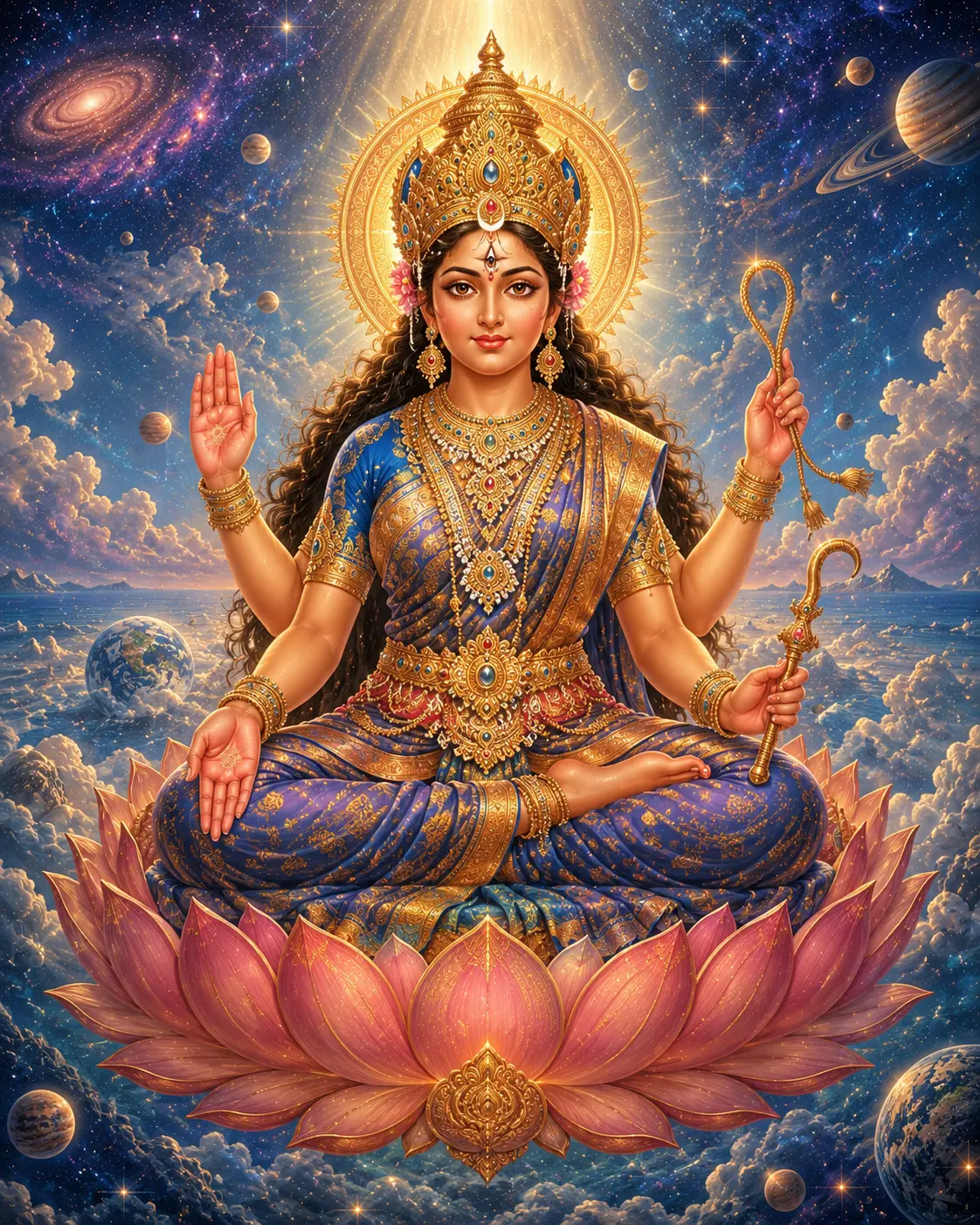
This piece depicts Maa Bhuvaneshvari — the fourth of the Dasha Mahavidyas, the Queen of the Universe, the goddess whose very body is the cosmos — in a composition of extraordinary spatial depth. She is seated in serene sovereignty on a great lotus throne that floats not on a sacred river or a celestial ocean but in the open expanse of the universe itself — a deep celestial blue sky that extends in every direction, with the forms of galaxies, star systems, and cosmic light visible in the background, arising from her presence as naturally as thoughts arise within a mind.
Her complexion is the warm rose-gold of divine dawn light — the colour of the first moment before the universe became fully visible, the quality of light that exists at the threshold between the formless and the formed. Four arms extend in her characteristic arrangement: two hands hold the noose (pasha) and the elephant goad (ankusha) with a lightness that signals these are not instruments of force but of gentle guidance — the gentlest weapons in all the Mahavidya tradition, carried by the gentlest and most vast of the ten goddesses. The other two hands rest in abhaya mudra (fearlessness and protection) and varada mudra (the freely flowing gift of grace). Three eyes see in all directions and across all times simultaneously, serene and all-knowing. A crescent moon adorns her forehead — the moon that in the tradition represents the waxing and waning of the manifested cosmos within her infinite being.
The palette of this artwork — deep celestial blue, warm rose-gold, the luminous silver-white of cosmic light — is entirely unlike any other in the collection. It is the palette of space itself: vast, deep, containing everything, illuminated from within rather than from any external source. Among all the Mahavidyas, Bhuvaneshvari's composition is the most spacious, the most open, the most explicitly cosmic in its visual field.
About Maa Bhuvaneshvari — The Goddess Whose Body Is the Universe
Maa Bhuvaneshvari is the fourth of the Dasha Mahavidyas and the most cosmologically vast of the ten — the goddess whose name means literally the sovereign of the worlds, the queen (Ishvari) of the universe (Bhuvana). But this name does not capture the full depth of what the tradition understands Bhuvaneshvari to represent. She is not sovereign over the universe in the way that a ruler is sovereign over a territory — as something separate from herself that she governs from outside. She is the universe. The Bhuvana — the world, the cosmos, all of manifest existence — is her body. Every galaxy, every planet, every grain of matter, every wave of energy that has ever arisen in the history of the cosmos has arisen within her and as an expression of her.
This is the central and most distinctive theological claim of the Bhuvaneshvari tradition within the Shakta Mahavidya framework: not that the goddess created the universe, or rules it, or will eventually dissolve it — but that the universe simply is her body, in the same way that thoughts are the body of the mind that thinks them. The cosmos does not exist separately from her and then receive her governance. It exists as her direct self-expression, with no gap between the goddess and what appears as the world.
Her name is composed of Bhuvana (world, all three worlds — earth, atmosphere, and sky — or more expansively, the entire cosmos) and Ishvari (sovereign, ruler, the feminine form of Ishvara). Together: the one who is sovereign of all the worlds — or, in the deeper reading, the one whose sovereignty consists in being the worlds themselves.
Akasha — The Element of Bhuvaneshvari
Each of the ten Mahavidyas is associated with a specific element (tattva) of the classical Indian understanding of the structure of reality. Bhuvaneshvari's element is Akasha — space, ether, the fifth and most fundamental of the five classical elements (Pancha Bhutas).
In the Indian philosophical tradition, the five elements arise in a sequence from the most subtle to the most gross: Akasha (space) → Vayu (air/wind) → Agni (fire) → Jala (water) → Prithvi (earth). Akasha is the first and most fundamental — the element from which all the others arise, the spacious ground within which every other element and every other quality of manifestation finds its room to exist. Without Akasha, there is no room for anything else to be. It is the container of everything while being identified with nothing in particular.
Bhuvaneshvari as the goddess of Akasha is the divine feminine principle of space itself — the boundless, open, containing quality that makes the existence of everything else possible. She does not fill the space; she is the space. And the space she embodies is not empty — it is the most full reality that exists, the ground from which all manifestation arises and into which all manifestation is held.
In the yoga and meditation tradition, Akasha is the element most directly associated with the quality of awareness in deep meditation: the sense of infinite openness that arises when the mind's habitual activity quiets and the quality of consciousness itself becomes the primary experience. The meditator who settles into that open spaciousness — vast, containing everything, identified with nothing — is, in the Shakta understanding, touching the quality that Bhuvaneshvari embodies.
Bhuvaneshvari's Place in the Mahavidya Sequence
As the fourth Mahavidya, Bhuvaneshvari occupies a specific structural position in the ten-goddess sequence that reflects her specific cosmic scale. The first three Mahavidyas — Kali (dissolution), Tara (crossing), and Tripura Sundari (sovereign bliss) — operate with fierce and concentrated energy. Kali strips everything; Tara carries the practitioner across the ocean of what Kali stripped away; Tripura Sundari reveals the bliss of the consciousness that was there all along.
Bhuvaneshvari arrives fourth as the expansion — the opening of the field. Having moved through the intense, concentrated work of the first three, the sequence opens into her vast cosmic spaciousness. She is the breath of relief, the opening of the hand after the grip, the recognition that the consciousness revealed by Tripura Sundari's sovereign bliss is not a small private realisation but a reality as large as the cosmos — because the cosmos is its body.
In this reading, Bhuvaneshvari represents the moment when the practitioner's experience of the divine stops being a localised, personal, interior event and opens into the recognition that the inner space of awareness and the outer space of the cosmos are the same space. The galaxies and the thoughts arise in the same field. The meditator who sits in what feels like infinite inner space and the astronomer who contemplates the actual scale of the universe are encountering different angles on the same reality — the Akasha that Bhuvaneshvari embodies.
The five Mahavidyas that follow her — Bhairavi, Chhinnamasta, Dhumavati, Bagalamukhi, Matangi — work within this vast space she has opened, each in their specific and concentrated way. Without Bhuvaneshvari's spaciousness, the fierce energies of the later Mahavidyas would have nowhere to operate.
The Gentlest Weapons — The Noose and Goad of Bhuvaneshvari
Among all the Mahavidyas, Bhuvaneshvari carries the most restrained and the gentlest arsenal. Where Kali holds a severed head and a sword, where Bagalamukhi brandishes a golden mace, where Bhairavi carries weapons of fire and transformation — Bhuvaneshvari holds the noose (pasha) and the elephant goad (ankusha).
These two implements appear across many goddess iconographies and carry consistent meanings. The noose (pasha) represents the power of binding — the capacity to hold, to contain, to prevent what needs to be restrained from moving freely. In Bhuvaneshvari's hands, this is understood as the very nature of space itself: the cosmos is held within her as naturally and as gently as a thought is held within the mind, without force, without effort, simply by virtue of the space being what it is.
The elephant goad (ankusha) represents the power of gentle direction — not the sword that cuts or the fire that transforms, but the steady, minimal pressure that redirects a large, powerful force with precision and economy of effort. The goad is the instrument of the skilled mahout who guides a creature vastly larger than himself not through force but through the precise application of pressure at the right point. In Bhuvaneshvari's hands, it signals the capacity of infinite space to guide the vast forces of the cosmos with a touch so light as to be imperceptible to those within it.
Combined with abhaya and varada mudras — fearlessness and grace freely given — Bhuvaneshvari's four arms express a form of sovereignty that requires no force because the sovereign and the territory are the same reality. She does not need to compel the cosmos to obey her. It is her body. Its every movement is already her movement.
Bhuvaneshvari and the Practice of Inner Space
For practitioners of meditation and yoga, Bhuvaneshvari carries a specific resonance that goes beyond theological description. The quality she embodies — infinite, open, containing everything without effort, identified with nothing in particular — is precisely the quality that deep meditation practice points toward.
In the Shaiva and Shakta traditions of non-dual meditation (including the Kashmir Shaiva practices that underlie many contemporary yoga-meditation approaches), the fundamental instruction is consistently to recognise the nature of awareness itself: not what arises within awareness but the space in which arising happens. This spacious, open, containing quality — prior to and more fundamental than any particular thought, sensation, or experience — is Akasha. It is Bhuvaneshvari's element. And the recognition that this inner space is not separate from the outer space of the cosmos — that the awareness within which the meditator's experience arises is of the same nature as the space within which the galaxies arise — is the recognition that Bhuvaneshvari's image points toward.
This makes her image a particularly natural presence in a meditation space: not as an object of devotion that the meditator looks at and worships, but as a visual pointer toward the quality that the meditation practice is cultivating — the vast, open, containing spaciousness that is always already present as the ground of every experience.
The Cosmic Palette — Reading the Visual Field of This Artwork
The visual field of this artwork is the most cosmically expansive in the collection. The deep celestial blue that extends in every direction behind the goddess is not simply a blue background — it is space itself, with the forms of star systems and cosmic light visible within it, arising from her presence as the natural expression of her being.
The celestial blue: deep, vast, the blue of actual space as we now know it — not the intimate Vrindavan blue of Krishna, not the sacred indigo of the Shiva meditation image, but the blue of interstellar space, the colour that the universe actually is when seen from outside the atmosphere that scatters our local sunlight. This is a palette that speaks to the contemporary mind's awareness of the actual scale of the cosmos.
The rose-gold complexion: where Krishna is the blue of infinite sky-consciousness, where Bagalamukhi blazes in the yellow of turmeric clarity, Bhuvaneshvari is the warm rose-gold of dawn — the colour of the moment when the formless becomes the formed, when the light that was everywhere in potential begins to take the specific quality of a particular morning. This colour is not cold or abstract; it is warm, maternal, approachable — the cosmos as mother rather than as mechanism.
The cosmos visible behind her: the star systems and cosmic light visible in the artwork's background are not decorative elements but the most direct possible visual statement of the Bhuvaneshvari theology: she does not stand in front of the universe — the universe flows from behind and around her because it is her body, her self-expression, her natural outpouring.
Displaying Bhuvaneshvari in the Home
Maa Bhuvaneshvari's image is displayed in Shakta practice spaces and Mahavidya altars by those who work with the ten-goddess tradition, and in meditation rooms by practitioners who are drawn to the quality of cosmic spaciousness that she represents.
In a dedicated Mahavidya collection, she occupies the fourth position — following Tripura Sundari and preceding Bhairavi — and her warm rose-gold and celestial blue provide a visually distinct counterpoint to the intense concentrated energies of the goddesses on either side of her.
In a meditation room or practice space, the image of the goddess whose body is the cosmos — seated serenely in the open expanse of space, containing everything, requiring nothing — is one of the most naturally supportive presences for the cultivation of the inner spaciousness that meditation practice aims toward.
The celestial blue and rose-gold palette suits a large wall where the cosmic scale of the composition can breathe. A dark or midnight blue frame, or a simple silver frame, will complement the deep blue of the background. Print on matte paper for the most accurate rendering of the deep cosmic blue.