About This Artwork
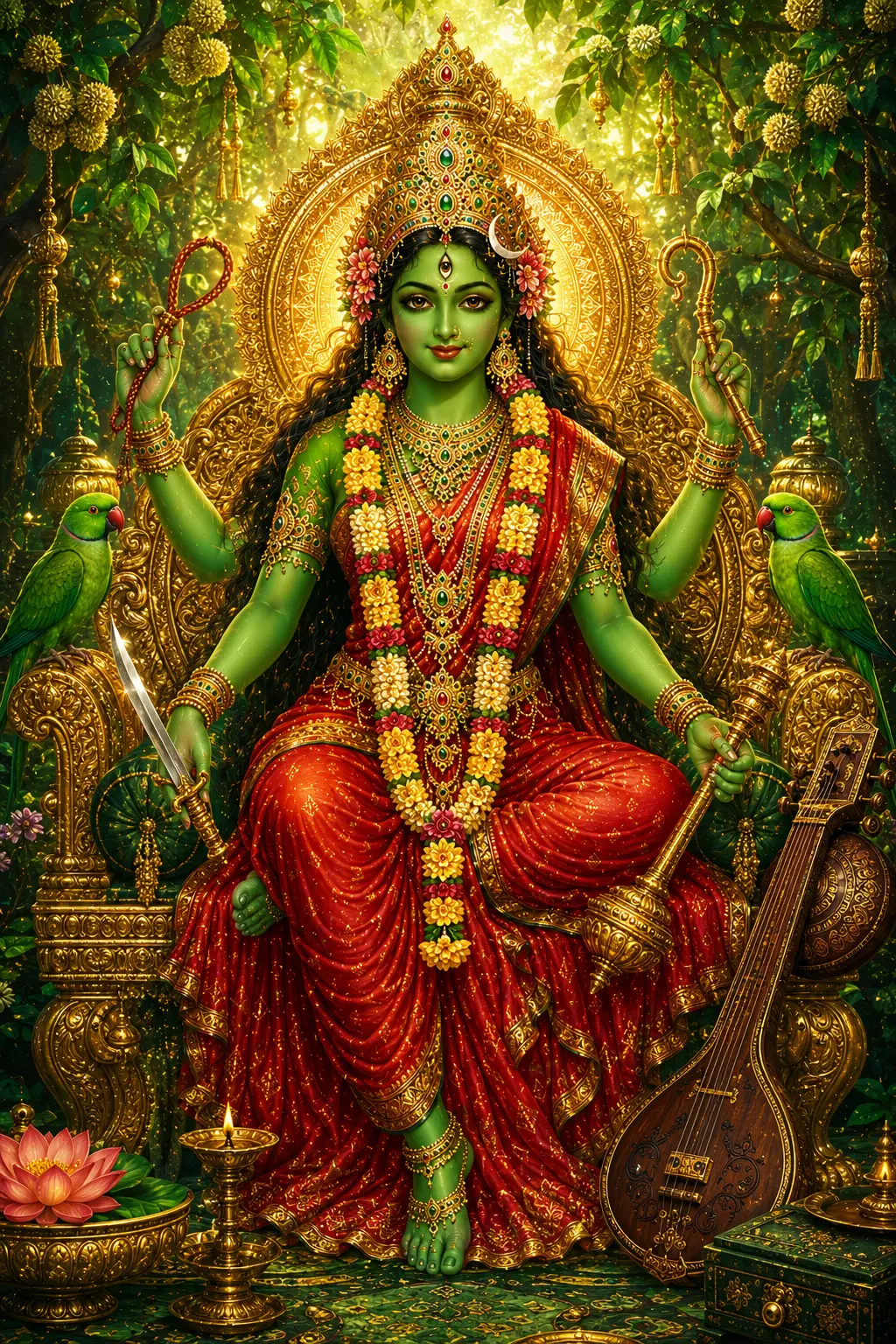
This piece depicts Maa Matangi — the ninth of the Dasha Mahavidyas, the Tantric counterpart of Saraswati, the goddess of sacred knowledge, eloquent speech, music, and the sixty-four arts — in the full richness of her most distinctive iconographic form. Her complexion is a deep, luminous emerald green — the colour of the kadamba forest in which she dwells, the colour of living nature in its most vibrant and vital expression, the colour that immediately distinguishes her from every other goddess in this collection. Four arms extend with the composed confidence of one who holds sovereign power lightly: the noose (pasha), the sword (khadga), the elephant goad (ankusha), and the club (gada). Beside her golden throne, a veena rests — the instrument that signals that her deepest knowledge is ultimately musical, that the truth she embodies sounds before it is spoken or written or thought.
Two green parrots are perched in attendance on either side — Matangi's sacred companions and the messengers through whom, the tradition holds, she communicates the secrets of sacred knowledge to those who listen with genuine attention. The parrots in Matangi's iconography are not decorative. They speak. In the living tradition they are understood as vehicles of the sacred speech that Matangi governs — the direct, unmediated communication of truth that bypasses the filters of convention and propriety and arrives at its target with the precision of a bird in flight.
Her three eyes carry an expression that is entirely her own within the Mahavidya tradition: not the fierce resolve of Kali, not the calm sovereignty of Tripura Sundari, not the terrible darkness of Dhumavati — but a quality of knowing intoxication, the slightly tilted gaze of one who sees through every surface and finds the whole situation, in all its complexity and wild beauty, deeply and irresistibly amusing. She is the goddess who has understood the joke at the heart of existence and who communicates it through music, through poetry, through the unexpected phrase that cuts through convention and lands in the listener's awareness like light through a crack.
The palette — rich emerald green, warm gold, the dappled light of the sacred kadamba forest — is entirely unlike any other in the collection. Where Saraswati is pure white, Matangi is vividly, unapologetically green. Where Saraswati sits on a white lotus in serene clarity, Matangi sits in the forest, in nature, in the living world, surrounded by parrots and the scent of kadamba flowers.
About Maa Matangi — The Ninth Mahavidya
Maa Matangi is the ninth of the Dasha Mahavidyas — the ten great wisdom goddesses of the Shakta Tantric tradition — and she is among the most theologically distinctive and iconographically vivid of the ten. Where the sequence begins with Kali's radical dissolution and moves through increasingly nuanced expressions of the divine feminine's transformative power, Matangi occupies the ninth position — just before Kamalatmika's concluding lotus abundance — as the goddess who governs the domain of sacred speech, music, knowledge, and the arts in their most alive and most direct expression.
Her name derives from the Sanskrit root matang — which is understood in different traditions as pointing to an elephant (matanga), to the outcaste or marginal community (also Matanga in some texts), or to intoxication (mada, madana). All three readings point toward something in Matangi's nature: she is large, powerful, and untameable like an elephant; she operates at the margins, outside the clean categories of conventional social and ritual order; and she carries a quality of divine intoxication — the state of consciousness that has been touched by the wine of genuine knowledge and can no longer pretend that the ordinary boundaries of propriety and convention are ultimately real.
She is described as the Tantric Saraswati — the counterpart of the classical Saraswati that exists within the Shakta Tantric tradition rather than the Vaishnava devotional tradition. The comparison is exact and illuminating: both goddesses govern speech, knowledge, music, and the arts. But where Saraswati is pure white, serene, classically composed, seated on a white lotus in the register of sattva — clarity, luminosity, the cultivated and refined — Matangi is emerald green, wild-eyed, slightly intoxicated, seated in a forest surrounded by parrots, working in the register of tamas converted into the fuel of genuine knowledge. She is what knowledge looks like when it has absorbed and transcended the conventional, when it operates from direct encounter with reality rather than from inherited categories.
The Theology of Transgression — What Matangi Actually Represents
The most distinctive and theologically sophisticated dimension of Matangi's tradition is the concept of ucchishtha — the leftover, the used, the impure remnant. In classical Hindu ritual practice, ucchishtha (food or substances that have been touched by another person's mouth or hands) is among the most ritually impure substances, to be carefully avoided in the context of worship.
Matangi's worship, in the Tantric tradition, specifically involves ucchishtha — she is called Ucchishtha Chandali, Ucchishtha Matangi, the goddess who is worshipped with what the conventional ritual tradition considers impure. This is not simply iconoclasm for its own sake. It encodes a theological position of considerable depth: that the divine is not confined to the pure, the clean, the ritually acceptable, and the conventionally sacred, but is equally and perhaps even more directly available in what has been declared impure by the structures of social and ritual convention.
In the Mahavidya tradition's understanding, Matangi represents the knowledge that arises precisely at the edge of what convention permits — the insight that cannot be reached by staying within the safe boundaries of what is already known and accepted. She is the goddess of the creative breakthrough, the unexpected perception, the knowledge that arrives not through patient accumulation of what is already sanctioned but through the willingness to encounter reality in forms that the conventional mind finds uncomfortable or improper.
This theology of transgression is not an invitation to carelessness or to the abandonment of ethical discernment. It is a recognition that genuine knowledge — of any kind, in any field — requires the capacity to move beyond what one already knows, to encounter what is actually there rather than what one expected or hoped to find, and to remain present to reality even when it does not conform to the existing map. Matangi is the goddess who presides over that capacity.
Matangi and Saraswati — The Two Faces of Sacred Knowledge
The contrast between Maa Matangi and classical Saraswati is one of the most illuminating pairs of goddess images in the entire Hindu tradition, because they govern the same domain — speech, knowledge, music, the arts — from opposite ends of the spectrum of how that domain is approached.
Classical Saraswati is the goddess of knowledge as cultivation: the patient accumulation of learning, the refinement of skill, the disciplined practice of art and music, the clear, composed intelligence that rises above the noise of undisciplined thought. She is white — the colour of sattva, of clarity, of the quality of mind that perceives without distortion. She sits on a white lotus, slightly apart from the world, in the register of the ideal.
Maa Matangi is the goddess of knowledge as direct encounter: the insight that arrives not through accumulation but through genuine contact with reality, the creative breakthrough that comes from the willingness to inhabit the margins of the known, the music that arises not from perfect technique alone but from genuine absorption in the living sound. She is emerald green — the colour of living nature, of growth, of the vital force that moves through the world without asking permission. She sits in the forest, surrounded by the noise and life of the natural world, in the register of the actual.
A tradition that contains both Saraswati and Matangi is saying something important about the nature of knowledge and creative expression: that both the cultivated and the direct are necessary, that neither the refined alone nor the wild alone captures the full range of how genuine insight and authentic creative work arise. The practitioner who has only Saraswati has polish without vitality. The practitioner who has only Matangi has vitality without form. Together they constitute the complete picture of what genuine knowledge and authentic art require.
The Iconography of This Artwork — Reading Matangi's Form
Emerald green complexion: The green of Matangi's form is the most immediately distinctive element of her iconography and the colour that separates her from every other Mahavidya. Green is the colour of the kadamba forest — of living, growing, vital nature. It is also the colour of Matanga — the elephant — which in classical Indian aesthetics is associated with power, intoxication (elephants in musth), and the quality of force that is simultaneously magnificent and ungovernable. Matangi's green is not a gentle sage or a decorative teal but a deep, rich, saturated emerald — the green of something alive and in full expression.
Four arms with noose, sword, goad, and club: The four weapons of Matangi signal sovereign power over the four aspects of consciousness that her tradition identifies as the terrain of her domain: the noose (pasha) binds and restrains what needs to be contained; the sword (khadga) cuts through what is false or obstructive; the elephant goad (ankusha) directs and guides the powerful forces that would otherwise move without direction; the club (gada) strikes with the decisive force of absolute authority. Together they signal complete mastery over the domain of speech, knowledge, and creative expression — in all its wild and ungovernable aspects.
The two green parrots: The parrots of Matangi are among the most iconographically significant of all the sacred animals in the Mahavidya tradition. Parrots are associated in Indian tradition with eloquence, with the capacity to transmit knowledge through direct speech, with the liminality of creatures that live between the human world and the natural world and speak to both. In the devotional tradition, Matangi's parrots are understood as the vehicles through which she communicates sacred knowledge — the direct, unmediated utterance that bypasses the structures of convention and arrives precisely where it needs to arrive.
The veena beside the throne: The veena resting beside rather than held in Matangi's hands is a detail worth noting. Unlike Saraswati, who is actively playing the veena — demonstrating the cultivation of musical art — Matangi's veena rests at her side as an attribute rather than an activity. This placement suggests that for Matangi, music is not something to be practised and demonstrated but something that is simply present as a quality of her being — the sound of consciousness knowing itself, available rather than performed.
The kadamba forest: The setting of Matangi's throne in a lush forest of kadamba trees places her iconography in the living natural world rather than in a temple or a cosmic ocean. The kadamba tree (Neolamarckia cadamba) is sacred in the tradition — associated with Krishna and the Vrindavan forest — and blooms with fragrant orange flowers during the rainy season. Matangi's kadamba forest is the setting of wild, alive, non-conventional knowledge: knowledge found not in the library or the hermitage but in the forest, in nature, in the direct encounter with the world as it actually is.
Matangi's Place in the Mahavidya Sequence — The Penultimate Wisdom
As the ninth Mahavidya, Matangi stands just before the culminating Kamalatmika — the lotus goddess of complete, bloomed abundance that closes the sequence. The placement is precise: Matangi's wild, unconventional, speech-and-knowledge-governed energy immediately precedes the lotus abundance of the tenth goddess.
In the tradition's understanding, this sequence encodes a teaching about the relationship between genuine knowledge and genuine abundance. Kamalatmika's lotus abundance — the sense of complete sufficiency, the recognition that what is present is enough — is not simply given or found by accident. It arises naturally when consciousness has moved through Matangi's domain: when it has been willing to encounter what is actually there rather than what convention prescribes, when it has absorbed the wild knowledge of direct experience and the authentic expression of what it has genuinely understood. The abundance of Kamalatmika flows from the knowledge of Matangi — the bloomed lotus follows the forest encounter.
Displaying Matangi in the Home
Maa Matangi's image is displayed in Shakta practice spaces and Mahavidya altars by those who work with her tradition specifically, and in creative workspaces — music studios, writing rooms, artist's studios — by practitioners who recognise in her iconography a resonance with the quality of creative work they are engaged in.
In a dedicated Mahavidya altar or collection display, Matangi represents the ninth position — with only Kamalatmika completing the set after her. Her emerald green palette is one of the most vivid in the collection and creates a striking visual presence in any multi-Mahavidya arrangement.
In a music studio, writing room, or creative workspace, Matangi's image carries an invitation: to the kind of knowledge and creative expression that arises from direct encounter with what is, that does not wait for permission from the conventional, that finds the living truth in the unexpected and the marginal as readily as in the sanctioned and the refined. This is a quality that every genuine creative practitioner recognises, regardless of their relationship to the Shakta tradition.
The emerald green and forest gold palette is bold and specific — it suits a dark green, gold, or natural wood frame. Print on matte paper at FedEx Office, Staples, or any professional print shop.