
About This Artwork
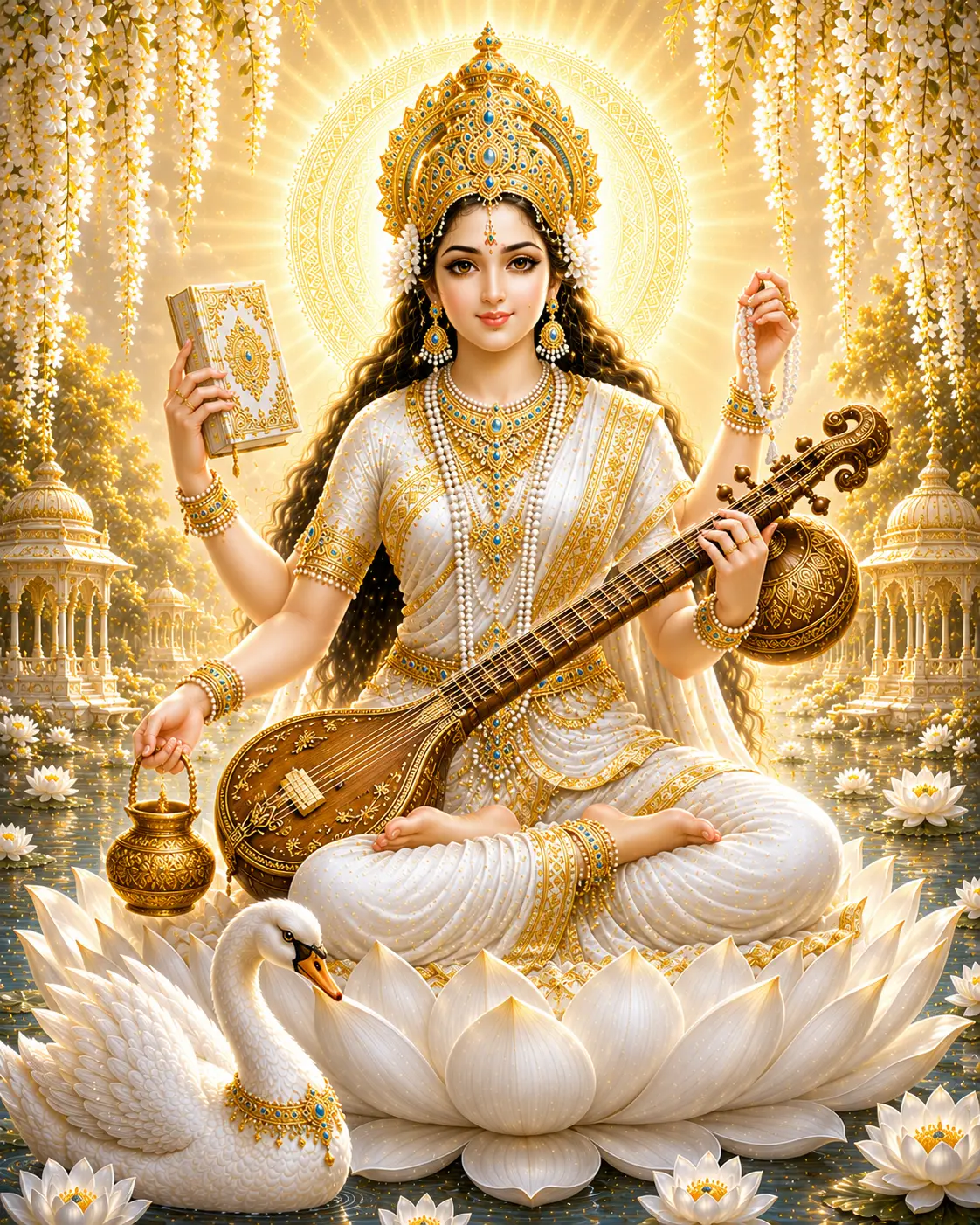
This piece depicts Goddess Saraswati in the iconographic form most consistently associated with her across all traditions and regions of the Hindu world. She is seated in padmasana on a pure white lotus throne that floats on a serene sacred river — the Saraswati River, whose name she shares and whose flow through the world is understood as the flow of knowledge itself. Her form is luminous white, clothed in a white and gold sari with ornate gold jewellery and a crown. Four arms extend with precision: the veena held in the two front arms ready to be played, a sacred book of divine knowledge held in one hand, a japa mala in another, and a small golden water kamandalu completing the set of attributes.
Beside her, a white swan rests in elegant attendance — the hamsa, her vahana. A peacock stands nearby, sometimes described as her second vehicle or as a companion who represents the full spectrum of colour and beauty that she governs in the world of the arts.
The palette of this artwork — pure white, soft ivory, and delicate gold — is entirely unlike any other piece in this collection. Where the Shiva images work in deep indigo and Himalayan blue, where Krishna glows in celestial sapphire and Vrindavan gold, and where Kamalatmika blazes in warm rose and molten amber, Saraswati's visual register is cool, still, and luminous. The quietness of this palette is itself a statement about what Saraswati governs: the clarity that comes before knowledge, the silence that makes speech possible, the stillness out of which all music arises.
About Goddess Saraswati
Goddess Saraswati is the Hindu goddess of knowledge, language, music, arts, wisdom, and the power of speech. She is one of the three principal goddesses of Hinduism — alongside Lakshmi (abundance and grace) and Durga (power and protection) — and she forms part of the Tridevi, the divine feminine triad that corresponds to the Trimurti of Brahma, Vishnu, and Shiva. Saraswati is associated with Brahma, the creator, which places her at the very origin of the universe: she is the knowledge, the language, the discernment, and the creative intelligence through which creation becomes possible and meaningful.
Her name in Sanskrit is understood to come from sara (essence) and swa (self) — she is the essence of the self, the fundamental intelligence that underlies all perception, expression, and understanding. Alternatively, it is read as Sara (flow) and svati (moving independently) — the one who flows freely, the river of consciousness that moves of its own will.
She is present wherever knowledge is sought or transmitted. She presides over schools and universities, over concert halls and music studios, over libraries and writing rooms, over any space where the human capacity for learning, expression, and understanding is actively engaged. Among the deities in this collection she is perhaps the one most immediately recognisable to people outside the Hindu tradition — not because she is widely known by name, but because what she represents is universal.
Who Is Goddess Saraswati? — Her Domain and Traditions
Saraswati's domain is unusually comprehensive. Unlike deities whose sphere is defined by a single quality or role, she governs the entire landscape of human intellectual and creative life:
Vidya: Knowledge in its broadest sense — not merely factual information but the deep understanding that transforms the knower. In Sanskrit tradition, Vidya is distinguished from mere information (data, jnana as intellectual knowledge) by its transformative quality. True Vidya changes not just what you know but how you see.
Vak: Speech, language, the power of the word. Saraswati is the goddess of vak — the sacred power of language to name, to describe, to evoke, to transmit meaning. In Vedic tradition, vak is not simply communication; it is the creative force that calls the world into being. The relationship between Saraswati and speech places her at the foundation of mantra practice — every sacred syllable is understood to be within her domain.
Sangita: Music and the performing arts — music, dance, and drama in their classical forms. The veena she plays in her iconography is not a single instrument but the representative of all music, all vibration, all the organised forms of sound that express what language alone cannot.
Kala: The arts in their full range — visual arts, craft, poetry, and every form of skilled creative expression. The sixty-four classical Indian arts (shatrukalas) are understood to be under Saraswati's governance.
Smriti: Memory, the capacity to retain and transmit knowledge across time. Without memory, knowledge cannot accumulate or build. Saraswati governs the fidelity with which knowledge is preserved and the clarity with which it is recalled.
Saraswati and Students — Vasant Panchami and the Tradition of Learning
The festival most closely associated with Saraswati is Vasant Panchami — the fifth day of the bright half of the month of Magha (typically late January to mid-February), which marks the beginning of spring in the Indian calendar. On this day, traditionally celebrated throughout North and East India, students bring their books, instruments, and tools of their craft to be blessed in Saraswati's presence. Young children are often given their first formal lessons on this day — their first letters, their first musical notes — under the auspices of the goddess.
The tradition of invoking Saraswati before examinations, before beginning a course of study, before performing publicly, or before starting a creative project is widespread across the Indian subcontinent and diaspora. In South India, the festival of Navaratri includes a specific Saraswati Puja on the ninth day (Mahanavami) when books, instruments, tools, and implements of craft are placed before the goddess for blessing — in recognition that every skill and every form of knowledge is ultimately under her care.
For students beginning a new academic year, for teachers preparing to teach, for musicians beginning a new practice cycle, for writers starting a new project, or for any practitioner of any discipline — placing Saraswati's image in the workspace is a traditional acknowledgement that what is being undertaken falls within her domain and invites her support.
The Iconography of This Artwork — What to Look For
The veena: The instrument held in Saraswati's two front arms is the veena — a classical South Indian stringed instrument, one of the oldest and most revered in Indian musical tradition. In her hands it is not simply an instrument of music but the instrument of the universe: the veena's gourd resonators are understood to represent the two poles of cosmic existence, its strings the various frequencies of manifestation, its tuning the harmony that holds creation in balance. The practitioner who tunes the veena knows that neither too tight nor too loose produces music — this is the famous teaching that the veena gave the Buddha, according to one account, on the nature of the middle path.
The sacred book: One of Saraswati's hands holds a sacred text — the Vedas in traditional representations, or more generally any book of sacred knowledge. The book signals that Saraswati's knowledge is not mystical and inaccessible but recorded, transmittable, available to those who study. She is the goddess of the library as much as of the meditation chamber.
The japa mala: The rosary of beads used in mantra repetition, carried in another hand. This links Saraswati to the practice of mantra — the use of sound as a vehicle for inner transformation — and signals that the knowledge she governs includes the knowledge of sacred sound and its effects on consciousness.
The kamandalu: The small water vessel carried by sages and ascetics, signifying purity, simplicity, and the renunciant orientation. In Saraswati's hands it suggests that the highest form of learning leads toward the simple, the essential, the clear.
The white swan (hamsa): The hamsa is Saraswati's vahana — her vehicle and constant companion. In Indian tradition the swan is associated with the capacity for discernment, specifically the capacity to separate milk from water when the two are mixed — a metaphor for the ability of true wisdom to distinguish the real from the apparent, the essential from the inessential. The hamsa is also associated with the hamsa mantra (the sound of the breath, so-hum / ham-sa) and with the highest state of meditation. To have the hamsa as one's vehicle is to be carried by pure discrimination and pure awareness.
The peacock: Also present in this artwork, the peacock beside Saraswati represents the full spectrum of colour and beauty — the arts in their expressive, visible dimension, in contrast to the pure white of the goddess herself. Peacocks are also associated with Kartikeya (who appears elsewhere in this collection), and Saraswati's association with the peacock places her in a relationship to the full beauty of the manifest world even as her own form is pure white.
The white lotus throne: The lotus on which Saraswati sits floats on a sacred river — the Saraswati River, a river that in the Vedic tradition was real and mighty, and that in later tradition became understood as the underground river of consciousness that flows through all knowledge and practice. The lotus throne, as always, signals complete purity — the knowledge she embodies is not contaminated by ego, by desire, or by any agenda other than the clarity of understanding itself.
The white palette: The white, ivory, and soft gold tones of this artwork are not simply aesthetic choices. White in Indian iconography represents sattva — the quality of clarity, luminosity, and balance among the three gunas. Saraswati is understood as the sattvic goddess par excellence, the goddess whose domain is the refinement and clarification of consciousness rather than its fierce transformation (Kali, Durga) or its opulent expression (Lakshmi, Kamalatmika).
Saraswati as a Gift — For Students, Teachers, Musicians, and Creatives
Saraswati's image is among the most meaningful and most generally accessible sacred gifts in the Hindu tradition — meaningful because her domain covers virtually every form of human learning and creative expression, and accessible because she is neither fierce nor esoteric in her presentation. Her white-robed, serene, instrument-playing form communicates something immediate and recognisable to viewers from any background.
As a gift for a student beginning university or a new school year — particularly within the Indian diaspora, where such gifts are a recognisable cultural tradition — a framed or rolled Saraswati print is a combination of cultural expression, aesthetic decoration, and genuine good wish.
For a musician beginning formal study, or an artist setting up a studio, or a writer establishing a workspace, the presence of Saraswati's image carries a specific invitation: to approach the craft with the clarity, discipline, and attentiveness that the goddess represents.
For a teacher establishing a classroom or study — particularly for those teaching within the Indian tradition or within any context where the sanctity of the teacher-student relationship is understood — Saraswati's image in the teaching space is a statement about what the work is for.
The digital download format is particularly practical in this context: print it immediately, at whatever size fits the space, frame it from any home store, and it is ready. The rolled and framed options offer finished, ready-to-display alternatives.
Displaying Saraswati in the Home
Saraswati is traditionally placed in the space most closely associated with learning and creative work — the study, the library, the music room, the creative studio. In Indian households, the bookshelf or the writing desk is her natural home. In a puja room she is often placed beside Lakshmi and Durga, completing the Tridevi.
The quiet, luminous palette of this artwork makes it one of the most versatile pieces in the collection for display in non-dedicated spaces. The white and ivory tones complement virtually any interior palette. The framed print with a white frame reads as contemporary and restrained; with a natural wood frame it sits warmly against most wall colours.
In a child's study or bedroom — particularly at the beginning of a school year — the image carries a specific cultural and aspirational meaning that is immediately legible to families from the Indian subcontinent and diaspora: this is a space for learning, and the learning is held under the goddess's care.