
About This Artwork
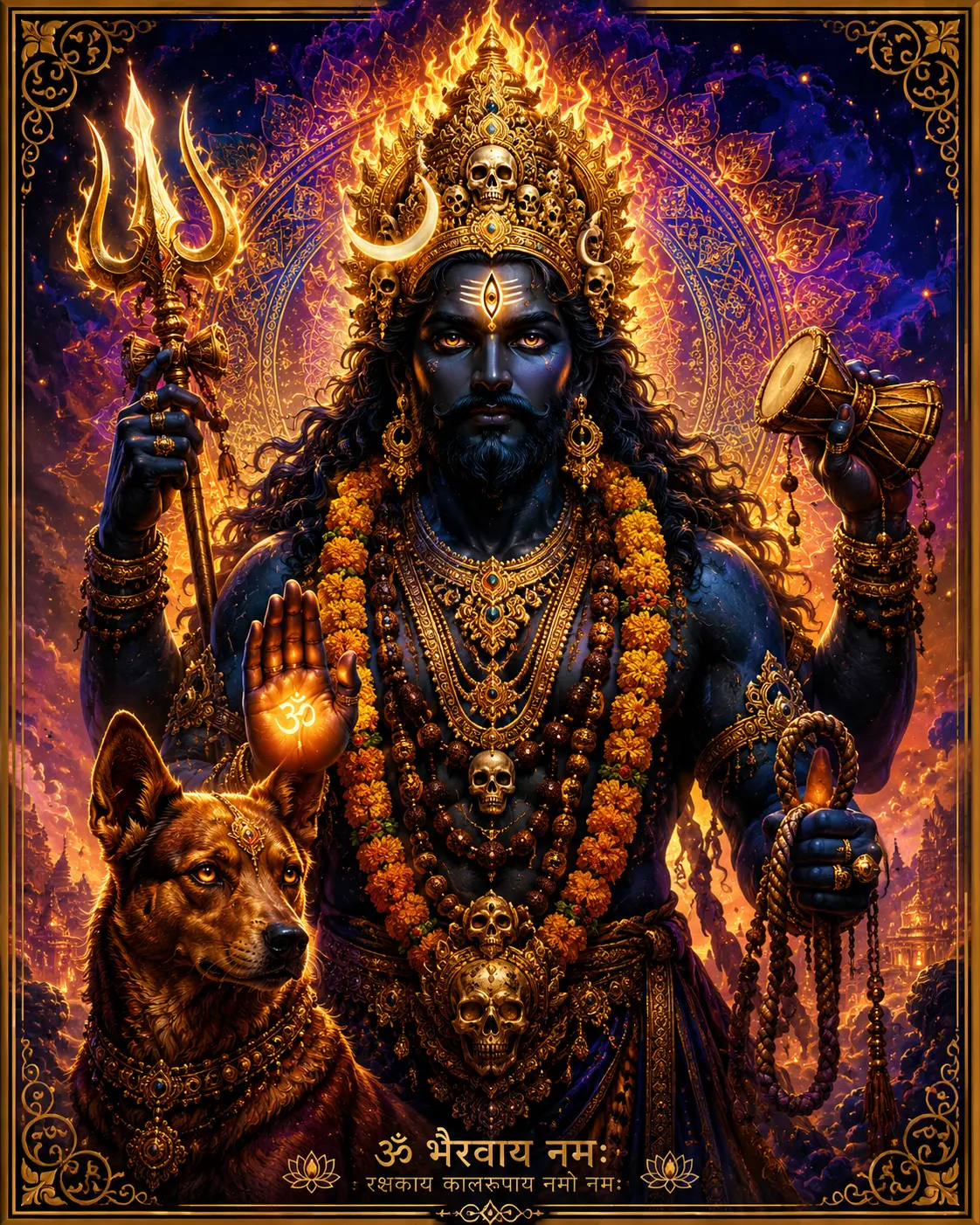
This piece depicts Lord Bhairava — the fierce, guardian form of Shiva — in the full energy of his iconic presence. His form is luminous blue-black, the deep midnight of the cosmic void from which Shiva's most direct and uncompromising aspects emerge. His third eye blazes at the centre of his forehead, the eye of supreme knowledge that sees through every veil and every construction of ordinary perception. His crown is adorned with skulls — the characteristic ornament of Bhairava and of the Tantric Shiva forms, skulls representing not death as ending but the dissolution of ego-identity as the necessary precondition for genuine awakening. He holds the trishul — the trident of Shiva, the sovereign instrument of the three planes — in one hand, and the damaru — the small hourglass drum whose primordial beat is the sound of creation itself — in another. Marigold garlands cascade in the warm orange-gold of sacred devotion.
At his side, a brown dog rests in quiet, patient attendance — the vahana of Bhairava, the animal that in Indian tradition is associated with the liminal, the threshold, the spaces between ordinary categories where Bhairava most naturally dwells. The background fills with the deep cosmic midnight blue and blazing crimson of the sacred fire of transformation — the fire that does not destroy but clarifies, that does not end but reveals.
On the image itself, in Devanagari script, the mantra: ॐ भैरवाय नमः / रक्षकाय कालरूपाय नमो नमः — Om Bhairavaya Namah / Rakshakaya Kalarupaya Namo Namah — salutation to Bhairava, to the protector, to the one whose form is time. The mantra completes the image as a living devotional offering rather than simply a sacred portrait.
About Lord Bhairava — The Fierce Guardian of Shiva
Lord Bhairava is the fierce, untamed, and most directly powerful manifestation of Shiva — the form in which the divine's transformative energy appears without moderation, without the mediated accessibility of the Adi Yogi meditating on Kailash or the cosmic grace of the dancing Nataraja. He is Shiva's face turned directly toward the seeker, without softening, presenting the reality of what the spiritual path actually requires: the dissolution of everything that is not real.
The name Bhairava is derived from the Sanskrit roots bhai (fear, awe) and rava (to cause, to produce) — he who produces awe, he who causes the genuine confrontation with what is. In the Shaiva tradition, however, Bhairava is understood as the form that dissolves fear precisely because he is its direct embodiment — the practitioner who has genuinely encountered Bhairava has, in that encounter, found that there is nothing to fear, because what appeared terrifying was the ego's resistance to reality, not reality itself. Bhairava terrifies only what is already false.
He is simultaneously the most fierce and the most compassionate of Shiva's forms — a paradox that the tradition holds deliberately: the compassion that is gentle and accommodating is one kind of grace; the compassion that is direct and uncompromising, that refuses to allow the practitioner to remain comfortable in illusion, is another and, in certain contexts, a more complete one.
The Origin of Bhairava — The Severed Head and the Wandering
The primary mythological account of Bhairava's origin is found in the Shiva Purana and in various Shaiva Agamic texts. The story centres on a dispute between Brahma and Vishnu about who among them is supreme. Shiva, observing the dispute, manifested Bhairava — described as a blazing column of fire from which the fierce form emerged, dark-complexioned, armed, and without precedent in the existing divine taxonomy.
In some accounts, Brahma's arrogance in claiming supremacy was the direct provocation: Bhairava, emerging from Shiva's anger at this ego-inflation in the creator himself, severed one of Brahma's five heads with a single stroke of his fingernail. The skull of Brahma then adhered to Bhairava's hand — the kapala (skull bowl) that Bhairava is often depicted carrying — and could not be removed. This began Bhairava's wandering (brahmahatya penance) through the three worlds, carrying the skull until he reached Kashi (Varanasi), where the skull fell from his hand and the sin of brahmahatya was dissolved by the sacred city's power.
The story encodes a series of significant theological statements. The severing of Brahma's head represents the destruction of the creator's ego — the recognition that even the creative faculty of the cosmic mind cannot claim autonomous supremacy without distorting its relationship to the deeper ground of consciousness. The skull that adheres is the consequence of that act — the practitioner who destroys false constructions cannot simply walk away from the consequences but must carry them and be purified through them. And Kashi as the site of purification establishes the intimate relationship between Bhairava and the sacred city of Varanasi that defines the living pilgrimage tradition.
The Eight Bhairavas and the Sixty-Four Forms
The Shaiva tradition does not present Bhairava as a single form but as a family of forms organised into an elaborate taxonomy. The eight principal Bhairavas — the Ashta Bhairavas — each govern one of the eight directions (ashtadikpalas) and one of the eight aspects of consciousness that the tradition identifies as requiring transformation on the path to liberation:
- Asitanga Bhairava — the formless one, associated with east
- Ruru Bhairava — the punisher, south-east
- Chanda Bhairava — the fierce, south
- Krodha Bhairava — the wrathful, south-west
- Unmatta Bhairava — the intoxicated, west
- Kapali Bhairava — the skull-bearer, north-west
- Bhishana Bhairava — the terrible, north
- Samhara Bhairava — the destroyer, north-east
Each of the eight Bhairavas is further multiplied into eight sub-forms, generating the sixty-four Bhairavas of the full Bhairava taxonomy. This elaborate structure reflects the Shaiva understanding that the transformative energy of Bhairava is not a single force but a multifaceted one — that different aspects of the ego's resistance to reality require different expressions of Bhairava's direct confrontation to dissolve them.
In Kashmir Shaivism, Bhairava is elevated beyond any of these specific forms to the position of the absolute itself — Param Bhairava, the supreme Bhairava, who is not a deity within the cosmos but the pure consciousness from which the cosmos arises. In the Bhairava Agamas of the Kashmir tradition, the recognition of one's own nature as Bhairava — not as the devotee approaching an external deity but as the awareness that is identical with what Bhairava represents — is the ultimate realisation of the path.
The Dog Vahana — What It Means
The brown dog that sits beside Bhairava in this artwork is his vahana — his vehicle and constant companion — and it is among the most iconographically distinctive and symbolically layered of all the animal companions in the Hindu pantheon.
The dog in ancient Indian culture was associated with the liminal — with cremation grounds, with the spaces between settlements, with the threshold between the world of the living and the world of the dead. It is an animal that does not observe the purity distinctions that structure much of traditional Hindu social and ritual life — the dog goes where it will, eats what it finds, and is neither pure nor impure in the ritual sense but simply present, alive, and without pretension.
That Bhairava — the form of Shiva who dwells precisely in the liminal, in the threshold between the constructed world of ordinary social reality and the unmediated reality beneath it — rides a dog rather than a lion or bull or eagle is a precise statement about the nature of his domain. He is not the deity of the socially sanctioned sacred. He is the deity of the edge, the threshold, the space where the structures of ordinary life have not yet imposed their categories.
In the devotional tradition, the dog is also understood as the most completely loyal of all animals — the one who gives its devotion unconditionally and without calculation. In this reading, the dog at Bhairava's side represents the quality of unconditional devotion that is the most natural response to encountering the divine in its most direct form: the devotee who has genuinely seen Bhairava face to face has nothing left to offer but this — complete, unconditional, calculating-nothing loyalty.
Bhairava as Guardian of Kashi — Varanasi's Protector
The most important sacred geography associated with Bhairava in the living pilgrimage tradition is Kashi — Varanasi, the sacred city on the Ganga, the oldest continuously inhabited city in India and, in the Hindu tradition, the city that is Shiva's earthly abode and the city where liberation (moksha) is granted to all who die within its boundaries.
In Kashi, Bhairava serves a specific and well-defined function: he is Kshetrapala — the guardian of the field, the protector of the sacred territory. He is the city's watch-keeper, the force that enforces the sacred laws of the kshetra (sacred territory) and that stands at its boundaries ensuring that the power of the city's liberation-granting presence is maintained and protected.
The Kala Bhairava temple in Varanasi — dedicated to the specific Kala Bhairava form — is among the most important and most visited temples in the city. Pilgrims to Kashi traditionally visit Kala Bhairava before visiting the Kashi Vishwanath temple, paying their respects to the city's guardian before approaching its presiding deity. This sequence encodes the understanding that Bhairava is not simply one deity among others in Kashi but the force that makes the entire sacred complex function as it does.
The Bhairava Ashtami — the eighth day of the dark fortnight of Margashirsha (typically November/December) — is the festival specifically associated with Bhairava and observed with particular intensity at the Kala Bhairava temple in Varanasi.
Bhairava in Kashmir Shaivism — The Supreme Consciousness
The most philosophically complete engagement with Bhairava in the Hindu tradition occurs in Kashmir Shaivism — the sophisticated non-dual Shaiva philosophy that flourished in Kashmir from approximately the 8th to the 13th century CE and that produced some of the most penetrating analyses of the nature of consciousness in any philosophical tradition worldwide.
In Kashmir Shaivism, the Bhairava Agamas — a corpus of texts distinct from the Shiva Agamas — present Bhairava not as a deity to be propitiated from outside but as the very nature of consciousness itself. The Vijnanabhairava Tantra, one of the most celebrated of these texts, is structured as a dialogue between Shiva (as Bhairava) and the goddess Bhairavi (Shakti), in which 112 dharanas (methods of contemplative inquiry) are presented — each one a method by which ordinary consciousness can recognise its own nature as the absolute Bhairava-consciousness that underlies it.
This is a fundamentally different religious orientation from devotional worship: rather than approaching Bhairava as an external deity whose grace is sought, the practitioner in this tradition is pointed toward recognising their own awareness as identical with what Bhairava represents. The fierce form is not something to be feared or propitiated but the direct, unmediated nature of consciousness itself — which is fierce precisely because it admits of no partition, no compromise, no comfortable distance between the knower and what is known.
The Vijnanabhairava Tantra's 112 methods include contemplative practices focused on the breath, on sensation, on the spaces between thoughts, on the recognition of awareness as the ground of all experience — methods that have found their way into contemporary mindfulness and meditation traditions, often without their Bhairava source being acknowledged.
The Mantra in This Artwork
The Devanagari text visible in this artwork encodes the primary Bhairava mantra:
ॐ भैरवाय नमः — Om Bhairavaya Namah — salutation to Bhairava
रक्षकाय कालरूपाय नमो नमः — Rakshakaya Kalarupaya Namo Namah — salutation to the protector, to the one whose form is time
The first line is the root mantra of Bhairava worship — the invocation that establishes the practitioner's orientation toward this form of consciousness. The second line addresses two of Bhairava's most fundamental qualities: Rakshaka (the protector, the guardian — the one who stands between the devotee and what threatens them) and Kalarupa (the one whose form is time — the recognition that Bhairava is not simply fierce in a personal sense but is the force of time itself, the dissolution that is built into the nature of existence).
The presence of the mantra text in the artwork itself places the image in the tradition of yantra — sacred diagrams that function as visual embodiments of divine energy rather than simply representations of divine figures. An image that includes the mantra of the deity depicted carries a quality of active invocation that a portrait alone does not.
Displaying Bhairava in the Home
Bhairava's image is displayed primarily in dedicated practice spaces — puja rooms, meditation rooms, and home altars — by practitioners within the Shaiva and Tantric traditions who work with this form specifically. He is less commonly displayed as general sacred décor and more purposefully placed by those who have a specific devotional or practice relationship with this aspect of Shiva.
In a practice space or meditation room, Bhairava's presence carries a specific quality: the confrontational directness of a form that refuses to allow comfortable distance from what is real. This is not a gentle or ambient quality — it is a quality that actively supports practices of self-inquiry, ego-dissolution, and the willingness to encounter what is without the mediation of comfortable belief.
In a puja room alongside other Shiva forms (the Shiva Meditation image, the Nataraja, the Shiva Yantra), Bhairava represents the most direct and unfiltered expression of Shiva's nature — completing the picture of what Shiva is by including what the other forms, in their gentleness or their cosmic distance, do not foreground.
The midnight blue and crimson palette of this artwork is bold and specific — it suits a dark or neutral wall, and a dark or black frame rather than the natural wood or white frames that suit the warmer palettes of the collection's other pieces.
The digital download allows immediate printing at your preferred size. Print on matte photo paper at FedEx Office, Staples, or any professional print shop.