About This Artwork
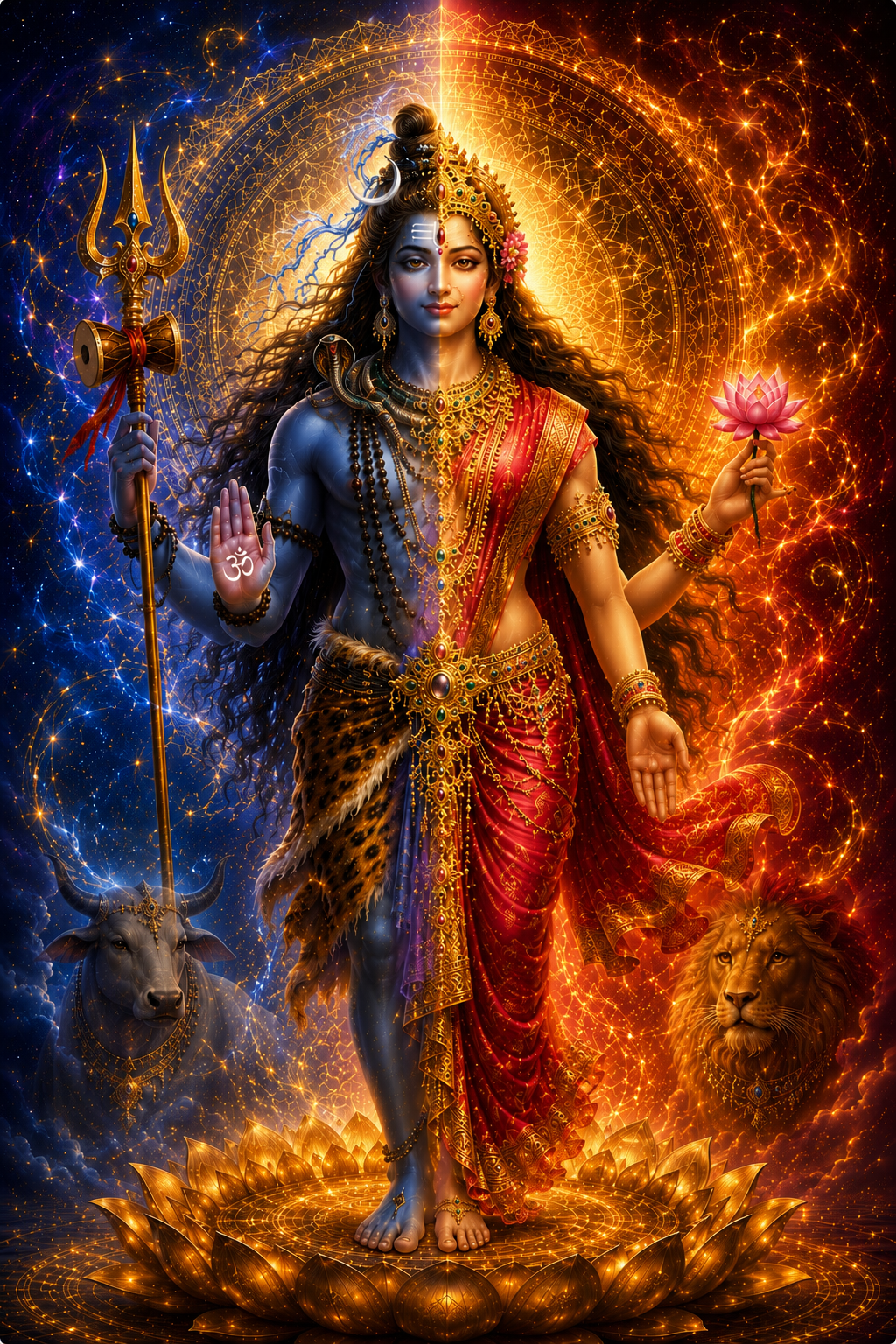
This piece depicts Ardhanarishwara — the composite form in which Shiva and Parvati are united in a single body, divided precisely at the vertical midline — in one of the most visually striking and iconographically precise compositions in the collection. The figure stands on a golden lotus throne, the vertical division between the two halves creating one of the most remarkable visual boundaries in all of sacred art: on the left, everything that Shiva is; on the right, everything that Parvati is; and in the centre, the single point where they are one.
The left half — Shiva — is blue-grey in complexion, the colour of the cosmic consciousness that pervades the universe without being limited by it. Matted hair rises above the crown. The crescent moon and a coiled cobra identify him immediately. In his upper left hand the trishul, the trident of divine sovereignty over the three planes. His lower left palm faces outward with the Om symbol glowing at its centre. Behind him, a cool deep starlit sky — the vast, open, witnessing consciousness that is Shiva's element. To his left, Nandi the bull rests in devoted attendance.
The right half — Parvati — is golden-skinned, the warm luminosity of Shakti, the active creative energy of the cosmos. She wears a rich red and gold silk sari with intricate embroidery, elaborate gold jewellery at neck, wrists, and ears. In her right hand she holds a pink lotus — the symbol of beauty, purity, and the fully bloomed consciousness that is her nature. Behind her, a warm fiery glow — the generative, creative, nurturing energy that is Parvati's element. To her right, her lion rests with the composed authority of the great goddess's vahana.
The visual meeting point of these two halves — the precise vertical line where starlit cool meets fiery warm, where blue-grey meets gold, where the trishul of ascetic power meets the lotus of generative grace — is the theological statement at the centre of the entire composition. This is not a figure that is divided. It is a figure that is finally showing what was always true: that what appears as two has always been one.
About Ardhanarishwara — The Form That Was Never Two
Ardhanarishwara — Ardha (half) + Nari (woman) + Ishwara (lord) — is the composite form of Shiva and Parvati in which the two supreme principles of the Shaiva-Shakta tradition are depicted as a single being, divided at the vertical midline: the left half is Shiva, the right half is Parvati, and together they constitute a single complete reality that is neither the one nor the other but both simultaneously.
This form makes a theological claim that is among the most direct and most complete in the entire Hindu tradition: that Shiva and Shakti — consciousness and energy, the witnessing principle and the creative principle, the masculine and the feminine as understood in the Shaiva philosophical framework — are not two separate realities that come together in union but a single reality that appears as two in the same way that the two sides of a coin appear to be different things while being one coin. The division is apparent, not actual. Ardhanarishwara is the form that makes the unity visible by showing the division and its resolution in a single image.
The form appears in Hindu temple sculpture from approximately the 1st–2nd century CE onward and becomes one of the most consistently depicted forms in South Indian Shaiva temple art during the Pallava, Chola, and Vijayanagara periods. Some of the most celebrated Ardhanarishwara sculptures — at the cave temples of Elephanta Island near Mumbai, at Badami in Karnataka, and in the Chola bronzes of Tamil Nadu — are among the masterworks of Indian sacred art.
The Theological Statement — Shiva and Shakti as One Reality
The most fundamental philosophical claim of the Shaiva-Shakta non-dual traditions — Kashmir Shaivism, the Trika system, and the broader family of non-dual Shaiva and Shakta philosophical schools — is that Shiva (consciousness) and Shakti (energy) are not two separate principles but one reality appearing in two aspects.
Shiva alone — pure consciousness without energy — is, as the tradition puts it, a corpse (shava). It is aware but cannot move, cannot create, cannot manifest. Shakti alone — pure energy without consciousness — moves without direction, creates without intelligence, manifests without purpose. It is only in their inseparable union — which is not a union of two things but the recognition that they were never separate — that the cosmos arises as the integrated expression of both simultaneously.
Ardhanarishwara gives this philosophical claim a visual form. By depicting the two as literally one body — divided at the midline but standing on one lotus, sharing one crown, constituting one being — the image makes the abstract principle immediately experiential. You cannot look at Ardhanarishwara and see two separate figures. You see one figure with two aspects, and the visual experience is itself the teaching.
In the Shaiva understanding, the practitioner's own nature is also Ardhanarishwara — the awareness within which experience arises (Shiva) and the experience that arises within it (Shakti) are not two separate realities but the two aspects of the single reality that the practitioner is. The recognition of this — not as an idea but as a direct experience — is the goal of the Shaiva-Shakta path of inner practice.
Reading the Two Halves — The Iconography in Detail
The left half — Shiva: The blue-grey complexion of the left half carries the same associations as the standing Shiva images elsewhere in this collection: the infinite sky-like nature of pure consciousness, the primordial ground that pervades everything without being limited to anything. The blue-grey is specifically the colour of the cosmic witness — the awareness that is always present, always still, always watching, never disturbed by what it witnesses.
The matted hair (jata) rising above the crown is Shiva's most consistent identifying attribute — the hair of the ascetic who has renounced all grooming in favour of the concentrated inward attention of yogic practice. The Ganga (river Ganges) is traditionally depicted flowing from the matted locks, though the emphasis here is on the overall ascetic register.
The crescent moon (chandrakala) at the crown signals Shiva's mastery over time — the moon's waxing and waning representing the cycles of time that Shiva witnesses without being caught within them. The cobra (Vasuki) coiled at the neck represents the awakened kundalini energy, the serpent power at rest in one who has fully awakened it. Together they identify this half immediately and unambiguously as Shiva.
The trishul held in the upper left hand — Shiva's sovereign weapon — signals authority over the three planes and the three gunas. The Om on the lower left palm is the primordial sound that is Shiva's most essential self-revelation, the vibration from which all of creation arises. Behind this half, the starlit night sky extends — cool, vast, open, the visual field of the witnessing consciousness that Shiva represents.
The right half — Parvati: The golden complexion of the right half is the warm, luminous gold of Shakti in her benevolent and generative aspect — the colour of the creative energy that pours itself into manifestation with the same ease and generosity with which sunlight pours into the world. This is not the fierce red-gold of Bhairavi or the blazing crimson of Kali's background — it is the warm, sustaining, maternal gold of Parvati as the great goddess in her most approachable and most complete expression.
The red and gold silk sari and the elaborate gold jewellery mark Parvati as the queen — the sovereign of the manifest world, the goddess whose domain is every form that Shiva's consciousness makes possible. The crimson of the sari is the colour of active energy, of the life force that flows through every living being, of the love that creates and sustains.
The pink lotus held in the right hand is Parvati's attribute as the goddess of grace, beauty, and the fully manifested consciousness — the lotus that blooms in the open, untouched by what nurtured it, the image of the perfected life that has moved through the conditions of the world and arrived at its own completeness. Behind this half, the warm fiery glow extends — the creative fire of Shakti's energy, the warmth that is the complement to Shiva's cool starlit stillness.
The shared lotus throne: Both halves stand on a single golden lotus — the symbol of the purity and completeness that encompasses both aspects of the divine simultaneously. The lotus does not divide; it supports. Both consciousness and energy, both Shiva and Parvati, rest on the same ground of pure awareness that the lotus represents.
Nandi and the lion: The two vahanas on either side complete the iconographic statement. Nandi — Shiva's devoted bull — rests to the left, the emblem of strength, steadiness, and devoted service. Parvati's lion rests to the right, the emblem of sovereign power, courage, and the fierce protectiveness of the great goddess. Together they flank the unified form as the representatives of the two vahana traditions, acknowledging a form that encompasses both their lords simultaneously.
Ardhanarishwara and the Question of Gender
Ardhanarishwara is sometimes discussed in contemporary contexts in relation to questions of gender identity and non-binary existence, and this connection is worth addressing with the care it deserves.
The tradition's understanding of the masculine and feminine in the Ardhanarishwara form is specifically cosmological and philosophical, not biological or social. Shiva and Parvati represent consciousness and energy — the two poles of the dynamic that produces the manifest cosmos — and their representation as male and female is the tradition's way of expressing a metaphysical duality using the most immediate and universally understood polarity available to human experience.
Within the Hindu philosophical tradition itself, the masculine and feminine in this context are understood as universal principles that are not limited to or defined by biological sex — every human being, every living being, is understood as a particular configuration of both consciousness (Shiva) and energy (Shakti), and the path of yoga is in part the path of recognising and integrating both.
The contemporary resonance of Ardhanarishwara's image for those outside the tradition's specific metaphysical framework — its suggestion that the apparent opposition between masculine and feminine resolves into a single complete being — is a genuine and meaningful resonance, even when the metaphysical specifics differ from the tradition's own understanding. The image speaks across that difference because the recognition it points toward — that apparent opposites, fully understood, reveal themselves as two aspects of a single reality — is a recognition that moves beyond any single cultural or philosophical context.
Ardhanarishwara in Temple Sculpture — The Artistic Tradition
Among all the divine forms depicted in this collection, Ardhanarishwara is the one with the most extensively documented and most consistently celebrated tradition in Indian temple sculpture. The form appears in some of the most celebrated sacred art sites in India:
Elephanta Island (Mumbai): The cave temples of Elephanta contain what many art historians consider the greatest single collection of Shaiva monumental sculpture in existence. The Ardhanarishwara panel at Elephanta — approximately 1.8 metres high, carved in the 6th–7th century CE — is among the most celebrated sculptures in Indian art, presenting the form with extraordinary refinement and iconographic completeness.
Badami Cave Temples (Karnataka): The 6th-century CE cave temples at Badami contain multiple Ardhanarishwara representations in the Chalukya style — powerful, frontal, and compositionally clear.
Chola bronzes (Tamil Nadu, 9th–13th centuries CE): The Chola period produced Ardhanarishwara bronzes of extraordinary refinement, with the characteristic Chola elegance of form and the precision of detail that makes this period's sacred bronzes among the greatest in any artistic tradition.
The consistency of the Ardhanarishwara form across these traditions — separated by centuries and by regional artistic conventions — reflects the centrality of the form's theological statement to the Shaiva tradition as a whole.
Displaying Ardhanarishwara in the Home
Ardhanarishwara is displayed in Shaiva and Shakta households as an image of the complete divine — the form that encompasses both Shiva and Parvati in their unity. In the puja room it represents the completeness of the divine couple without requiring two separate images. In a meditation or yoga space it carries the specific philosophical invitation of the Shaiva non-dual traditions: to recognise the consciousness that is witnessing experience (Shiva) and the experience being witnessed (Shakti) as two aspects of a single reality.
The dual palette of this artwork — the striking visual contrast between the cool starlit blue-grey of the left half and the warm fiery gold of the right — makes it one of the most immediately striking pieces in the collection for any wall. The precise vertical division creates a visual rhythm that draws the eye to the midline — to the point of union — and then outward to the two aspects on either side. This quality makes the image work as both a devotional piece and a visually compelling element in any interior.
A simple dark or natural wood frame allows the composition's own visual drama to speak without competition. Print on matte paper for the truest rendering of both the cool blue-grey and the warm gold tones.