
About This Artwork
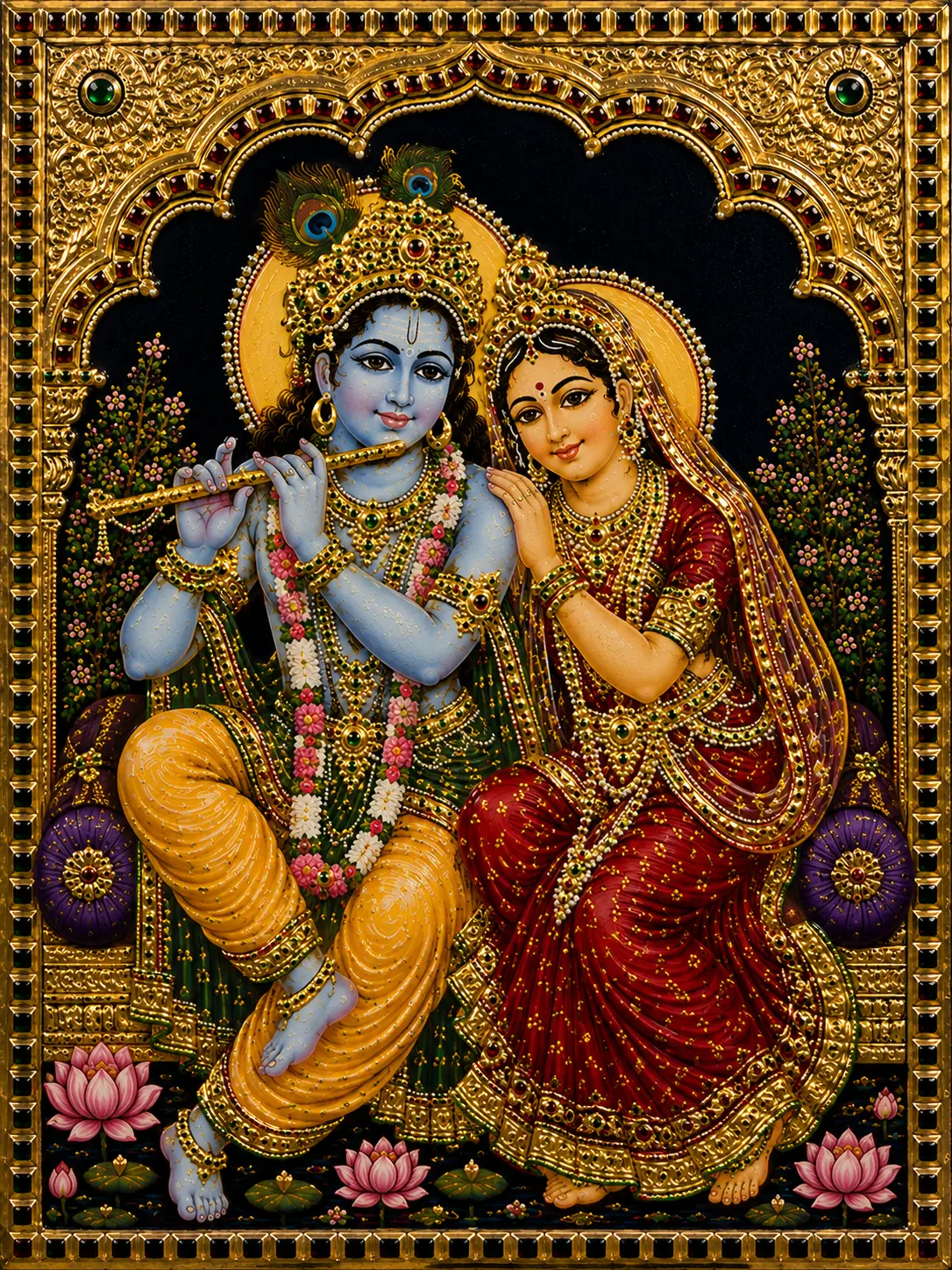
This piece renders Radha and Krishna — the most beloved divine couple in the entire Hindu devotional tradition, the embodiment of the most complete expression of the soul's relationship with the supreme — in the visual language of the Tanjore (Thanjavur) painting tradition of South India, with its characteristic deep black background that makes every colour and every gold detail blaze with a luminosity and depth that no other artistic tradition can match.
Krishna is depicted in his full divine glory — luminous deep blue skin glowing with the light of the supreme consciousness, his peacock feather crown adorned with jewels, golden halo behind him, his flute raised to his lips with the ease and grace of one for whom the music of existence is as natural as breathing. Radha stands beside him in the warmth of her bridal glory — golden skin radiant, dressed in a magnificent deep crimson and gold silk saree, adorned with elaborate pearl and gold ornaments.
The deep black background of the authentic Tanjore aesthetic makes every colour and gold detail blaze with extraordinary luminosity. The elaborate ornate gold-embossed border frames the composition with the opulence that is the most immediately recognisable feature of the classical Tanjore tradition. Pink lotus flowers bloom at their feet. The lush green forest of Vrindavan opens behind them.
About Radha and Krishna — The Cosmic Beloved
The relationship between Radha and Krishna is understood in the Vaishnava bhakti tradition — particularly in the Gaudiya Vaishnava and Pushti Marg streams — as the most complete possible model of the relationship between the individual soul (jivatman) and the supreme consciousness (Brahman). Krishna is the supreme — the Purushottama, the divine flute player who calls every soul back to its original home. Radha is the supreme devotee — the one whose love for Krishna is so complete, so unconditional, and so total that she has become the model of what bhakti (devotional love) looks like at its highest and most complete expression.
This is not romantic love in the ordinary sense. The relationship between Radha and Krishna is understood as the most intimate possible form of the non-dual recognition — the individual soul (Radha) discovering that its deepest nature is not separate from the supreme (Krishna), not through philosophical analysis but through the direct experience of love so complete that the boundary between the lover and the beloved becomes permeable.
The Tanjore Painting Tradition — 400 Years of Sacred Art
Tanjore paintings (also Thanjavur paintings, from the city of Thanjavur in Tamil Nadu) are a classical South Indian painting tradition that developed primarily during the 16th–18th centuries CE under the patronage of the Nayak rulers and later the Maratha rulers of Thanjavur. The tradition is characterised by a specific set of features that make Tanjore paintings immediately recognisable:
The deep black background: The characteristic backdrop of most Tanjore paintings — a deep, rich black that makes every foreground colour and every gold detail stand out with extraordinary luminosity. No other painting tradition uses this specific device with the same consistency or to the same effect.
The elaborate gold-embossed border: The ornate gold border that frames the painting — often incorporating raised gold work, semi-precious stones, and intricate geometric and floral patterns — is the most immediately distinctive feature of the Tanjore tradition and the one that most directly communicates the tradition's association with royal patronage and devotional splendour.
The gold-foil work on the figures: Tanjore paintings traditionally incorporate 22-carat gold foil applied to the crowns, jewellery, and decorative elements of the deities depicted, giving the figures a three-dimensional luminosity that painted gold cannot achieve. In this digital artwork, the gold detail is rendered with the same intention of luminosity and depth.
The specific devotional subjects: Tanjore paintings are almost exclusively devotional in subject matter — depicting Vishnu, Krishna, Rama, Shiva, and other deities in their most celebrated iconic forms, with the opulence and detail appropriate to the royal courts that commissioned them.
Radha Krishna in the Bhakti Tradition
The love between Radha and Krishna is the central teaching of the bhakti (devotional) path — the path that understands love itself as the most direct and most complete means of spiritual realisation. The Gaudiya Vaishnava tradition founded by Sri Chaitanya Mahaprabhu (1486–1534 CE) places the Radha-Krishna relationship at the absolute centre of its theology: Radha is not simply a character in the Krishna stories but the very essence of bhakti itself — the personification of the complete devotional love that is both the path and the destination.
The Radha Ashtami (the festival celebrating Radha's appearance) and the Radha Govinda worship that characterises the daily liturgy of Gaudiya Vaishnava temples worldwide are expressions of this centrality: in the Gaudiya tradition, the image of Radha with Krishna is more complete and more theologically central than Krishna alone.
Displaying Radha Krishna Tanjore in the Home
The Radha Krishna Tanjore composition is most naturally placed in a Vaishnava puja room as the primary sacred image, or in a bedroom or intimate living space where the specific quality of the love it represents — complete, unconditional, cosmic — is the quality being invoked. The opulent Tanjore aesthetic makes it a statement piece in any interior.
The deep black and gold palette suits a gold frame, a natural dark wood frame, or a simple black frame that continues the composition's ground tone. The format is portrait — standard portrait frame sizes suit this artwork.