
About This Artwork
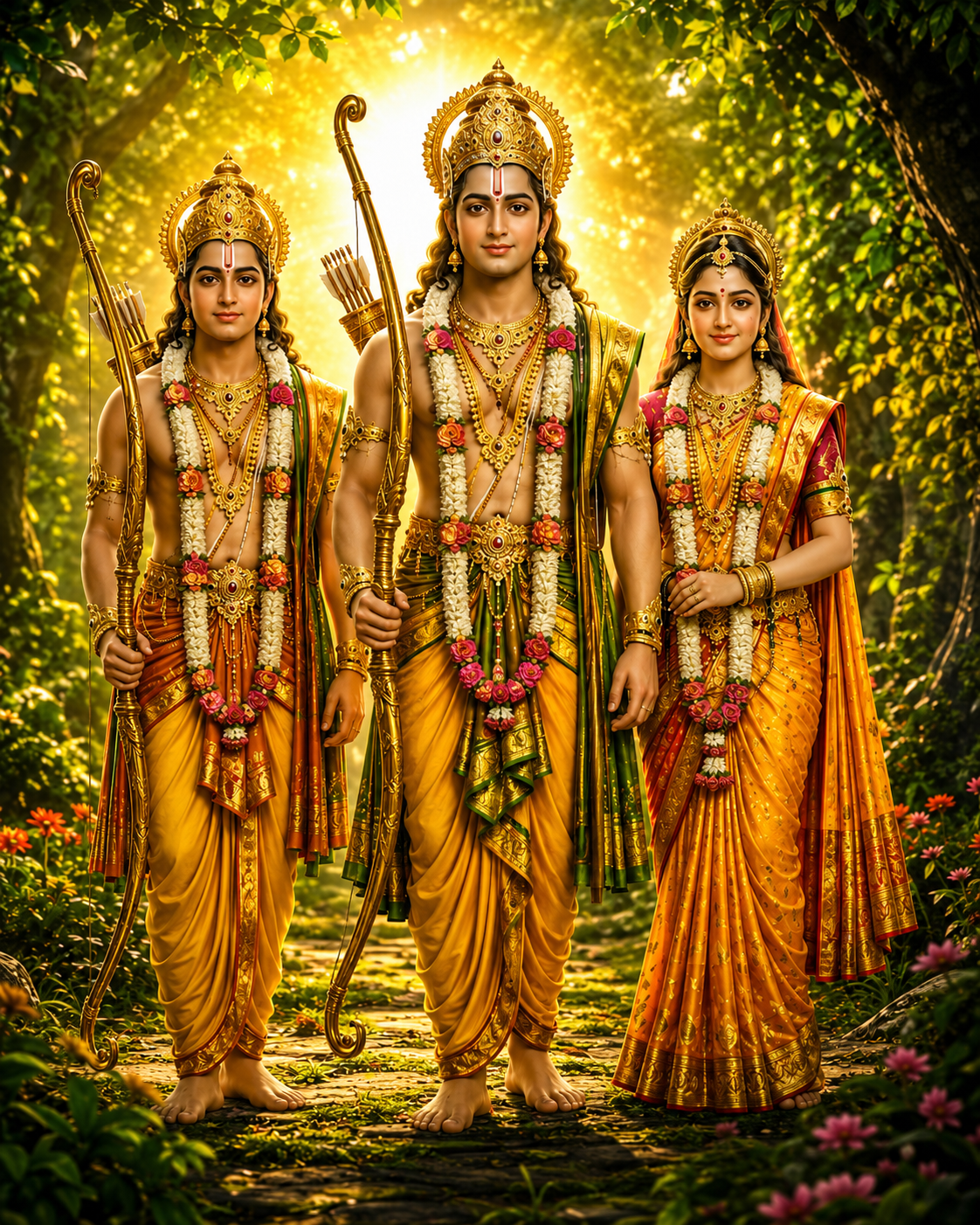
This piece depicts the divine forest trinity of the Ramayana — Lord Ram, Goddess Sita, and Lord Lakshmana — standing together in the luminous sacred forest of their exile, serene, complete, and radiating the quality of three beings who have chosen dharma above every worldly comfort and who have arrived, through that choice, at the most profound contentment available in human experience.
This is not the formal throne room composition of the Rama Darbar — the three are not on a throne or in a palace but in the living, breathing forest that recognised their divinity even when the human world had not yet caught up. Lord Ram stands at the centre with his golden bow held with quiet confidence, dressed in royal yellow and gold with elaborate crown and garlands. Lord Lakshmana stands to his left — equally adorned, bow in hand, his entire bearing the bearing of one whose life is a continuous act of sacred service. Goddess Sita stands to Ram's right — luminous in golden-orange silk with gold embroidery and traditional jewellery, her serene expression radiating the complete courage of the most devoted and most powerful woman in the Ramayana.
Behind all three the sacred forest blazes with golden light pouring through the emerald green canopy. Sacred wildflowers bloom at the edges. The warm gold, luminous emerald green, and blazing orange of the composition make it one of the most colourful and most alive of the collection's group pieces.
The Three Pillars of the Ramayana — Ram, Sita, and Lakshmana
The three figures in this artwork together constitute the complete map of the dharmic life as the Ramayana tradition encodes it:
Lord Ram (Maryada Purushottam) is the ideal human being — the person in whom every thought, word, and action is in complete alignment with dharma, the cosmic order of right conduct. His bow is not a weapon of aggression but the instrument of his dharma — the extension of his will into the world, the expression of the relationship between inner intention and right outer action that the Ramayana proposes as the model for human life. He chose exile over the throne without hesitation when dharma required it. He upheld his given word above his own desires in every circumstance. He is the person who demonstrated that the highest possible human life consists not of accumulating power or pleasure but of acting in complete alignment with what is right in every specific situation that life presents.
Goddess Sita is the Shakti of that dharma — the divine feminine whose presence makes Ram's dharma not merely possible but meaningful, whose purity and courage constitute the moral heart of the entire Ramayana story. Sita is not passive. She makes active, courageous choices throughout the narrative — including the choice to follow Ram into exile when she could have stayed in the palace. Her ultimate trial — the agni pariksha, the fire test — and her eventual departure from the earth rather than compromise her dignity on anyone's terms, mark her as the most completely self-possessed of all the Ramayana's figures, the one whose inner sovereignty was never in question regardless of what circumstances the external world imposed.
Lord Lakshmana is the principle of absolute selfless service and devotion — the one who gave up every personal comfort, including sleep, to walk beside his brother and protect what is most sacred. Lakshmana's devotion is so complete that in the yogic and Tantric reading of the Ramayana he represents the disciplined mind (manas) that subordinates its own preferences entirely to the service of the higher self (Ram). His presence completes the trinity: right action (Ram), the feminine grace that sustains it (Sita), and the devoted service that protects both (Lakshmana).
The Sacred Forest — Aranya Kanda and Panchavati
The forest setting of this artwork corresponds to the Aranya Kanda — the forest book — of the Valmiki Ramayana, the period of fourteen years during which Ram, Sita, and Lakshmana lived in the forest of their exile. The specific setting that many commentators associate with this tableau is Panchavati — the grove of five trees near the banks of the Godavari river in present-day Nasik, Maharashtra — which is the place where the trio built their forest hermitage and where the Ramayana's central crisis (the abduction of Sita by Ravana) would eventually occur.
The forest in the Ramayana is not simply a backdrop. It is an active presence in the narrative — the forest sages welcome and protect the divine family, the animals and birds of the forest recognise Ram's divinity, and the entire natural world is shown as responsive to the presence of three beings who are living in complete alignment with dharma. The golden light that floods the forest canopy in this artwork captures this quality of the sacred forest as a place that is already in its own natural dharmic alignment.
The Ramayana as a Living Map
The Ramayana — the story of Ram and Sita and Lakshmana — is not merely one of the world's great epics. It is the living map of the dharmic life as understood in the Vaishnava and broader Hindu tradition. Ram's choices are studied and discussed and debated across millennia not as historical events but as the most precise and most complete model of how a human being can live when every dimension of their life is oriented toward what is right rather than what is convenient.
The global spread of this map is remarkable. The Ramayana has been retold and performed in over three hundred distinct versions across the cultures that were shaped by Indian civilisation — from the Thai Ramakien to the Cambodian Reamker to the Javanese Kakawin Ramayana to countless oral traditions across South and Southeast Asia. The story of Ram, Sita, and Lakshmana has proven to be one of the most durable and most widely resonant stories in human history.
Displaying Ram Sita Lakshmana in the Home
The Ram Sita Lakshmana trio is displayed in Hindu homes across the North Indian tradition and in any Vaishnava household where the Ramayana tradition holds special significance. For the enormous Rama devotional community across India and the diaspora — which encompasses hundreds of millions of people — this image is among the most fundamental possible sacred images.
The warm, luminous palette suits a natural wood or gold frame. The composition is portrait-format, standard sizes suit standard frames.