About This Artwork
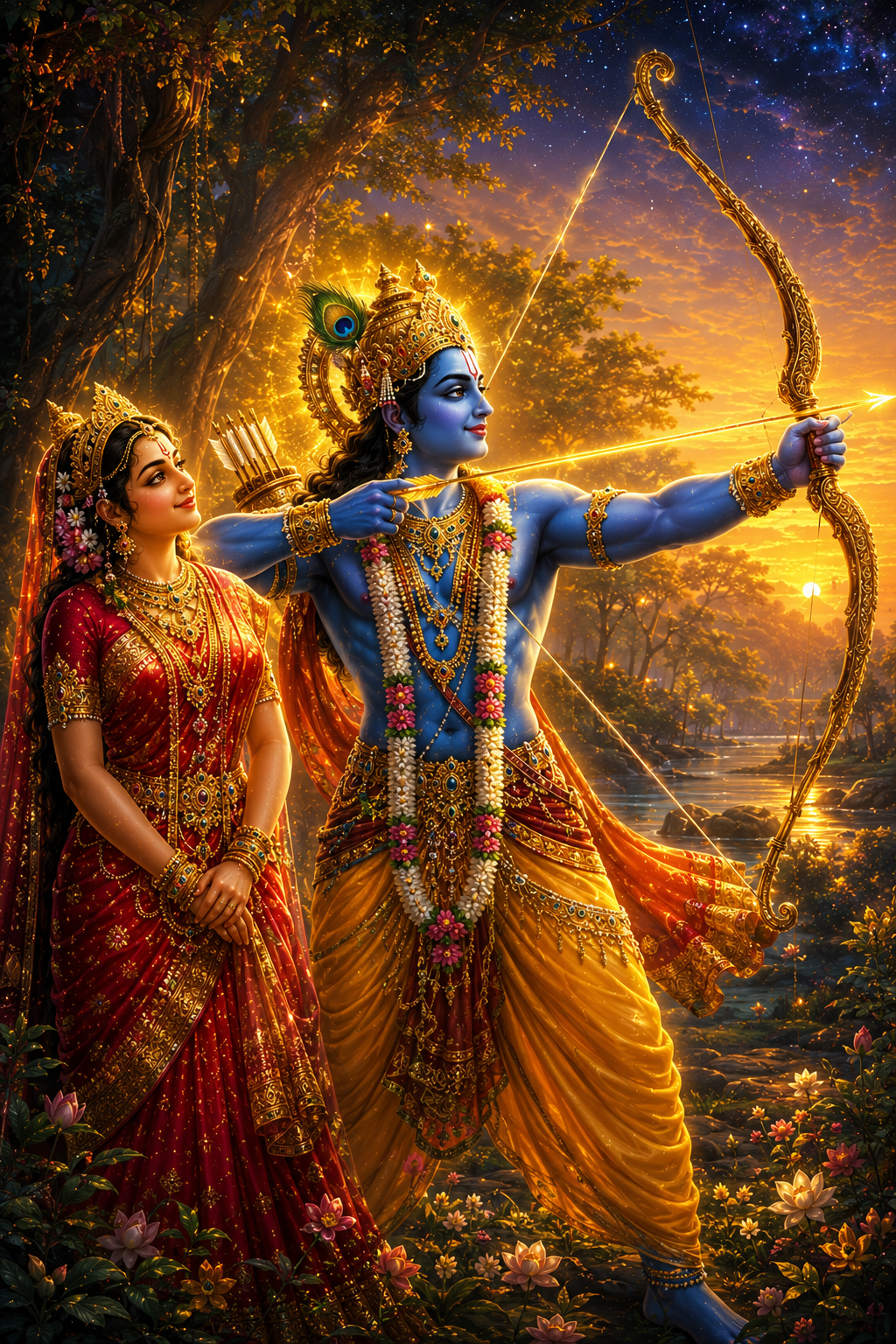
This piece depicts Lord Ram and Goddess Sita in a compositional moment that is entirely unlike the conventional Rama iconographic tradition — not the formal frontal Rama Darbar in which Ram is enthroned with Sita to his right, Lakshmana and Hanuman in attendance, everyone facing forward for the devotee's gaze. This is Ram in the archer's stance: deep cosmic blue skin turned in side profile, the sacred bow fully drawn with an arrow of golden light, the quiet serene joy in his expression — not the warrior's fierce concentration but the complete ease of one who is utterly at home in the dharma he was born to embody.
And behind him — slightly, watching not where the arrow goes but watching him — Goddess Sita. Her blazing crimson silk saree with heavy gold embroidery flames like sacred fire against the deep blue of Ram's cosmic form. Her gaze is entirely on Ram. Her expression radiates the most tender, most joyfully loving devotion imaginable — the expression of one watching the person she loves doing exactly what they were born to do.
The ancient sacred forest of Panchavati surrounds them — enormous ancient trees, golden dappled light filtering through the emerald canopy, a sacred river glimpsed in the distance, the first stars of evening appearing in the golden sky above. Warm gold, deep cosmic blue, blazing crimson, and luminous forest green: this composition is more alive, more intimate, and more completely unlike anything else in the Ram-Sita visual tradition than any other Rama image in the collection.
Ram and Sita — Consciousness and Its Beloved
Lord Ram and Goddess Sita are the supreme divine couple of the North Indian Vaishnava tradition — the most beloved and most widely worshipped of all the divine pairs in the Hindu tradition's enormous pantheon of paired presences. The relationship between them is not simply the relationship of a husband and wife who happen to be divine beings. In the deepest reading of the Ramayana tradition, they represent the most fundamental of all possible relationships: the relationship between consciousness (Ram) and the Shakti of that consciousness (Sita), between the witness and what the witness witnesses, between the principle of perfect dharmic action and the energy that makes that action not merely possible but meaningful.
Without Sita, Ram's bow has no purpose — the dharma has no context in which to express itself, no beloved for whom the world is worth ordering. Without Ram, Sita's devotion has no object — the Shakti has no ground to move through, no consciousness to give direction to its energy. Together they are the complete picture of what existence is: the meeting of witnessing awareness and creative energy in the most intimate and most complete possible relationship.
The Archer's Stance — Dhanus in the Service of Dharma
The image of Ram drawing his bow — the dhanus, the instrument of his dharma — is one of the most powerful and most immediately recognisable in all of Hindu iconography. But the specific quality of this composition's archer stance is different from the standard iconographic depiction. Ram is not in the warrior's fierce pose of battle. He is in the quiet, complete ease of the perfect practitioner — drawing his bow the way a master musician draws their bow across the strings: not with effort but with total effortlessness, not with tension but with complete release into the action that the moment requires.
This is Ram as the model of karma yoga — the yoga of action, the path of performing every action in complete alignment with what the moment requires, without personal agenda, without the residue of the ego's desire to appear in a particular way. The bow drawn like this is the most direct possible visual statement of what the Bhagavad Gita means when Krishna tells Arjuna to perform action without attachment to the fruits of action: to be completely present in the action, completely available to what the moment requires, and completely free of the ego's investment in how the action lands.
Sita's Gaze — The Witness Behind the Witness
The most revealing detail of this composition is not Ram's archer stance but Sita's gaze. She is not watching where the arrow goes. She is watching him. Her entire attention is on Ram — not on the outcome of the action, not on the trajectory of the arrow, not on the target or the result, but on the being who is acting. This is the most precise visual statement of what the devotional tradition means by Sita's nature: she is the awareness behind the action, the presence that witnesses and sustains the one who acts.
In the Tantric reading of the Ramayana, Sita is Shakti — the creative, sustaining, devotional energy that enables Shiva (Ram) to act. The Shakti does not act directly; she is the power that makes the action possible, the ground from which the action arises, the love that gives the action its meaning. Sita watching Ram draw his bow is Shakti enabling Shiva — the energy giving the consciousness its context, the beloved making the act of the beloved worth performing.
Panchavati — The Sacred Forest Setting
The forest setting of this artwork is Panchavati — the sacred grove of five trees (panca = five, vata = banyan tree) on the banks of the Godavari river in what is now Nasik, Maharashtra, where Ram, Sita, and Lakshmana built their hermitage during the years of their forest exile. Panchavati is the site of some of the Ramayana's most significant events — the encounter with the demoness Shurpanakha, whose infatuation with Ram and Lakshmana led eventually to the chain of events that resulted in Sita's abduction by Ravana.
This is not incidentally the backdrop of the action: Panchavati is the place where the forest is most alive, where the sacred river is most immediately present, where the ancient trees have witnessed the most dramatically significant events of the divine couple's earthly journey. The golden light filtering through the emerald canopy in this artwork is Panchavati at its most luminous — the sacred forest in the golden hour, the natural world's most beautiful setting for the most intimate moment in the Ramayana.
Displaying Ram Sita in the Home
The Ram Sita composition — with its warm, intimate, alive palette of deep cosmic blue, blazing crimson, warm gold, and luminous forest green — is among the most naturally beautiful of all the couple compositions in the collection. It suits a bedroom or intimate living space where the quality of the relationship it depicts — completely devoted, completely present, watching each other with the total attention of love that has been through everything and emerged knowing that what they share cannot be diminished by any circumstance — is the quality being invited into the space.
In a puja room it serves as the primary Rama-Sita devotional image for any household where the Rama tradition is central. The warm forest palette suits a natural wood or gold frame.