About This Artwork
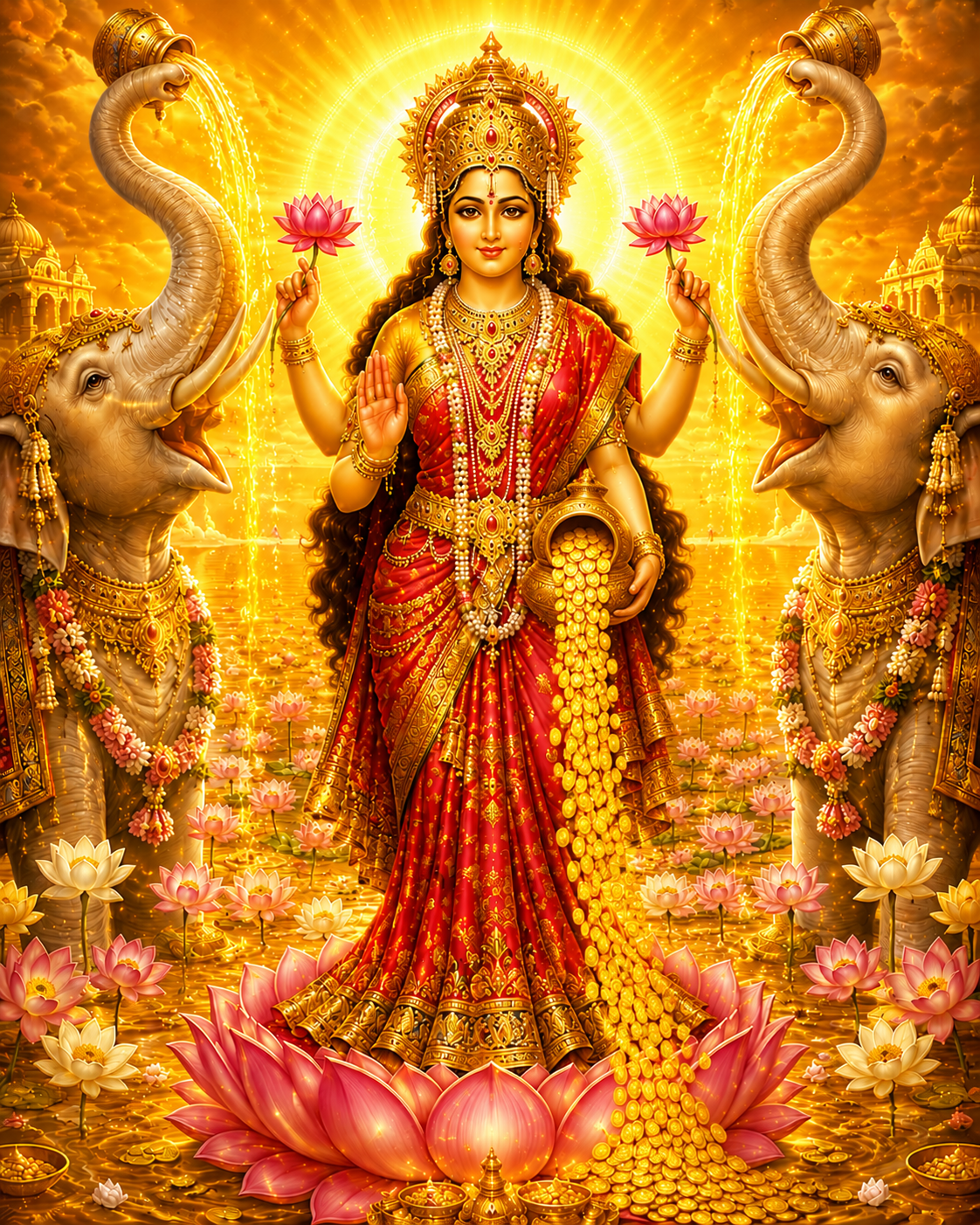
This piece depicts Maa Lakshmi in the Gaja Lakshmi form — the most widely depicted and most immediately recognisable of all the classical Lakshmi iconographic traditions. She stands in sovereign composure on a magnificent blooming pink lotus, four arms extended in the precise arrangement of her classical iconography: upper arms holding pink lotuses, lower right hand in varada mudra with golden coins cascading from her open palm, lower left arm raised in abhaya mudra — the gesture of protection and fearlessness simultaneously offered alongside the gesture of giving. On either side, two white elephants raise their trunks and pour golden nectar from great vessels in the ceremonial abhishekam of the four directions.
She wears a vivid crimson and gold sari with intricate embroidery, cascading gold jewellery, and elaborate ornaments at crown, throat, wrists, and waist. The overall palette — warm molten gold, deep crimson, the rose and pink of the lotus and the nectar — is among the most celebratory and most immediately recognisable in the entire collection. This is the Lakshmi of Diwali, the Lakshmi of the household entrance, the Lakshmi whose image is the most universally present of all sacred images in Hindu domestic spaces worldwide.
The composition is vertical, upright, and balanced — the goddess perfectly centred, the elephants symmetrical on either side, the lotus beneath her feet and the golden light radiating behind her crown. It is an image of completeness: nothing is missing, nothing is withheld, the abundance she represents is flowing in every direction simultaneously.
About Maa Lakshmi — Goddess of Abundance, Beauty, and Grace
Maa Lakshmi is the Hindu goddess of abundance, prosperity, beauty, grace, and auspiciousness — and the most universally present deity in Indian domestic life. She is the consort of Vishnu, the sustainer of the universe, and together they represent the complementary poles of existence: Vishnu as the sustaining consciousness that underlies all of creation, Lakshmi as the sustaining abundance — the grace, the beauty, the flourishing — that makes continued existence not merely possible but worth having.
Her name derives from the Sanskrit root laksh — to perceive, to observe, to mark — making her literally the one who is perceived, the one whose presence is recognised, the one whose marks are the signs of auspiciousness in any situation. Where Lakshmi is, things flourish. Where she withdraws, things decline. This is not simply a belief about supernatural intervention but an observation about the quality of awareness and attention that Lakshmi represents: when grace, beauty, and the capacity to receive abundance are present in a person, a household, or a situation, good things tend to accumulate around them.
She is one of the three forms of the great goddess (Tridevi) alongside Saraswati (knowledge) and Durga (power), and she is the form most directly associated with the Vaishnava tradition — present in virtually every Vaishnava household, temple, and devotional practice as the essential complement to Vishnu's sustaining presence.
The Gaja Lakshmi — Reading the Classical Standing Form
The form depicted in this artwork is the Gaja Lakshmi — Gaja (elephant) + Lakshmi — the most widely depicted and most immediately recognisable of all Lakshmi's iconographic forms. It appears in ancient temple sculpture across India (some of the oldest Gaja Lakshmi carvings date to the 2nd century BCE), in manuscript illumination, in contemporary calendar art, and in devotional prints displayed in homes, businesses, and sacred spaces across the entire Hindu world.
The elements of the Gaja Lakshmi form and what they encode:
The lotus throne: Lakshmi stands on a fully bloomed pink lotus that rises from sacred waters — the same symbolism as the Kamalatmika form: rooted in the depths, blooming in the open, untouched by what nurtured it. The lotus grounds the goddess in the understanding that true abundance is not contaminated by the conditions that produced it.
Four arms: The four arms represent the four aims of human life (Purusharthas) — Dharma (right action), Artha (material prosperity), Kama (desire and aesthetic pleasure), and Moksha (liberation) — all within the scope of Lakshmi's domain. She does not preside over material abundance alone but over the completeness of a well-lived human life.
Varada mudra with coins: The lower right hand extended downward with the palm facing outward, from which golden coins cascade — the gesture of giving, of the freely flowing abundance that does not withhold. The coins represent Artha (material prosperity) but in the tradition are understood to flow naturally from the cultivation of the other three Purusharthas: right action, the satisfaction of genuine desire, and the orientation toward liberation create the conditions in which material abundance naturally arises.
Abhaya mudra: The lower left hand raised in the gesture of protection and fearlessness — simultaneously with the giving gesture. Lakshmi does not give with one hand and withhold with the other; she protects and gives together, and the protection she offers is precisely the removal of the fear that prevents the natural flow of abundance from being received.
Pink lotuses in upper hands: The upper two hands each hold a pink lotus — the symbol of the consciousness she embodies in its fully bloomed form. The lotuses in her hands are what she offers beyond material abundance: the quality of awareness, the openness, the beauty of a mind fully present to what is.
The two elephants: The white elephants flanking the goddess and pouring nectar in the ceremonial abhishekam are the four directions of the cosmos paying homage. Elephants in Indian tradition are associated with royalty, with the clouds that bring rain and therefore harvest, with memory and reliability, and with auspicious power. The four directions represented by the two elephants (expanded to four in some versions of the iconography) signal that Lakshmi's abundance is not directionally limited but extends in all directions simultaneously.
Who Is Maa Lakshmi? — Her Relationship to Vishnu and to Creation
Lakshmi is understood in the Vaishnava tradition as the eternal consort of Vishnu — not simply his wife in a domestic sense but his Shakti, the energy without which his sustaining function could not operate. Vishnu as the sustaining consciousness of the universe requires Lakshmi's grace and abundance to be the sustaining force that it is: consciousness without grace sustains nothing; it is her presence that makes his sustenance genuinely nourishing.
The Vishnu Purana describes Lakshmi as arising from the cosmic ocean (Kshirasagara) during the Samudra Manthan — the churning of the cosmic ocean — along with Amrita (the nectar of immortality), the Kaustubha gem, and other divine gifts. She arose in full sovereignty, already adorned and complete, chose Vishnu as her consort, and has been inseparable from him across all his descents and manifestations ever since.
Each of Vishnu's avatars is accompanied by a corresponding form of Lakshmi: Sita accompanies Rama, Rukmini accompanies Krishna, Padmavathi accompanies Venkateswara. In each case, the avatar's capacity to fulfil his specific cosmic function is inseparable from the presence and support of Lakshmi in her corresponding form. Vishnu without Lakshmi is consciousness without the grace that makes consciousness effective. Lakshmi without Vishnu is abundance without the awareness that can receive and direct it.
The Ashtalakshmi — The Eight Forms of Abundance
The Ashtalakshmi — the eight forms of Lakshmi — enumerate the different dimensions of the abundance she provides, offering a more complete picture of her domain than simply "the goddess of wealth." The eight forms, as traditionally listed:
Adi Lakshmi (Maha Lakshmi): The primordial form, the original and most complete expression — Lakshmi as the fundamental sustaining grace of existence itself.
Dhana Lakshmi: The form associated with material wealth — coins, gold, jewels, the tangible forms of material abundance.
Dhanya Lakshmi: The form associated with agricultural abundance — grain, harvest, the food that sustains the body. Associated with Annapurna in some traditions.
Gaja Lakshmi: The form depicted in this artwork — the elephant form, associated with royalty, authority, and the abundance that flows from the recognition of one's sovereign nature. This is the form most widely depicted in devotional art and most present in household and temple images.
Santana Lakshmi: The form associated with the abundance of progeny — children, lineage, the continuity of the family across generations.
Veera Lakshmi (Dhairya Lakshmi): The form associated with courage, strength, and the abundance of inner fortitude — the capacity to meet challenges without being depleted by them.
Vijaya Lakshmi: The form associated with victory — success in endeavours, the achievement of goals, the realisation of what was aimed at.
Vidya Lakshmi: The form associated with knowledge and learning — the abundance of understanding, skill, and wisdom.
Together these eight forms describe a completeness of abundance that includes every dimension of human flourishing: material, bodily, familial, courageous, victorious, and wise. Lakshmi is not simply the deity of money but of the complete flourishing of a human life.
Lakshmi and Diwali — The Festival of Her Arrival
The festival most directly associated with Maa Lakshmi is Diwali — the Festival of Lights — observed annually on the new moon night of the month of Kartika (typically October or November). Diwali is the night on which Lakshmi is understood to wander the world and enter those homes that are clean, welcoming, brightly lit, and prepared for her arrival.
The specific Diwali practices — the deep cleaning and whitewashing of homes, the lighting of countless diyas (oil lamps) to banish darkness, the drawing of rangoli (coloured patterns) at the entrance and threshold, the leaving of windows and doors open — are all understood in the tradition as preparations for Lakshmi's arrival. She comes to the homes that are ready to receive her: ordered, clean, bright, and genuinely welcoming.
The Lakshmi Puja performed on Diwali night — which includes the ceremonial worship of her image, the offering of flowers, sweets, and gold or silver coins, and the chanting of her mantras and the Lakshmi Ashtottara Shatanamavali (108 names of Lakshmi) — is the central ritual of the festival and one of the most widely observed pujas in the Hindu calendar.
In the Indian diaspora worldwide, Diwali has become one of the most publicly visible Hindu festivals — celebrated in community events, in shared spaces, and increasingly in the public calendars of cities with significant South Asian populations. The image of Lakshmi on a lotus, with oil lamps glowing around her, is the most immediately recognisable visual of this celebration.
Displaying Maa Lakshmi in the Home
Lakshmi is the most universally present goddess image in Hindu domestic spaces — more Lakshmi images are displayed in Indian homes, in India and across the diaspora, than of any other deity. She is placed at the entrance of homes and businesses (to welcome abundance into the space), in the puja room as the primary or co-equal goddess of the household, in the kitchen alongside Annapurna, and in any space associated with prosperity and the household's wellbeing.
The tradition of placing Lakshmi's footprints (drawn in rangoli or rice paste) leading from the entrance of the house into the interior — as if tracing the path of the goddess's arrival — is observed in many households at Diwali and at other auspicious occasions, expressing the same understanding that underlies the Diwali lamps: the goddess must be welcomed to arrive.
In a business or office, Lakshmi's image carries a specific meaning: the alignment of the work being done with the values she represents — not simply money-making but the genuine creation of value, the offering of something of quality, the maintenance of the integrity and beauty that makes Lakshmi stay rather than depart.
This artwork, with its warm gold and crimson palette and its sovereignly composed central figure, works in a puja room, an entrance hallway, a living room, or a study. A natural wood or gold frame suits the warm tones of the composition. The digital download allows immediate printing at your preferred size from 5×7 to 16×20.