
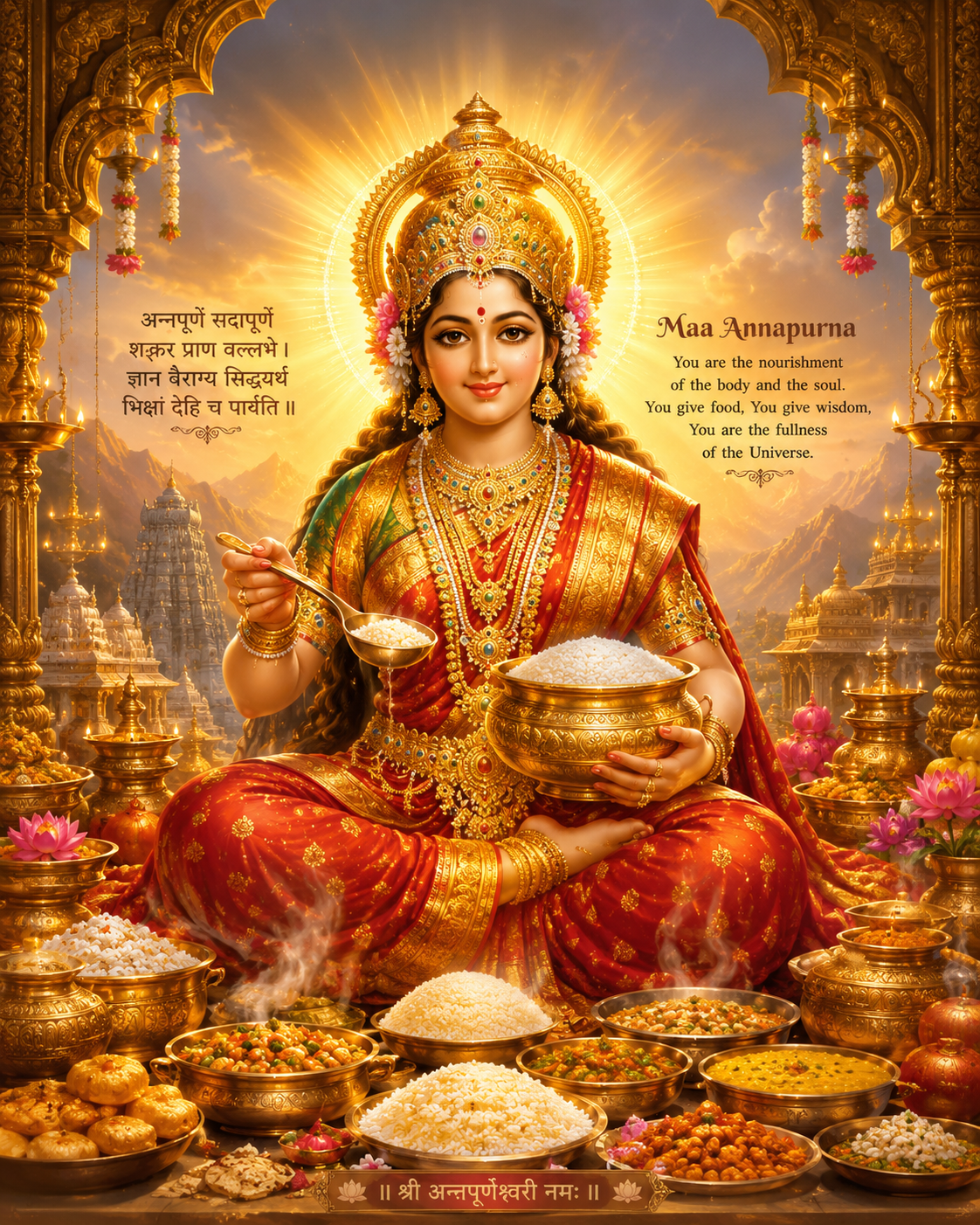
About This Artwork
This piece depicts Maa Annapurna — Annapurneshwari, the goddess of nourishment, the mother whose bowl is always full and whose ladle is always ready — in the devotional form most closely associated with her principal shrine at Kashi (Varanasi). She is dressed in a vivid crimson sari with elaborate gold jewellery, her bearing one of complete generosity and complete abundance. In her right hand she holds the ladle (sruk); in her left, the golden vessel (patra) filled with rice — the food of life, the most basic and most universal of all the gifts the earth and the divine together offer to the living.
On the image itself, framing the goddess in sacred text, the devotional inscription appears in both Sanskrit and English: "Maa Annapurna. You are the nourishment of the body and the soul." This bilingual inscription makes the image accessible across generations and communities — the grandmother who reads Sanskrit and the grandchild who reads English are addressed by the same piece in their own language, held by the same mother.
The palette is warm and approachable — gold, crimson, the tones of a well-lit kitchen at the hour when food is being prepared, the colours of warmth and plenty rather than the cosmic blue of the Vishnu compositions or the fierce gold of the Bagalamukhi image. Annapurna's visual register is domestic, immediate, and generous — the divine in the form most directly related to the daily acts of cooking, feeding, and sustaining life that are themselves understood in the tradition as sacred.
About Maa Annapurna — The Goddess Who Feeds the World
Maa Annapurna is the Hindu goddess of food and nourishment — the divine mother whose specific domain is the provision of sustenance, the goddess who ensures that no living being goes without the food that their life requires. Her name is Sanskrit: Anna (food, grain, that which is eaten) + Purna (full, complete, that which lacks nothing) — she is the one who is complete in food, whose food is always complete and always available, the one who has never run out and never will.
She is a form of Parvati — the consort of Shiva, the mother of Ganesha and Kartikeya — in the aspect most specifically associated with the nourishing, sustaining, feeding dimension of the divine feminine. Where Durga is Parvati as the fierce warrior, where Kali is Parvati as the radical dissolver, where Saraswati represents the divine feminine's creative intelligence, Annapurna is Parvati as the mother who cooks, who feeds, who ensures that the biological and spiritual sustenance of every living being is provided for.
Her presence in the Hindu tradition is not incidental or minor. She is enshrined at the Annapurna Temple in Kashi (Varanasi), one of the most sacred sites in the entire tradition, located within a short walk of the Kashi Vishwanath temple that is the city's presiding Shiva shrine. The relationship between Annapurna's food and Kashi Vishwanath's liberation is theologically precise: the tradition holds that Shiva himself comes to Kashi to receive Annapurna's food, and that the moksha granted at Kashi is inseparable from the nourishment she provides. Spiritual liberation and physical sustenance are not separate in this understanding — they are two aspects of the same divine provision.
The Origin Story — When Shiva Asked for Food
The most widely told mythological account of Annapurna's manifestation involves Shiva — characteristically and deliberately — testing the limits of the material world's significance. In a philosophical debate with Parvati about the nature of maya (illusion) and the reality of the material world, Shiva argued that food, like all material things, is ultimately maya — appearance without ultimate substance. Parvati's response was immediate and practical: if food is maya, let us see what happens when it disappears.
She withdrew from the world. Immediately, all nourishment ceased. Plants stopped growing. Animals stopped finding food. The gods themselves grew thin. Shiva, observing the consequence of his argument about maya's unreality, recognised what Parvati was demonstrating: that the material world's nourishment, even if ultimately beyond classification as absolutely real or absolutely unreal, is practically indispensable, and that the divine force that provides it is not to be theorised away but to be honoured.
He went to Kashi, where Parvati had reappeared in her form as Annapurna, and he stood before her with his begging bowl — the great ascetic, the renunciant, the lord who needs nothing, standing before the goddess who is the source of everything that sustains life — and he asked for food. She fed him. And he acknowledged: matter is not nothing, food is sacred, and the mother who provides it is divine.
This story encodes one of the most practically grounded theological positions in the Hindu tradition: that the physical world's provision of sustenance is not a lesser reality than the spiritual but is itself a form of the sacred. Annapurna is the divine recognition that the body's needs are not obstacles to the spiritual path but its foundation.
Anna Brahman — Food as the Divine
The Taittiriya Upanishad contains one of the most direct statements of a principle that underlies Annapurna's theological significance: Anna Brahman — food is Brahman, food is the absolute. The passage begins with the recognition that from food all beings are born, by food they are sustained in life, and into food they dissolve at death. Food is therefore not a material thing that supports the spiritual — it is the material through which the spiritual sustains itself in embodied form.
This principle is the ground of the extraordinary care that Indian culinary and ritual tradition brings to the preparation and offering of food. The kitchen is not simply a room where meals are produced; it is a space where the divine act of nourishment is performed. The cook is not simply a person making food; they are a participant in the divine provision that sustains life. The meal is not simply nutrition; it is prasad — the grace of the divine received in its most direct and most universally needed form.
Annapurna is the goddess of this understanding. Her bowl and ladle are not symbols of plenty in a general sense but the specific instruments of the sacred act of feeding — the instruments through which the divine provision of sustenance is made available to embodied beings who need it.
The Annapurna Sahasranama — the Thousand Names of Annapurna — enumerates every dimension of the nourishment she provides: not only food for the body but wisdom for the mind, peace for the emotions, grace for the spirit. Annapurna in this expanded understanding is not limited to the kitchen but encompasses every form of sustenance that life requires to continue and to flourish.
The Annapurna Temple at Kashi
The Annapurna Devi Mandir in Varanasi is one of the most visited and most beloved temples in the city — which is remarkable given that Varanasi itself is one of the holiest cities in the world, home to thousands of temples. Located in the Vishwanath Galli (the lane of Kashi Vishwanath), the Annapurna temple is situated so close to the Kashi Vishwanath Jyotirlinga that their relationship is immediately apparent: she feeds him; he liberates those she has fed.
The presiding image of Maa Annapurna in the temple is shown in her characteristic form — holding the patra (vessel) of food and the sruk (ladle) — and is adorned with elaborate ornaments, changed according to the ritual calendar. The temple kitchen (bhog shaala) prepares and distributes prasad daily to pilgrims and devotees.
The specific prasad of the Annapurna temple — rice pudding (kheer) in many accounts, though the specific prasad varies — is understood in the tradition as the most direct form of Annapurna's grace: the goddess's own food, offered back to those who come to her, carrying the quality of nourishment that is inseparable from her nature.
The Varanasi tradition holds that no one goes hungry in Kashi — that Annapurna's presence in the city ensures that food is available to every person who comes there, regardless of their circumstances. This is not only a spiritual belief but a material one: the temple's charitable feeding programmes and the broader tradition of annadana (the gift of food) in Varanasi are understood as practical expressions of Annapurna's presence in the city's life.
Annadana — The Sacred Gift of Food
Annadana — the gift of food — is considered in the Hindu tradition to be one of the highest and most meritorious of all charitable acts. The reasoning is straightforward: every other gift requires something from the recipient to make use of it. The gift of food requires only that the recipient be alive and hungry — conditions that are universal and that require no special capacity or circumstance to benefit from.
The Bhagavata Purana and other texts rank annadana among the highest of the seventeen forms of dana (charitable giving). The Mahabharata's Anushasana Parva contains an extended treatment of food's spiritual significance and the merit generated by feeding those who are hungry. The practical expression of this theological understanding is the langar system of Sikhism, the temple kitchens (bhog shaala) of Hindu temples across India, the distribution of prasad at every major religious gathering, and the tradition of feeding guests, strangers, and the poor as a sacred obligation.
Annapurna presides over all of this. She is the theological ground of the understanding that feeding another person is not merely a social good but a sacred act — an act that participates in the divine provision of nourishment that she represents.
The Kitchen as Sacred Space — Annapurna's Natural Home
Among all the goddess images in this collection, Annapurna is the one whose most natural placement in the home is not the puja room or the meditation space but the kitchen. This is not a secondary position — in the Hindu understanding of the domestic sacred, the kitchen is one of the most important of all sacred spaces in the house.
The tradition of maintaining a small altar or image in the kitchen — often near the stove or at the entrance of the cooking area — reflects the understanding that the work of feeding the household is sacred work, that the kitchen is the space where Annapurna's grace is most directly and most practically expressed, and that having her image present in that space is an acknowledgement of what the act of cooking and feeding actually is.
This placement is also the most universally accessible: the kitchen is a space that every person who eats — which is every person — has a relationship with. Annapurna's image in the kitchen is available to the most devout practitioner and to the person who is simply feeding their family with care, because both are doing the same thing: participating in the sacred act of nourishment that is Annapurna's domain.
In a puja room, Annapurna is often placed alongside Lakshmi — the two goddesses together representing the completeness of the home's material provision: Annapurna for food, Lakshmi for wealth, together for the household's abundance in all its dimensions.
As a gift for a new home, a new household, or any occasion where the blessing of the family's sustenance is what is being acknowledged — Annapurna's image is among the most meaningful and most directly appropriate in the collection.
The digital download allows immediate printing at your preferred size. Print on matte or semi-gloss paper at FedEx Office, Staples, or any professional print shop and frame in a style that suits your kitchen or puja room.