
About This Artwork
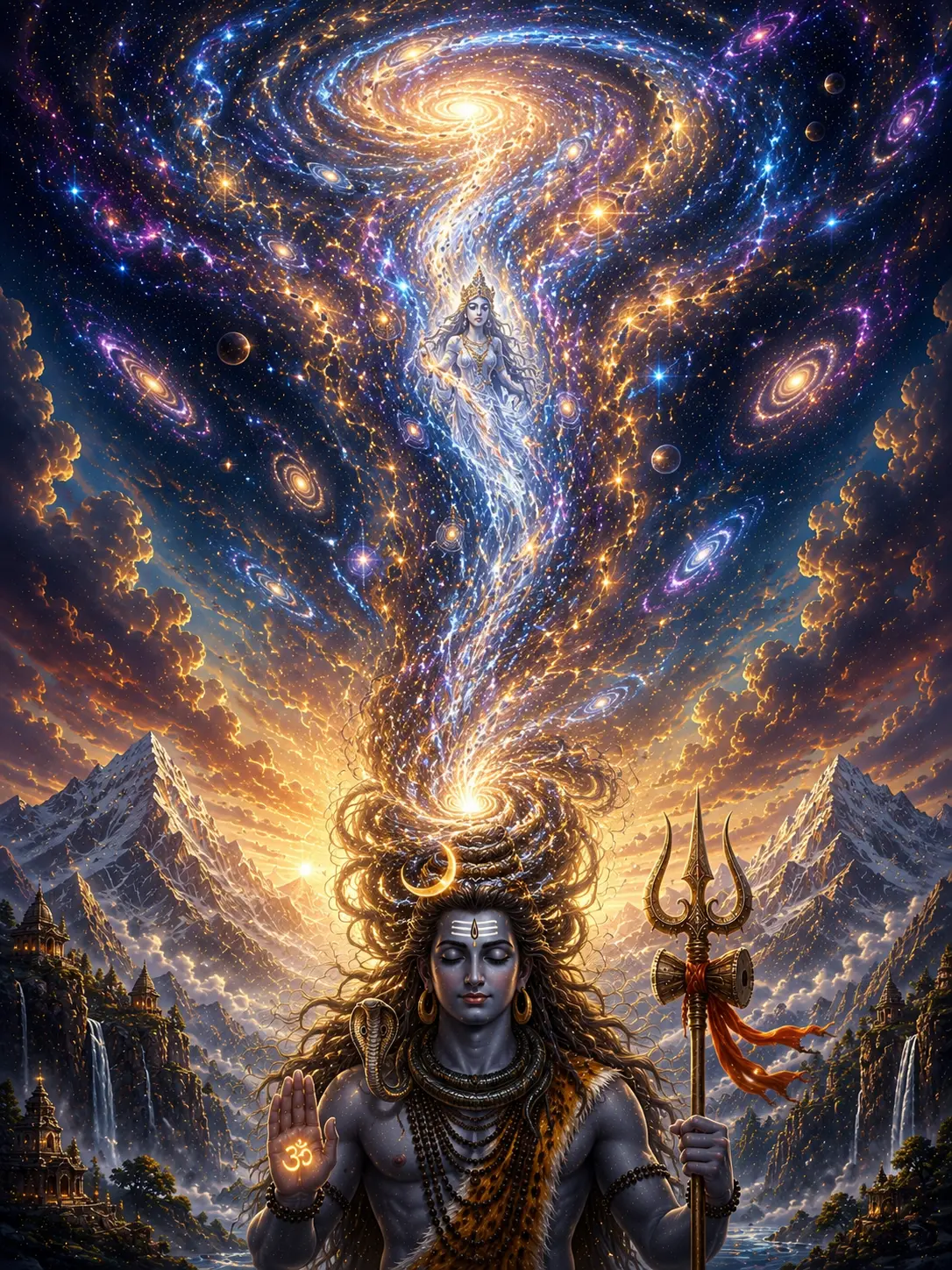
This piece depicts the Ganga Avataran — the descent of the sacred river Ganga from the heavens to the earth — with Lord Shiva as the cosmic force that makes the descent possible and survivable. Shiva stands in meditation before the snow-capped peaks of the Himalayas: blue-complexioned, the crescent moon and the coiled cobra visible in his matted locks (jata), the trishul held firm in one hand, and the other raised with the Om symbol glowing on the open palm in the gesture of blessing and reception.
Above him, the Ganga descends — not as a simple river but as a spiraling torrent of starlight and cosmic light, flowing downward through galaxies and nebulae, the celestial river in its pre-earthly form as a force of cosmic magnitude whose original velocity would shatter the earth if nothing intercepted it. Shiva's raised, receptive palm, and the vast containing capacity of his matted locks, are precisely that interception: the only force in the universe compassionate enough and powerful enough to receive the full force of the sacred river and release it gently enough for the earth and its living beings to receive.
The palette — cool Himalayan blue, the luminous white and silver of the cosmic Ganga, the deep indigo of the cosmic space through which she descends — is the most specifically Himalayan and most devotionally cool in the collection.
The Ganga Avataran — The Story of the Sacred Descent
The story of the Ganga's descent from the heavens is found in the Valmiki Ramayana (Bala Kanda) and in various Puranic texts, and it is one of the most beautiful and most theologically rich narratives in the entire Hindu tradition. The story begins with King Sagara, whose sixty thousand sons were destroyed by the sage Kapila (or in some versions by fire or a curse) and whose ashes lay unburned on the earth — unable to reach the liberation that cremation and the rites of death would normally provide.
Sagara's descendants, across several generations, undertook the austerity of bringing the Ganga — which flowed only in the heavens — down to earth, to flow over the ashes of the sixty thousand and release their souls. The sage Bhagiratha finally succeeded, through thousands of years of austerity, in persuading Brahma to release the Ganga from the heavens. But there was a problem: the Ganga's velocity on her descent would be too great for the earth to receive. She would shatter it.
Bhagiratha then turned to Shiva — and Shiva agreed to stand beneath the Ganga's descent and receive her in his matted locks. He did so: the Ganga fell into his jata, was absorbed by the vast containing capacity of his hair, and then released gently in the multiple streams of the Himalayan river system, flowing across the plains of India toward the ocean, purifying everything she touched.
Why Shiva Could Receive What Nothing Else Could
The theological significance of Shiva's role in the Ganga Avataran is precise. Only Shiva could stand beneath the celestial river's full force and receive it without being destroyed or overwhelmed. This is because Shiva's nature is precisely the quality that makes reception possible: the vast, open, completely still witnessing consciousness that is disturbed by nothing, that receives everything without being moved by any of it, that contains all of existence without being defined or limited by any of it.
The Ganga's force is the force of the cosmic creative energy in its most concentrated and most purifying form — the grace of heaven descending to earth in its fullest intensity. The only appropriate vessel for such a force is the consciousness that is already infinite: Shiva's own cosmic awareness, which is as large as the cosmos and which receives the Ganga in his matted locks the way the ocean receives a river — easily, completely, without being overwhelmed, and then releases it transformed.
Ganga — The Sacred River of Liberation
The Ganga (Ganges) is the most sacred river in the Hindu tradition and one of the most sacred in any religious tradition in the world. She is worshipped as a goddess — Ganga Devi — and understood as the divine mother whose waters carry the purifying grace of the heavens. The tradition holds that bathing in the Ganga, drinking her waters, or having one's ashes immersed in her after death provides liberation (moksha) — the end of the cycle of rebirth.
The cities along the Ganga — Varanasi (Kashi), Haridwar, Allahabad (Prayagraj at the Triveni Sangam), Rishikesh — are among the most sacred pilgrimage sites in Hinduism. The Kumbh Mela — the largest religious gathering in the world — occurs at the confluence of sacred rivers including the Ganga. The tradition of immersing the ashes of the deceased in the Ganga is among the most widely observed final rites in the Hindu tradition, practiced across all regional and community boundaries.
Displaying Shiva Ganga in the Home
The Shiva Ganga image is displayed in Shaiva puja rooms and in any home where the sacred Ganga tradition is specifically honoured. It works alongside the other Shiva forms in this collection — the Shiva Meditation, Nataraja, Bhairava, Dakshinamurti, and Lingodbhava — as the sixth Shiva form, each revealing a different dimension of Shiva's nature. Where the Lingodbhava shows Shiva as the infinite, and the Nataraja shows Shiva as the cosmic dancer, the Shiva Ganga shows Shiva as the cosmic receiver — the one whose compassion and capacity make the impossible possible, who catches what would otherwise destroy the earth and releases it as purification.