About This Artwork
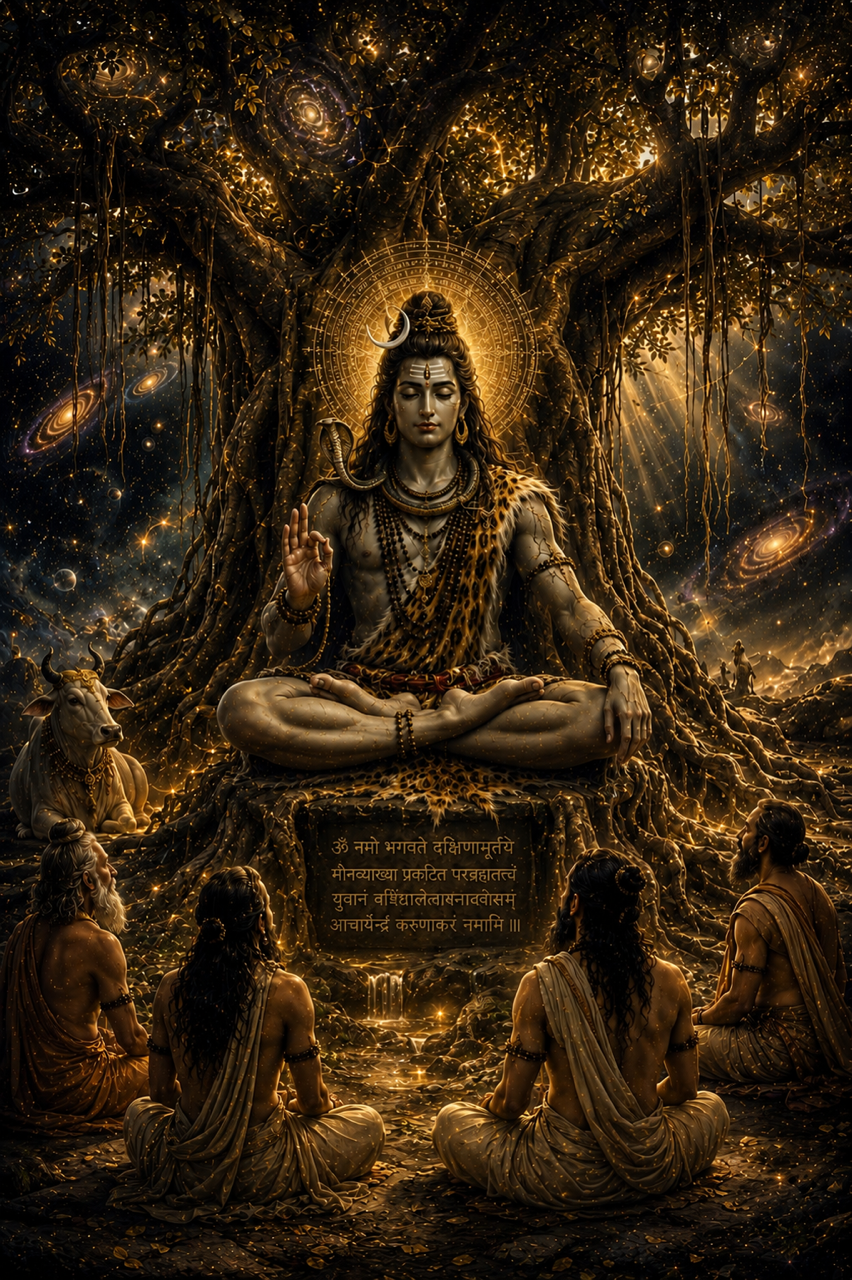
This piece depicts Dakshinamurti — Shiva in the form of the supreme teacher, the south-facing one, the sage who transmits the deepest knowledge not through speech but through silence — in a composition of extraordinary conceptual depth and visual beauty. He sits in padmasana beneath the great banyan tree, the ancient tree whose roots grow downward and whose branches spread in every direction, the tree that in the Indian tradition is the image of the teacher whose wisdom feeds in all directions simultaneously and whose roots go deeper than any student can trace. His right hand is raised in jnana mudra — the gesture of knowledge, the joining of thumb and forefinger into the circle of the complete, the other three fingers extended. His crescent moon and cobra identify him as Shiva; the sacred ash on his brow identifies him as the supreme ascetic.
Before him, four sages — the four Sanat Kumaras, the ancient seekers of the Shiva Purana tradition — sit in padmasana, their faces turned toward the teacher, their hands in the anjali mudra of profound reception. They have come with their deepest questions. And Dakshinamurti answers with the only answer that reaches all the way to the source of the question: he sits in silence. The sages, receiving that silence, understand. What could not be spoken has been transmitted. What no word could carry has arrived.
The banyan tree above is not an ordinary tree but a cosmic one — its roots and branches dissolve upward into a galaxy-filled sky, the stars and nebulae of the actual universe visible in its canopy, making the teaching scene simultaneously intimate (the guru beneath the tree, the students before him) and infinitely vast (the cosmos as the context in which this teaching occurs, the universe as the classroom). Nandi, Shiva's faithful bull, rests peacefully to the side. At the base of the composition, a Sanskrit verse of salutation is inscribed — the opening salutation of the Dakshinamurti Stotram, honouring the silent teacher who dispels the darkness of ignorance.
The palette — warm earth tones of the ancient grove, deep gold of the enlightened presence, the deep cosmic indigo of the galaxy-filled canopy — is the most contemplative in the collection, the most suited to sustained looking and to the quality of inward attention that this particular Shiva form invites.
About Dakshinamurti — Shiva as the Supreme Silent Teacher
Dakshinamurti is the most philosophically specific and the most contemplatively oriented of all the forms of Shiva in the Hindu tradition. He is Shiva in the role that the tradition identifies as his deepest and most necessary function — not the cosmic dancer who expresses the five cosmic actions, not the Adi Yogi who originates the science of yoga, not the fierce Bhairava who stands at the threshold of what cannot be named — but the supreme teacher of the direct knowledge of reality, the guru who transmits through silence the understanding that all words point toward and none can reach.
The name is composed of Dakshina (south) + Murti (form, deity) — the south-facing one, the deity whose face is turned toward the south. In the Indian directional cosmology, south is the direction of Yama (the lord of death and transformation), of the completion of cycles, of the moment when the ordinary ego-self encounters the absolute and discovers what remains when everything temporary has dissolved. That Dakshinamurti faces south is a precise theological statement: he faces the direction of ultimate truth, the direction from which there is no comfortable return to the partial and the temporary.
In the Shaiva tradition, Dakshinamurti is the original guru — the first teacher, in the same sense that Shiva as Adi Yogi is the first yogi. He is the source from which the lineage of teacher-student transmission that runs through all the Indian philosophical schools ultimately derives. Every guru who has ever transmitted genuine understanding through the meeting of awareness with awareness, through the silence that says more than any formulation, is understood in this tradition as a manifestation of Dakshinamurti.
The Banyan Tree — The Guru's Eternal Seat
The banyan tree (Ficus benghalensis) beneath which Dakshinamurti is seated is not incidental to the iconography — it is one of the most carefully chosen of all the symbolic elements in this form. The banyan grows in a way that makes it the natural image of the eternal teacher: its aerial roots descend from the branches to the ground and themselves become trunks, so that a single tree expands across time into an entire grove, each new trunk arising from above and rooting itself below, the original trunk indistinguishable from its descendants.
This growth pattern — roots from above, trunks from below, the tree growing downward as much as upward — is the pattern of the Ashvattha, the sacred tree of the Bhagavad Gita's fifteenth chapter, which Krishna describes as the eternal tree with its roots above and its branches below. The teacher is the root, above; the transmission descends; the student becomes a new trunk, a new root point from which further transmission can grow. The lineage of wisdom is literally like the banyan: the original teacher is no longer separable from the vast grove that grew from a single seed.
In this artwork, the banyan's canopy dissolves into the galaxy-filled sky — the teacher's knowledge as vast as the cosmos, its roots as ancient as the universe, its branches extending in every direction through the students who received the transmission and became teachers in their turn.
Jnana Mudra — The Gesture of Knowledge
The most characteristic and most theologically specific element of Dakshinamurti's iconography is the jnana mudra — the gesture of knowledge held in his right hand. The thumb and index finger are brought together in a circle, the other three fingers extended. This gesture appears across multiple traditions and contexts — in yoga and meditation practice as a common hand position, in Buddhist iconography in the family of teaching mudras, and in Hindu iconography specifically as the gesture of Dakshinamurti.
The theological interpretation most commonly given for the jnana mudra is precise. The three extended fingers represent the three states of ordinary experience — waking (jagrat), dreaming (svapna), and deep sleep (sushupti) — the three modes through which ordinary consciousness moves in its cycle. The thumb represents the absolute, the witness-consciousness that underlies all three states without being any of them. The index finger represents the individual self, the jivatman — the small self that, in ordinary experience, believes itself to be separate from the absolute.
The gesture of bringing the index finger to touch the thumb — making the circle — is the gesture of the recognition of identity: the individual self and the absolute are one. The apparent separation was always the mistake. The jnana mudra is the teacher's silent demonstration of the teaching: the jivatman and Brahman are not two things but one, and the recognition of this identity is the liberation that Dakshinamurti embodies and transmits.
The Teaching Through Silence
The most distinctive and most philosophically demanding aspect of Dakshinamurti's tradition is the specific claim that his teaching is transmitted through silence — not simply that he is quiet, but that the silence itself is the teaching, that what is transmitted in the meeting of the student's inquiring awareness with the teacher's established awareness is precisely what no words can carry.
This is not a paradox or a mystification. It is a precise statement about the nature of the knowledge being transmitted. The understanding that Dakshinamurti embodies — the direct recognition that the awareness within which all experience arises is identical with the absolute Brahman — cannot be transmitted by describing it, because any description is an object within awareness while the awareness itself is the subject, the knower, the background in which every description appears. To know awareness directly is to know it as oneself. And this knowing cannot be given as a piece of information; it can only be pointed toward, and the pointing is most precise in the complete absence of the pointing — in the silence that is not the absence of information but the most complete and most direct presence of what the information was trying to indicate.
The four sages who sit before Dakshinamurti come with their questions about the nature of consciousness, about the relationship between the individual self and the absolute, about how the apparent multiplicity of the world arises from the undivided absolute. These are questions that the entire Upanishadic tradition circles. And Dakshinamurti answers them by sitting — by being completely and transparently what he is, which is the answer itself, the living demonstration of the recognition the questions were seeking.
The tradition records that the sages received the transmission. Their questions dissolved — not because they were answered with better information, but because the source of the questions was recognised as identical with the source of the awareness in which Dakshinamurti sat. When the source of the question recognises itself, the question has no more ground to stand on.
The Dakshinamurti Stotram — Adi Shankaracharya's Hymn of Silence
The most celebrated textual expression of the Dakshinamurti tradition is the Dakshinamurti Stotram composed by Adi Shankaracharya — the 8th-century Advaita Vedanta philosopher whose codification of the non-dual understanding of the Upanishads is the foundation of the most widely studied and most influential philosophical tradition in Indian history.
The Stotram consists of ten verses, together with a dhyana shloka of salutation, addressed to Dakshinamurti as the supreme teacher. The opening salutation begins: "Om, salutation to the revered Dakshinamurti, the teacher in the form of the Lord, who dispels the great darkness of ignorance by his compassionate gaze alone."
What makes the Stotram remarkable within the Advaita Vedanta tradition is that it uses every possible philosophical tool — metaphor, direct statement, logical argument, poetic evocation — to point toward the understanding that Dakshinamurti embodies through silence. It is, in a sense, the most elaborate possible verbal meditation on a teaching that cannot ultimately be verbally transmitted. The Stotram knows this about itself: it is the tradition's self-aware attempt to use language to point beyond language, to use the teacher's intellectual tradition to gesture toward the place where the teacher sits in silence.
Shankaracharya's own commentary on the Dakshinamurti Stotram is one of the foundational texts of Advaita Vedanta study. The Stotram itself is recited in Shaiva temple traditions across South India and is a standard text in the study of Advaita Vedanta and Kashmir Shaivism alike.
The South-Facing Direction and Its Significance
Dakshinamurti faces south — and this directional choice is among the most specific iconographic decisions in all of the Shaiva tradition. In standard Hindu temple and puja practice, deities typically face east, toward the rising sun, the direction of illumination and auspiciousness. To face south is to face the direction of Yama, of death, of the completion of ordinary cycles.
That Dakshinamurti faces south signals that this form of Shiva is specifically associated with the completion of the ego's journey — with the recognition that comes at the end of the search for a separate self, when the self turns to face what it has been running from and discovers that what it feared was always itself. The south-facing teacher faces the direction from which there is no comfortable return to the partial and the temporary — and in doing so, he offers the one thing that the south's association with Yama makes possible: the end of the fear of death, because the direct recognition of what one actually is dissolves the identification with what dies.
In many South Indian temple traditions, Dakshinamurti shrines are placed specifically on the south wall of the garbhagriha (inner sanctum) — facing south, receiving the gaze of those who approach from the north, the direction of ordinary life and ordinary consciousness. The devotee approaching from the north meets Dakshinamurti's gaze coming from the south: the ordinary self meeting the recognition of its own absolute nature, face to face.
The Four Sages and the Lineage of Transmission
The four figures seated before Dakshinamurti in this artwork are identified in the tradition as the four Sanat Kumaras — Sanaka, Sanandana, Sanatana, and Sanatkumara — the ancient, perpetually young sages who are among the first created beings in the Puranic cosmology. They are depicted as eternally childlike because they took a vow of celibacy from birth and never accumulated the adult ego-formations that ordinary life generates; they are, in a sense, the image of human potential at its most pure — awareness without the accumulated overlay of personal history.
These four represent the first students, the original recipients of the transmission that Dakshinamurti holds. The lineage that flows from that first transmission — through the Upanishadic teachers, through Shankaracharya, through the great Advaita teachers of every subsequent generation — is the lineage of what was transmitted in that grove, in that silence, beneath that banyan tree.
In the broader tradition, the four sages before Dakshinamurti represent all who have ever come to the teacher with genuine questions — all who have sat in the silence of genuine inquiry and found, in that silence, the answer they could not have formulated in advance. Every practitioner of genuine self-inquiry participates in this scene: the seeker before the teacher who teaches through silence, the question dissolving in the presence of the awareness that was always the answer.
Displaying Dakshinamurti in the Home
Of all the Shiva forms in this collection, Dakshinamurti is the one most naturally at home in a study, a library, or a space dedicated to learning and philosophical inquiry. The tradition of placing Dakshinamurti's image in a study — particularly for those engaged in Vedantic study, yoga philosophy, or any form of sustained intellectual and contemplative inquiry — is well established within the Shaiva and Advaita Vedanta traditions.
In a yoga teacher's space or a meditation room, the image of Dakshinamurti carries the specific invitation of the Advaita non-dual tradition: that what the practitioner is seeking is identical with the awareness doing the seeking, and that the practice of inquiry — turning attention back toward its own source — is itself the transmission that Dakshinamurti embodies.
In a dedicated Shiva altar or puja room alongside the other Shiva forms in this collection, Dakshinamurti represents Shiva's most philosophically complete face: the cosmic dancer (Nataraja) expresses the five actions; the meditating Adi Yogi embodies the origins of practice; the fierce Bhairava confronts illusion directly; and Dakshinamurti transmits the understanding that all of these forms are pointing toward — the recognition of one's own nature as identical with the absolute consciousness from which all of Shiva's forms arise.
The warm earth and cosmic gold palette of this artwork, with its galaxy-filled canopy, suits a natural wood or gold frame and works particularly well at 11×14 or 16×20, at a size where the composition's detail — the four sages, the Sanskrit verse, the banyan roots dissolving into galaxies — can be fully seen and contemplated. Print on matte or semi-gloss paper at FedEx Office, Staples, or any professional print shop.