About This Artwork
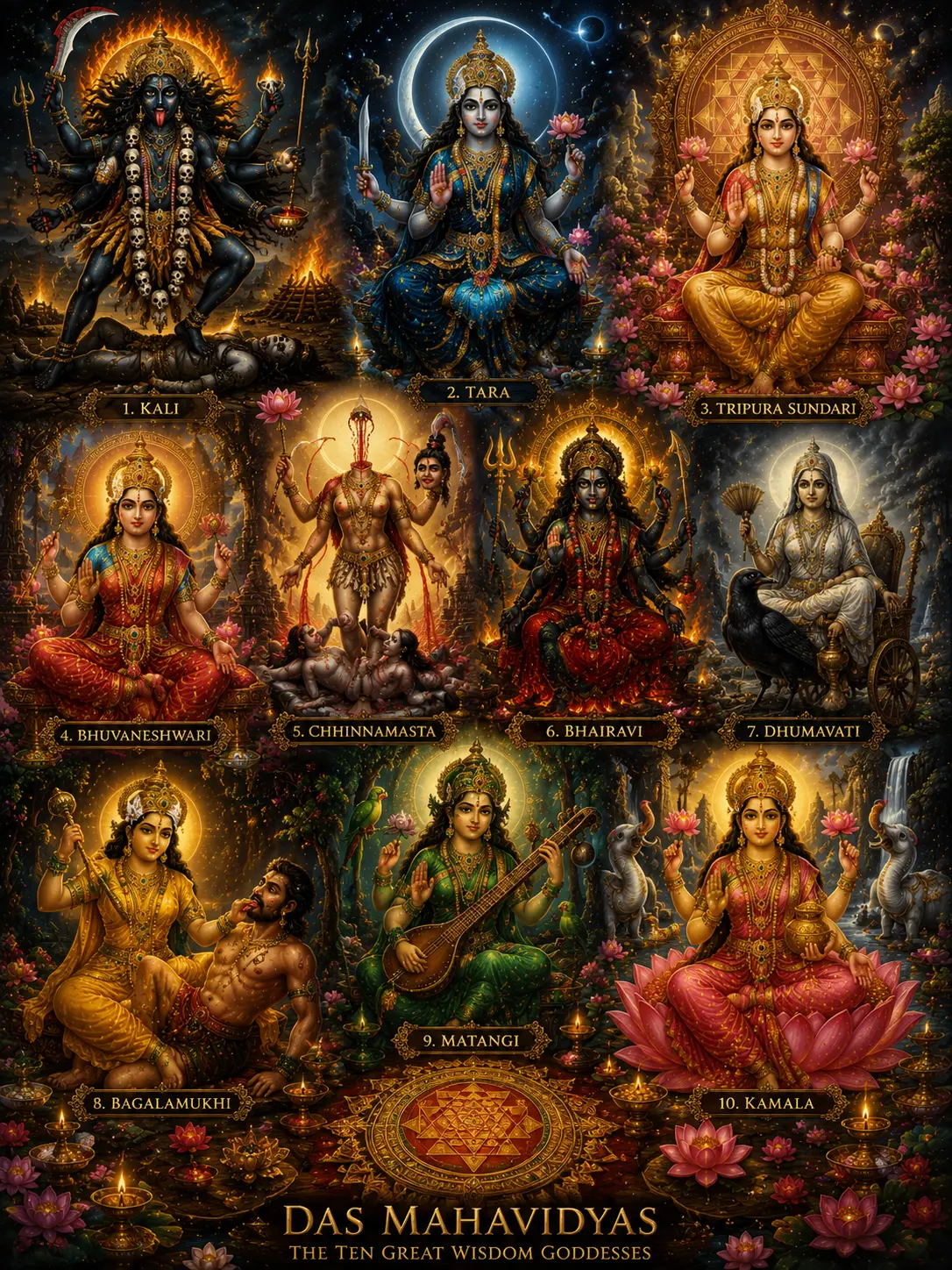
This piece presents all ten Dasha Mahavidyas — the ten great wisdom goddesses of the Hindu Tantric tradition — in a single complete composition, each in her distinctive iconographic form, arranged together as a complete visual mandala of the divine feminine. This is the most comprehensive single image of the Shakta Tantric tradition available in the collection, and among the most comprehensively rendered sacred feminine compositions in the Western sacred art marketplace.
The ten goddesses are: Kali — the fierce liberator, first and most radical, dark-skinned, skulls and sword; Tara — the compassionate guide, blue-skinned, cremation ground, skull cup and scissors; Tripura Sundari (Shodashi) — the most beautiful, the grace of the Sri Vidya tradition, radiant and complete; Bhuvaneshvari — the cosmic queen whose body is the universe, spacious and all-containing; Bhairavi — the fierce solar fire of sacred transformation, brilliant and burning; Chhinnamasta — the self-transcending goddess who has removed her own head, the most radical of all the Mahavidya forms; Dhumavati — the crone of sacred emptiness, grey and unhurried; Bagalamukhi — the yellow-robed paralyzer, clarity stilling what opposes; Matangi — the wild intoxicated goddess of sacred knowledge and authentic expression; and Kamalatmika — the lotus goddess, the complete flowering of consciousness, radiant abundance.
Each goddess is rendered in her specific colour, with her specific instruments and attributes, in the specific posture and compositional context of her individual tradition. Together they form a complete visual mandala — a single image that is also a complete teaching, a complete map, a complete altar.
About the Dasha Mahavidyas — Ten Faces of the One Shakti
The Dasha Mahavidyas (dasha = ten, maha = great, vidya = wisdom/knowledge) are the ten great cosmic wisdom goddesses of the Shakta Tantric tradition — the ten specific expressions of the one supreme Shakti (the primordial divine feminine power), each representing a distinct quality, a distinct teaching, and a distinct face of the reality that underlies all of existence.
The Mahavidyas are not ten separate goddesses who happen to be worshipped together. They are ten windows through which the one supreme divine feminine consciousness reveals herself in her complete fullness. Each Mahavidya represents a specific dimension of that fullness — a specific quality that the ordinary human consciousness needs to encounter in order to move from its contracted, ego-identified state toward the expanded, liberated awareness that is the tradition's understanding of the goal of spiritual practice. Together they form the most complete map of the divine feminine and the most comprehensive guide to the inner landscape of the serious spiritual practitioner that the Shakta Tantric tradition has produced.
The Ten Goddesses and Their Specific Teachings
1. Kali — The Fierce Liberator: The first and most radical Mahavidya. Kali dissolves the ego's false constructions with the most direct and most unconditional force available. She is the teacher who begins by removing — stripping away every false identification, every comfortable illusion, every accumulated layer of what is not real. Her dark complexion, skull garland, and the dead bodies beneath her feet are not symbols of destruction for its own sake; they are the most precise possible visual statement of what genuine liberation requires: the death of what is not real.
2. Tara — The Compassionate Guide: The second Mahavidya, and the compassionate counterpoint to Kali. Where Kali strips away, Tara carries across. She is the guide through the territory that Kali's dissolution opens, the ferry across the ocean of what has been released, the star that guides the navigator through the darkest passage.
3. Tripura Sundari (Shodashi) — The Supreme Grace: The third Mahavidya and the presiding deity of the Sri Vidya tradition. She is the most beautiful — the beauty that is not aesthetic pleasure but the recognition of the supreme as it appears when the ego's distortions have been sufficiently cleared to see what is actually there.
4. Bhuvaneshvari — The Cosmic Spaciousness: The fourth Mahavidya, the queen of the universe — whose body is the universe itself. She is the goddess of space, of expansion, of the cosmic perspective that arises when the practitioner's identification has moved from the personal to the universal.
5. Bhairavi — The Sacred Fire: The fifth Mahavidya, the fierce solar fire of transformation. Bhairavi is the intense, burning, purifying energy that consumes impurity in the same way the sun consumes darkness — not by fighting it but simply by being what it is.
6. Chhinnamasta — The Self-Transcendence: The sixth Mahavidya, and the most iconographically radical — the goddess who has removed her own head. Chhinnamasta is the teaching of complete self-transcendence, the dissolution of the ego-boundary at its most total and most precise. The blood that flows from her severed neck feeds two attendants and herself — the self-transcending consciousness does not deplete; it becomes the source of nourishment for whatever it has released.
7. Dhumavati — The Sacred Emptiness: The seventh Mahavidya, the crone of the void. Dhumavati is the deliberately inauspicious goddess who presides over the territory after Chhinnamasta's self-transcendence: the empty space, the silence, the profound stillness of the void that what the ego feared as annihilation turns out to be the most complete peace available.
8. Bagalamukhi — The Clarity: The eighth Mahavidya, Pitambari, the yellow-robed one. Bagalamukhi stills every force that opposes the alignment of the practitioner's path with truth. Her specific power (stambhana) is the power of discriminative clarity — viveka — that naturally brings to rest every turbulent force by recognising it precisely for what it is.
9. Matangi — The Sacred Knowledge: The ninth Mahavidya, the wild, intoxicated goddess of authentic creative expression and sacred knowledge. Matangi is the divine feminine's most unconventional face — associated with the transgressive, the creative, the arts, and the specific kind of knowledge that comes from genuine absorption in the divine rather than formal study of it.
10. Kamalatmika — The Abundant Flourishing: The tenth and final Mahavidya, the lotus goddess of supreme abundance. Kamalatmika is the complete flowering of consciousness — the state of the practitioner who has moved through all nine of the preceding encounters and arrived at the recognition that the nature of the absolute is infinite abundance, inexhaustible generosity, the fullness of the lotus bloomed in every direction simultaneously.
The Progressive Arc of the Ten
The Mahavidya sequence is not random. It follows a specific arc from the most radical dissolution (Kali) through increasingly nuanced and increasingly refined encounters with the nature of reality, arriving at the full abundance of the realised consciousness (Kamalatmika). This arc is the Shakta Tantric tradition's most complete description of the inner journey: what the practitioner moves through on the path from the ordinary contracted ego-consciousness toward the expanded, liberated awareness that is the goal of the tradition.
Placing all ten together — as this artwork does — is placing the entire journey in a single frame.
Displaying the Dasha Mahavidya
The Dasha Mahavidya composition is displayed in dedicated Shakta practice spaces as the primary altar image and in any space where the complete tradition of the divine feminine's wisdom is honoured. It is the most informationally complete image in the Sacred Collections section — the 16×20 size works best for spaces where each of the ten goddesses can be distinguished and contemplated individually.