About This Artwork
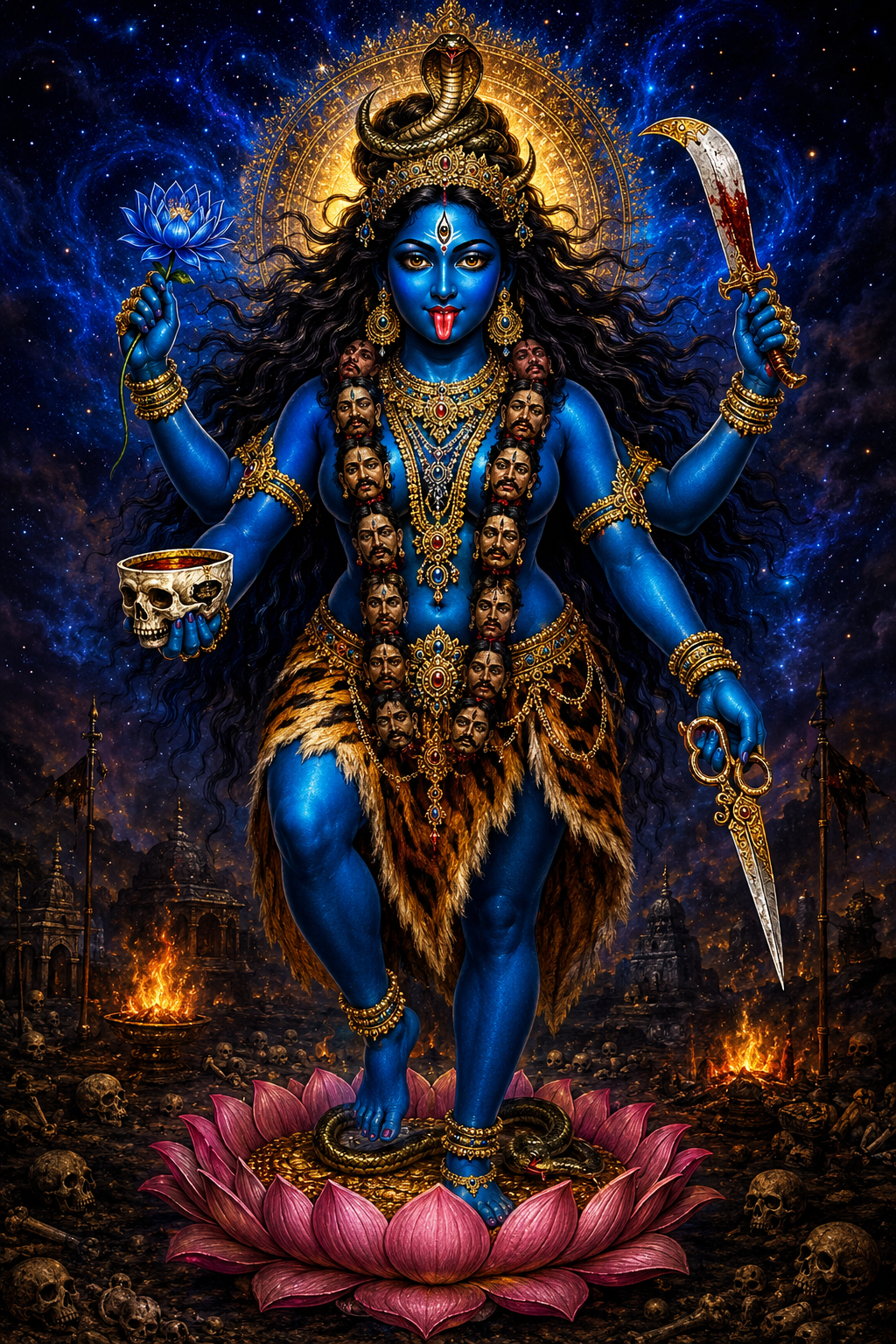
This piece depicts Maa Tara — the second of the Dasha Mahavidyas, the fierce compassionate guide who carries the sincere practitioner across the ocean of conditioned existence to the shore of liberation — in her full traditional iconographic form. She stands in the cremation ground — the place where all illusions are burned away — luminous and completely untroubled by what surrounds her. Her deep blue skin glows with divine energy against the background of sacred fires and the deep cosmic blue of the night sky.
In her four arms she holds the instruments of her fierce compassion: the blue lotus (the symbol of spiritual awakening that blooms even in the most difficult conditions), the skull cup (the vessel of transforming what has died into nourishment for what is alive), the kartari (the curved chopper that cuts through every last thread of attachment and illusion), and the large scissors (that sever what binds). Around her head, a cobra coils as a crown. She wears a tiger skin. A pink lotus blooms beneath her feet, declaring: this fierce, cremation-ground-dwelling, skull-holding goddess stands on the purity of the fully bloomed lotus. Fierceness and complete purity are the same quality, expressed in different registers.
About Maa Tara — The Second Mahavidya
Maa Tara is the second of the Dasha Mahavidyas — the ten great wisdom goddesses of the Hindu Tantric tradition — and the compassionate complement to Kali's radical dissolution. Where Kali (first Mahavidya) strips away everything false in the most direct and most uncompromising way possible, Tara carries the practitioner across what has been stripped away. She is the guide, the ferry, the compassionate intelligence that knows the path across the ocean of suffering and is willing to carry those who cannot make the crossing alone.
Her name in Sanskrit (tara, tarini) means star, but also she who carries across, she who saves. Both meanings operate simultaneously in her nature: she is the star that guides the navigator across dark waters — the fixed point of reference that does not waver — and she is the force that actively carries what needs to be carried from where it is to where it needs to go.
The Cremation Ground — Tara's Sacred Domain
Tara stands in the cremation ground — the shmashana, the place where bodies are burned, where the gross physical form is dissolved back into its elements, where the most direct possible confrontation with impermanence takes place. The cremation ground in the Tantric tradition is not simply a place of death; it is the most honest possible description of the nature of ordinary existence: everything that has appeared will be dissolved, everything that has been accumulated will be released, everything the ego clings to as its permanent possession is, in fact, already in the process of burning.
Tara's complete ease in the cremation ground — standing on her lotus, holding her instruments of fierce compassion, completely untroubled by the fires and the bones that surround her — is the most direct visual statement of her teaching: the acceptance of the nature of existence, the willingness to be present in the place where all illusions are burned away, is itself the beginning of liberation.
Tara's Four Arms and Their Attributes
Each of the four instruments in Tara's four arms is a precise statement about the nature of her fierce compassion:
The blue lotus (utpala): The symbol of spiritual awakening in its most beautiful and most resilient form — the lotus that blooms in the most difficult conditions, the blue of the infinite sky and the infinite ocean, the colour of Tara's compassionate awareness that extends beyond every ordinary limitation.
The skull cup (kapala): The cup made from a human skull, holding the elixir of liberation. The skull cup transforms the most extreme symbol of death — the human skull — into a vessel of nourishment, declaring that what appears to be the most terrifying aspect of existence is actually the gateway to what is most nourishing. This is Tara's characteristic move: she takes what the ego fears most and reveals it as the source of what the ego was seeking in all the wrong places.
The kartari (curved chopper): The instrument that cuts through every last thread of attachment, every final identification with what is not real. The kartari is not a weapon of aggression; it is the instrument of the most radical compassion — cutting the chains that bind the practitioner to suffering, regardless of how beautiful or how comfortable those chains have been made to appear.
The scissors (kartika or nishanka): The scissors that sever — cutting the relationship between the practitioner and what is generating the suffering. Scissors are not a single-blade cutting instrument; they are the principle of severance through the meeting of two edges, suggesting that what Tara cuts is not simply the object of attachment but the relationship between the attacher and the attached.
Tara and the Hindu-Buddhist Connection
The Tara tradition in Hinduism has significant overlap with the Buddhist Tara tradition — particularly Tibetan Buddhism's Green Tara and White Tara — because both traditions drew from the same ancient Indian roots and have exchanged influences across centuries. The Hindu Tara (second Mahavidya) and the Buddhist Tara (Green Tara, White Tara) are not the same deity and operate within different theological frameworks. But they share the same essential quality: the compassionate, active, guiding feminine energy that rescues from danger and carries across what cannot be crossed alone.
For practitioners who have encountered Tara through the Tibetan Buddhist tradition, the Hindu Maa Tara of the Mahavidya system offers a related but distinct angle on the same essential quality — the same compassionate guidance and fierce protective love expressed through the Hindu Tantric iconographic tradition rather than the Tibetan Buddhist one.
Displaying Maa Tara
Maa Tara is placed in Mahavidya practice spaces in the second position — following the Kali image (first) and preceding the Tripura Sundari image (third). Her blue-skin and sacred-fire palette creates a striking visual counterpoint to Kali's dark forms and to the warm gold of the Sri Yantra and Tripura Sundari compositions.
In a meditation room she serves as a focal point for the cultivation of Tara's quality — the compassionate, guiding, carrying presence. The deep blue and cremation-fire palette suits a dark or neutral wall. A simple dark or gold frame suits the composition.