About This Artwork
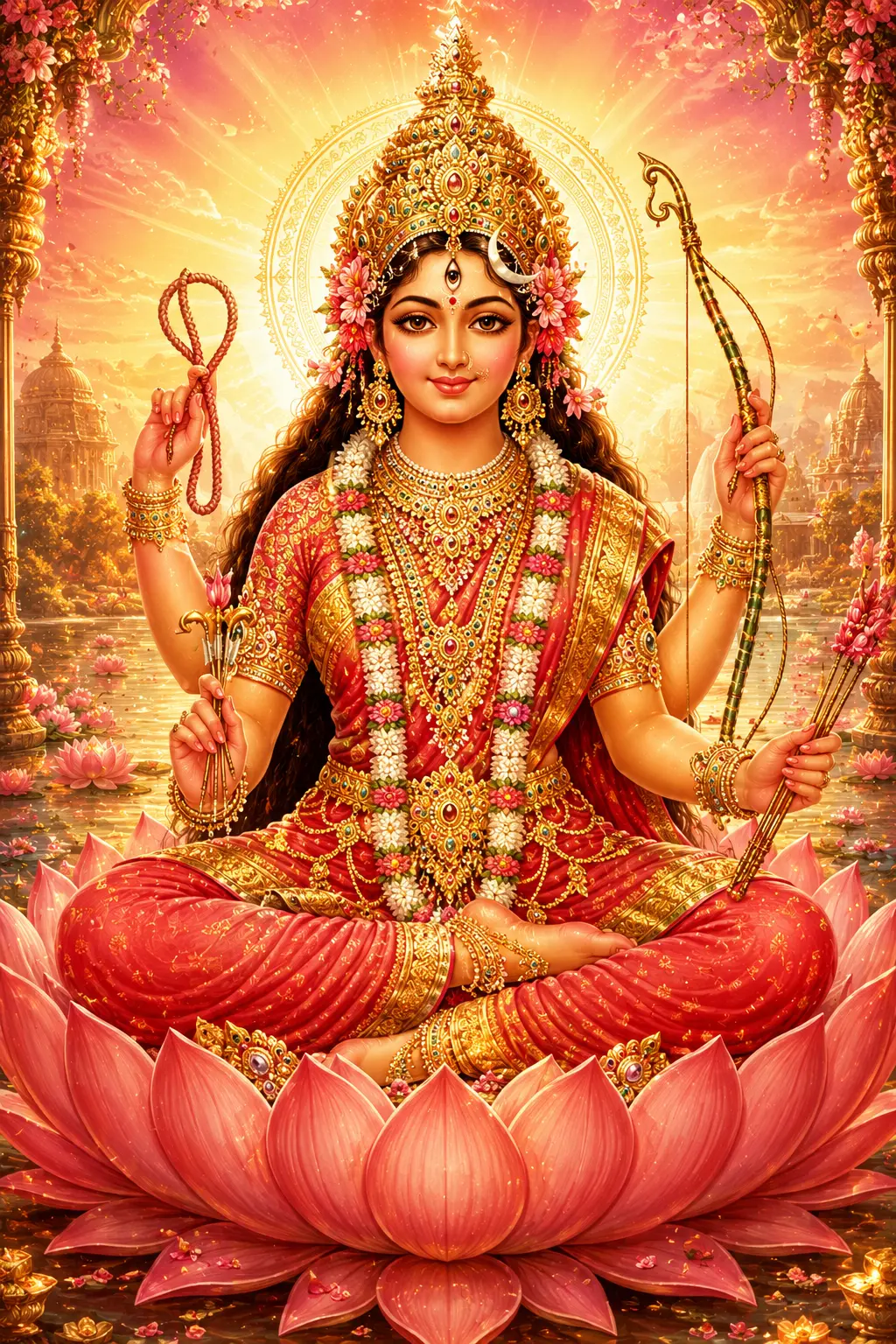
This piece depicts Maa Tripura Sundari — the third of the Dasha Mahavidyas, the supreme goddess of the Sri Vidya tradition, the most beautiful in all three worlds, the embodiment of the recognition that the entire cosmos is consciousness expressing itself as beauty — in a composition of extraordinary refinement and warmth. Her complexion is the golden-rose of dawn at its most luminous — the colour of the first light that reveals rather than announces, the warmth of consciousness that has arrived at the recognition of its own nature and finds that recognition indistinguishable from beauty itself. She is seated in padmasana on a magnificent pink lotus throne, completely composed and completely radiant, the serene knowing smile of one who understands that the entire display of the universe is her own reflection and finds it, in its entirety, beautiful.
Four arms extend in the precise arrangement of her most distinctive iconographic form: the upper right hand holds the pasha (noose) — the binding of love; the upper left holds the ankusha (elephant goad) — the directing intelligence; the lower right holds the ikshudanda (sugarcane bow) — the mind whose sweetness can be drawn upon to release the five flower arrows; and the lower left holds the pancha pushpa bana (the five flower arrows) — the five senses transformed into instruments of liberation rather than bondage. She wears a magnificent crimson and gold silk garment of extraordinary beauty, elaborate gold jewellery, and a golden crown. Her third eye blazes at the centre of her forehead with the supreme knowledge that underlies and encompasses the beauty she embodies.
The palette — warm golden-rose, deep crimson, the pink of the lotus and the gold of the ornaments — is the most warmly luminous in the entire Mahavidya sequence, occupying a precise register between Kali's cool blue-black depth and Bhairavi's concentrated red fire. This is the palette of consciousness in its most fully expressed and most beautiful form — not the darkness before form, not the fire that transforms form, but the light in which form appears at its most completely itself.
About Maa Tripura Sundari — Names and Their Meanings
Maa Tripura Sundari carries more names than almost any other deity in the Hindu tradition, and each name points to a different facet of the same recognition she embodies. Understanding the names is the first step into understanding why she is the presiding goddess of what many scholars consider the most complete and most philosophically sophisticated of all Shakta Tantric systems.
Tripura Sundari: Tripura (of the three worlds/cities) + Sundari (beautiful one) — the most beautiful in all three worlds. The three worlds (Tri-Bhuvana) are understood variously as the three physical planes (earth, atmosphere, heavens), the three states of consciousness (waking, dreaming, deep sleep), and the three aspects of the divine (creation, preservation, dissolution). She is beautiful across all of them simultaneously — her beauty is not limited to any particular plane or state but pervades the entire structure of manifest existence.
Shodashi: The sixteen-year-old, the one who is eternally sixteen — the perpetual youth that represents the fullness of divine beauty at the precise point between the incompleteness of childhood and the maturity that has already begun its movement toward dissolution. Sixteen is understood in the tradition as the number of fullness — the sixteen phases of the moon in its complete cycle, the sixteen kalas (aspects) of the complete human being. Tripura Sundari as Shodashi is the divine at the peak of its own expression, the fullness that is complete without yet having turned toward its own ending.
Lalita: The playful one, the one who plays, the one whose creative activity — the manifestation of the entire universe — is play rather than effort, joy rather than labour, delight rather than purpose. Lalita Tripura Sundari is the supreme goddess of the Sri Vidya tradition, and her primary text — the Lalita Sahasranama, the Thousand Names of Lalita — describes her in extraordinary detail as the goddess whose play is the cosmos, whose city is the Sri Chakra, and whose nature is the inseparable union of consciousness (Shiva) and energy (Shakti) in their most complete and most beautiful expression.
Kamakshi, Meenakshi, Kamala: Regional names of the same goddess in different temple traditions — Kamakshi at Kanchipuram, Meenakshi at Madurai, and Kamala as the lotus goddess of the Sri Vidya system.
The Sri Vidya Tradition — The Most Complete Shakta System
Tripura Sundari is the presiding deity of the Sri Vidya (Srividya) tradition — the Shakta Tantric system that is, by most scholarly assessments, the most philosophically complete, the most ritually elaborate, and the most widely transmitted of all the Shakta Tantric traditions. Sri Vidya has been practiced continuously for at least a thousand years and has influenced virtually every major strand of Hindu philosophy and devotion, directly or indirectly.
The Sri Vidya tradition is organised around three interconnected elements: the deity (Tripura Sundari herself), the mantra (the Sri Vidya mantra, known as the Panchadashi or Shodashi mantra — the fifteen or sixteen syllable mantra that is the most carefully transmitted mantra in the Shakta tradition), and the yantra (the Sri Chakra or Sri Yantra — the geometric diagram that is understood as the visible body of the goddess).
The philosophical framework of Sri Vidya is non-dual — the fundamental recognition that the goddess and the practitioner, the worshipped and the worshipper, the cosmos and the consciousness that perceives it, are ultimately one reality expressing itself in apparent multiplicity. This recognition is not merely a philosophical position but the experiential goal of the practice: the direct recognition, in one's own awareness, of the identity between the beauty of the goddess and the nature of the consciousness that is perceiving her.
The Sri Vidya tradition has been transmitted within major lineages including the Kaula, Samaya, and Mishra schools, through teachers including Adi Shankaracharya (who composed the Soundarya Lahari — the Wave of Beauty — in praise of Tripura Sundari and is credited with establishing Sri Vidya temples across India), and through living lineages that continue in South India and in the diaspora to the present day.
The Four Weapons — The Path of Transformation
The four weapons that Tripura Sundari holds in this artwork are the most theologically distinctive element of her iconography and the clearest expression of what makes the Sri Vidya path different from the paths represented by the other Mahavidyas.
The pasha (noose): The noose of binding — but in Tripura Sundari's hands, the binding is the binding of love. What holds the practitioner in relationship with the goddess is not obligation or fear but the noose of devotional love, the attraction of beauty to the consciousness that recognises beauty as its own nature. The pasha is the irresistible pull of the supreme beauty toward the awareness that is its source.
The ankusha (elephant goad): The goad of directing intelligence — the minimal, precise pressure that redirects the vast force of the mind toward the recognition of its own nature. Like the mahout who guides the elephant not by force but by touch, the ankusha of Tripura Sundari's grace directs the practitioner's awareness toward the beauty that was always present, awaiting recognition.
The ikshudanda (sugarcane bow): The bow made of sugarcane is among the most philosophically specific attributes in all of goddess iconography. Sugarcane is sweet — it yields its sweetness when pressed, when the effort of practice draws out what is already there. The mind (manas) is the sugarcane: it is inherently sweet, inherently oriented toward the beautiful, inherently capable of recognising the goddess's nature as its own. The bow made from it is the mind that has been bent and strung into the instrument of directed attention — the concentrated, sweetness-releasing attention that releases the flower arrows toward their target.
The pancha pushpa bana (five flower arrows): The five arrows made of flowers — each corresponding to one of the five senses — are the most immediately surprising element of Tripura Sundari's weaponry. These are not arrows of renunciation — they are arrows of transformation. In the Sri Vidya understanding, the five senses are not obstacles to be overcome on the path but instruments to be transformed into vehicles of the recognition of beauty. Sight, sound, taste, touch, and smell — each sense, when cultivated through the practice of recognising the goddess's presence in what it perceives, becomes an arrow that hits the target of the direct recognition of Tripura Sundari's nature as the nature of all experience.
This fourfold armamentarium is the most complete possible statement of the Sri Vidya philosophical position: the path to liberation is not the rejection of experience but its transformation — the recognition that every experience, perceived through the lens of the goddess's beauty, reveals the consciousness that is doing the perceiving as identical with what is perceived.
Beauty as a Metaphysical Principle
The most important theological contribution of the Tripura Sundari tradition to the broader Hindu philosophical conversation is the articulation of beauty (Sundari) as a metaphysical principle rather than simply an aesthetic quality.
In ordinary understanding, beauty is a quality that some things have and others lack — a property of objects perceived by subjects who judge them against a standard. In the Sri Vidya understanding, this is precisely backward. Beauty is not a quality that things have; it is the nature of the consciousness that perceives them. The goddess's beauty is not something she possesses — it is what she is, and what all of consciousness is, in its self-recognition.
The Soundarya Lahari of Adi Shankaracharya — one hundred verses of extraordinary literary and devotional beauty composed in praise of Tripura Sundari — is the most celebrated articulation of this understanding in Sanskrit literature. The text moves through every aspect of the goddess's form, describing each attribute in language of extraordinary poetic density, while the cumulative effect of the description is not the detailed portrait of a goddess but the progressive revelation that what is being described is the nature of reality itself — that the consciousness that perceives beauty and the beauty that is perceived are the same consciousness recognising itself.
This understanding — that the beauty of the world is the beauty of consciousness recognising its own nature — is what makes Sri Vidya the tradition of the divinisation of experience rather than its renunciation. The practitioner is not asked to abandon the beautiful in order to find the divine. They are invited to recognise that what appears as the beautiful is already the divine — that Tripura Sundari's beauty is the beauty of the cosmos at the moment of recognition.
The Three Worlds of Her Beauty
The name Tripura (of the three worlds) points to a specific understanding of the terrain that Tripura Sundari's beauty encompasses. The tradition gives several different accounts of what the three worlds are, each pointing to the same non-dual recognition from a different angle:
The three planes of existence: Earth (Bhur), atmosphere (Bhuvah), and the heavens (Svaha) — the three worlds of the Vedic cosmological framework. Tripura Sundari is beautiful across all three — her beauty is not confined to the subtle or the spiritual but pervades the gross physical world, the intermediate realm of energy and emotion, and the high subtle realm of pure spirit simultaneously.
The three states of consciousness: Waking (jagrat), dreaming (svapna), and deep sleep (sushupti). Her beauty shines in the waking state in the forms perceived by the senses; in the dreaming state in the images and narratives of the dream mind; and in deep sleep — where there is no perception and no content — her beauty is the pure, undifferentiated awareness that underlies all three states as their ground. The practitioner who has recognised Tripura Sundari in the waking state and in the dream has not yet found her everywhere; the recognition is complete only when her beauty is found in the contentless awareness of deep sleep.
The three aspects of the divine: Creation (Brahma), preservation (Vishnu), and dissolution (Shiva) — the Trimurti, the three cosmic functions. Tripura Sundari presides over all three as the Shakti without which none of the three can operate. She is the beauty of creation in its arising, the beauty of the world in its sustaining, and the beauty of dissolution in its returning to the source.
The Lalita Sahasranama — One Thousand Names of the Goddess
The Lalita Sahasranama — the Thousand Names of Lalita Tripura Sundari — is one of the most revered texts in the entire Shakta tradition and is recited daily by Sri Vidya practitioners across India and the diaspora. Found in the Brahmanda Purana, it consists of one thousand names of the goddess, each describing a different quality or aspect of her nature, arranged in a sequence that constitutes a complete philosophical description of both the goddess and the universe she is.
The recitation of the Sahasranama is understood in the tradition as the most complete act of worship available to the Sri Vidya practitioner — not simply because it honours every aspect of the goddess by name, but because the sustained attention required to move through one thousand names, each held with full meaning, constitutes a complete meditation on the nature of reality as the goddess understands it. By the end of the recitation, the practitioner has — in principle — moved through every dimension of the goddess's nature and arrived, if the practice is genuine, at the recognition that the consciousness doing the reciting is the consciousness being described.
Displaying Tripura Sundari in the Home
Maa Tripura Sundari's image is displayed in Sri Vidya practice spaces alongside the Sri Chakra yantra (the geometric diagram that is her visible body), in Mahavidya altars in the third position, and in any space dedicated to the cultivation of the recognition of beauty as a spiritual practice.
In a Mahavidya collection, she occupies the third position — following Kali's radical dissolution and Tara's compassionate crossing, she represents the arrival at the bliss of the consciousness that has been stripped by Kali and sustained by Tara: the recognition that what remains is beauty itself.
In a meditation or yoga space, Tripura Sundari's image carries the specific invitation of the Sri Vidya path: not to look away from experience but to look more carefully — to find in what appears as the world the beauty that is the goddess's self-expression, and in that finding to recognise the consciousness that finds it as identical with what it finds.
The warm golden-rose and crimson palette of this artwork suits a natural wood, gold, or deep red frame. The image's warmth and luminosity make it one of the most naturally beautiful pieces in the collection for display in any space.