About This Artwork
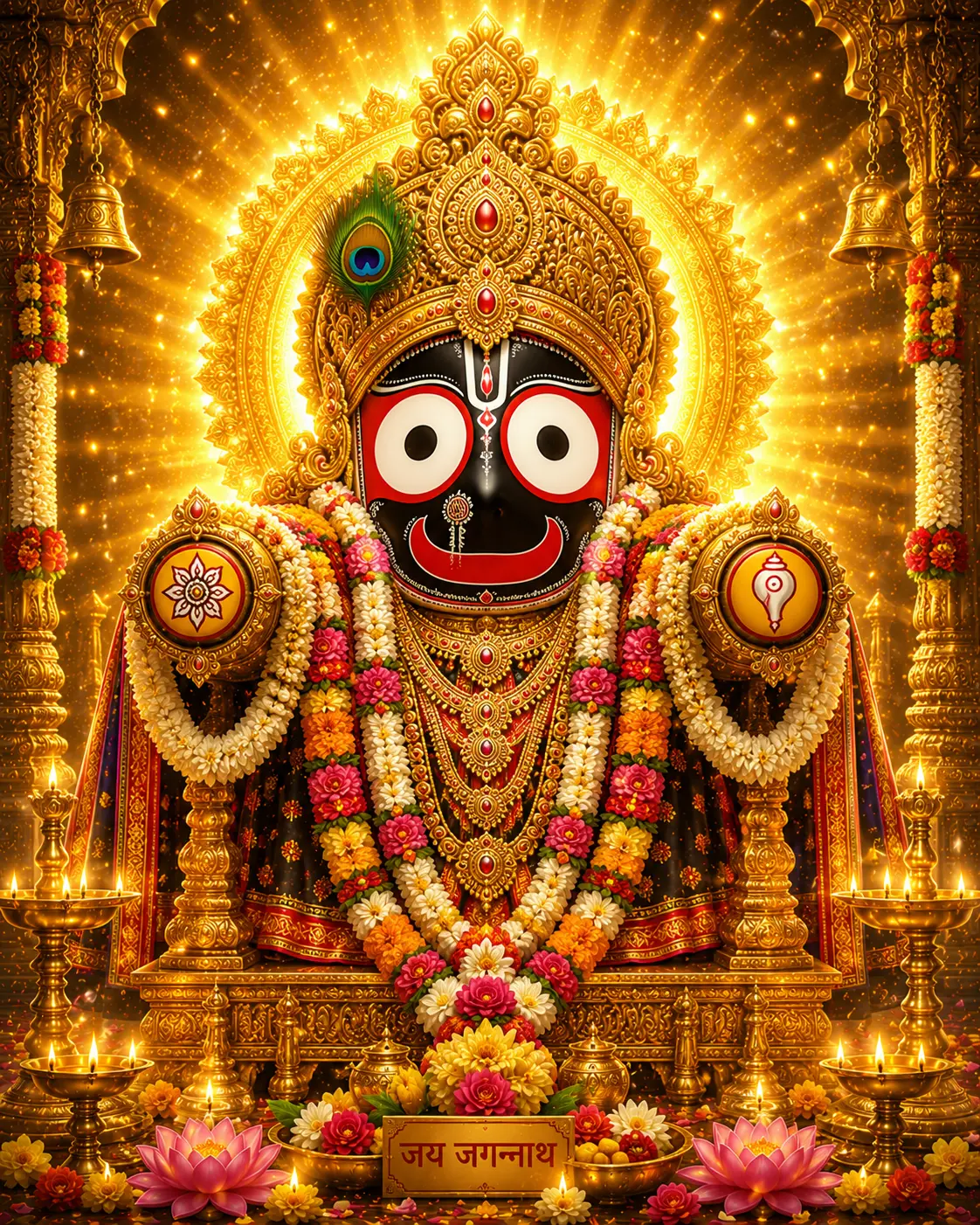
This piece depicts Lord Jagannatha — the Lord of the Universe, Jagat (universe) + Natha (lord) — in his living temple form as he appears in the sacred sanctum of the Jagannatha Temple in Puri, Odisha. No deity in the Hindu tradition has a form quite like Jagannatha's. The face is black, wide, and luminous. The eyes are enormous round circles — not the almond-shaped eyes of the classical Sanskrit sculptural canon but great discs that see in every direction simultaneously, that encompass the entirety of creation in a single unblinking gaze. The mouth is a wide red crescent, the smile of the universe looking at itself with complete recognition and complete joy. There are no clearly articulated hands or feet in the traditional Puri murti form — the deity's presence extends beyond the boundaries that limbs would impose.
In this artwork, Jagannatha is depicted in the full living-deity register of the Puri temple tradition: peacock feather crown, elaborate gold jewellery, and cascading garlands of jasmine, marigold, and rose in the layered abundance of temple offering. On either side, the Sudarshana chakra and the shankha confirm his Vaishnava identity. Golden temple bells hang in the sacred atmosphere. Brass diyas cast warm light. Pink lotus flowers bloom around the base. At the bottom of the composition, the inscription जय जगन्नाथ — Jai Jagannath, Victory to the Lord of the Universe — completes the image as a living devotional offering.
The palette — black, gold, the vivid reds and yellows of the garlands, the warm sacred light of the diyas — is completely unlike any other piece in this collection. Jagannatha's form does not resemble any other deity's form. He is entirely himself, entirely Puri, entirely the specific mystery of a presence that has been meeting devotees at that sacred threshold for at least a thousand years.
About Lord Jagannatha — The Lord of the Universe
Lord Jagannatha is one of the most distinctive, most ancient, and most universally beloved presences in the Hindu tradition — and one of the most immediately recognisable. His form breaks almost every rule of classical Sanskrit iconographic convention: the round, large eyes that see everything, the wide red crescent mouth, the black sacred complexion, the absence of clearly defined hands and feet in the traditional murtis. He is not trying to conform to the aesthetic standards of the temple sculpture tradition that produced the elegant Vishnu forms of South India or the refined Chola bronzes. He is something older, more direct, more immediately available — the deity who looks back at you from across the threshold of ordinary categories.
The name Jagannatha is Sanskrit: Jagat (the moving, the universe, all of manifest existence) + Natha (lord, protector). He is the Lord of the Universe — not a regional deity, not a deity of a particular community or tradition, but by his own name the lord of everything that moves and exists. The Jai Jagannath (जय जगन्नाथ) greeting used in Odisha serves the same function as Jai Shri Ram in North India or Om Namah Shivaya in the Shaiva tradition — it is simultaneously a greeting, a devotional practice, and a statement about the nature of the divine.
The Jagannatha Temple at Puri — One of the Four Sacred Dhams
The Jagannatha Temple at Puri, Odisha, is one of the four Char Dhams — the four sacred pilgrimage sites that together constitute the most important pilgrimage circuit in Hinduism. The four dhams are: Badrinath (in the Himalayas, associated with Vishnu/Narayana), Dwarka (in Gujarat, associated with Krishna), Rameswaram (in Tamil Nadu, associated with Shiva and Rama), and Puri (in Odisha, associated with Jagannatha as Vishnu). A Hindu who completes the Char Dham yatra — the pilgrimage to all four — is understood to have completed the most geographically comprehensive act of devotion available within the tradition.
The Puri temple, dedicated to Jagannatha, Balabhadra (his elder brother), and Subhadra (his sister), is one of the largest temple complexes in India. Its main tower (deula) rises approximately 65 metres above the surrounding landscape and is visible for many kilometres in every direction — a landmark of the Odisha coastline that has guided pilgrims and sailors for centuries. The white flag that flies from its summit is changed daily as part of the living ritual of the temple, and it is said that the flag always flies in the direction opposite to the wind — one of the mysteries the tradition attributes to Jagannatha's extraordinary nature.
The temple's kitchen (Mahaprasad kitchen) is, by various accounts, the largest kitchen in the world — feeding between 10,000 and 100,000 pilgrims daily with the Mahaprasad, the sacred food offered to Jagannatha. The Mahaprasad of the Puri temple is understood to be entirely non-hierarchical: it is offered to all devotees equally, without distinction of caste or background, and accepting it is understood as an act of receiving the Lord's grace directly.
The Iconography of Jagannatha — Why His Form Is Unlike Any Other
Jagannatha's form has attracted theological and anthropological attention for generations, because it is so clearly different from the standard Sanskrit iconographic canon that it raises questions about its origin, its relationship to pre-Vedic or tribal traditions, and its specific theological meaning.
The large round eyes: Jagannatha's defining iconographic feature — enormous circular eyes that encompass the entire visible field — are understood in the tradition as the eyes that see all of creation simultaneously. The round, unblinking, all-encompassing eye is an image of omniscience: this deity is not looking at one thing but at everything, always. In the Puri temple tradition, these eyes are repainted and refreshed during the Nabakalebara ritual (the renewal of the deity's body) and are understood to be charged with concentrated divine presence at that moment.
The black complexion: Jagannatha's black face is understood in multiple ways depending on the tradition. Within the Vaishnava framework it connects to the dark complexion of Vishnu and Krishna. Within the broader Jagannatha theology it is associated with the dense mystery of the unmanifest absolute — the darkness from which all light arises, the ground of being that cannot be seen because seeing happens within it. Black in this context is not absence but fullness: the colour of the seed from which everything visible grows.
The red crescent mouth: The wide red mouth — crescent-shaped, joyful — is among Jagannatha's most distinctive features and one of the most iconographically unusual in the temple tradition. It is the smile of the universe, the expression of the deity who sees everything and finds it, in its entirety, to be a source of joy.
The abbreviated form: The Jagannatha murtis at Puri have arms that taper to blunt ends rather than full hands, and no clearly defined feet. This form is understood in the tradition as the deity in the process of manifesting — not yet fully formed in the physical sense but fully present in the devotional sense. It is also connected to specific Puranic accounts of the deity's origin. The incompleteness of the physical form paradoxically intensifies the sense of divine presence: this is not a statue of a person but a direct vehicle of the sacred.
The Tribal and Pre-Vedic Roots of Jagannatha
Jagannatha's tradition is understood by scholars and by many practitioners to contain elements that predate the classical Vaishnava theological framework — the distinctiveness of his form, the specific traditions of his worship, and accounts in the Puranas and local Odishan traditions all point toward a deity whose origin may lie in the tribal (particularly Savara) traditions of ancient Odisha rather than in the mainstream Sanskrit Vaishnava stream.
The most commonly told origin story involves King Indradyumna of ancient Malava, who received instructions in a dream to find a sacred form of Vishnu hidden in Odisha. The deity's form was to be carved from a sacred log of neem wood (daru brahma — the divine wood) that would wash ashore at a specific location. The divine architect Vishwakarma came in the form of an old carpenter to carve the form, asking for absolute privacy during the work. When the king broke the agreement and opened the workshop before the work was complete, Vishwakarma vanished — leaving the three forms of Jagannatha, Balabhadra, and Subhadra in their current unfinished state.
In the parallel tribal account, the Savara tribal tradition holds that their deity Nila Madhava was absorbed into the Jagannatha tradition as it expanded and formalized under royal patronage. The specific ritual traditions of the Puri temple — including the hereditary rights of the Daitapati priests, who are identified as descendants of the tribal Savara community — preserve this history within the living practice of the temple to the present day.
What this means for understanding Jagannatha is significant: he is not a deity that arrived from outside Odisha and replaced something that was there before. He is a deity that grew up from within the landscape, the community, and the pre-existing religious life of the region — and the result is a tradition that is both profoundly Vaishnava and, in some of its most distinctive features, something older and more local than Vaishnavism as an all-India phenomenon.
The Rath Yatra — The Chariot Festival
The Rath Yatra (chariot journey) of Puri is among the most spectacular and most ancient religious festivals on earth. Held annually in the Hindu month of Ashadha (typically June/July), it draws several million pilgrims to Puri for the festival days and is one of the largest peaceful gatherings of human beings anywhere in the world.
The festival involves the installation of Jagannatha, Balabhadra, and Subhadra on three enormous wooden chariots — Nandighosh (Jagannatha's), Taladhwaja (Balabhadra's), and Darpadalana or Devadalana (Subhadra's) — which are constructed fresh each year from specific types of wood according to traditional specifications. The chariots are massive: Jagannatha's Nandighosh is approximately 14 metres high and 10 metres square at the base, with 16 wheels each over two metres in diameter.
The three chariots are pulled by hundreds of thousands of devotees through the main road (Bada Danda, the Grand Road) from the Jagannatha Temple to the Gundicha Temple — understood as the garden house of the deity's grandmother — where the deities stay for nine days before being pulled back to the main temple in the return journey (Bahuda Rath Yatra). The pulling of the chariot ropes is considered among the most meritorious acts of devotion available to a pilgrim — the devotee who pulls the ropes of Jagannatha's chariot is understood to receive the accumulated merit of countless pilgrimages and acts of devotion.
The English word "juggernaut" — meaning an overwhelming, unstoppable force — derives directly from "Jagannatha" via the Portuguese Juggernaut, a 16th-century misrepresentation of the Rath Yatra by European travellers who described pilgrims throwing themselves under the chariot wheels (an account now understood to be greatly exaggerated if not entirely fabricated). The linguistic survival of Jagannatha's name in English, even in this distorted form, is a measure of the impression the festival made on those who witnessed it.
The Rath Yatra is now celebrated by Jagannatha devotees and ISKCON communities worldwide — in cities across the United States, the United Kingdom, Canada, Australia, and beyond — making it one of the Hindu festivals most visible to non-Hindu audiences in the contemporary world.
Jagannatha's Universalism — The Deity Who Belongs to Everyone
One of the most theologically significant aspects of the Jagannatha tradition is its explicit and historic commitment to universalism — the understanding that Jagannatha belongs to all devotees without distinction of caste, community, or background.
The Mahaprasad of the Puri temple is the most famous expression of this: it is offered to all who come, across every distinction, and accepting it together is understood as an act of equality in the presence of the Lord. The Panchasakha tradition — the five Odishan poet-saints of the 15th–16th centuries — articulated a theology of radical devotional equality centred on Jagannatha, drawing on the universalism implicit in his form and his tradition to critique caste hierarchy and exclusion in a way that had significant social as well as spiritual impact.
This aspect of the Jagannatha tradition is one of the reasons ISKCON (the International Society for Krishna Consciousness), founded by A.C. Bhaktivedanta Swami Prabhupada, took Jagannatha as one of its central deities from the earliest days of its activity in the West. The tradition's explicit openness to all devotees, regardless of background, aligned with ISKCON's mission to bring Krishna consciousness to the entire world. The ISKCON Rath Yatras now held in cities across the world are a direct continuation of this universalist impulse.
Displaying Jagannatha in the Home
Jagannatha's image is displayed in Odishan homes, in ISKCON temples worldwide, in Vaishnava households across many traditions, and increasingly in any home where the specific quality of Jagannatha's presence — the all-seeing eyes, the joyful cosmic smile, the absolute universalism of his welcome — is the quality that is sought.
In a puja room or home altar, Jagannatha's image is often placed alongside Balabhadra and Subhadra (as in the separate trio print elsewhere in this collection) or as a solo presence receiving his own daily devotion. The image works as a standalone sacred piece on any wall — the boldness of the black face and round eyes makes it one of the most visually striking pieces in the collection and one that communicates its sacred nature immediately, without requiring any knowledge of the iconographic tradition.
The digital download allows immediate printing. Print on matte or semi-gloss paper at your preferred size and frame in a style that suits your space. The warm gold, black, and vivid garland colours suit a natural wood or dark wood frame particularly well.