About This Artwork
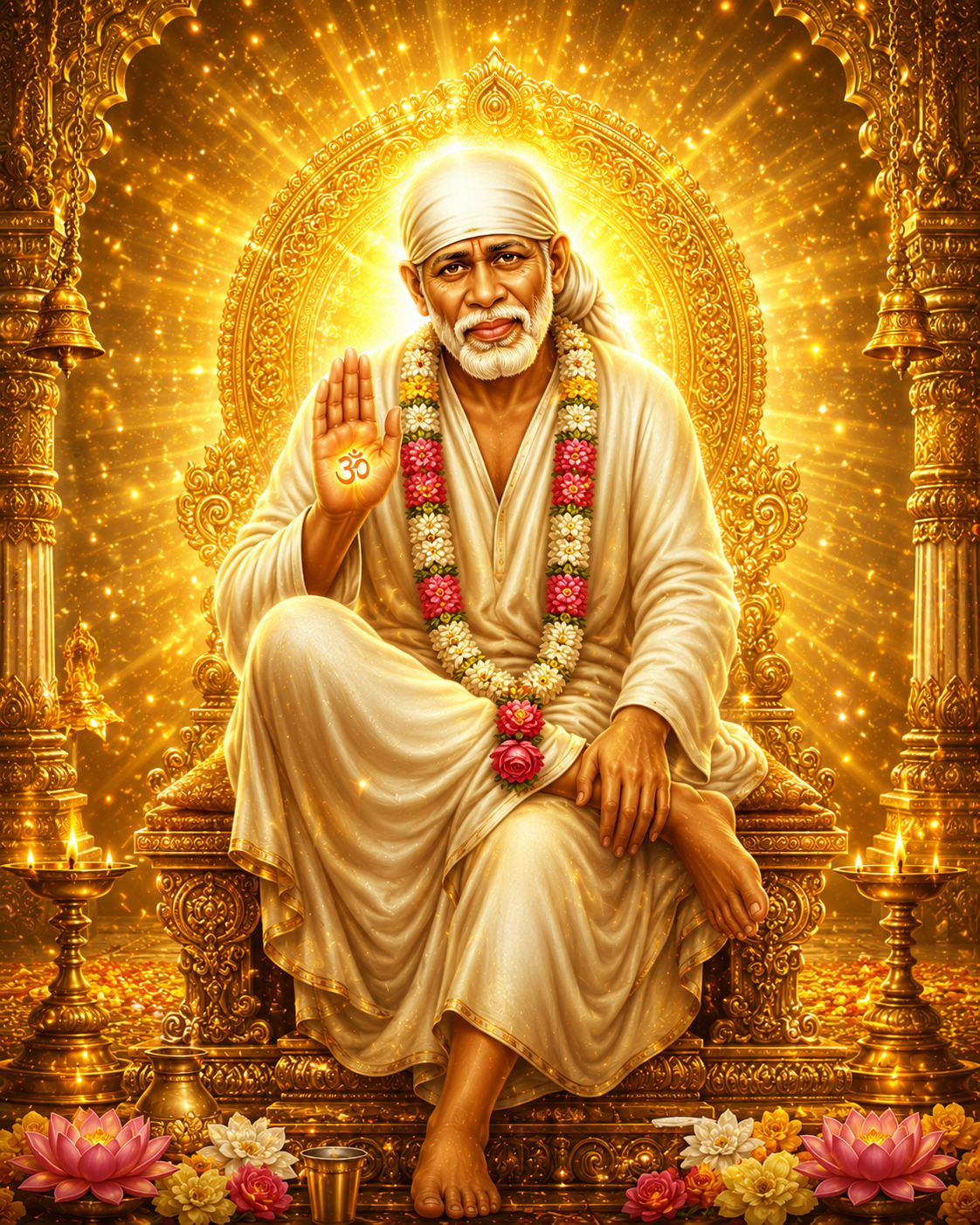
This piece depicts Shirdi Sai Baba — the saint of Shirdi, Maharashtra, who lived and taught at the Dwarkamai mosque in Shirdi from approximately the 1850s until his mahasamadhi (conscious departure from the body) in 1918 — in the temple darshan form in which he is most widely depicted in devotional art. He is seated on his golden temple throne in the simple white cotton robe and cloth head wrap he characteristically wore during his lifetime. His bearing is one of complete stillness and complete presence — not the composed dignity of a deity enthroned but the settled, unaffected, unconditional availability of a human being who has dissolved all personal agenda.
His right hand is raised in abhaya mudra, the gesture of fearlessness and protection, with the sacred Om symbol glowing at the centre of his open palm. His left hand rests at ease in his lap. His expression is the one that devotees across generations and traditions have described as impossible to categorise — the smile of someone who sees what is happening completely, who finds it neither alarming nor trivial, and who has no interest in anything other than the person standing before him.
Cascading flower garlands — white jasmine, orange marigold — hang from his throat to his lap. Golden oil lamps (diyas) burn at his feet. Pink lotus flowers bloom around the base of his throne. The warm golden light of the temple setting fills the entire composition. The simplicity of his dress — unadorned white, no crown, no divine weapons, no elaborate jewellery — makes his presence in this ornate setting more striking rather than less. He is not dressed for this throne. He is simply who he is, and that is enough.
About Shirdi Sai Baba — The Saint of Shirdi
Shirdi Sai Baba was a spiritual master who lived in the small village of Shirdi in the Ahmednagar district of Maharashtra, India, from some point in the mid-nineteenth century until his passing on 15 October 1918. His origins are unknown. He arrived in Shirdi as a young man, settled in a dilapidated mosque he called Dwarkamai (after the sacred city of Dwarka associated with Krishna), and remained there for the rest of his life — a period of roughly sixty years, during which he became one of the most widely revered spiritual figures in the Indian tradition.
Who he was before Shirdi, where he came from, what his birth name was, what tradition he was trained in — none of these questions have definitive answers, and Sai Baba himself consistently deflected them. When asked if he was Hindu or Muslim, he would typically respond with Sabka Malik Ek — the one master of all is one — refusing the question's premise. He dressed in the kafni (a long robe) and carried the satka (a short staff) associated with Sufi fakirs. He tended a sacred fire (dhuni) in the Dwarkamai that has burned continuously since his lifetime. He quoted from both the Quran and the Puranas. He conducted Hindu pujas in the morning and offered namaz (Muslim prayer) at evening. He addressed devotees with the Islamic greeting Allah Malik (God is the master) and the Hindu invocation Om Sai Ram with equal comfort.
In a country and a tradition where religious identity is often precise and load-bearing, Sai Baba's consistent refusal to be categorised was not diplomatic evasion but lived practice — an expression of a realisation that the divine the various traditions were pointing toward was not several things but one, and that any teacher genuinely established in that recognition would naturally be available to seekers from every approach.
Sabka Malik Ek — The Teaching at the Centre
The phrase most closely associated with Sai Baba — Sabka Malik Ek (the master of all is one) — is both his greeting and his complete teaching compressed into four words. Every elaboration of his instruction that his disciples recorded returns to this recognition: that what appears as many separate presences, traditions, deities, and paths is ultimately one reality, and that the practitioner's work is to move from the apparent multiplicity toward the recognition of that unity without discarding the specific forms through which they approach it.
This teaching was not presented as a philosophical position to be argued for but as a practical reality to be verified in practice. Sai Baba did not deliver systematic lectures or write treatises. He spoke to individuals, in the specific circumstances of their specific situations, addressing what each person actually needed rather than what a general teaching would prescribe. His recorded instructions are full of parables, stories, and direct interventions in the specific difficulties — material, relational, psychological, and spiritual — of the people who came to him.
His two primary instructions, consistently returned to across all the accounts of his teaching, were:
Shraddha — faith, the quality of trusting in the divine intelligence that underlies and supports the practitioner's path, even when that intelligence is not immediately visible in events.
Saburi — patience, the quality of remaining steady in practice and in life without demanding that the fruits of practice arrive on the practitioner's preferred timetable.
These two qualities — faith and patience — are at the centre of the Shirdi Sai tradition as a practical teaching, independent of any specific theological framework.
Sai Baba's Life at the Dwarkamai
The physical centre of Sai Baba's life and teaching was the Dwarkamai — the mosque he inhabited in Shirdi from his arrival in the village until his passing. The name Dwarkamai is itself a statement of synthesis: Dwarka is one of the four Hindu dhams (the sacred city of Krishna), while the mosque form of the building is Muslim. The name brought them together in a single sacred space.
In the Dwarkamai, Sai Baba tended the dhuni — the sacred fire — which he kept burning continuously. Devotees came to receive the udi (sacred ash from the dhuni) which Sai Baba distributed liberally, understanding it as both a material blessing and a teaching: that the dhuni of practice burns through the accumulated residue of the ego, leaving only ash — the pure and humble remainder.
He slept on a simple wooden plank suspended from the ceiling by ropes. He cooked food for devotees and the poor in large pots, feeding whoever came to him. He begged for food from a small number of households in Shirdi each day and combined what he received into a common pot from which all were fed — a practice that, like all of his observable habits, carried both a practical dimension (feeding the poor) and a teaching dimension (all food is God's, the saint begs from all and gives to all, there is no distinction of source or recipient).
The Shirdi Sai Baba Temple — Pilgrimage and Contemporary Reach
The Shirdi Sai Baba Sansthan Trust, established to manage the Sai Baba temple in Shirdi and the associated charitable institutions, administers what has become one of the most visited pilgrimage sites in India. The Shirdi temple complex — centered on the samadhi mandir (the shrine built over the site of Sai Baba's burial, in the style of a Hindu mandir) and the adjacent Dwarkamai — receives several hundred thousand pilgrims per month and millions annually.
The samadhi mandir was constructed over the marble samadhi that holds Sai Baba's mortal remains — an unusual circumstance in itself, since a Muslim saint is typically buried at a dargah (shrine at a burial site), while a Hindu saint is typically cremated and the site marked with a samadhi stone. Sai Baba's wishes, expressed before his mahasamadhi, led to his body being preserved and interred in the mandir form rather than the dargah form — another instance of his characteristic refusal to allow his tradition to be fully categorised.
The Shirdi Sai Baba Sansthan runs an extensive programme of charitable activity — hospitals, schools, dharmashalas (rest houses for pilgrims), and free food distribution — funded entirely from the temple's donations. The scale of the charitable enterprise is among the largest operated by any religious trust in Maharashtra.
Sai Baba's devotional reach extends well beyond Shirdi and well beyond Maharashtra. He is worshipped across India by Hindus, and in some communities by Muslims who understand him within the Sufi tradition. Sai Baba temples exist across the Indian diaspora in the United States, the United Kingdom, Canada, Australia, and across Southeast Asia. His image is present in homes and altars across virtually every regional Hindu tradition in India and the diaspora — a cross-community reach that is virtually unparalleled among figures of the modern era.
The Iconography of This Artwork — Reading the Image
The seated posture: Sai Baba is depicted seated on his ornate golden temple throne — the formal devotional rendering of the saint as enshrined in his temple. In his lifetime he sat on a simple wooden plank; in the devotional art tradition he is presented with the royal dignity appropriate to one who is worshipped as divine, while his dress remains the simple white robe of the Dwarkamai. This contrast — the saint's simplicity within the throne's grandeur — is visually deliberate.
The white robe and head covering: The kafni and the cloth head wrap that Sai Baba characteristically wore are his most immediate iconographic identifiers. No crown, no divine weapons, no elaborate ornamentation on the body — the simplicity of his dress in this ornate setting is itself a statement about the nature of authentic spiritual authority: it does not require decoration.
Abhaya mudra with Om: The right hand raised in the gesture of fearlessness, with the Om symbol glowing at the centre of the open palm, is the most commonly depicted mudra in Sai Baba's iconography and the most direct visual expression of his central teaching. The gesture says: do not fear. The Om on the palm says: what protects you is the same primordial ground from which everything arises. The combination encodes Sabka Malik Ek in a visual form.
Flower garlands: The cascading white and orange garlands that devotees offer to Sai Baba's image in temple worship — jasmine for purity, marigold for auspiciousness — are present in this artwork as the most immediate and universal expression of devotion. Across all traditions that approach Sai Baba, the offering of flowers is the gesture of love made visible.
The golden diyas: Oil lamps burning before the saint's presence in the warm golden light of the Dwarkamai — the dhuni's light, the tradition of keeping the sacred fire — are present in the lower foreground of this composition. The flame that never goes out is one of the central images of the Shirdi Sai tradition.
Why Sai Baba's Presence Crosses All Traditions
Sai Baba is one of very few figures in the Indian spiritual tradition whose devotional reach genuinely crosses the Hindu-Muslim boundary — and one of even fewer whose cross-tradition appeal has grown rather than diminished in the century since his passing. Understanding why requires understanding what he actually represented.
He did not represent a compromise between Hinduism and Islam — a kind of diplomatic middle ground designed to offend no one. He represented a recognition that was prior to both traditions: the recognition that what the various traditions are pointing toward is one, that the divine is not the property of any single approach, and that a human being fully established in that recognition is naturally available to seekers from every direction.
This is a position that the traditions themselves contain — the Vedanta's Ekam sat vipra bahudha vadanti (truth is one, the sages call it by many names), the Sufi tradition's wahdat al-wujud (the unity of being), the bhakti tradition's insistence on the direct accessibility of the divine to every sincere heart regardless of social position. Sai Baba embodied what these teachings describe, rather than merely teaching about them — and it is this quality of embodiment, reliably transmitted even through his recorded actions and instructions, that continues to draw devotees across every tradition and background.
Displaying Sai Baba in the Home
Sai Baba's image is displayed in Hindu homes across every regional tradition in India and the diaspora, in some Muslim households where he is honoured within a Sufi understanding, and in any home where the quality of unconditional availability and cross-tradition grace that he represents is the quality being sought.
In a puja room he is often placed as a central or co-equal presence alongside the deities of the household's primary devotional tradition — Ganesha, Lakshmi, Shiva, Vishnu, Krishna. His simplicity of form and dress makes him visually distinct from the more ornate deity images while sitting comfortably among them.
In a living room or study, his image carries the specific quality of a presence that is recognisable across cultural and religious backgrounds — the warmth of the golden palette, the abhaya mudra, the completely composed expression — communicating the essential quality of his tradition to viewers who may know nothing of the specific historical and religious context.
The digital download allows immediate printing at your preferred size. The warm golden palette suits a natural wood or dark wood frame. Print on matte or semi-gloss paper at FedEx Office, Staples, or any professional print shop.