About This Artwork
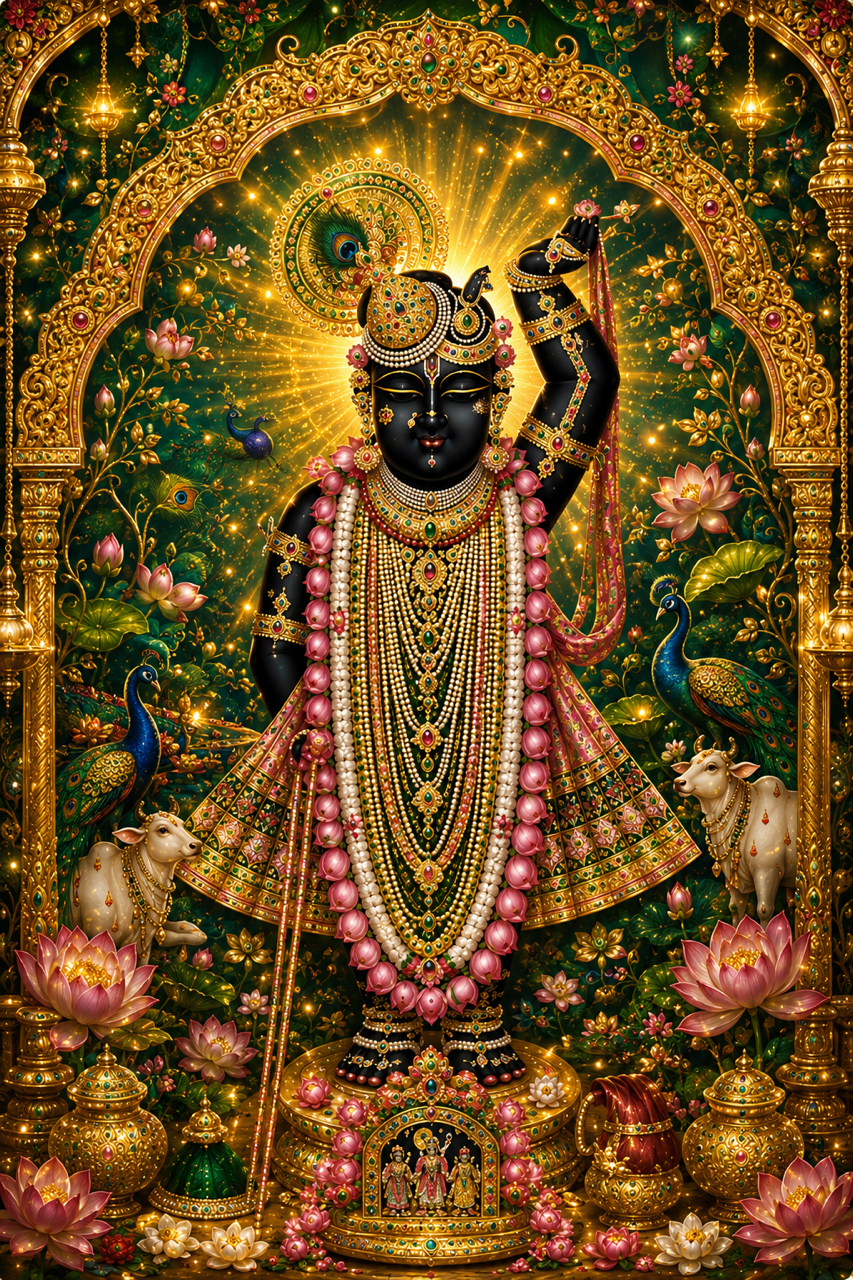
This piece depicts Srinathji — Krishna in the Govardhan-lifter form as enshrined at the Nathdwara temple in Rajasthan, one of the most sacred Vaishnava pilgrimage sites in India and the home of the Pushti Marg tradition founded by Vallabhacharya. He stands in the classical Srinathji posture: dark-complexioned, one arm raised at the elbow in the gesture of lifting Govardhan Hill, the left arm resting at the hip — the posture that has been preserved and worshipped at Nathdwara for over four centuries and that is instantly recognisable to any Vaishnava devotee across the world.
His form is adorned in the elaborate style of Nathdwara's distinctive artistic tradition: layered pearl and gemstone garlands cascade from crown to waist, the peacock feather crown rises from the beautifully decorated head, and beneath the golden archway of the shrine, carved vines and blossoms frame the Lord's presence in the lush, garden-like aesthetic that characterises the Nathdwara Pichwai tradition. On either side of the shrine, two white cows — Krishna's beloved cattle of Vraja — rest peacefully in attendance. Two peacocks — the birds whose cry signals monsoon, whose beauty the Lord wears in his crown — stand beside the cows. Lotus flowers bloom at the base, and the entire composition is saturated with the warm, jewel-toned palette of authentic pichwai paintings: deep indigo, rich gold, the warm terracotta of devotion.
About Srinathji — Krishna as the Lifter of Govardhan
Srinathji is the specific form of Krishna enshrined at the Nathdwara temple in the Rajsamand district of Rajasthan. The name Srinathji (from Sanskrit: Sri — auspicious, revered + Natha — lord) is the name by which this specific murti is known, and the deity and the murti are understood in the Pushti Marg tradition as one: the image is not a representation of Krishna but Krishna himself, arrived at Nathdwara after a remarkable journey from the original site of his appearance (Govardhan Hill in Vrindavan, in Uttar Pradesh) in the 17th century.
The posture that makes Srinathji immediately recognisable — the right arm raised at the elbow, the left arm resting at the hip — represents the eternal moment of the Govardhan Leela: the seven-year-old Krishna lifting the Govardhan Hill on his little finger to shelter the cowherds of Vraja from Indra's devastating rains. The moment is eternally present in this murti: Srinathji is always lifting, always sheltering, always protecting the devotees who have gathered beneath his arm. The pilgrimage to Nathdwara is the pilgrimage to stand beneath that raised arm.
The Pichwai Tradition — Sacred Painting for the Lord's Darshan
Pichwai paintings — large cloth or paper paintings that serve as the backdrop behind the Srinathji murti during different sringara (decorative dressing) ceremonies — are one of the most distinctive and most celebrated sacred painting traditions in India. The name pichwai comes from Sanskrit: pich (back) + wai (hanging) — the hanging at the back. The paintings are changed throughout the day and according to the festival calendar, creating a living, rotating visual context for the Lord's darshan.
The pichwai tradition developed in Nathdwara over the four centuries since Srinathji's arrival there, and it has produced what art historians recognise as one of the most remarkable and most technically accomplished devotional painting traditions in the world. The characteristic elements — the dark-complexioned Srinathji against lush garden backgrounds of cows, peacocks, lotus flowers, and the devotional community of Vraja — are present in this artwork, which is executed in the spirit of the pichwai tradition while being adapted for wall art display in the home altar or sacred space.
The Pushti Marg — The Path of Grace
The Pushti Marg (the path of grace or nourishment) is the Vaishnava devotional tradition founded by Vallabhacharya (1479–1531 CE) and centred on the worship of Srinathji at Nathdwara. The theological foundation of Pushti Marg is shuddhadvaita (pure non-dualism) — the understanding that the individual soul and Brahman are not different but are one in essence — and its devotional practice centres on the constant awareness that one lives in Krishna's presence and that every act of daily life is an opportunity for devotional offering to the Lord.
The Pushti Marg tradition is particularly strong in Gujarat and Rajasthan and among the Gujarati diaspora communities worldwide. The Srinathji image in this artwork is the image that millions of Pushti Marg devotees have before them in their home puja rooms and altar spaces — the darshan of the Lord as he appears at Nathdwara, brought into the home.
The Cows, Peacocks, and Lotus — Reading the Pichwai Elements
Every element of the Srinathji pichwai composition carries devotional significance rooted in the stories of Krishna's Vraja life:
The white cows (Kamadhenu): Krishna spent his childhood and youth as a cowherd of Vraja, tending the cattle of Gokul and Vrindavan. The cows in pichwai paintings represent the Vraja cattle that the Lord personally tended, loved, and protected — they are not decorative but the living community of devotees in animal form that surrounded him in his pastoral life.
The peacocks: The peacock feather in Krishna's crown is his most universally recognised attribute. The peacocks in the pichwai carry the dual symbolism of beauty (the Lord's own aesthetic, expressed in the most beautiful of all birds) and of the monsoon (the season most associated with Krishna's Vraja leelas, when Vraja is most lush and the entire natural world responds to the Lord's presence).
The lotus flowers: The lotus is the throne of the divine across all Hindu traditions, and in the Vaishnava context specifically represents the emergence of the sacred from the world — the divine presence arising naturally and unstained from the conditions of ordinary life. The lotus-blooming Vraja at Srinathji's feet is Vraja as the Lord knows it: constantly blooming, constantly sacred, constantly alive with the presence of the one who dwells there.
Displaying Srinathji in the Home
Srinathji's image is the central image of the Pushti Marg home puja room, and is widely displayed in any Vaishnava household that has a connection to the Nathdwara tradition. For Gujarati and Rajasthani families in India and the diaspora, the Srinathji image is among the most fundamental sacred images in the home — the Lord of the family's devotional tradition, the one whose darshan is sought daily.
In a more general Vaishnava or Hindu context, the Srinathji image carries the specific quality of the most intimate and most pastoral of all Krishna forms — not the cosmic teacher of the Bhagavad Gita (Vishwavijay), not the mighty warrior (Parthasarathy), but the child who lifted a hill to shelter his people and who stands in that posture forever, waiting to shelter everyone who comes to him.