About This Artwork
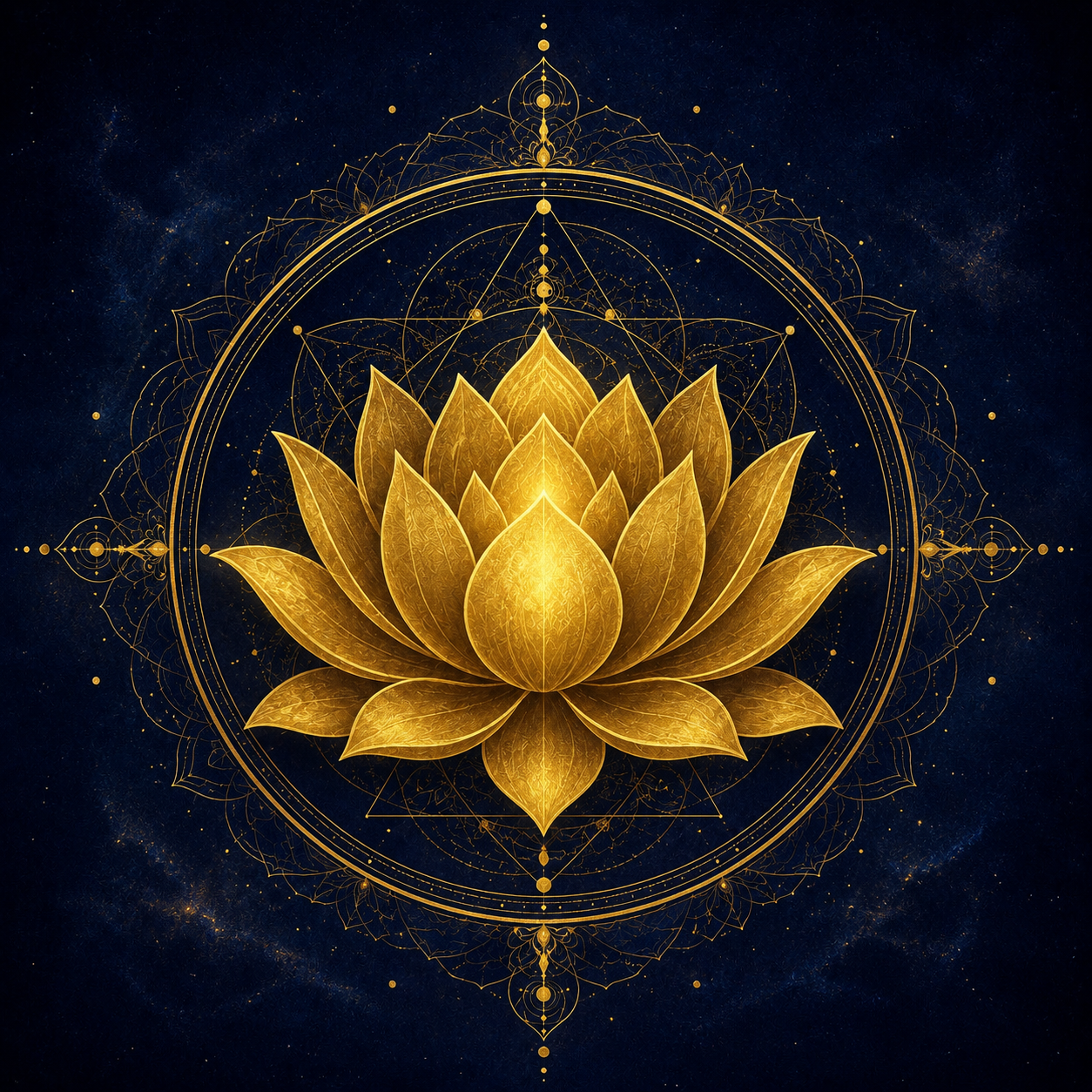
This artwork depicts the Golden Lotus Mandala — a magnificent fully bloomed lotus flower at the precise centre of a composition of concentric rings of intricate sacred geometric patterns, each ring radiating outward from the lotus as if the lotus itself is the source from which the entire geometric cosmos unfolds. The lotus is rendered in warm gold with the specific quality of metallic luminosity — not the flat yellow of paint but the three-dimensional depth of gold that catches and returns light from multiple angles simultaneously. Around it, the concentric rings of sacred geometry glow with soft rose, warm gold, and luminous white — serene, uplifting, and deeply beautiful, the colours of the subtle body at its most receptive and most open.
The palette of this artwork is the most warmly luminous in the Yantras & Sacred Symbols section — distinct from the pure gold-on-navy of the Sacred Mandala and the cosmic blue of the Sri Yantra. Where those pieces work in the register of precision and depth, the Golden Lotus Mandala works in the register of warmth and opening — the soft rose that is the colour of the lotus and of the heart chakra (Anahata), the warm gold that is the colour of the awakened consciousness within which the lotus blooms.
About the Golden Lotus Mandala
The lotus (Nelumbo nucifera) is the most symbolically rich flower in the Hindu, Buddhist, and Jain traditions — and arguably in any sacred tradition anywhere in the world. Its specific qualities — rooted in mud, rising through water, blooming in open air, untouched and unstained by what nurtured it — make it the most complete natural metaphor for the spiritual path that exists: the movement of consciousness from the unconscious depths through the emotional and pranic body into the open air of pure awareness, the blooming that leaves behind no trace of the darkness it grew through.
The Lotus Mandala depicted in this artwork combines these two primary sacred geometric forms of the tradition: the lotus and the mandala. The lotus at the centre is the goal and the symbol of the destination; the mandala's concentric rings are the map of the path to that destination; and the composition as a whole is both simultaneously — a depiction of what awakening looks like and a map of how to get there.
The Lotus in the Chakra System
The seven principal chakras of the subtle body are each depicted, in the traditional iconography of Kundalini yoga, as a lotus with a specific number of petals. The Muladhara (root chakra) has four petals; Svadhisthana (sacral) has six; Manipura (solar plexus) has ten; Anahata (heart) has twelve; Vishuddha (throat) has sixteen; Ajna (third eye) has two; and the Sahasrara (crown) has a thousand petals — the full blooming of consciousness at the crown of the head, the completion of the Kundalini's journey from the root to the crown, from the four-petalled root lotus to the thousand-petalled crown lotus.
The Golden Lotus in this artwork — fully bloomed, radiant gold, the thousand-petalled blossoming that is the goal of the entire yogic journey — is specifically the Sahasrara in its full expression: the crown lotus, the blooming of awakened consciousness at the summit of the subtle body, the image of what the Kundalini's arrival at the crown looks like from the outside.
The Lotus and the Heart Chakra
The soft rose palette that surrounds and infuses the lotus composition in this artwork connects it specifically to the Anahata chakra — the heart centre, the fourth chakra, the point at which the path turns from the lower, more earthly energies toward the higher, more refined. The twelve-petalled lotus of Anahata is the lotus of love — the opening of the heart to the reality of one's own nature and to the lives of others, the movement from self-interest to the broader awareness that all living beings are expressions of the same consciousness.
The rose colour of the heart chakra is the colour most directly associated with the quality of love in its most refined expression — not romantic attachment but the open, spacious, unconditional quality of awareness that recognises itself in everything it encounters. This rose-gold palette of the Golden Lotus Mandala is the visual register of that quality: warm, open, completely present, untouched by what it illuminates.
The Lotus in the Hindu Sacred Tradition
In the Hindu tradition, the lotus (padma) is among the most universal sacred symbols. It is the throne of the gods: Brahma sits on a lotus that emerges from Vishnu's navel; Lakshmi stands on a lotus; Saraswati is seated on a lotus; the Devi in her most complete forms is depicted on a lotus throne. In each case, the lotus signals the same quality: purity, the complete non-attachment of the divine presence to the conditions from which it arises.
The lotus also gives its name to the padmasana — the full lotus posture of seated meditation, in which the practitioner sits in the precise form of the blooming lotus, the feet resting on the opposite thighs as the lotus petals rest on the surface of the water, the spine erect as the lotus stem, the awareness opening upward as the lotus faces the light.
Displaying the Golden Lotus Mandala
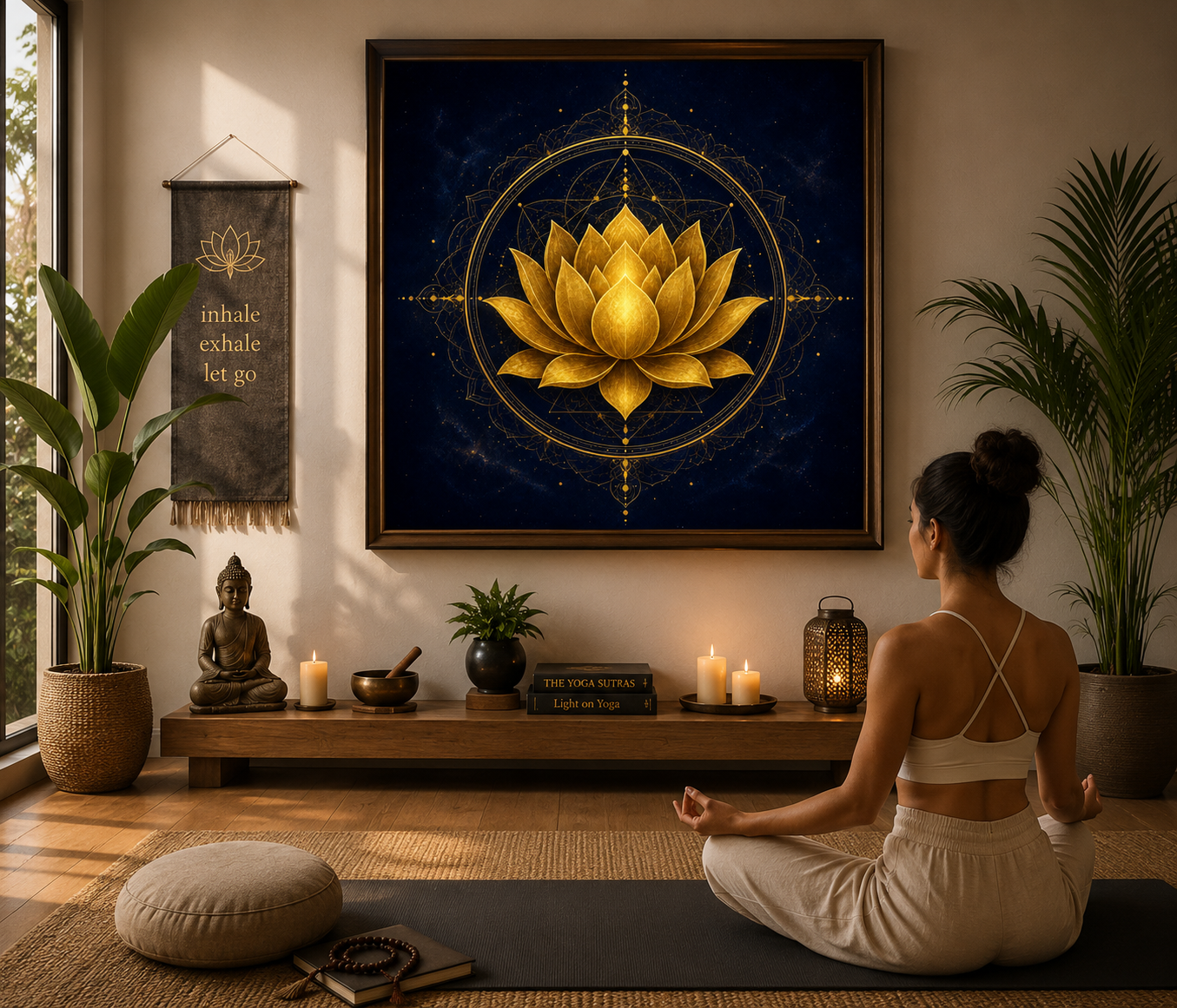
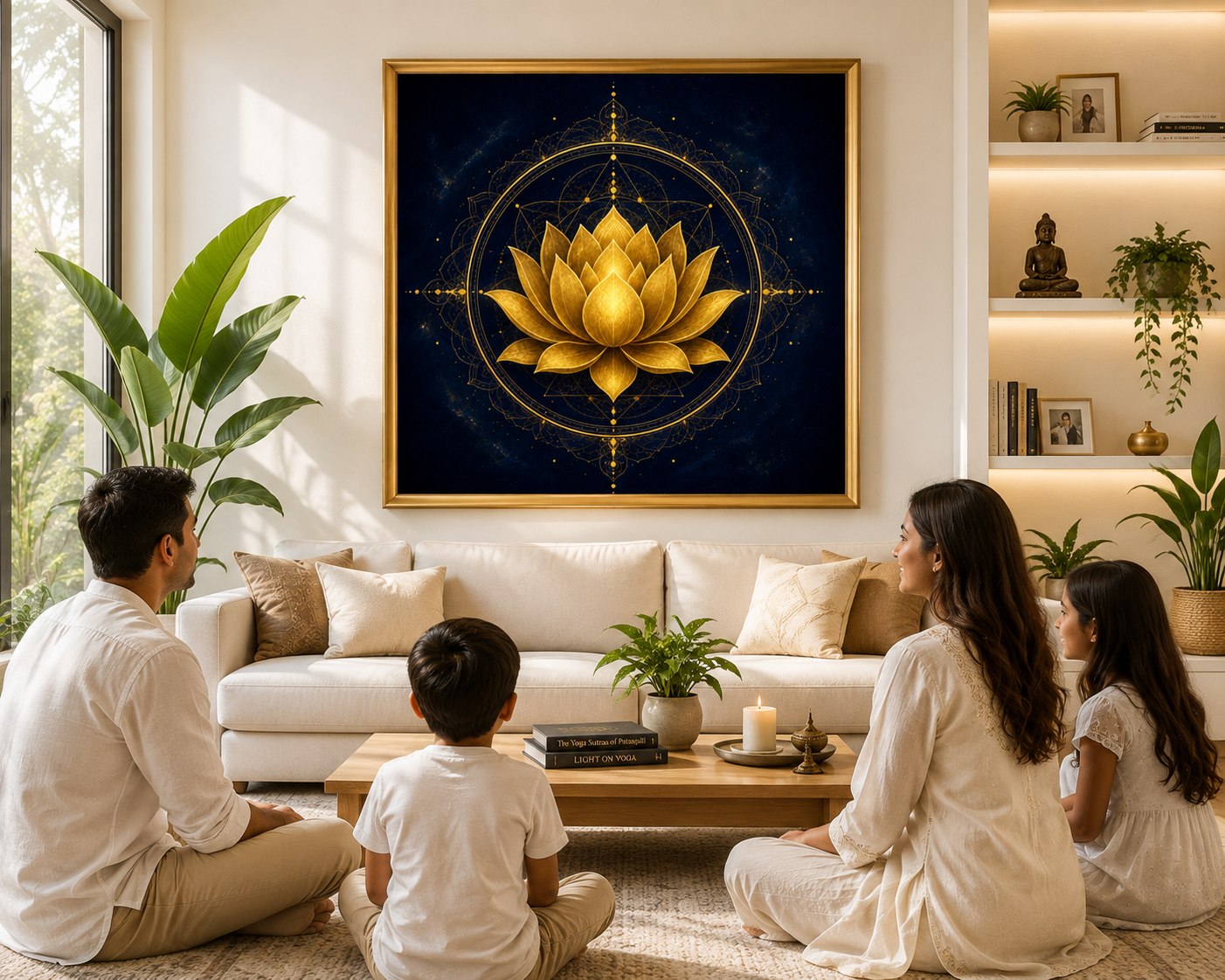
The Golden Lotus Mandala is the warmest and most immediately welcoming piece in the Yantras & Sacred Symbols section — well-suited to spaces where the quality of openness and heart-centred awareness is the specific quality being cultivated. In a yoga studio it works beautifully as the primary wall piece, the warm rose and gold palette creating an environment of warmth and aspiration. In a meditation room or home altar it serves as a constant visual reminder of the destination of the path — the fully bloomed lotus of awakened consciousness, radiant gold, completely open.
The soft rose and gold palette suits a natural wood or gold frame. Print on matte paper. The composition is square — use a square frame.