About This Artwork
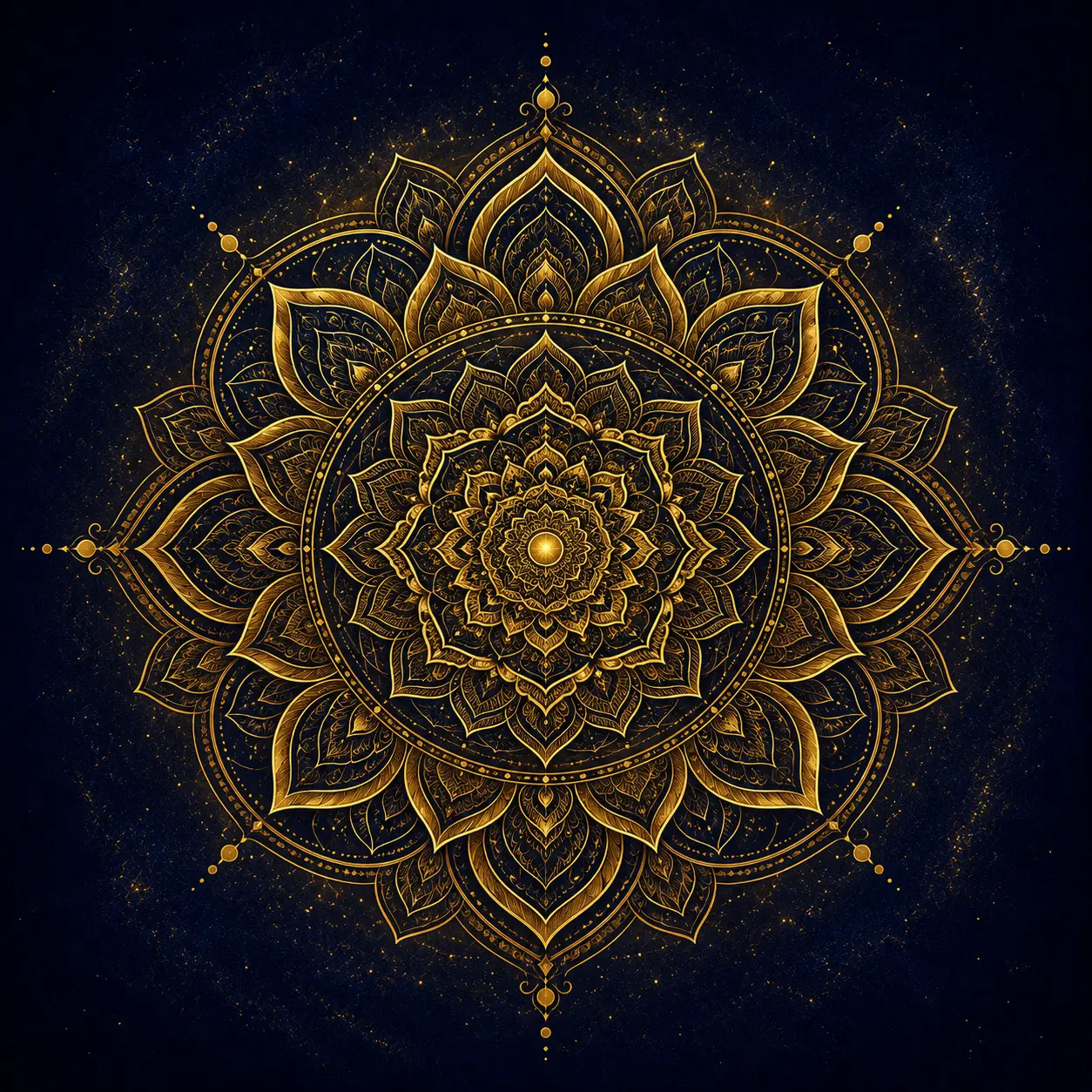
This artwork depicts the Sacred Mandala — a luminous cosmic geometric composition of intricate concentric rings of sacred geometric patterns radiating outward from a brilliant central point of pure light. Each ring is more complex and more detailed than the last, the whole composition pulsing with the stillness of perfect geometric order — the order of the cosmos at its most organised and most beautiful, before the complications of narrative or symbol have been added.
The palette is the most focused and most architecturally precise in the collection: deep navy blue as the ground — the cosmic space in which geometry arises — and brilliant gold as the substance of every line and every curve of the concentric patterns. Gold on deep navy is both the most visually striking combination in the collection's visual identity and the most specifically sacred: gold for the geometry of cosmic intelligence, navy for the infinite space in which it appears.
The composition is perfectly symmetrical and precisely circular — a true mandala in the original sense: a circle that is complete, that has no beginning and no end, that excludes nothing and privileges nothing, that is at rest in its own completeness. At the absolute centre, a single brilliant point — the bindu, the still point of the turning world, the source from which all the concentric rings radiate and to which they return.
About the Sacred Mandala — The Circle That Contains Everything
The word mandala comes from the Sanskrit: manda (essence) + la (container) — that which contains or holds the essence. In the broadest sense, a mandala is any circular composition that represents the structure of the cosmos or of the practitioner's inner landscape — the two being, in the tradition's understanding, the same structure seen from different angles.
Mandalas appear in virtually every contemplative tradition in the world: in Tibetan Buddhism as the geometric homes of enlightened deities used in advanced visualisation practices; in Hinduism as yantras — the geometric bodies of the deities of the Shakta Tantric tradition; in Jainism as geometric representations of the cosmic structure; in the sand paintings of Native American traditions; in the rose windows of medieval Christian cathedrals; and, in Carl Jung's psychology, as spontaneous expressions of the psyche's movement toward wholeness and integration.
This universal presence is not coincidence. The circle — having no beginning and no end, no corners and no edges, containing everything within it — is the most complete geometric form available to consciousness, and every tradition that has contemplated the nature of consciousness deeply enough has eventually arrived at the circle as its primary visual language.
The Mandala in the Hindu Tantric Tradition
In the Hindu Tantric tradition, the mandala is understood specifically as the geometric body of the divine — the visual form of the deity in the language of sacred mathematics rather than in the language of human iconography. Every deity has their mandala; every chakra of the subtle body is depicted as a mandala; the Sri Yantra — the most complex and most complete of all sacred diagrams — is simultaneously a yantra and a mandala, a geometric body and a cosmic map.
The Sacred Mandala depicted in this artwork is the universal form — the mandala without a specific deity's iconographic content, the pure geometric expression of the cosmic order itself. This makes it the most broadly accessible piece in the Yantras & Sacred Symbols section of this collection: it requires no specific devotional context, no particular tradition's framework, and no prior knowledge of any symbolic system to communicate its essential quality to whoever stands before it.
The Bindu — The Still Point at the Centre
The most important element of any mandala — the element from which everything else radiates — is the bindu: the central point, dimensionless, without extension, the source from which all the geometric patterns emerge and to which they return.
In the Tantric tradition, the bindu is the seat of the deity's most concentrated presence — the point at which the geometric body of the divine is most charged, most alive, most immediately available to the practitioner's attention. In the practice of trataka (fixed-gaze meditation), the practitioner directs their gaze to the bindu and holds it there, allowing the concentric rings of the mandala to fill the peripheral awareness while the concentrated attention remains at the centre.
In this practice, the bindu becomes a point of entry — a doorway from the ordinary, distracted awareness of the periphery into the concentrated stillness of the centre. The outer geometry is not bypassed or ignored; it forms the container and the context within which the movement inward takes place. But the destination is always the bindu: the point of stillness at the centre of the circle that contains everything.
The Mandala as Meditation Support
The mandala is among the oldest and most widely used meditation supports in any contemplative tradition. Its circular, symmetrical form serves several specific functions in practice:
Concentration support: The perfectly symmetrical mandala gives the wandering mind a clear and complete object to rest on. Unlike a deity image — which has narrative elements, human features, and iconographic details that engage the mind's interpretive faculty — the pure geometric mandala is content without narrative, form without story, beauty without information. It asks only to be looked at, completely and without agenda.
Boundary marker: The outer ring of the mandala — the bhupura in the yantra tradition, or simply the outermost circle of the composition — marks the boundary of the sacred field. Inside the circle is the meditation; outside is the ordinary world. The mandala creates a visual sacred space that the practitioner enters through the act of directing and holding attention.
Journey map: The concentric rings of the mandala, moving from the circumference toward the bindu at the centre, provide a map of the contemplative journey: from the outer, busy, conceptual world of ordinary awareness toward the still, concentrated, non-conceptual awareness at the centre. The mandala's geometry is a diagram of the path.
Sacred Geometry — The Language of Cosmic Intelligence
The concentric rings of sacred geometric patterns in this artwork are not arbitrary decorative elements. Each ring uses specific geometric forms — circles, polygons, flower patterns, star patterns, radially symmetric arrangements — that recur throughout the natural world as expressions of the same fundamental mathematical intelligence that generates the shape of a snowflake, the spiral of a galaxy, the arrangement of seeds in a sunflower, and the double helix of DNA.
Sacred geometry is the study of these patterns and their relationships — the recognition that the geometric forms embedded in the structure of the natural world are also the forms used in traditional sacred art and architecture across every culture and every millennium. The mandala as a geometric composition is a concentrated expression of these patterns, arranged in a circular hierarchy that places the practitioner's attention at their source.
Displaying the Sacred Mandala
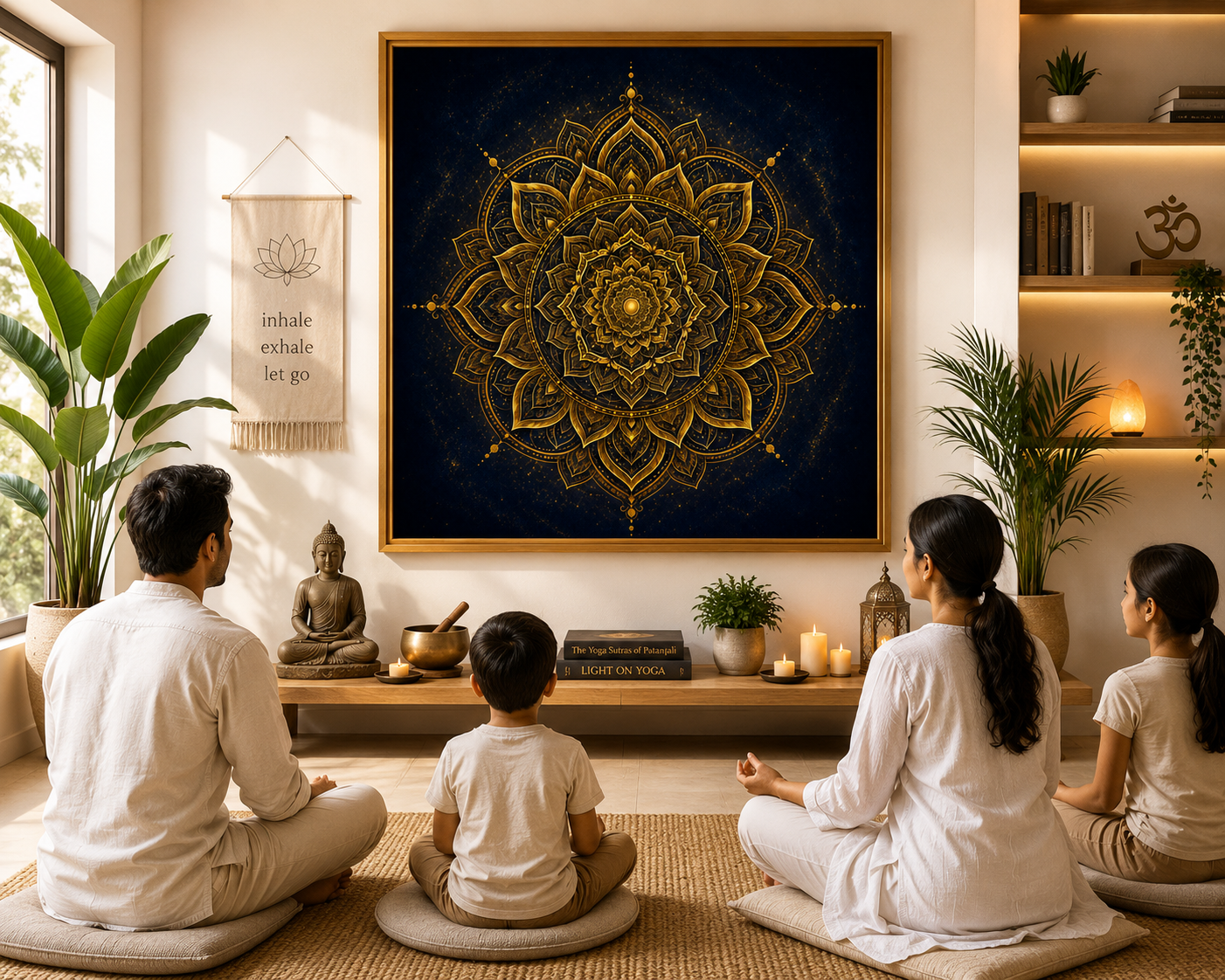
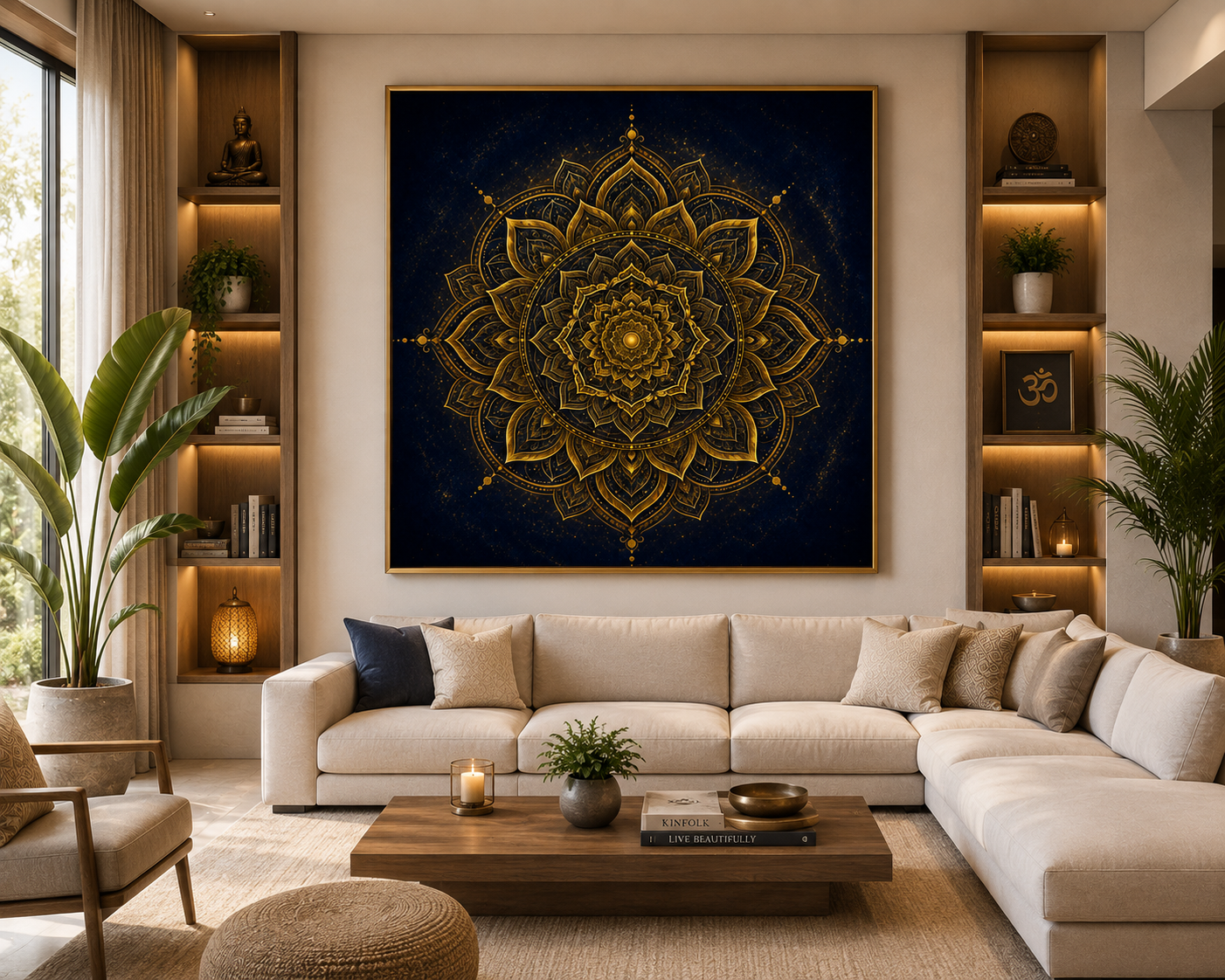
The Sacred Mandala is the most universally applicable piece in the Yantras & Sacred Symbols section — suited to meditation rooms, yoga studios, home altars, therapy rooms, creative studios, and any space where a quality of contemplative depth and geometric beauty is sought.
Its deep navy and brilliant gold palette — the visual identity of the entire Shakti Yoga Arts collection — makes it a natural anchor piece for any display of works from this collection. At 16×20 inches (the largest available size) it makes a statement. At 11×14 or 8×10 it is intimate and focused.
Print on matte paper for the deepest rendering of the navy blue. A gold or dark navy frame complements the composition. Square frames are also appropriate for this circular composition mounted on a square ground.