About This Artwork
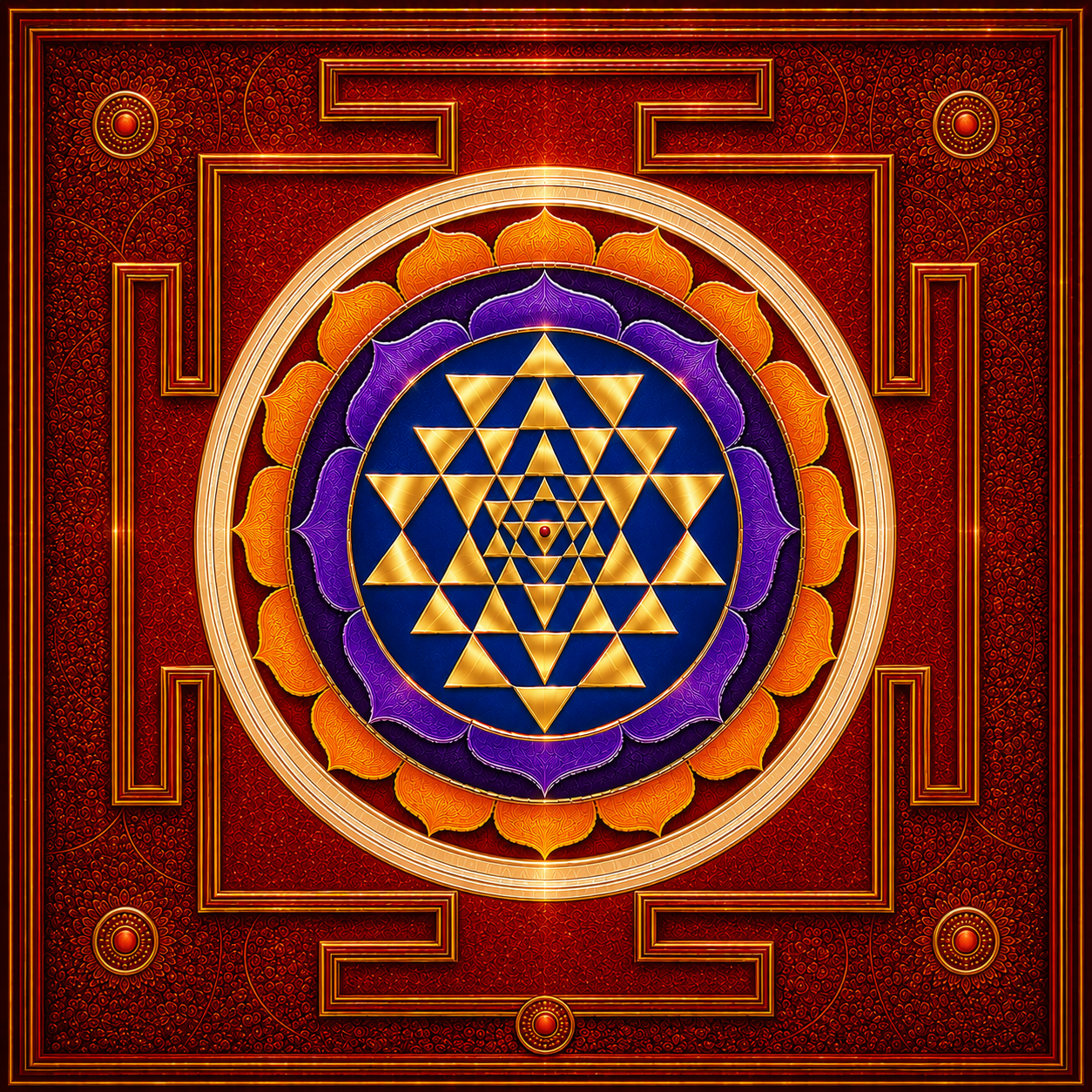
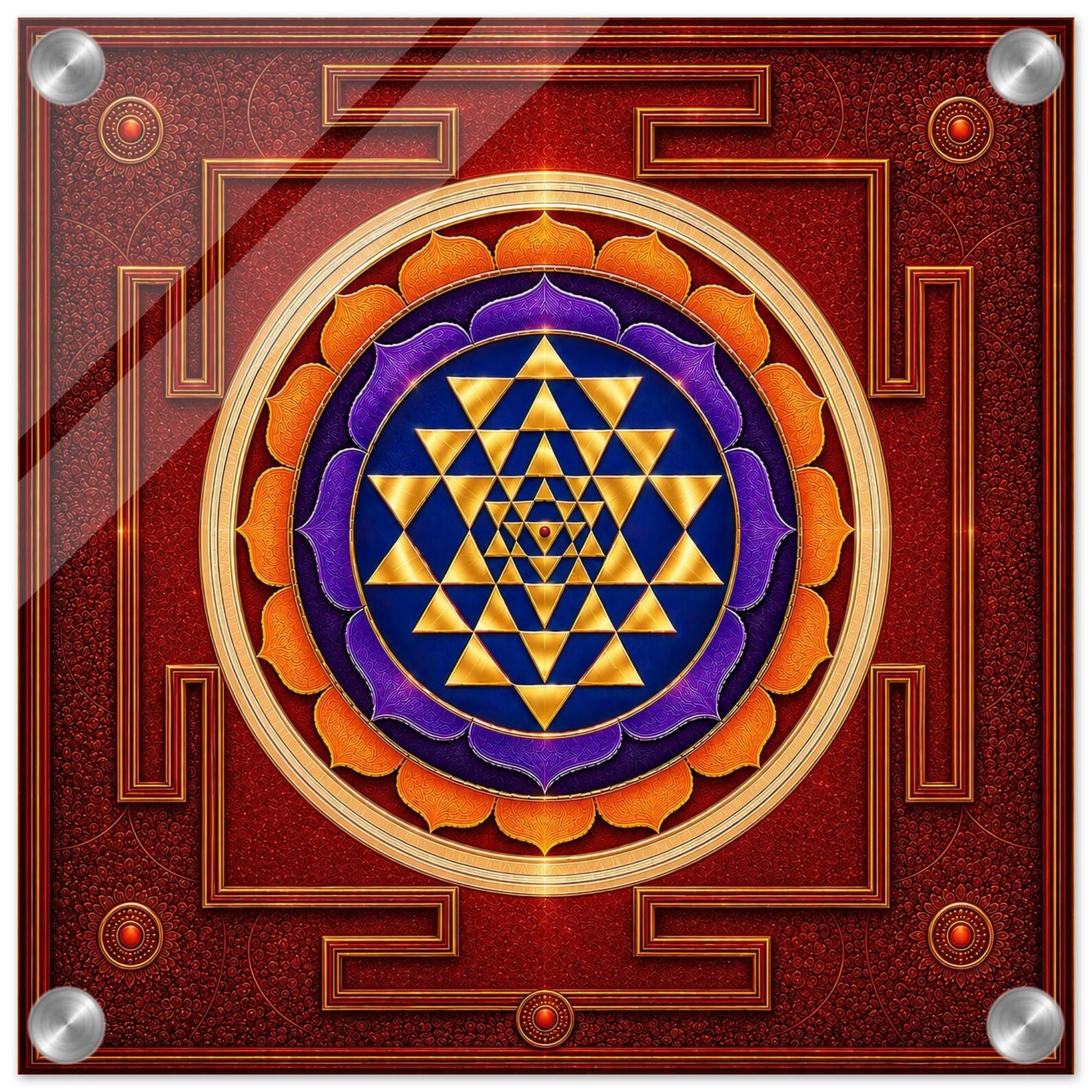
This artwork renders the Sri Yantra — universally acknowledged as the most complex and most complete of all sacred geometric diagrams — with the precision its tradition demands. At the centre lies the navayoni chakra: nine interlocking triangles, four pointing upward (Shiva, consciousness, the masculine principle) and five pointing downward (Shakti, energy, the feminine principle), their intersections generating forty-three smaller triangles that together constitute a map of the entire manifest cosmos.
Surrounding the central geometry, rings of orange and violet lotus petals unfold outward in layers of devotional opening. Beyond them lies the ivory circle of the inner sanctum, and finally the crimson bhupura with its four golden T-shaped gates. At the absolute centre: a single red bindu — the meeting point of Shiva and Shakti, the seat of Tripura Sundari's most concentrated presence.
Palette: Deep indigo, orange, violet, crimson, and gold — the most specifically prescribed palette in the collection, each colour encoding a quality of consciousness in the Sri Vidya tradition.
What is the Sri Yantra?
The Sri Yantra is the yantraraj — the king of all yantras — and the geometric body of Tripura Sundari, the third Mahavidya. It has been used in the Sri Vidya tradition for at least fifteen hundred years, and the tradition holds that Adi Shankaracharya installed Sri Yantras at the four principal Shakti peethas he established.
The complete Sri Vidya system is organised around three inseparable expressions of the same reality: the yantra (geometric form), the mantra (the Panchadashi and Shodashi syllable sequences), and the devata (Tripura Sundari herself). The yantra is not a picture of the goddess. In the tradition's own terms, it is the goddess, expressed in the language of pure geometry.
The navayoni chakra — nine triangles, forty-three sub-triangles
At the heart of the Sri Yantra sit nine interlocking triangles: four pointing upward and five pointing downward. The upward triangles are the Shiva trikonas — consciousness, fire, the still witnessing principle. The downward triangles are the Shakti trikonas — energy, water, the creative and manifesting principle. Where they intersect, forty-three smaller triangles are generated, and each of these has a name, a presiding shakti, and a place in the cosmological scheme.
That five Shakti triangles outnumber four Shiva triangles is not incidental. It states, geometrically, that in the manifest world Shakti predominates — energy is what appears, consciousness is what witnesses. The construction must be exact: incorrect angles produce a figure that resembles the Sri Yantra but is, in the tradition's judgment, non-functional as a support for practice.
The nine avaranas — the inward journey
The Sri Yantra is organised into nine avaranas or enclosures, moving from the outer bhupura to the central bindu. Each enclosure corresponds to a dimension of the cosmos and to a set of attendant shaktis, and each has its own name, its own mantra, and its own contemplative content.
The Sri Yantra meditation moves inward through all nine in sequence, dissolving one layer of the manifest world at each stage until only the bindu remains. It is one of the most graduated and precisely mapped contemplative journeys described in any tradition — a complete cosmology and a complete practice held inside a single square of geometry.
Modern resonance
Mathematicians and physicists have observed that constructing an accurate Sri Yantra requires solving a genuinely difficult geometric problem — one that predates modern analytical geometry by many centuries. Its structure has been compared to standing-wave interference patterns and to Lissajous figures, and it recurs in discussions of the relationship between symmetry, resonance, and form.
The statue of Nataraja installed at CERN is the most widely cited example of this cross-disciplinary dialogue: not an argument that ancient India anticipated modern physics, but a recognition that both traditions have reached for the same imagery when describing how form arises out of pattern.
Where to place it
In Sri Vidya practice the Sri Yantra is placed on the altar facing east. Outside a formal practice context it is equally at home in a meditation room, a study, or a living space, as the most complete expression of the divine feminine in geometric form.
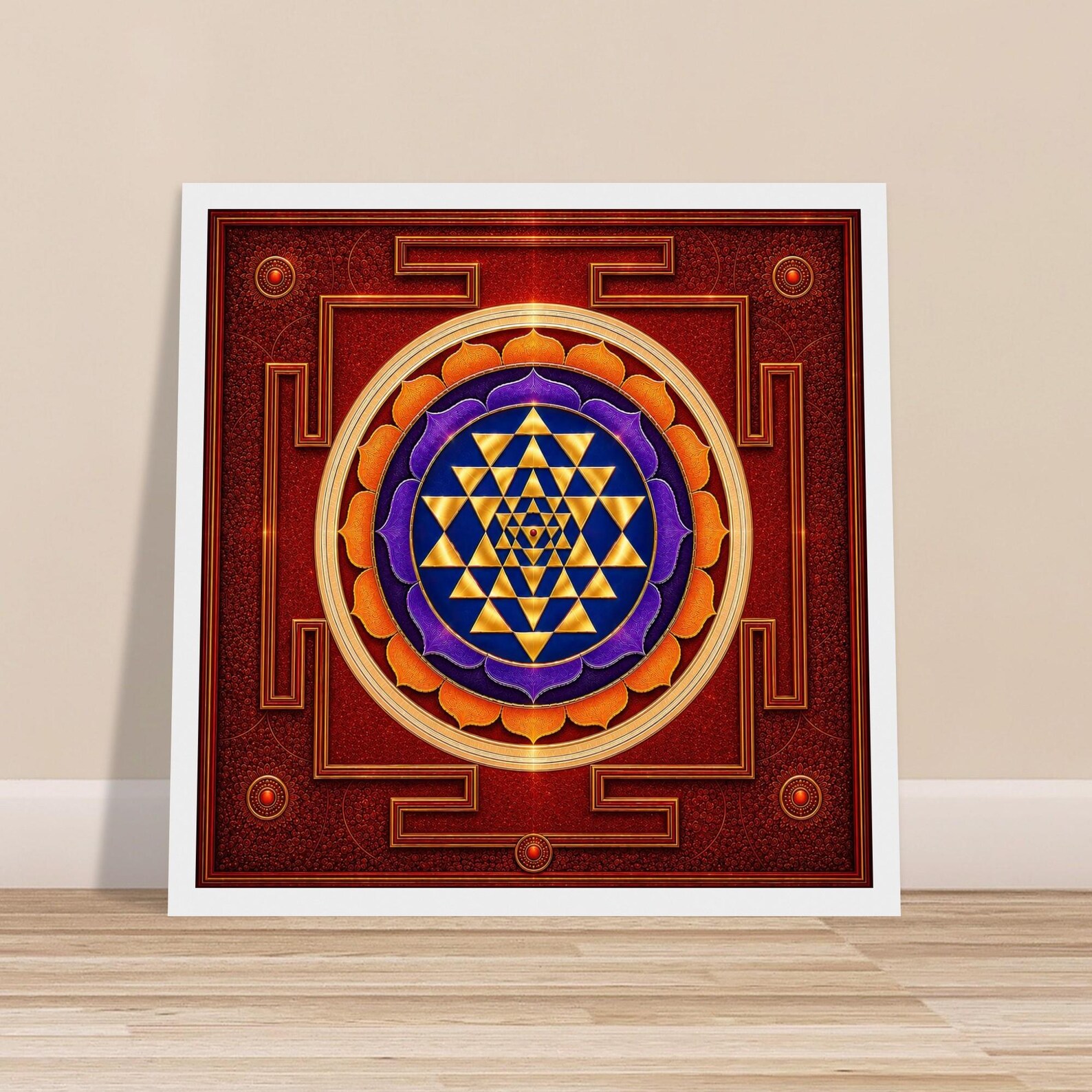
The acrylic format suits this yantra particularly well — the glass-like surface deepens the indigo ground and lifts the brilliance of the gold linework. Because the artwork is square, frame it in a square frame; standard square sizes are widely available.
What Is a Yantra?
A yantra — Sanskrit for that which holds or restrains — is a sacred geometric diagram used in the Hindu Tantric tradition as a visual form of the divine. It is not understood as a symbol standing in for a deity, but as the deity expressed in geometry. Where a murti gives the deity human form and a mantra gives the deity sound, the yantra gives the deity line, triangle, circle, petal, and enclosure.
Read from the outside inward, a yantra is built in five stages:
- Bhupura: the outermost square with T-shaped gates on four sides — the four directions, and the four entries into sacred space.
- Lotus petals: one or more rings blooming outward — the opening of consciousness in the deity's presence.
- Circles: cosmic horizon bands — wholeness, and the completion of cycles.
- Central geometry: the triangles, hexagrams, or complex arrangements specific to each deity.
- Bindu: the dimensionless central point — the deity's most concentrated presence, where individual consciousness meets the absolute.
Every yantra artwork in this collection is square. Print it in a square size and frame it in a square frame — standard square frames are widely available at IKEA, Target, Amazon, and most home stores.