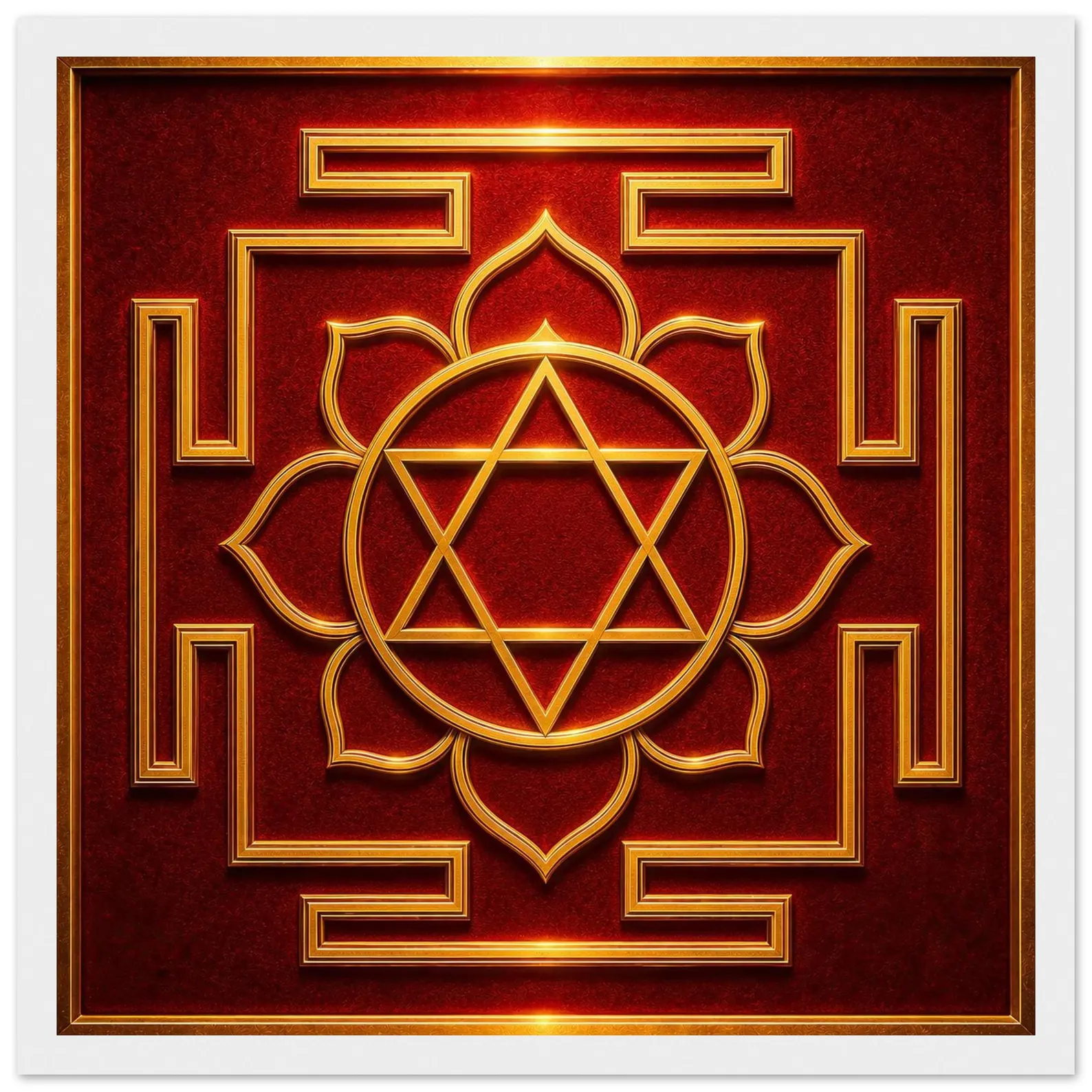
About This Artwork
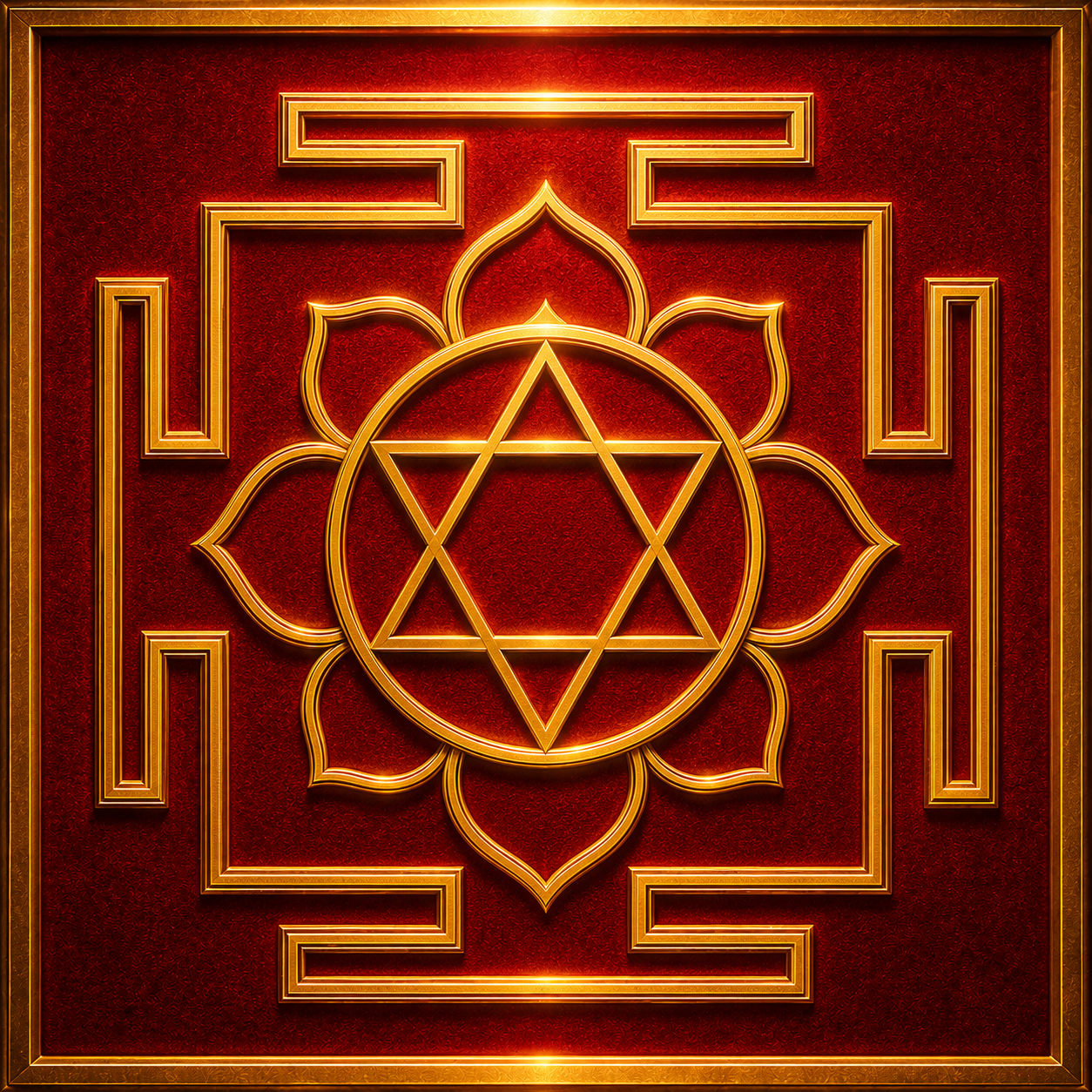
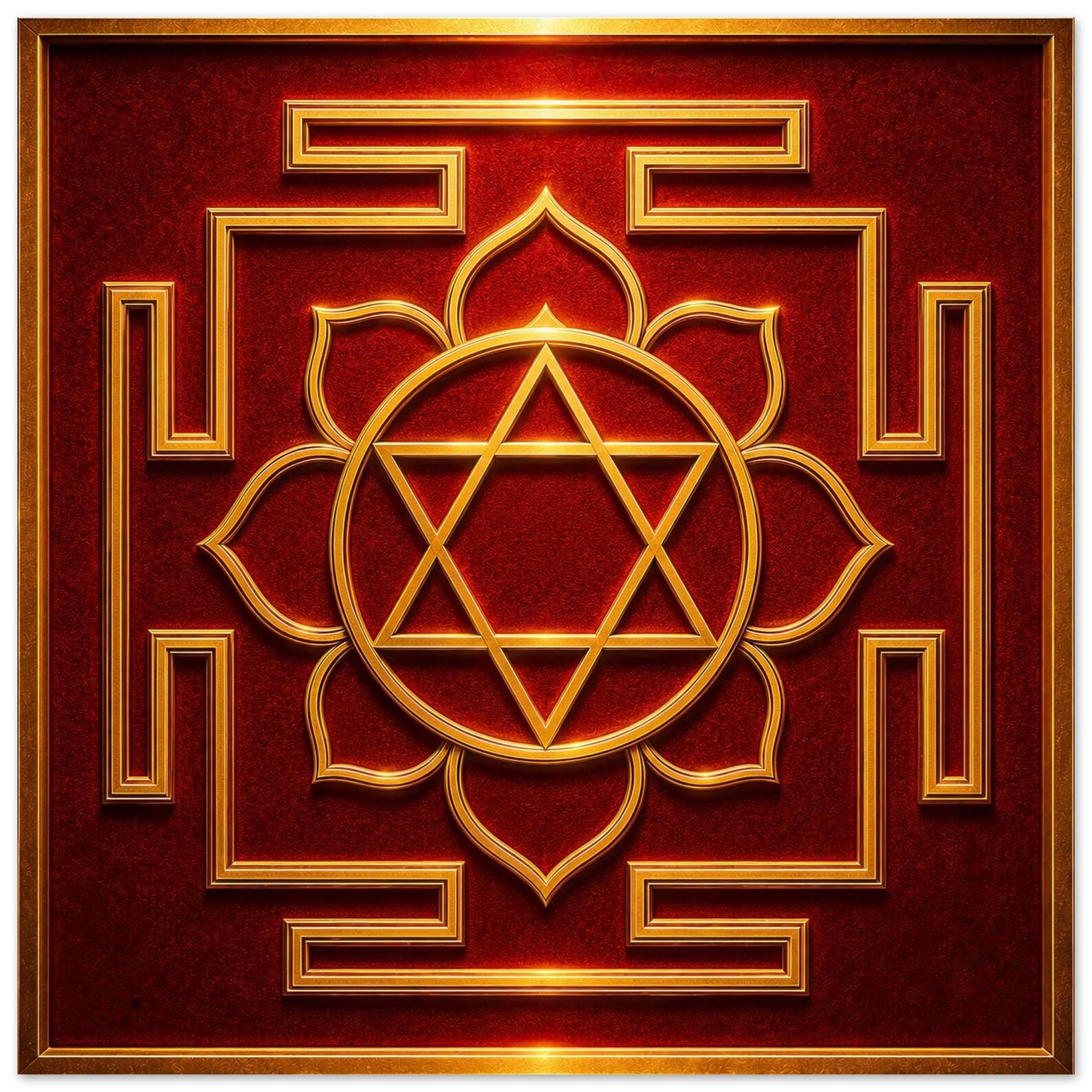
The Mahalakshmi Yantra is rendered in the warm rose-pink and gold palette of Lakshmi's tradition. The hexagram — two interlocking triangles in perfect balance, upward Shiva and downward Shakti meeting in equilibrium — is the geometric expression of the completeness from which Lakshmi's abundance flows naturally: consciousness and energy in right relationship.
Pink and gold lotus petals bloom outward in successive rings of offering. The warm, luminous palette is the most welcoming and most accessible of the eight — the visual register of a grace that does not demand but simply offers.
The most widely placed yantra
Of all the yantras in the Hindu tradition, the Mahalakshmi Yantra is the one most commonly found outside a formal practice setting — in homes, shops, offices, and financial institutions across the Hindu world, often alongside an image of the goddess herself.
Its ubiquity has not diluted it. The tradition holds that Lakshmi arrives where welcome has been prepared, and the yantra is understood as a form of that preparation: a place made ready before anything is asked for.
The balanced hexagram
The hexagram encodes Lakshmi's particular quality with precision. Abundance, in this reading, is not produced by effort alone. It arises where consciousness and energy stand in balanced relationship — where what is understood and what is done are not at odds with each other.
This is why the Mahalakshmi Yantra uses the equilibrium figure rather than a single dominant triangle. The geometry is the teaching: nothing overpowers anything else, and what results is fullness.
Diwali and household practice
During Diwali the yantra is installed on the puja altar alongside the Lakshmi image. The geometric and the iconic forms together constitute the most complete welcome the tradition offers for the goddess's arrival — one form for the eye, one for the mind.
Through the rest of the year it is commonly kept in the entrance, the family room, or the place where household accounts are kept.
Display
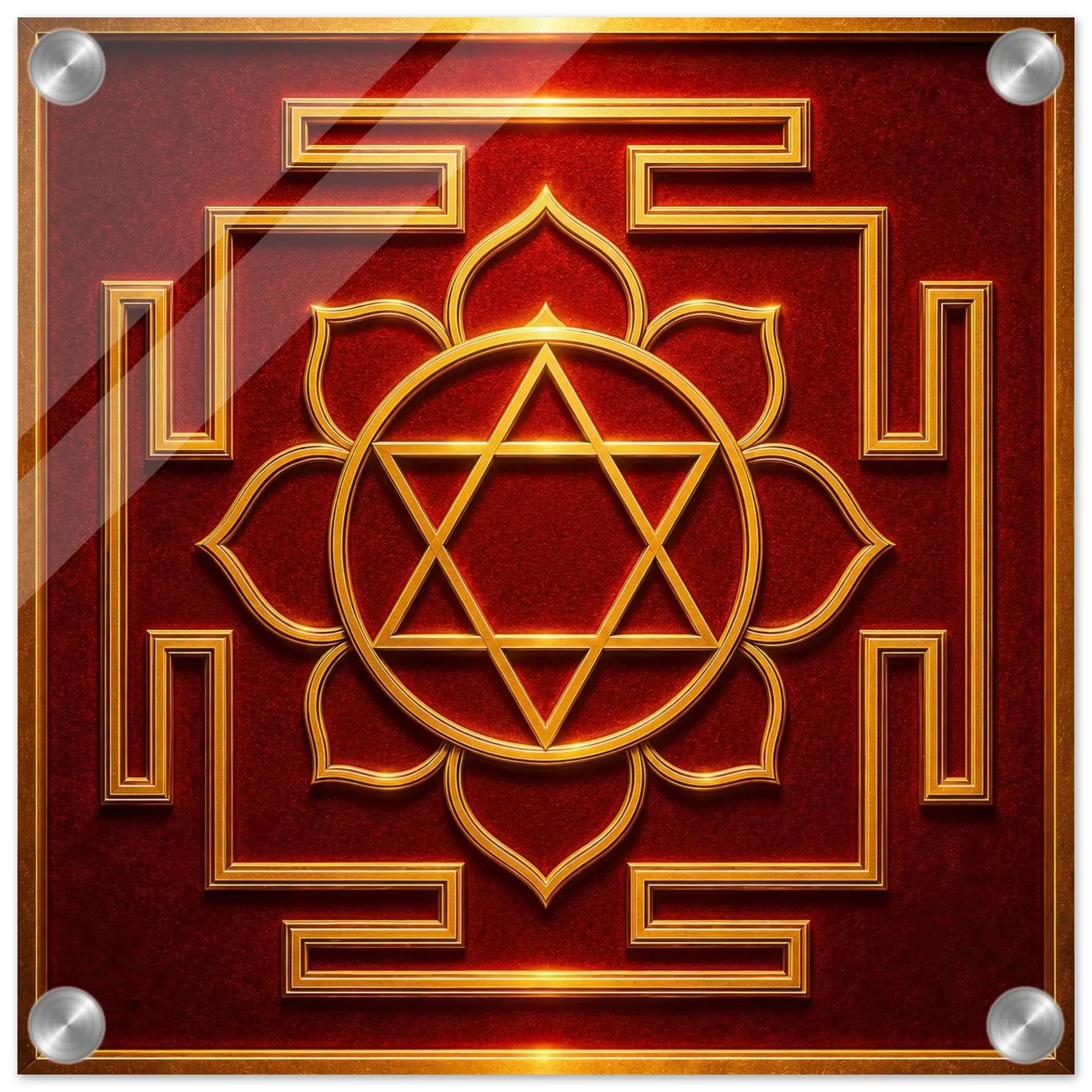
The rose-pink and gold palette suits virtually any interior colour scheme, which makes this the easiest of the eight to place. A gold or natural wood square frame is ideal.
As with every piece in this series, the artwork is square — print it square and frame it square.
What Is a Yantra?
A yantra — Sanskrit for that which holds or restrains — is a sacred geometric diagram used in the Hindu Tantric tradition as a visual form of the divine. It is not understood as a symbol standing in for a deity, but as the deity expressed in geometry. Where a murti gives the deity human form and a mantra gives the deity sound, the yantra gives the deity line, triangle, circle, petal, and enclosure.
Read from the outside inward, a yantra is built in five stages:
- Bhupura: the outermost square with T-shaped gates on four sides — the four directions, and the four entries into sacred space.
- Lotus petals: one or more rings blooming outward — the opening of consciousness in the deity's presence.
- Circles: cosmic horizon bands — wholeness, and the completion of cycles.
- Central geometry: the triangles, hexagrams, or complex arrangements specific to each deity.
- Bindu: the dimensionless central point — the deity's most concentrated presence, where individual consciousness meets the absolute.
Every yantra artwork in this collection is square. Print it in a square size and frame it in a square frame — standard square frames are widely available at IKEA, Target, Amazon, and most home stores.