
About This Artwork
This piece depicts Harihara — the composite form of Shiva (Hara) and Vishnu (Hari) united in a single body, the most direct possible visual statement that the Shaiva and Vaishnava traditions, which have sometimes understood themselves as distinct paths approaching different deities, are ultimately approaching the same supreme reality from different directions.
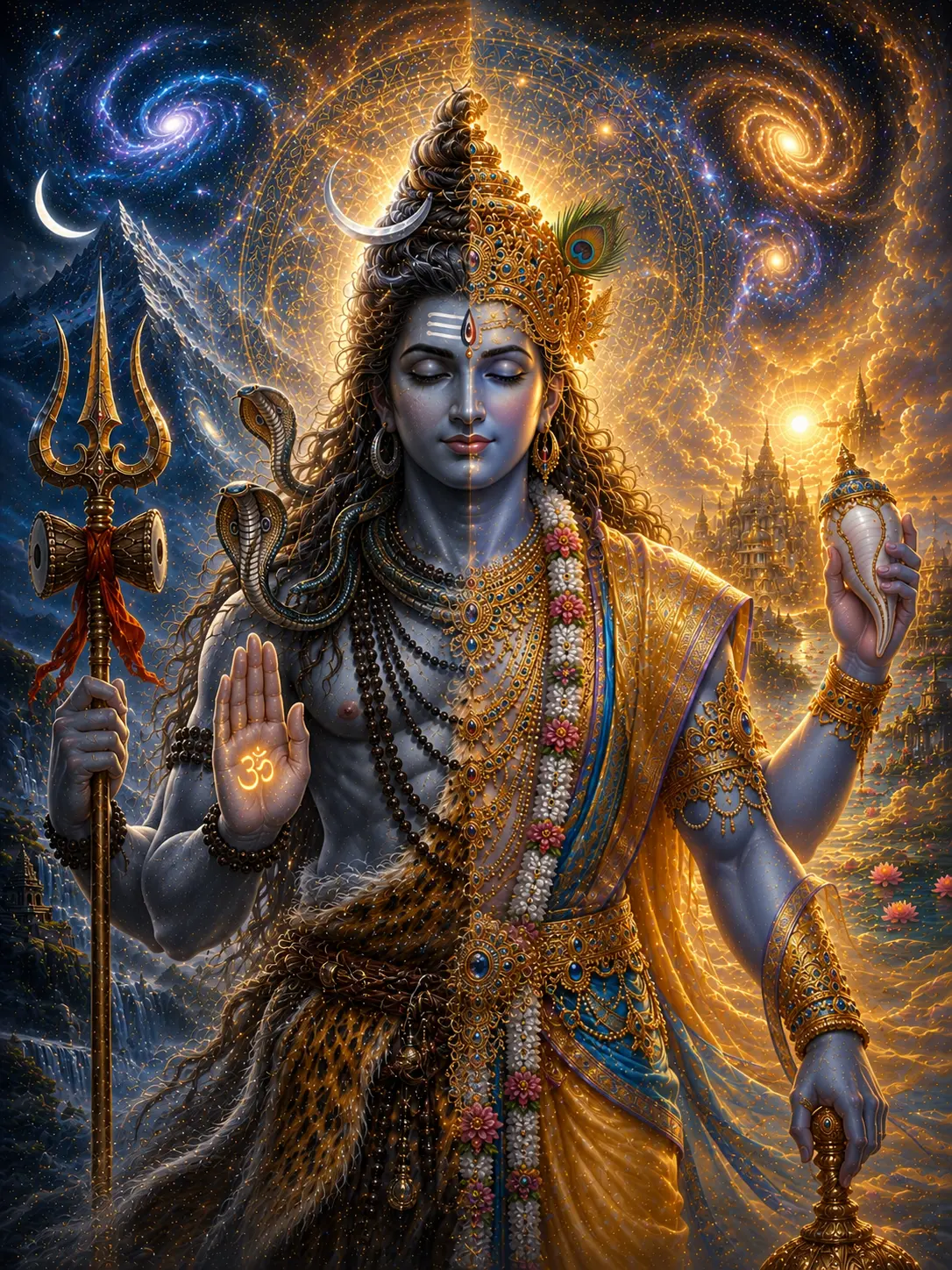
The composition is vertically divided: the left half is Shiva — blue-grey skinned, cobras coiled at the shoulder, trishul held in one hand and the Om symbol glowing on the raised palm. Behind this half, a cool moonlit sky extends: the vast, witnessing, still awareness of Shiva's nature. The right half is Vishnu — golden complexioned, crowned in the jewelled crown of the sustainer, holding the shankha (conch shell) in one hand, draped in yellow silk. Behind this half, a warm sunlit glow extends: the active, sustaining, generative energy of Vishnu's nature.
Both halves share one face. Both share one halo — interlocking rings of cosmic light, one set cool and silver, the other warm and gold, meeting at the exact centre in a visual statement of the philosophical claim: Hara and Hari are one supreme reality, known by two names, approached by two paths, and ultimately revealing the same truth from two angles.
The background — a galaxy-filled cosmic space and distant mountain peaks — is shared: the cosmos and the Himalayas are the shared dwelling of both Shiva and Vishnu, and the suggestion of a distant temple city on the Vishnu side confirms that both the mountain ashrama and the city temple are homes of the same divine.
About Harihara — The Supreme Being Beyond the Division
Harihara is the composite form of Shiva (Hara — the one who removes) and Vishnu (Hari — the one who removes, the greenish-golden one) in a single body. The name is a compound: Hara + Hari = Harihara, the two greatest names of the two great streams of Hindu devotional tradition, joined in a single word to name the single being that encompasses both.
The Harihara form is found in South Indian temple sculpture from at least the 7th century CE — the period of the Pallava dynasty in Tamil Nadu — and has been a consistent presence in Shaiva temple iconography ever since, particularly in the Smarta tradition that explicitly worships both Shiva and Vishnu (and other deities) as forms of the same supreme Brahman.
Hara and Hari — The Two Great Names
Hara is Shiva: the one who removes suffering, who strips away illusion, who dissolves the accumulated debris of the conditioned ego in the fire of his transformative presence. Hari is Vishnu: the one who removes suffering by sustaining, by preserving, by providing the grace and abundance that makes continued existence not merely possible but worth having. Both names encode the same essential function — the removal of what causes suffering — but in completely different modes. Hara removes by destroying the false. Hari removes by providing and sustaining the real. Together, they cover the complete range of how the divine addresses human suffering.
Harihara and the Smarta Tradition
The Smarta tradition — the broad, philosophically inclusive Hindu tradition that recognises the validity of all six major deity-worships (Shaiva, Vaishnava, Shakta, Ganapatya, Saura, and Kaumara) as paths to the same Brahman — finds in Harihara its most direct visual expression. The Smarta understanding, associated historically with Adi Shankaracharya and with the Advaita Vedanta philosophical framework, holds that Shiva and Vishnu are not two different gods but two names and two approaches to the same supreme non-dual consciousness.
Harihara as a deity form does not require the practitioner to choose between the Shaiva and Vaishnava paths. It is the image for the household that honours both, the puja room that has both the Shivalinga and the Vishnu murti, the practitioner who finds both Shiva and Vishnu resonant as approaches to the divine.
The Cool Moon and the Warm Sun — Reading the Visual Split
The most important visual element of this Harihara composition — beyond the split complexion (blue-grey Shiva / golden Vishnu) — is the environmental split in the background: cool moonlit sky behind Shiva, warm sunlit glow behind Vishnu.
This split is the visual statement of the complementary nature of the two streams. Shiva is associated with the moon — the cool, reflective, receptive light that illuminates by borrowing from the sun, that waxes and wanes in cycles, that governs the tides and the emotions and the inward dimensions of consciousness. Vishnu is associated with the sun — the active, self-originating, outward-radiating light that makes all of creation visible and sustains all of life directly. Together, moon and sun cover the complete range of light: the inward and the outward, the cool and the warm, the receptive and the active, the contemplative and the sustaining.
Displaying Harihara in the Home
Harihara is displayed in puja rooms and household altars where both Shiva and Vishnu are honoured — particularly in Smarta households and in any household where the practitioner does not identify exclusively with either the Shaiva or Vaishnava path. The image also has a specific appropriateness for interfaith or multi-tradition households, where members of the family may approach the divine through different forms.
The dramatic split palette — cool blue-grey and warm gold, moonlit and sunlit — makes this one of the most visually striking compositions in the Divine Forms & Pairs section. It pairs naturally with the Ardhanarishwara image (the masculine-feminine unity) to form a complete statement about the nature of divine unity: the union of the two sexes, and the union of the two great devotional streams.