About This Artwork
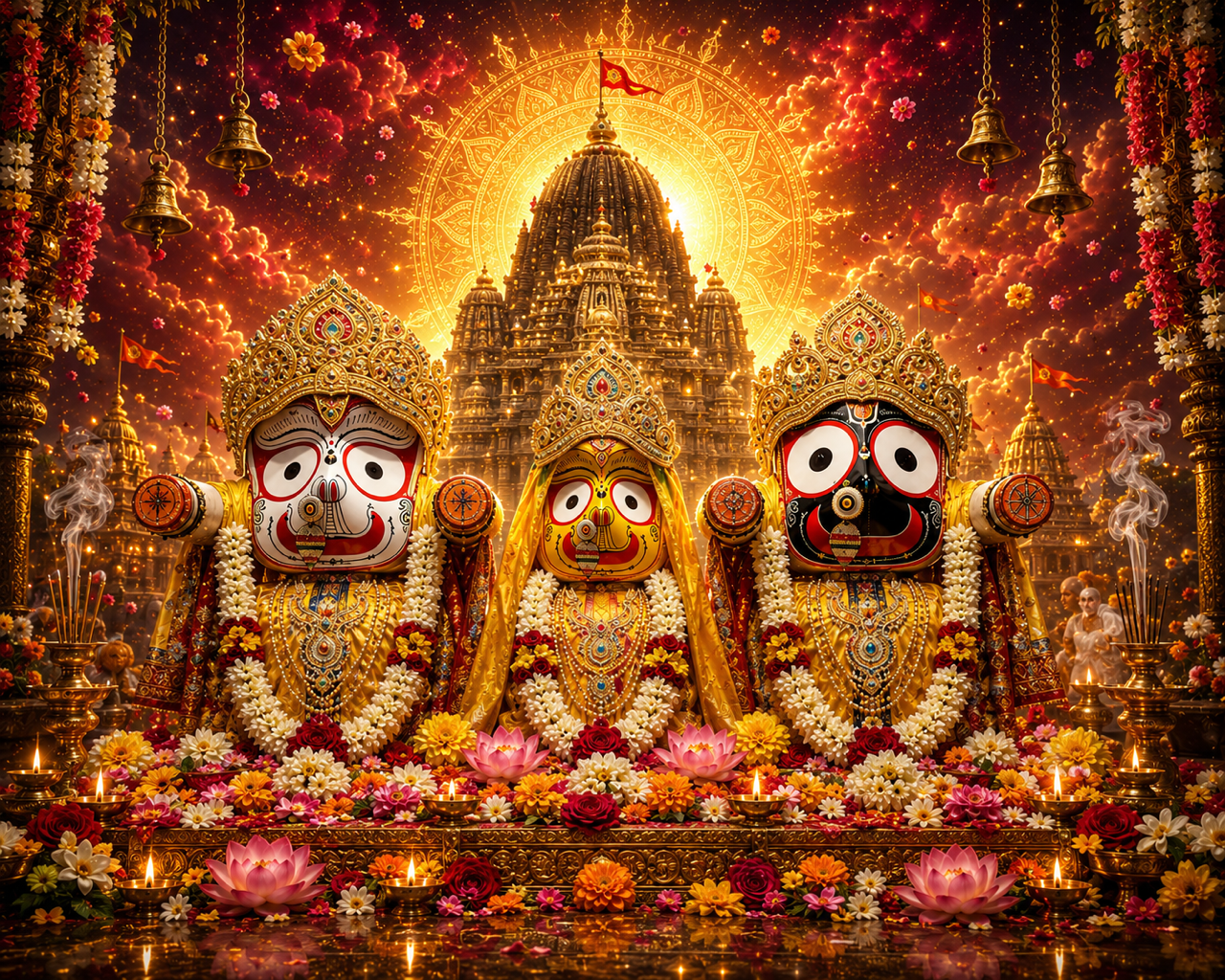
This piece depicts the complete sacred trinity of Puri — Lord Balabhadra, Devi Subhadra, and Lord Jagannatha — in their authentic traditional forms as they appear in the inner sanctum of the Shree Jagannatha Puri Mandir in Odisha, the most ancient and most beloved Vaishnava temple in Eastern India and one of the four Char Dhams (the four sacred corners of Hindu pilgrimage).
The three are presented in the precise arrangement of their eternal darshan: Balabhadra in white on the left, Devi Subhadra in yellow at the centre, and Lord Jagannatha in black on the right. Each is adorned with their distinctive round eyes — the most immediately recognisable iconographic feature of the Puri trinity, found nowhere else in Hindu sacred art — their elaborate jewelled crowns, and their gold alankaram (ornamental adornment). Cascading garlands of jasmine, marigold, and rose flow from crown to base. The magnificent gopuram of the Puri Shree Mandir rises behind them in golden divine light, and on either side, sacred incense spirals upward and glowing diyas burn in the atmosphere of the most auspicious darshan.
About the Puri Trinity — Jagannatha, Balabhadra, and Subhadra
The three deities enshrined at the Jagannatha Puri Mandir — Lord Jagannatha (the Lord of the Universe), Lord Balabhadra (his elder brother, also known as Balarama), and Devi Subhadra (their sister) — constitute the sacred trinity of Puri and the central objects of devotion for the entire Odishan and broader Vaishnava tradition of Eastern India.
Jagannatha is understood as a form of Vishnu or Krishna — but a very specific and very distinctive form. The characteristic round eyes, the unfinished arms (the murtis appear limbless), and the simple geometric form of the Puri deities are unlike any other major temple deities in India and are the subject of rich theological and iconographic interpretation. One of the most widely held understandings is that the murtis were carved by the divine craftsman Vishwakarma and left incomplete — and that their incompleteness is itself the most complete possible statement about the divine: it is always still being created, always still in the process of becoming more fully itself.
The Ratha Yatra — The Chariot Festival of Puri
The festival most closely associated with the Jagannatha trinity is the Ratha Yatra — the chariot procession, observed annually on the second day of the bright half of Ashadha (typically June or July). During the Ratha Yatra, the three deities are brought out of the inner sanctum — which is normally restricted to Hindus — and placed on enormous wooden chariots (rathas) that are pulled by thousands of devotees through the streets of Puri to the Gundicha temple, where the deities reside for nine days before being returned to the main temple.
The Ratha Yatra is one of the oldest and most widely observed pilgrimage festivals in India, drawing several hundred thousand devotees to Puri each year. It has also spread globally: the Hare Krishna (ISKCON) movement has conducted Ratha Yatras in cities around the world since the 1960s, making the image of Jagannatha on his chariot one of the most internationally visible images from the Hindu tradition.
The English word "juggernaut" — meaning an unstoppable force — derives from the name Jagannatha and the sight of the massive chariot being pulled through the streets of Puri, which struck early European travellers with its sheer scale and momentum.
Balabhadra and Subhadra — The Complete Family of the Lord
Balabhadra (Balarama) — the elder brother of Krishna/Jagannatha — is depicted in white, the colour associated with his nature as the plough-wielding elder sibling, the embodiment of divine strength and protective elder-brotherly love. In the Vaishnava tradition Balabhadra is understood as the avatar of Ananta Shesha — the cosmic serpent on whom Vishnu rests — taking human form to accompany his younger brother Krishna through his earthly life.
Subhadra — the sister, depicted in yellow — is understood as a form of Yoga Maya, the divine creative power, or as the goddess Durga in the tradition's broader theological reading. Her presence between the two brothers completes the sacred family: in the Odishan tradition, the three together represent the complete divine — Jagannatha as the supreme lord, Balabhadra as the embodiment of divine strength, and Subhadra as the divine feminine power that holds them together.
The Puri Shree Mandir — One of the Char Dhams
The Jagannatha Puri Mandir is one of the four Char Dhams — the four sacred corners of Hindu pilgrimage that a devout Hindu traditionally aspires to visit in their lifetime: Badrinath in the north (Himalayan Vishnu), Rameshwaram in the south, Dwarka in the west (Krishna's legendary city), and Puri in the east (Jagannatha). The tradition of the Char Dham pilgrimage is among the most ancient in Hinduism and is attributed to Adi Shankaracharya.
The Puri temple complex is enormous — covering several acres, with a 65-metre-high main tower (the Deula) visible for miles across the flat coastal landscape of Odisha. The kitchen of the Puri temple is said to be the largest in the world, feeding tens of thousands of pilgrims with mahaprasad (the sacred food offering) every day.
Displaying the Jagannatha Trinity in the Home
The Jagannatha trinity is displayed in Odishan homes as the central sacred image, and in any Vaishnava household where the Puri tradition holds special significance. For the Odishan diaspora across India and worldwide, the image of Jagannatha, Balabhadra, and Subhadra is the most fundamental of all sacred images — the Lord of the Universe in the form that is most immediately and most intimately his own.
The warm gold and jewel-tone palette of this artwork suits a natural wood or gold frame. The landscape format accommodates the three deities side by side in their traditional arrangement.