
About This Artwork
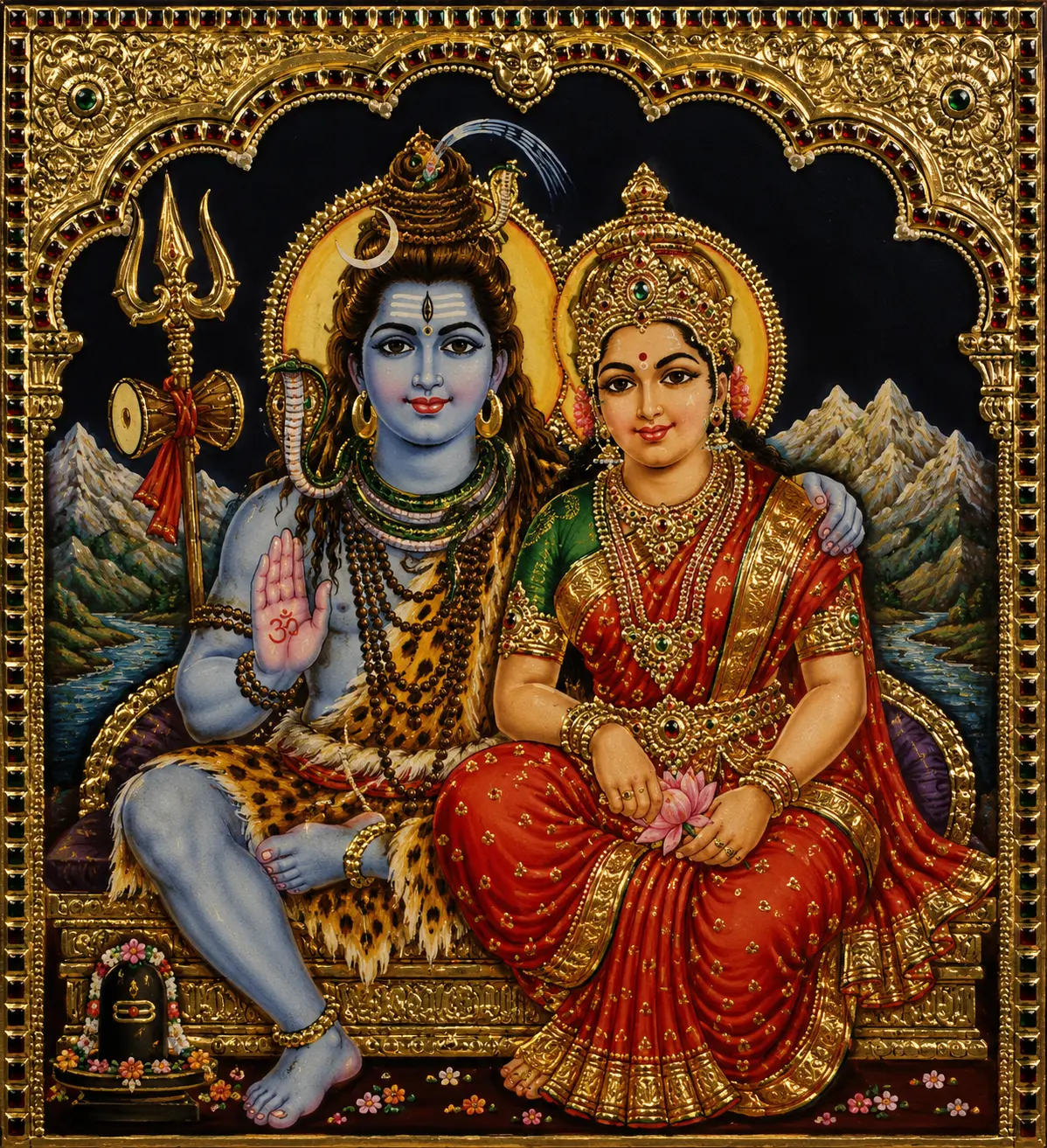
This piece depicts Lord Shiva and Goddess Parvati in the intimate embrace that is the most fundamental image in all of Shaiva sacred art — the eternal divine couple, seated together, his arm around her, the two great streams of the cosmos (consciousness and energy, Shiva and Shakti) shown in the most personal and most complete form of their inseparable unity. The composition is rendered in the Tanjore painting tradition of South India, with its deep black background that makes every colour blaze with extraordinary luminosity and the elaborate ornate gold-embossed border that frames the entire composition in the opulence of classical South Indian sacred art.
Shiva appears in his classical Shaiva form — luminous blue skin glowing with divine energy, matted hair (jata) with the crescent moon and the coiled cobra, his trishul standing to his left, his damaru behind him, his rudraksha malas cascading down his chest, his right hand raised in the abhaya mudra with the Om symbol glowing on his palm. His arm is around Parvati with the ease and completeness of one who has held his beloved since before time began.
Parvati appears in full bridal glory — warm golden skin radiant, dressed in the most magnificent crimson and gold silk saree with heavy gold embroidery, adorned with elaborate gold and pearl jewellery in the South Indian bridal tradition, holding a pink lotus with the gentle grace that is most characteristic of her nature. The sacred Shivalinga adorned with flowers sits at their feet. The Himalayan mountains and the sacred river Ganga provide the natural background of Kailash — their eternal home.
About Shiva and Parvati — The Supreme Divine Couple
Shiva and Parvati are the supreme divine couple of the Shaiva tradition — the two poles of the ultimate reality, each incomplete without the other, together constituting the most complete possible expression of what the cosmos is.
In the Tantric and Shaiva theological frameworks, Shiva (pure consciousness, the witnessing awareness, the unchanging ground of all experience) and Parvati/Shakti (the dynamic creative power of that consciousness, the force that moves and creates and sustains and dissolves) are not two separate beings who exist independently and then come together. They are a single reality appearing in two aspects — as inseparable as light and the capacity to illuminate, as inseparable as fire and its heat. The Ardhanarishvara is the most direct visual statement of this inseparability: the two aspects literally sharing a single body.
The image of Shiva and Parvati together in seated embrace is the most intimate and most personally accessible expression of this same theological truth — the two shown not in the abstract geometric form of Ardhanarishwara but in the warm, human, recognisable form of a couple, the most intimate possible relationship serving as the most direct possible image of the nature of ultimate reality.
The Tanjore Tradition — Sacred Art for the Royal South
The Tanjore painting tradition developed in the South Indian city of Thanjavur (Tanjore) in Tamil Nadu, primarily during the patronage of the Nayak dynasty (16th century) and later the Maratha rulers (17th–18th centuries). The tradition's characteristic combination of deep black background, gold-foil work, semi-precious stone inlay, and elaborate border design made it the preeminent sacred painting tradition of the South Indian royal courts.
The specific subjects depicted in Tanjore paintings are almost exclusively devotional — Vishnu, Krishna, Rama, Shiva, Parvati, and other major deities in their most celebrated iconic forms — and the opulence of the treatment was understood as appropriate to the supreme status of the deities depicted: the most beautiful and most costly artistic tradition for the most important possible subjects.
Parvati's Devotion — The Story Behind the Union
The story of how Parvati won Shiva as her consort is one of the most compelling and most theologically significant narratives in the Puranic tradition. Shiva, after the death of his first consort Sati, withdrew into the most extreme ascetic absorption — sitting in meditation on Kailash for aeons, completely unavailable to the rest of the cosmos. Parvati — the daughter of the Himalayan king Himavat, the reincarnation of Sati herself — undertook the most intense austerity in order to win his attention and eventually his love.
Her tapas — the austerities she practiced — eventually surpassed even Shiva's own. The tradition uses this detail to make a theological point: the love that brought the most complete ascetic in the cosmos out of his withdrawn absorption and into the relationship depicted in this artwork was not ordinary romantic attraction. It was the most complete expression of Shakti's sovereign power — the power of the creative, loving, relentlessly devoted energy of the universe to draw the pure witnessing consciousness back into relationship with what it had created.
The Shivalinga at Their Feet
The Shivalinga adorned with flowers that sits at the feet of the divine couple in this artwork is among the most theologically significant details in the composition. The Shivalinga — the most widely worshipped aniconic form of Shiva in the temple tradition — is present at the feet of Shiva's own personal form as a reminder that behind every beautiful name and form is the formless absolute that all names and all forms are pointing toward. The Shivalinga is Shiva as the Lingodbhava — the infinite pillar of light, without beginning and without end — compressed into the specific form that is accessible in the specific sacred space where it is installed.
Displaying Shiva Parvati Tanjore in the Home
The Shiva Parvati Tanjore composition is one of the most universally appropriate sacred images in the collection — suitable for any Shaiva or Shakta household, for any space dedicated to the celebration of the divine couple, and as a wedding gift that carries the deepest possible blessing of the tradition's understanding of what a sacred partnership is.
The deep black and gold palette suits a gold frame or a natural dark wood frame. Standard portrait frame sizes.