
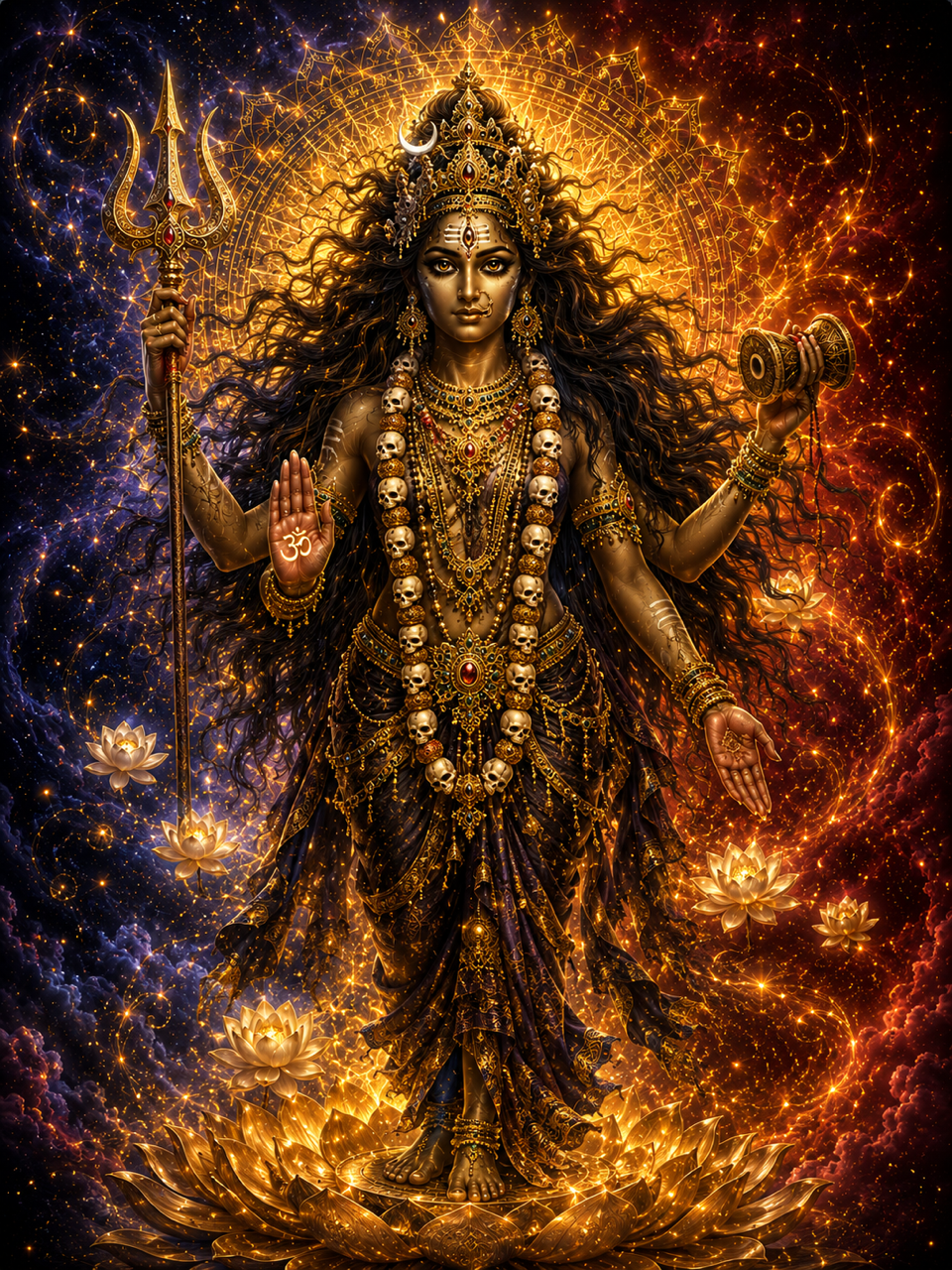
About This Artwork
This piece depicts Chamunda Devi — the fierce, emaciated, wrathful form of the Mother Goddess who emerged from the brow of Durga in the heat of battle — in a composition that holds her ferocity and her sanctity in the same frame. Her complexion is deep and dark, the colour of the night that swallows every form, and her three eyes carry the unblinking attention of one who sees what is actually there rather than what the mind prefers to imagine. A crescent moon rests in her crown; a garland of skulls falls across her chest — the characteristic ornament of the fierce goddesses, each skull marking an identity that dissolved in her presence.
She holds the trishul — the three-pronged spear of Shiva, the weapon that cuts through the three gunas and the three kinds of suffering — and the damaru, the small hourglass drum whose sound is the rhythm of creation and dissolution itself. She stands upon a golden lotus: the traditional signal that however fierce the form, what stands here is divine and unstained, purity that fire cannot touch.
The background is split — cool blue-violet on one side, blazing orange-red on the other — a deliberate composition that places her at the meeting point of the two cosmic movements she governs. On one side, the cool stillness of dissolution and the night; on the other, the heat of destruction and the fire that consumes. Chamunda stands precisely at the seam, the point where one becomes the other, unmoved by either.
About Chamunda Devi — The Fierce Protector
Chamunda is among the most fearsome and most anciently attested forms of the Hindu Goddess. Her name is a direct record of her deeds: Cha(nda) + Munda — she who slew the demons Chanda and Munda. She is counted among the Sapta Matrikas (the Seven Mother Goddesses) and is closely associated with — in many traditions identified with — Kali, sharing her dark complexion, skull garland, and role as the destroyer of what cannot be reasoned with.
Her iconography is deliberately uncomfortable. In classical temple sculpture she is often shown emaciated, ribs visible, sunken-eyed, garlanded in skulls and seated on a corpse. This is not a depiction of weakness. It is a theological statement: Chamunda has consumed everything, including the appetite that consumes, and what remains is pure devouring awareness with nothing left in it to be flattered, bribed, or deceived. She is the form of the Mother that no negotiation reaches.
Devotees turn to her precisely for that quality. Where the serene forms of the Goddess are approached for blessing, abundance, and learning, Chamunda is approached for protection — the removal of obstacles that will not move on their own, the ending of harm that will not stop being harmful. Her fierceness is not the opposite of her motherhood; it is her motherhood, expressed as the absolute unwillingness to let her children be destroyed.
The Devi Mahatmyam — Chanda, Munda, and the Birth of Chamunda
The origin of Chamunda is told in the Devi Mahatmyam (the Durga Saptashati), the seven-hundred-verse text of the Markandeya Purana that is the foundational scripture of the Shakta tradition.
In the account, the demon brothers Shumbha and Nishumbha have conquered the three worlds. They send their generals Chanda and Munda to seize the Goddess, who has appeared as Ambika, radiant and alone upon the mountain. When Chanda and Munda advance upon her with their armies, the Goddess's face darkens with wrath — and from the furrow of her brow springs forth Kali: black, gaunt, lolling-tongued, clothed in a tiger skin, carrying a skull-topped staff and a sword, her mouth wide and terrible.
She sweeps into the demon army, devouring elephants, horses, chariots, and warriors together, grinding the great asuras between her teeth. Chanda and Munda advance on her directly. She seizes them both by the hair, severs their heads with her sword, and carries the two heads to Ambika, laughing terribly.
The Goddess receives them and speaks the words that name her forever: because you have brought me Chanda and Munda, you shall be known in the world as Chamunda. The name is a title conferred in the moment of victory — a recognition rather than a birth-name, marking the form of the Goddess defined entirely by what she is willing to destroy for the sake of those she protects.
The theological point of the account is that Chamunda is not a separate deity who arrives from elsewhere. She emerges from the brow of the Mother herself. The fierce and the gracious are one being: the wrath that annihilates the demon and the tenderness that shelters the devotee arise from the same source, and in the Shakta reading neither is more real than the other.
Reading the Iconography
The skull garland (mundamala). The skulls are traditionally counted as fifty — one for each letter of the Sanskrit alphabet, the entire field of language and therefore the entire field of conceptual thought worn as an ornament by the awareness that precedes it. To wear the alphabet as a garland is to have finished with words as the final measure of what is real.
The trishul. Chamunda's three-pronged spear marks her Shaiva affiliation and her function. The three prongs are read as the three gunas (sattva, rajas, tamas), the three times (past, present, future), and the three afflictions — all of them pierced by a single stroke.
The damaru. The drum in her hand is the same drum held by Shiva Nataraja. Its beat is the pulse of manifestation: sound arising and subsiding, worlds beginning and ending. Held by Chamunda, it signals that her destruction is rhythmic and lawful rather than chaotic — dissolution as one half of the cosmic breath.
The crescent moon. A mark of Shiva's own crown, worn by Chamunda to indicate that her fierceness is not raw appetite but consecrated power, held within the discipline of the Shaiva-Shakta tradition. The moon also carries the quality of coolness held within heat — the still point inside the wrath.
The golden lotus. She stands on the lotus rather than on a corpse in this composition — a devotional rather than tantric emphasis, presenting her as the Mother in her protective aspect, approachable by the householder devotee rather than the cremation-ground sadhaka alone.
The split cosmic background. The blue-violet and orange-red halves place her between the cool and the burning, dissolution and destruction, night and fire. She is not on one side of the pair. She is the axis on which the pair turns.
Temple Traditions — Chamunda Across India
Chamunda is worshipped across the subcontinent, and her major shrines are among the oldest continuously active Shakta sites.
Chamunda Mata, Jodhpur. Installed at Mehrangarh Fort in 1460 by Rao Jodha, who brought the image from the old capital of Mandore, Chamunda is the kuldevi (clan goddess) of the Rathore rulers and the presiding deity of the city. She is worshipped as the protector of the fort and of Jodhpur itself, and Navaratri at Mehrangarh draws enormous crowds to her shrine.
Chamundeshwari, Mysuru. On the Chamundi Hills above the city stands the temple of Chamundeshwari, the tutelary deity of the Wadiyar dynasty and the goddess from whom Mysuru's Dasara celebrations take their meaning. Here she is honoured as the slayer of the buffalo demon Mahishasura — the demon from whom the city Mahishuru, now Mysuru, takes its name — and her image presides over one of the grandest Navaratri festivals in India.
Chamunda Devi, Kangra. In the Himachal hills near Dharamshala, the Chamunda Nandikeshwar Dham stands on the banks of the Baner river, counted among the important Shakta pilgrimage sites of the western Himalaya and drawing continuous pilgrimage traffic through Navaratri.
Across these traditions the pattern is consistent: Chamunda is installed where protection is needed — over forts, above cities, at the edges of kingdoms. She is the goddess of the boundary, placed where danger comes from.
Displaying Chamunda in the Home
Chamunda's image is traditionally kept by devotees who seek protection — households facing difficulty, practitioners working with fear, and those in the Shakta lineages for whom she is the kuldevi. In a home puja room she is placed facing the entrance or the direction from which trouble is felt to come, in keeping with her role as the guardian of the threshold.
In a practice space, her image carries a specific instruction: that spiritual work is not only gentle. There are attachments that will not loosen through kindness and patterns that must simply be ended. Chamunda is the presence invoked when what is required is a clean cut rather than a slow negotiation.
Visually, the split blue-violet and orange-red palette of this artwork carries weight in a room and works best with space around it. A dark wood, black, or antique gold frame suits the composition; avoid busy surroundings that compete with the cosmic background. Print on matte or semi-gloss paper at FedEx Office, Staples, or any professional print shop.