About This Artwork
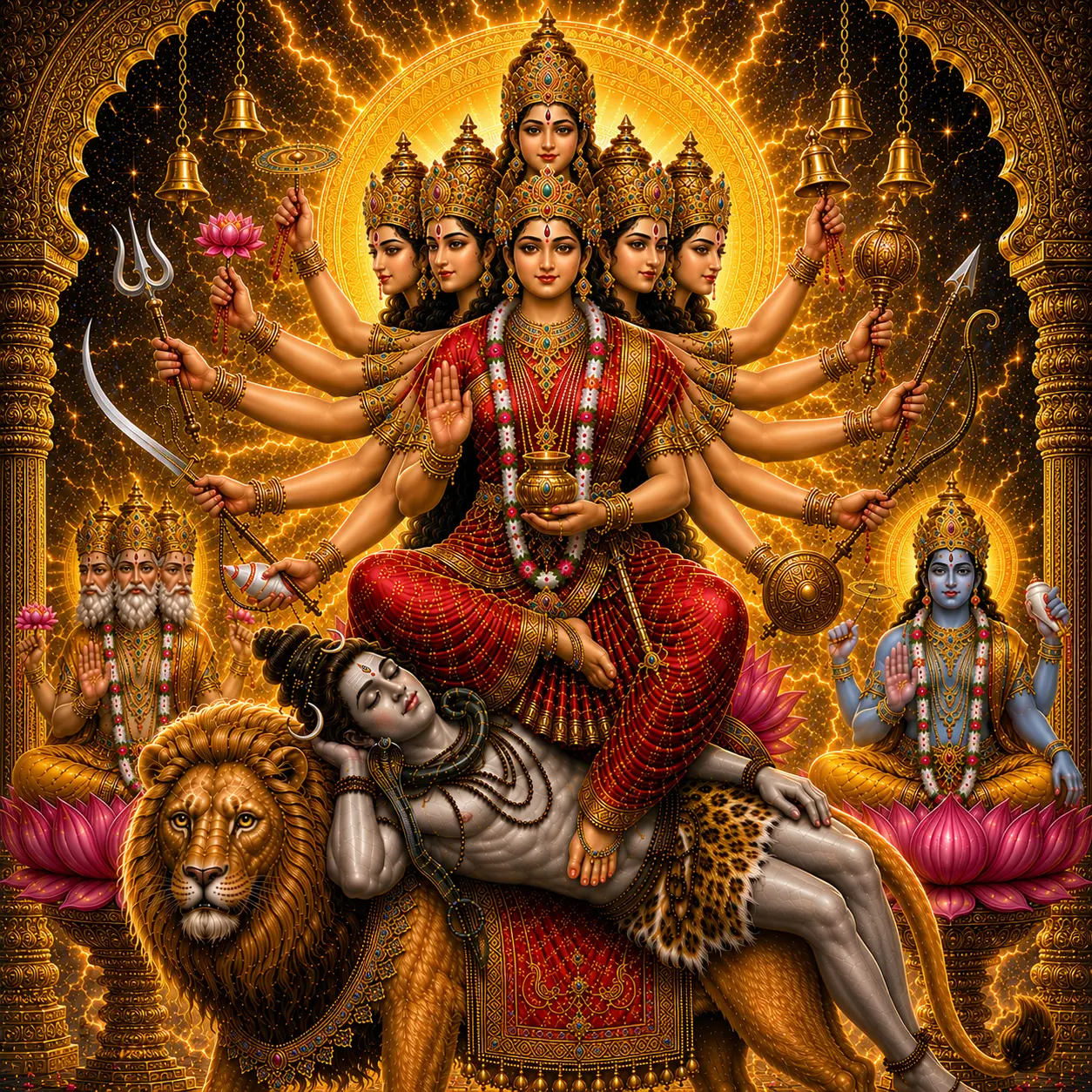
This piece depicts Kamakhya Devi — the most primal form of the Mother Goddess, the Shakti worshipped at her principal seat atop Nilachal Hill in Guwahati, Assam, where the Kamakhya temple is considered the most powerful of all the Shakti Peethas — in a composition of extraordinary sovereign grandeur. She appears in her fullest multi-armed, ten-headed form: the maximum possible expression of the divine feminine's power and scope. In her arms she holds the full range of the goddess's instruments — the trishul (trident), the khadga (sword), the Sudarshana chakra (discus), the dhanu (bow), the gada (mace), the padma (lotus), the kalasha (sacred vessel) — while one of her hands is raised in the abhaya mudra of blessing and protection.
She is seated in sovereign majesty on a reclining Shiva, who himself rests on the lion that is her vahana — a visual hierarchy that encodes the Shakta theological position precisely: the Shakti is the ground of Shiva's consciousness, and the lion of fierce power is the vehicle on which this entire sovereignty rests. On either side, in attitudes of reverence: four-headed Brahma on the left, blue-skinned Vishnu on the right — the creator and the sustainer of the cosmos bowing before the primal Shakti from whom all their functions derive.
The golden temple pillars and the lightning-veined halo behind the goddess give the composition the specific quality of the Kamakhya temple's sacred space — the most concentrated, most ancient, and most primal Shakti presence in the Indian tradition.
About Kamakhya Devi — The Primal Shakti
Kamakhya Devi is the presiding deity of the Kamakhya temple on Nilachal Hill in Guwahati, Assam — the most significant and most ancient Shakti Peetha (seat of the goddess) in the entire Hindu tradition. She is understood as the primal form of Adi Shakti (the original, primordial divine feminine power), the source from which all other goddess forms arise and to which they ultimately return. Her name derives from two Sanskrit roots: Kama (desire, love, creative power) + Akhya (named or known as) — the one who is known as desire itself, the one whose nature is the creative principle of existence.
She is worshipped primarily as the goddess of creation — not in the limited sense of biological procreation, but in the cosmic sense of the primordial creative power from which all of existence springs. The Kamakhya tradition is one of the oldest and most continuously maintained Shakta Tantric traditions in India.
The Shakti Peetha Tradition
The Shakti Peethas — the sacred seats of the goddess — are the places across the Indian subcontinent where parts of the body of Sati (the goddess, Shiva's first consort) are said to have fallen when Shiva carried her dead body across the cosmos and Vishnu cut it into pieces to help Shiva release his grief. Each piece fell to earth and became a Shakti Peetha — a permanently charged sacred site where the goddess is immediately and overwhelmingly present.
Kamakhya is the most significant of all the Shakti Peethas. The tradition holds that the yoni (the generative organ) of Sati fell on Nilachal Hill — and it is this that is worshipped at the Kamakhya temple. The goddess is not represented there by any anthropomorphic image but by a natural rock formation in the shape of the yoni, kept perpetually moist by an underground spring. The worship of Kamakhya at this site is the worship of the creative principle of existence in its most elemental form.
The Kamakhya Temple — The Most Ancient Shakti Shrine
The Kamakhya temple on Nilachal Hill has been a sacred site since at least the 8th century CE and is believed by many scholars to be significantly older. The current structure dates primarily from the 17th century (built by the Ahom kings of Assam) after earlier temples were destroyed. The temple's beehive-shaped shikhara (tower) is among the most distinctive in Indian temple architecture.
The Ambubachi Mela — the annual festival held in June at the Kamakhya temple — is the most significant festival at the site and one of the most important Shakta festivals in India. During Ambubachi, the temple remains closed for three days during which the goddess is understood to be in her annual menstrual period — and when the temple reopens on the fourth day, pilgrims gather from across India for the darshan. The festival draws hundreds of thousands of devotees and is among the largest religious gatherings in Northeast India.
Kamakhya in the Tantric Tradition
The Kamakhya tradition is among the most important centers of Shakta Tantric practice in India. The Kamakhya temple and its associated traditions have historically been the home of significant Tantric knowledge lineages, and the goddess is understood in the Tantric tradition as the embodiment of the Mahavidyas (the ten great wisdom goddesses) in their most complete and most primary form. The Kali-kula (the Kali family) of Tantric goddesses, which includes Kali, Tara, Tripura Sundari, Bhuvaneshvari, Bhairavi, Chhinnamasta, Dhumavati, Bagalamukhi, Matangi, and Kamalatmika, is understood as having Kamakhya as its ultimate source and ground.
The Multi-Armed Form — Reading the Iconography
The ten-headed, multi-armed form of Kamakhya depicted in this artwork is the Mahakali form of the goddess in her most complete cosmic expression — the same iconographic approach as the Navadurga (nine forms of Durga) tradition, here concentrated into a single form. The multiple heads represent the goddess's ability to perceive in all directions simultaneously, to know all things, to act in all realms at once. The multiple arms represent the full range of her cosmic functions — creation, preservation, transformation, liberation — all simultaneously active.
Brahma and Vishnu in reverence beside her signal that the primal Shakti is prior to and more fundamental than the cosmic functions they perform: she is the source of both creation (Brahma's function) and sustaining (Vishnu's function), and both of these great masculine principles bow before her.
Displaying Kamakhya in the Home
Kamakhya's image is displayed in Shakta households and in homes where the Northeast Indian or Assamese tradition is specifically honoured. For the Bengali, Assamese, and broader Shakta diaspora communities, Kamakhya is the most primal and most powerful form of the goddess — the one whose worship reaches deepest into the sacred feminine's most essential nature.
The crimson and gold palette of this artwork suits a warm wall in a dedicated goddess altar space. A natural wood or gold frame complements the warmth of the composition.