
About This Artwork
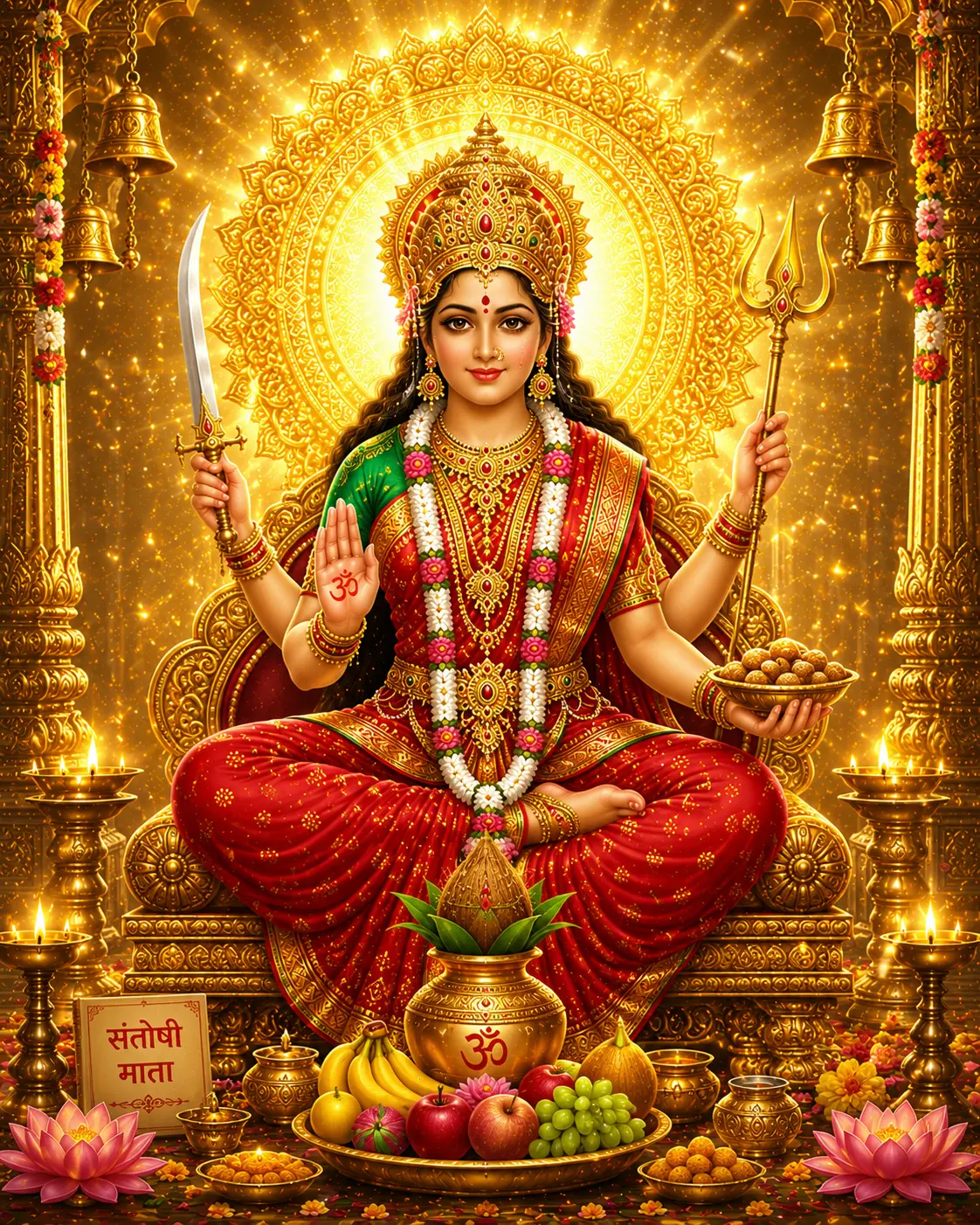
This piece depicts Santoshi Ma — the goddess of contentment and satisfaction, Ganesha's daughter, the mother whose domain is the quality of inner peace that makes what one has feel genuinely sufficient — in the warm, approachable devotional register most associated with her popular tradition. She is seated on her golden throne, dressed in a vivid crimson sari with gold jewellery and garlands. In her hands she holds a sword and a trishul — the implements of protection and of Shiva's sovereign power — while on her open right palm the Om symbol glows, the universal ground that encompasses everything she offers. Before her, a bowl of fruit and a pot with a coconut — the traditional offerings of her Friday vrat.
Her expression carries the quality most central to her teaching: serene sufficiency. Not the fierce energy of Durga, not the cosmic grandeur of the Nataraja, not the opulent abundance of Kamalatmika. Santoshi Ma's quality is simpler and in some ways more elusive — the settled inner quality of one who has found that what is present is enough, that the present moment contains everything necessary, that the restless seeking for more is itself the only real poverty.
The warm palette — deep crimson, antique gold, the golden light of devoted offering — is intimate and immediate. This is not a cosmic image but a domestic one, the goddess who belongs in homes rather than temples, who is found in the Friday morning prayers of ordinary women managing ordinary households under the pressures of ordinary life.
About Santoshi Ma — The Goddess of Contentment
Santoshi Ma — Maa Santoshi, Santoshi Mata — is the Hindu goddess of contentment and satisfaction. Her name is derived directly from the Sanskrit santosha: contentment, the quality of being satisfied with what is, the inner state of sufficiency that does not depend on external conditions being arranged in any particular way.
She is understood in the devotional tradition as the daughter of Lord Ganesha — the granddaughter, therefore, of Shiva and Parvati, a member of the immediate family of the divine that also includes Kartikeya. Her birth story, as told in popular tradition, describes Ganesha's two sons Shubh (auspiciousness) and Labh (profit) requesting a sister. From the divine light that emerged from Ganesha's two consorts Riddhi (prosperity) and Siddhi (achievement), Santoshi Ma came into being — the daughter of abundance and accomplishment who teaches that the deepest satisfaction is not the achievement of either but the contentment that precedes both.
Her significance in the living tradition is remarkable for its specificity: she is a goddess whose primary devotional practice is the Friday vrat (fast and worship), and whose presence is associated almost entirely with the domestic life of the household rather than with the great temples, the cosmic mythologies, or the elaborate ritual systems of the older traditions. She is, in a very real sense, the goddess of ordinary life — of the household under pressure, of the woman managing a family's needs with limited means, of the practitioner who is not a sage or a renunciant but a person in the middle of the world trying to maintain equanimity within it.
The Friday Vrat — The Practice of Santoshi Ma
The primary devotional practice associated with Santoshi Ma is the Shukravar Vrat — the Friday fast. Devotees, traditionally women though not exclusively, observe a fast on Fridays for sixteen consecutive weeks, during which they abstain from sour foods (tamarind, citrus, and other acidic ingredients) and perform a simple puja — offering flowers, fruit (typically bananas and jaggery), chanting the Santoshi Ma aarti, and reading or listening to the Santoshi Ma Katha (the story of the goddess and her devotees).
The prohibition on sour foods during the vrat is one of its most distinctive features and is tied to the mythological accounts of the goddess's nature: sour foods are associated with discord and dissatisfaction, and their avoidance during the vrat is an outer expression of the inner practice of releasing what is sour — the sourness of complaint, of comparison, of the dissatisfaction that arises when the mind measures what is against what it thinks should be.
The vrat concludes after sixteen Fridays with an udyapan (completion ceremony) in which the fast is formally ended with the feeding of eight young boys — representing the eight directions of the universe receiving the goddess's blessing — and the preparation and sharing of the traditional prasad. The entire arc of the vrat — the commitment, the discipline, the avoidance of sourness, the completion and the feeding of others — encodes the teaching of santosha in a lived, embodied practice rather than a philosophical statement.
In the Indian diaspora, the Friday vrat of Santoshi Ma is widely observed — in homes across North America, the United Kingdom, the Caribbean, Fiji, South Africa, and wherever large Indian diaspora communities have settled and maintained their devotional traditions.
Santosha — The Yogic Principle of Contentment
The quality that Santoshi Ma embodies — santosha — is not simply a folk devotional concept but one of the foundational principles of classical yoga. In Patanjali's Yoga Sutras (II.32), santosha is listed as the second of the five niyamas — the personal observances that form the foundation of yogic practice:
Saucha (purity), Santosha (contentment), Tapas (disciplined effort), Svadhyaya (self-study), and Ishvara Pranidhana (surrender to the divine).
The Yoga Sutra's treatment of santosha is brief but precise: "Santosha anuttama sukha labhah" — from contentment, supreme happiness is attained (Yoga Sutras II.42). The point is not that contentment is a passive resignation to circumstances but that it is the specific inner quality from which the deepest form of happiness is accessible. The happiness that depends on circumstances — on having what one wants, on things going as planned — is contingent and therefore unstable. The happiness that arises from santosha — from the settled recognition that what is present is genuinely sufficient — is not contingent on anything external and is therefore available regardless of circumstances.
This is a demanding teaching. It does not mean pretending that difficulties don't exist or that wanting to improve one's situation is wrong. It means cultivating the inner quality of sufficiency that is not waiting for better conditions before it becomes available. Santoshi Ma as a devotional figure embodies this teaching in a form that is immediately accessible to people who may not study the Yoga Sutras but who recognise in their own experience the exhausting quality of the mind that is never satisfied, and who feel the pull toward the goddess who promises — through her name, through her vrat, through her image — a quality of peace that is not dependent on circumstances rearranging themselves first.
Santoshi Ma and the 1975 Film — How a Goddess Spread
One of the most documented cases of popular devotion shaping the spread of a deity in the modern era involves Santoshi Ma and the 1975 Bollywood film Jai Santoshi Maa (Hail to the Goddess of Satisfaction), directed by Vijay Sharma and produced on a modest budget. The film told the story of a devoted woman, Satyavati, who observes the Friday vrat with complete sincerity and is ultimately rewarded by the goddess's protection of her family.
The film was an unexpected phenomenon. It played in theatres for months, drew extraordinary audiences across North India, and is reported to have been watched in a devotional rather than an entertainment mode by many viewers — women who removed their footwear before the screen, who bowed to the goddess's image, who observed the no-sour-foods prohibition even while watching the film. The practical consequence was a massive expansion of Santoshi Ma's devotional reach across India — temples that had not existed before the film's release were established in response to the demand generated by it, and the Friday vrat became one of the most widely observed devotional practices among North Indian Hindu women.
Scholars of religion have found in this phenomenon a clear demonstration of something the Hindu tradition has always understood intuitively: that the divine can make itself known through any medium that genuine devotion reaches. The goddess is not more or less real for having spread through cinema rather than through an ancient text or a pilgrimage tradition. What matters is whether the devotion is genuine, and by every available measure — the temples built, the vrats observed, the prayers offered — the devotion that Jai Santoshi Maa generated was entirely genuine.
The film has been studied by academics including Kathleen Erndl and others working in the anthropology of Hindu popular devotion as a case study in the dynamics of how deity traditions develop, spread, and establish themselves in contemporary conditions.
The Iconography of This Artwork — What to Look For
The sword and trishul: Santoshi Ma's most commonly depicted attributes are the sword — representing the power to cut through obstacles and the protective force that guards her devotees — and the trishul (Shiva's trident), which in her hands signals her place within the Shaiva family as Ganesha's daughter and Shiva's granddaughter. Both weapons in the hands of a goddess of contentment are not paradoxical: protection and peace are not opposites but complements. She protects the space in which contentment can be cultivated.
The Om on the open palm: The right palm raised with the Om symbol glowing at its centre is an abhaya mudra variant — the gesture of protection and fearlessness — combined with the universal ground sound that encompasses all of existence. Together they say: you are safe; the ground of existence itself holds you; there is nothing that needs to be feared that would prevent the cultivation of the contentment I represent.
The fruit bowl and coconut pot: The offerings before the goddess — a bowl of fruit (typically bananas and other sweet, non-sour fruits associated with her vrat) and a pot with a coconut — are the specific prasad elements of the Friday vrat. Their presence in the artwork grounds the image in the living practice rather than in mythology alone. This is not simply a portrait of a deity but an image of the deity as she is approached and encountered in the weekly practice of her devotees.
The crimson sari and gold ornaments: The vivid red sari is associated in Hindu iconography with power, auspiciousness, and the active feminine energy — the same red associated with Durga and with the married woman's devotional status. The gold ornaments signal the abundance she represents — not the extreme opulence of Kamalatmika's lotus ocean, but a domestic, accessible abundance, the sufficiency of the household rather than the cosmic plenty of the great goddesses.
Santoshi Ma in the Diaspora — Why She Travels Well
Among all the goddess figures in this collection, Santoshi Ma is perhaps the one whose appeal translates most readily across cultural contexts. The reason is the universality of the quality she embodies: contentment — the teaching that what is present can be genuinely sufficient, that the restless seeking for more is itself the source of suffering, that the inner quality of santosha is available in any circumstance — speaks to experiences that are not culturally specific.
In the Indian diaspora, where the pressures of immigration, cultural negotiation, economic striving, and the maintenance of family connections across distances create a specific and often demanding experience of ordinary life, Santoshi Ma's promise of inner sufficiency has a particular resonance. The Friday vrat, which can be observed in any home without a temple nearby, with simple and widely available ingredients, in a practice that fits within a working week's rhythm, is an ideal diaspora devotion — portable, adaptable, and rooted in the immediate domestic environment rather than in a specific sacred geography.
Her image in a home or puja room carries the invitation to cultivate the specific quality she represents: not waiting for circumstances to improve before allowing sufficiency, but finding the settled inner recognition that what is present — the family around you, the home you are in, the body you inhabit, the life you are actually living — is genuinely enough to work with, and that this recognition is itself the ground of genuine peace.
Displaying Santoshi Ma in the Home
Santoshi Ma's image is most naturally placed in the home puja room, ideally in a position that can serve as the focus of the Friday vrat puja. The image can be installed on the primary altar or in a smaller, dedicated Friday vrat space if the household observes the practice regularly.
For those who do not observe the formal vrat but are drawn to the teaching of contentment — whether from a Hindu devotional background or from the yogic tradition's santosha principle — her image works in any space dedicated to practice, reflection, or daily intention-setting. The warm, approachable palette of this artwork suits a bedroom, study, or living room as naturally as a formal puja room.
The digital download format is particularly practical for this image — you can print it immediately, frame it simply, and have it ready for the next Friday without any waiting time. Print on matte or semi-gloss paper at FedEx Office, Staples, or any professional print shop.