About This Artwork
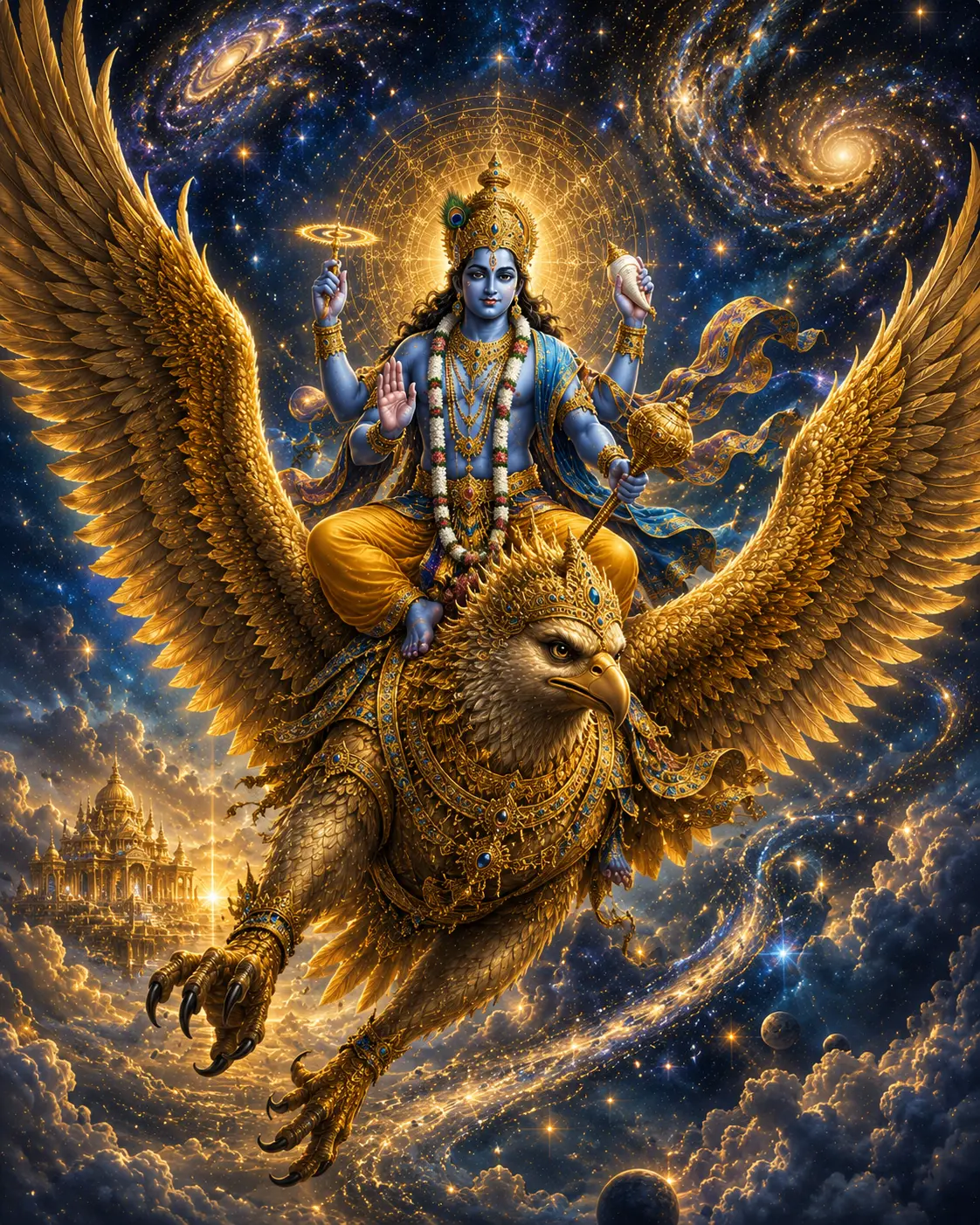
This piece depicts Lord Vishnu in the Garudavahanana form — riding the great eagle Garuda across the cosmic expanse of the universe, the four arms holding the instruments of his sustaining sovereignty and his freely given grace. His blue complexion — the infinite sky-consciousness that characterises Vishnu as the all-pervading sustainer — is set against a backdrop of galaxies and starlight, the cosmos in its full scale as the domain within which Vishnu's protection operates.
Garuda's great golden wings spread wide beneath the Lord — the eagle who is himself a divine being, the king of birds, the sworn enemy of serpents, the vehicle chosen by Vishnu as the most appropriate form through which the sustaining Lord moves when he must move swiftly. The peacock feather crown of Vishnu (which is also the peacock feather of Krishna, one of his most beloved avatars) adorns the Lord's head.
In the four hands: the Sudarshana chakra (the spinning disc of cosmic order, the weapon that cannot be deflected), the shankha (conch shell, whose sound is the primordial Om that announces Vishnu's presence), and the hand extended in varada mudra — the gesture of freely flowing grace toward the devotees far below, toward the glowing golden temple visible through the cosmic light at the bottom of the composition.
About Garuda — The King of Birds, Vishnu's Vehicle
Garuda — the great eagle, the vahana (vehicle) of Vishnu — is among the most significant of all the divine beings in the Hindu tradition. He is not simply Vishnu's mount in the mechanical sense; he is a divine being in his own right, the son of the sage Kashyapa and the celestial being Vinata, the king of all birds, the sworn enemy of the nagas (serpents), and the embodiment of the swiftness and sovereignty that Vishnu's protective presence requires.
The Garuda Purana — one of the eighteen principal Puranas — is named for him and addresses him directly, recording his conversation with Vishnu on the nature of death, karma, and liberation. The Garuda is also the national symbol of Indonesia (where Hindu influence shaped the culture for centuries) and of Thailand, where it appears in the royal seal.
Garuda's speed is cosmic: he can traverse the entire universe in a single wingbeat. His appointment as Vishnu's vehicle is therefore not merely convenient but cosmologically precise — the sustainer who must be present wherever he is needed throughout the entire cosmos requires the only vehicle that can be everywhere at once.
Vishnu Riding Garuda — The Form of Active Protection
The Garudavahanana form of Vishnu — Vishnu seated on or riding Garuda — is the most dynamic of all Vishnu's major iconic forms, and the most directly expressive of his protective function. The reclining Anantha Padmanabha (Vishnu on the cosmic serpent) is Vishnu as the ground of the cosmos, the sustaining presence that underlies all of creation. The standing four-armed Vishnu of the temple tradition is Vishnu as the sovereign presence in his own domain. But Vishnu riding Garuda is Vishnu in motion — the sustainer who has heard his devotees call, who has risen from his cosmic ground and is coming, swiftly, across the universe, toward whoever needs him.
The tradition holds that whenever a devotee calls sincerely — not merely saying the words but genuinely turning toward the Lord — Vishnu mounts Garuda and comes. The Garudavahanana form is the visual form of that promise: not Vishnu at rest but Vishnu in response, Vishnu in the act of answering.
The Sudarshana Chakra and the Shankha
The two weapons most associated with Vishnu in the Garudavahanana form:
The Sudarshana Chakra (the spinning disc of auspicious vision): The most powerful of all divine weapons, the Sudarshana chakra is Vishnu's instrument of cosmic order — the force that cannot be deflected, that moves at the speed of intention, that cuts through every obstacle to the restoration of dharma. In the Garudavahanana form, the chakra is held ready: the Lord is in motion and the chakra is with him, available to address whatever has called him forth.
The Shankha (conch shell): The cosmic sound of Vishnu's presence — when the shankha is blown, its sound is the primordial Om, the announcement that the sustainer is present, the signal that sets all of creation's processes in their correct alignment. The shankha in the Garudavahanana form signals that Vishnu's arrival is announced: the sound of the conch has already gone ahead of him.
Displaying Vishnu Riding Garuda in the Home
The Garudavahanana form is displayed in Vaishnava homes and puja rooms as the most dynamic and most actively protective of Vishnu's forms. In a puja room that includes other Vishnu images, the Garudavahanana provides the counterpoint to the more static, throned or reclining forms: Vishnu in motion, Vishnu coming, Vishnu actively present in the world of his devotees.