About This Artwork
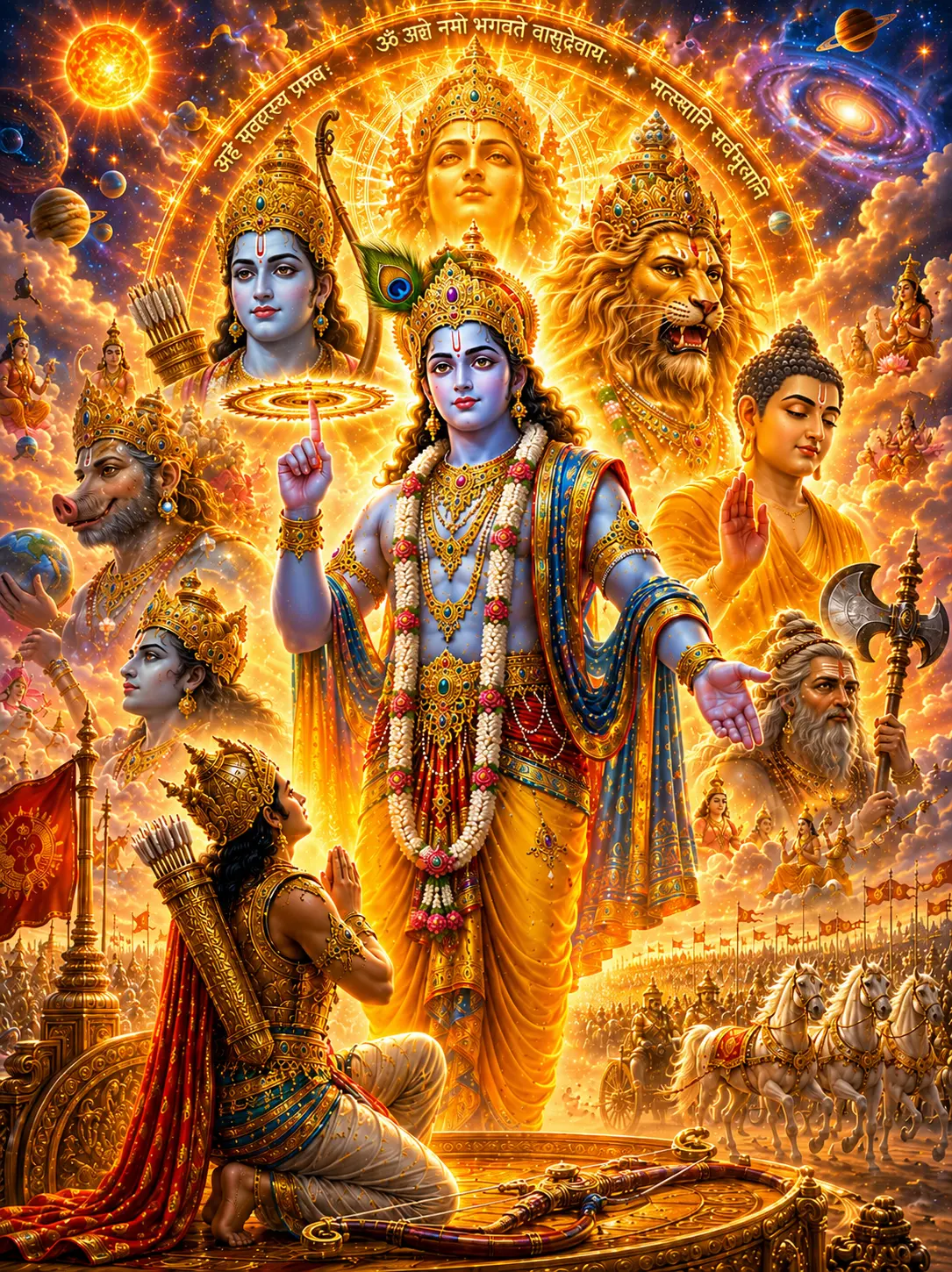
This piece presents all ten avatars of Lord Vishnu — the Dasha (ten) avatara (descents) — in a single complete composition, arranged in their traditional sequence from Matsya (the fish) through Kalki (the future avatar). Each avatar is depicted in their essential iconic form, their specific attributes and the cosmic moment of their appearance rendered with the care and intention of a composition that serves simultaneously as sacred wall art, as a complete devotional image of the Vaishnava tradition, and as a visual guide to the most celebrated and most intellectually rich teaching in all of Hindu theology.
The composition brings together the full range of divine forms: the primal animal avatars of the most ancient ages (Matsya, Kurma, Varaha), the transitional forms that bridge the animal and human (Narasimha), the increasingly human and increasingly refined divine presences (Vamana through Parashurama), the avatars of the ideal human and the cosmic beloved (Rama and Krishna), the awakened sage (Gautama Buddha), and the yet-to-come future king (Kalki) who will close the current cosmic cycle and initiate the next.
About the Dashavatara — The Ten Avatars of Vishnu
The Dashavatara is the Vaishnava tradition's most comprehensive theological teaching about the nature of the divine's relationship to the material world. It holds that Vishnu — the sustainer of the cosmos — has descended into the world in ten primary forms (with many more secondary ones), each appearing at a specific cosmic moment when the balance of dharma required a specific divine intervention.
The word avatar derives from the Sanskrit ava (down) + tara (to cross) — the one who has crossed down, the divine that has descended into the material world. Each avatar is Vishnu himself — not a representative or a manifestation at a lower level but the full divine presence in the specific form that a specific cosmic crisis required.
The Ten Avatars — Their Sequence and Cosmic Moments
Matsya (the Fish): The first avatar. Vishnu appeared as a giant fish to save the seven sages (and the Vedas) from the primordial flood — the cosmic deluge that periodically dissolves the universe between cycles. Matsya prefigures the deluge narratives found across world mythology and is the most ancient of the avatars.
Kurma (the Tortoise): Vishnu as the cosmic tortoise who supported Mount Mandara on his back during the Samudra Manthan — the churning of the cosmic ocean — which produced both Amrita (the nectar of immortality) and Lakshmi, among many other divine gifts.
Varaha (the Boar): Vishnu as the cosmic boar who dived to the bottom of the primordial ocean to rescue the earth (Bhudevi) from the demon Hiranyaksha, who had dragged her into the depths. Varaha lifted the earth on his tusks and restored her to her place in the cosmos.
Narasimha (the Man-Lion): The fierce, transitional avatar — half human, half lion — who appeared at the threshold (neither inside nor outside, neither by day nor by night, neither on the ground nor in the air) to destroy the demon Hiranyakashipu, who had made himself invulnerable to death from any weapon by any being under any ordinary circumstance.
Vamana (the Dwarf): Vishnu as a small Brahmin boy who approached the demon king Bali — who had conquered the three worlds through extraordinary austerity and devotion — and asked for three paces of land. When Bali agreed, Vamana expanded to cosmic size and crossed the entire universe in two steps, placing his third on Bali's head.
Parashurama (the Warrior Sage): Vishnu as the axe-bearing Brahmin warrior who appeared to restore the balance between the warrior (Kshatriya) class, which had grown arrogant and oppressive, and the other castes. Parashurama is the bridge between the purely mythological avatars and the historically resonant human avatars.
Rama (the Ideal King): The seventh avatar — Vishnu as the ideal human king, the embodiment of Maryada Purushottam (the supreme boundary-setter of right conduct). Rama's story is the Ramayana — one of the world's greatest epics and the most complete map of the dharmic human life.
Krishna (the Divine Teacher and Beloved): The eighth and most beloved avatar — Vishnu as the divine cowherd, the cosmic beloved, and the supreme teacher of yoga whose instruction to Arjuna on the battlefield of Kurukshetra is the Bhagavad Gita.
Gautama Buddha (the Awakened One): The ninth avatar — the historical figure whose teaching of the Four Noble Truths and the path to liberation is understood in the Vaishnava tradition as a divine descent specifically appropriate to the needs of the current age.
Kalki (the Future Rider): The tenth avatar — yet to appear. Kalki will ride a white horse, carry a blazing sword, and appear at the end of the Kali Yuga (the current age of darkness and conflict) to destroy what has accumulated beyond redemption and initiate the next cycle of cosmic time, beginning with the Satya Yuga (the age of truth).
The Dashavatara and the Theory of Evolution
The Dashavatara's sequence — from the fish through the tortoise and boar, through the transitional man-lion, to the fully human avatars, and finally to the future avatar who closes and initiates the cosmic cycle — has been compared by many scholars and teachers to the theory of biological evolution. The sequence mirrors, with striking correspondence, the movement from aquatic life forms through amphibious and terrestrial animals, through transitional and early human forms, to fully developed humanity.
Whether this correspondence is coincidence, intuition, or something else is a question that has been discussed across traditions and disciplines. What is clear is that the Dashavatara encodes a sophisticated understanding of progressive development — of the divine expressing itself in increasingly complex and increasingly refined forms as the cosmic cycle advances.
Displaying the Dashavatara
The Dashavatara composition is particularly well suited to yoga studios, classrooms, and teaching spaces where its function as a complete visual map of the Vaishnava tradition's understanding of divine evolution is most valuable. In a puja room it serves as the most complete possible Vaishnava altar image — all ten faces of Vishnu simultaneously present. The full 16×20 size works best for spaces where the individual avatars can be seen and distinguished.