
About This Artwork
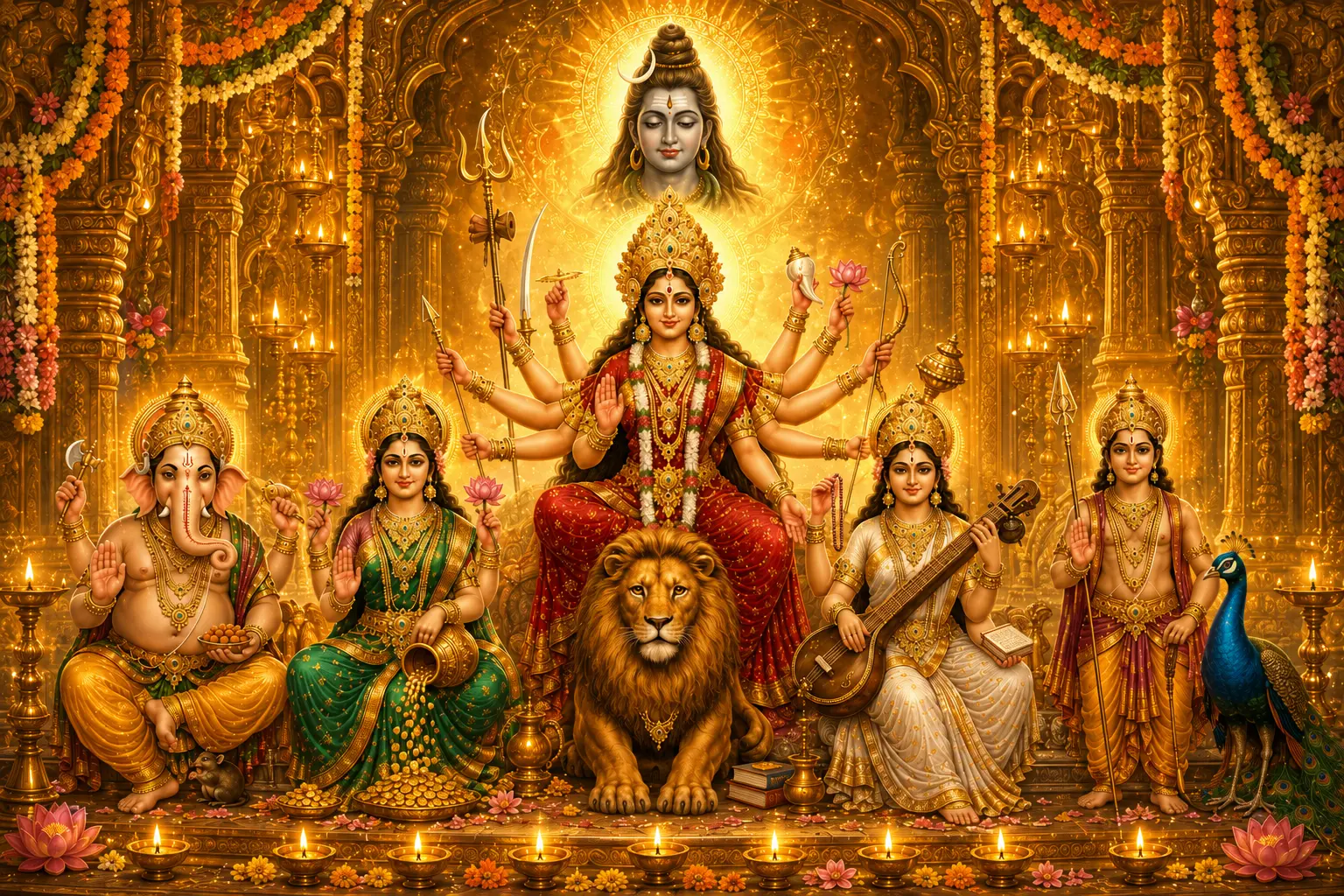
This piece depicts the complete Durga Puja sacred family — the divine tableau at the heart of one of the most widely celebrated religious festivals in the Indian tradition. Maa Durga is seated in sovereign composure at the centre of the composition on her lion, the fierce protective mother who is simultaneously the supreme consciousness and the most loving of all possible parents. Around her, her divine family completes the picture of what the tradition calls the most complete and most joyful expression of the divine.
To her right, Ganesha — the beloved elephant-headed remover of obstacles — and Maa Lakshmi, the goddess of abundance and grace. To her left, Kartikeya — the divine warrior son — and Maa Saraswati, the goddess of wisdom and sacred knowledge. And above all, Shiva — the supreme consciousness, the cosmic lord, Durga's consort and the ground from which her sovereign energy arises.
Oil lamps (diyas) burn at the base. Golden divine light bathes the entire composition. The palette — warm gold, the orange of lamp light, the rich jewel tones of the garments and ornaments — is the palette of a Bengali Durga Puja pandal at its most luminous and most celebratory.
The Durga Puja Divine Family — The Bengali Sacred Tableau
The specific grouping depicted in this artwork — Durga with Ganesha, Lakshmi, Kartikeya, and Saraswati — is the sacred family of the Durga Puja tradition as it developed over centuries in Bengal. It is among the most widely recognised and most deeply loved sacred tableaux in the entire Hindu tradition.
The theological reading of the family is precise and complete. Durga at the centre is not simply one goddess among others — she is the Adi Shakti, the primordial divine feminine consciousness, the source from which all the other divine presences around her arise and flow. Her four children are understood not as separate beings with separate domains but as four fundamental qualities that the awakened consciousness expresses simultaneously: the wisdom to remove obstacles (Ganesha), the power to overcome darkness (Kartikeya), the grace to attract abundance (Lakshmi), and the knowledge to illuminate the path (Saraswati). Shiva presiding above is the supreme consciousness — the ground from which Durga's Shakti arises, her consort, the witnessing awareness that underlies and enables everything the family represents.
Durga Puja — The Festival of the Family's Return
The specific devotional context for which this composition was created is Durga Puja — the annual festival celebrating the return of Maa Durga to her family home for five days each autumn (Mahalaya through Vijaya Dashami, typically September or October). In the Bengali tradition, Durga Puja is understood not primarily as a festival of cosmic battle or divine supremacy but as a homecoming: the divine mother coming home to her parents (in the mythological framework) and to her devotees (in the devotional framework), bringing her entire family with her.
The five-day festival is the most important and most elaborate of all Bengali cultural and religious events — pandals (temporary temples) of extraordinary scale and artistic ambition are constructed across Kolkata and West Bengal, and the celebration has been recognised by UNESCO as an Intangible Cultural Heritage of Humanity (2021). For the Bengali diaspora worldwide, Durga Puja is the most emotionally significant gathering of the year — the time when community, tradition, family, and the divine all come together in a form that no other festival in any tradition quite replicates.
The Six Faces of the Divine
Each member of the divine family in this composition represents a specific dimension of what the tradition understands as the complete divine:
Maa Durga: The supreme consciousness expressing itself as the fierce, protective, unconditionally loving mother. The source from which all the others emerge.
Shiva: The cosmic witness, the supreme masculine consciousness, the ground of pure awareness that enables Durga's Shakti to operate and create.
Ganesha: The divine intelligence that clears obstacles, the lord of auspicious beginnings, the energy that makes every sacred undertaking possible.
Kartikeya (Murugan): The divine warrior of discriminative clarity, the energy of decisive, directed action that overcomes every force of darkness.
Maa Lakshmi: The divine grace of abundance, beauty, and the sustaining prosperity that makes continued flourishing possible.
Maa Saraswati: The divine light of knowledge, the wisdom that illuminates the path, the sacred creative intelligence through which the divine expresses itself in art, music, and learning.
Together these six presences constitute what the tradition describes as the most complete map of the divine available in a single image.
Displaying the Divine Family
The divine family composition is most naturally placed in the puja room or sacred corner as the primary image — the complete divine tableau that encompasses every dimension of the divine that the household honours. For Bengali families and diaspora communities, it is the image most closely associated with the most important festival of the year.
In a yoga studio or meditation room it works as a complete sacred teaching in visual form — every practitioner's path touching each of the six presences at different times.